Antique & Decorative Ceramics
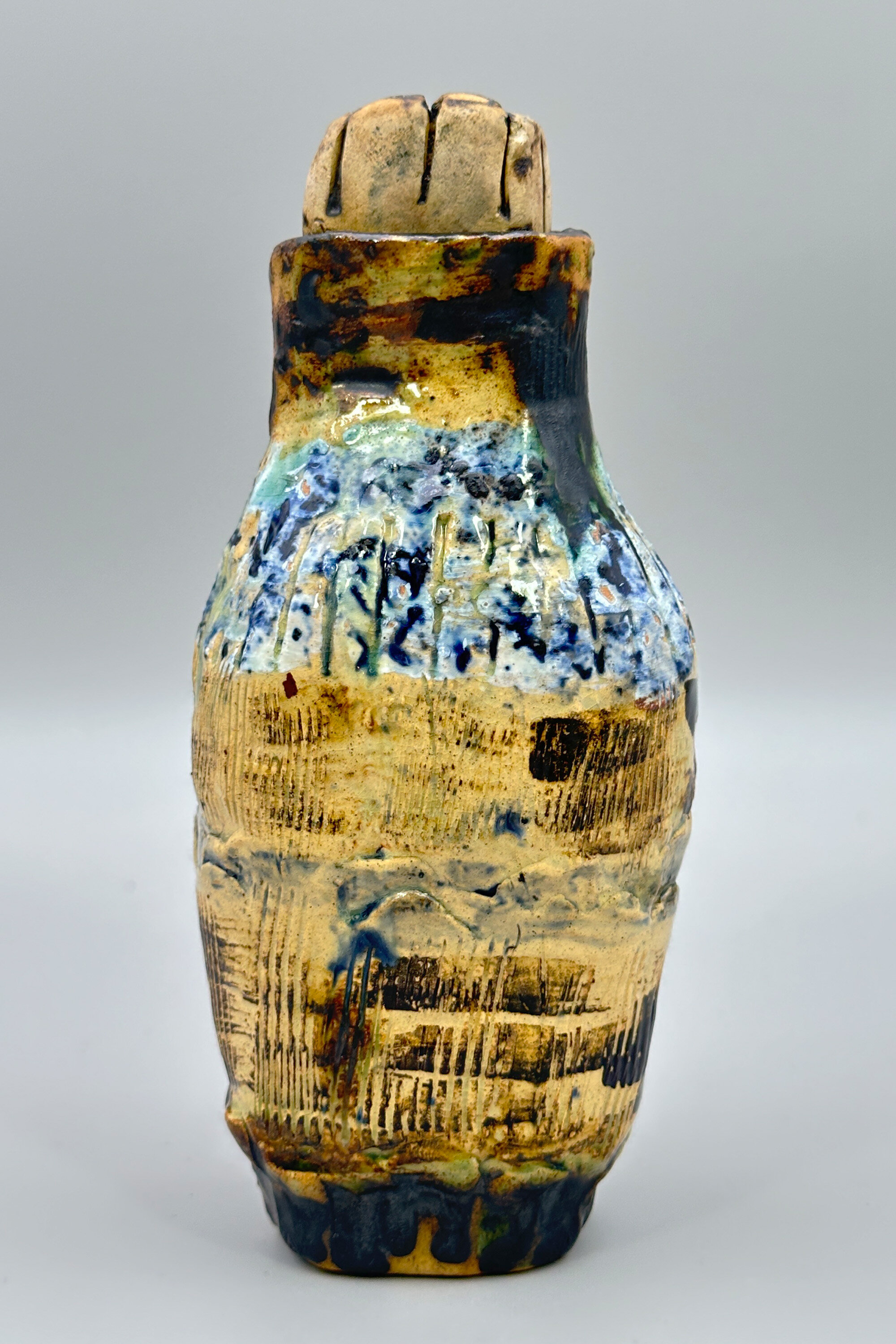
Primitive studio pottery Flask and Cover, signed, possibly Allison Weightman, C20th
Price: £45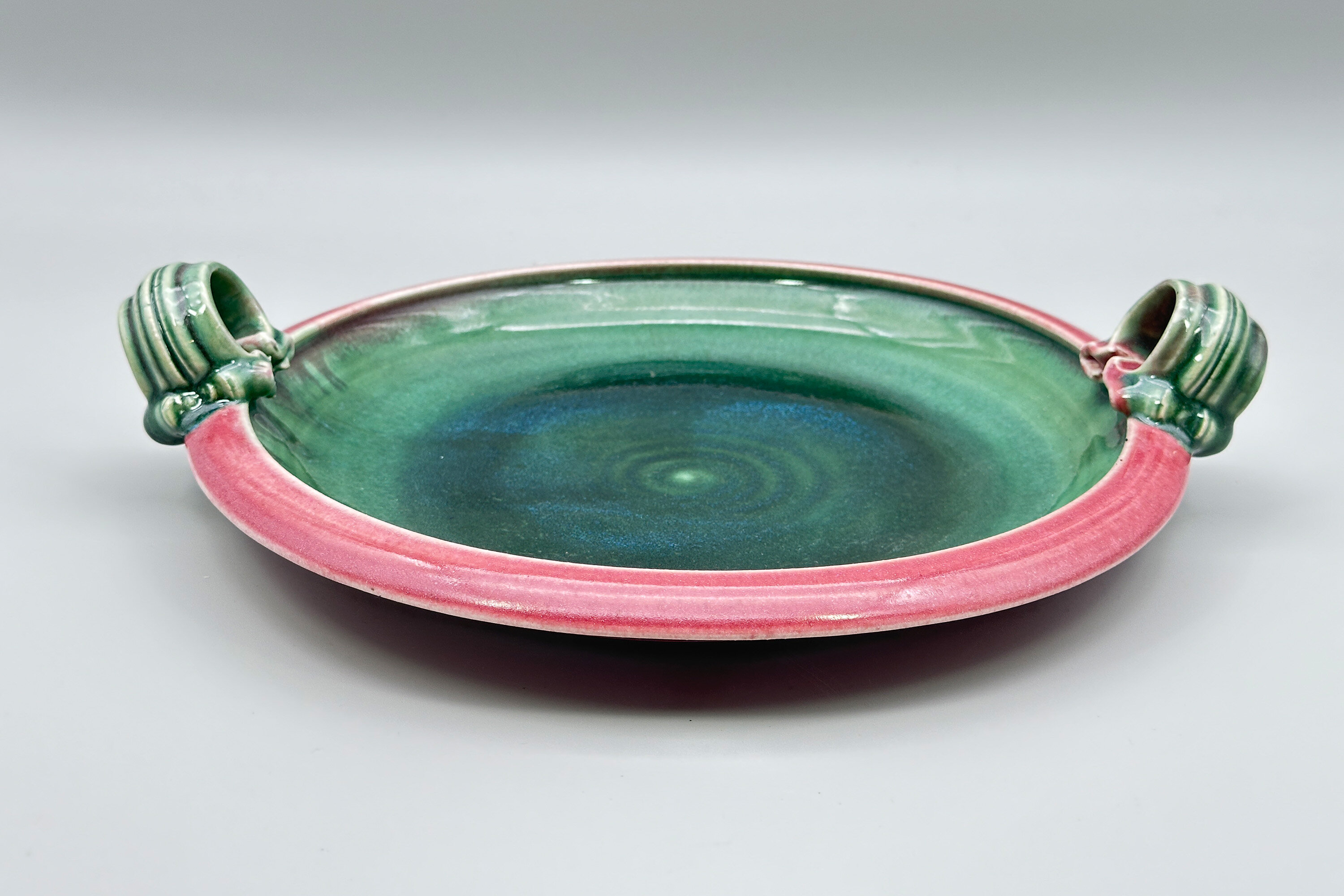
Studio Pottery Shallow Bowl with handles, signed MJ, possibly French C20th
Price: £55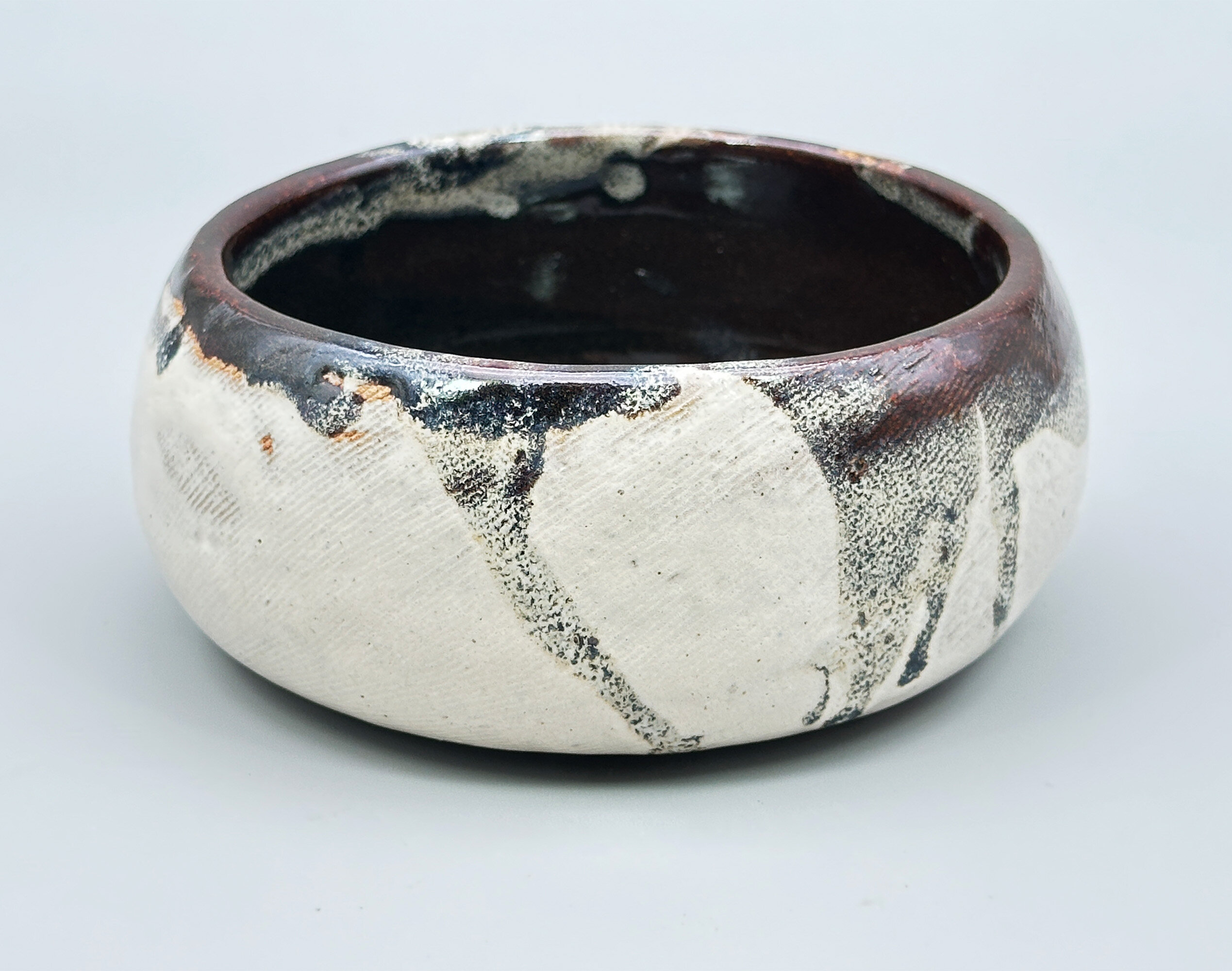
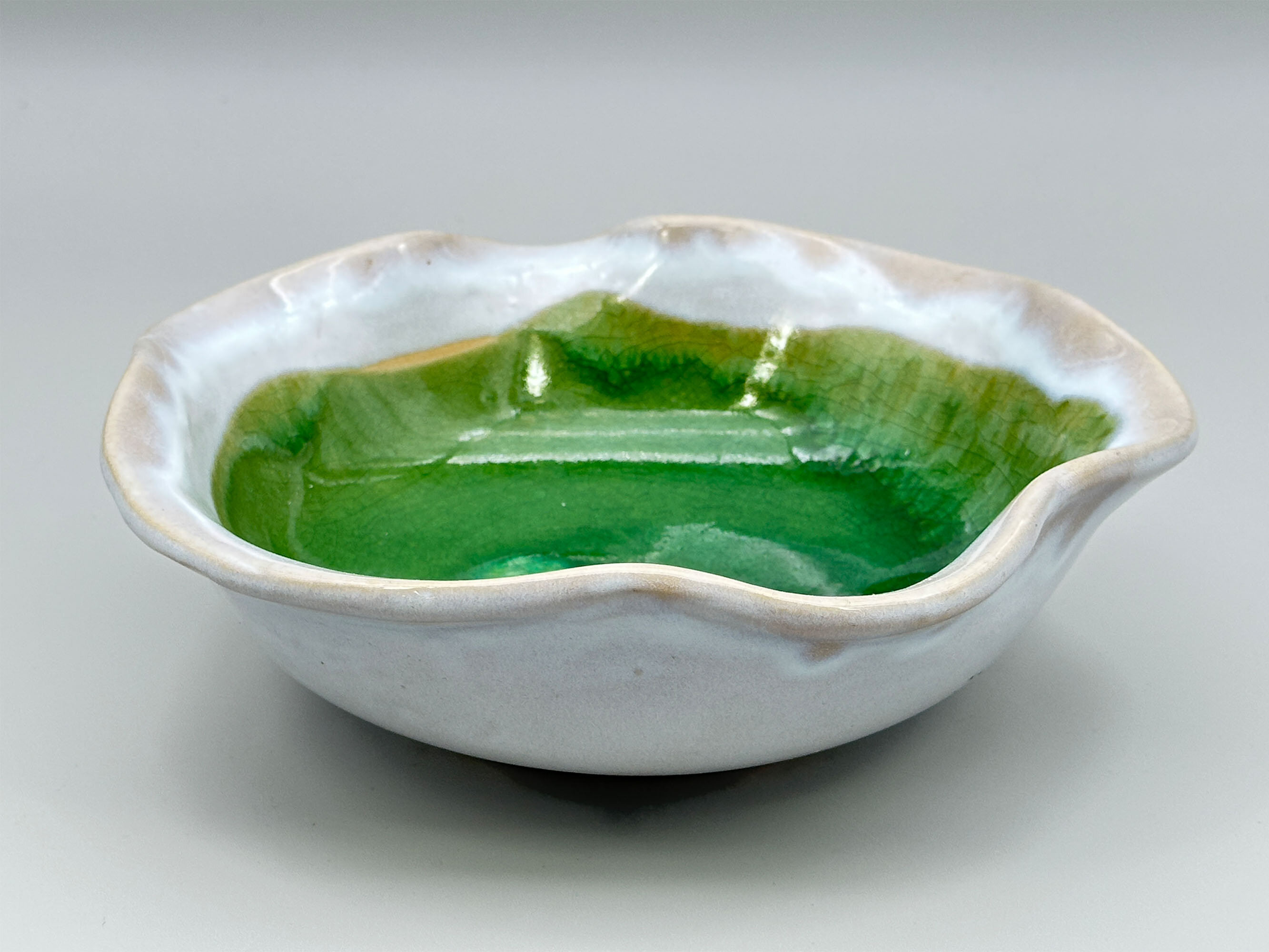
Studio Pottery Bowl with Yukishino style glaze, signed M Lazenbury, C20th
Price: £35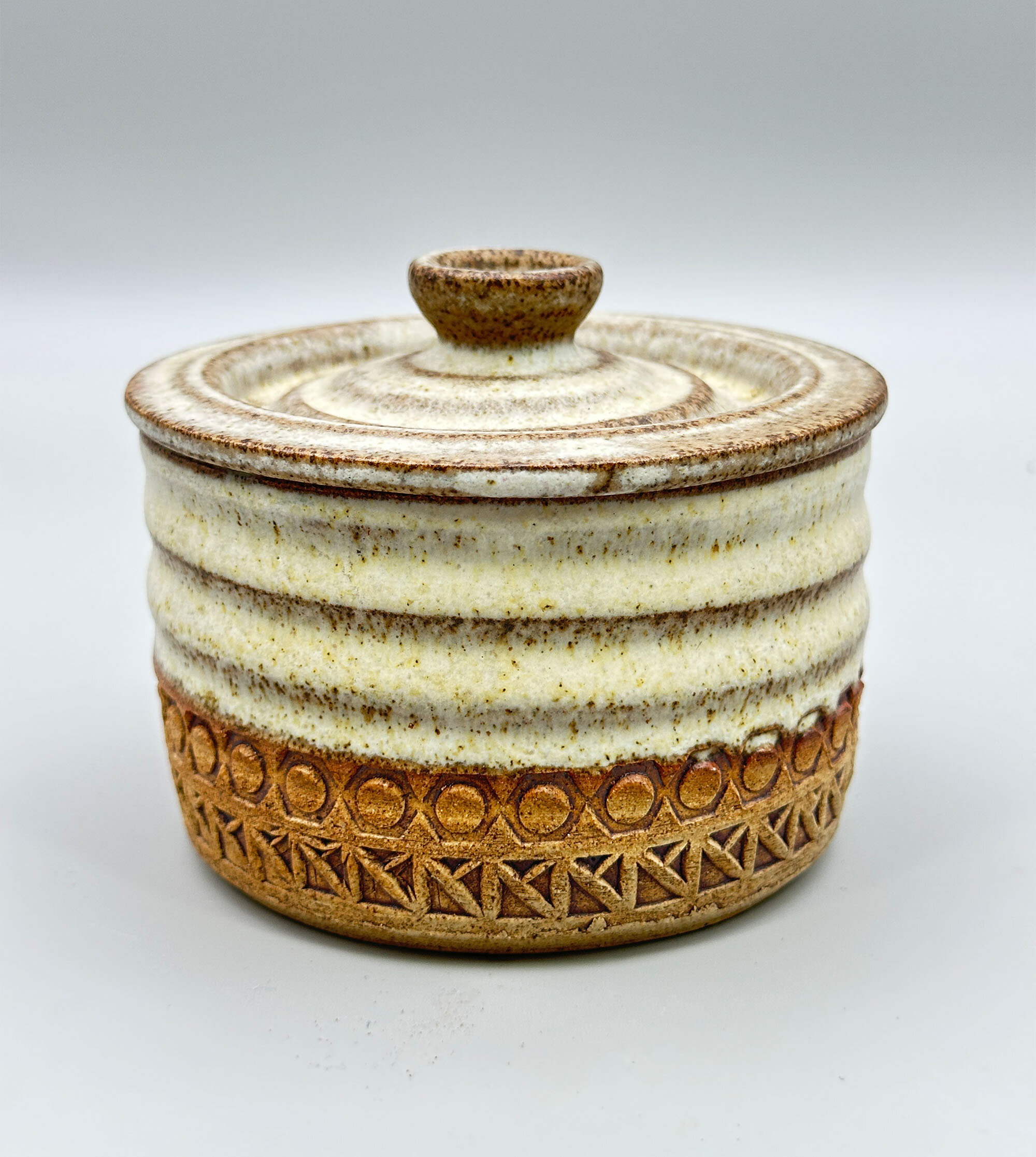
Broadstairs Pottery Bowl and Cover, signed, 1968-1983
Price: £45Broadstairs Pottery was founded by David White in 1968 as a successor to an earlier firm Thanet Pottery. For the mark, see ‘British Studio Potters’ Marks’ by Eric Yates-Owen and Robert Fournier (2nd edition 2005 p534). White worked there with assistants, some of whose initials appear on the pieces produced, until 1983 when he closed to business to concentrate on his own work, an example of which can be seen elsewhere in this sale. Both the incised geometric bands and the pronounced ridging effects are hallmarks of the firm’s output and this bowl and cover, marked only with the factory name, is a classic example of its productions.
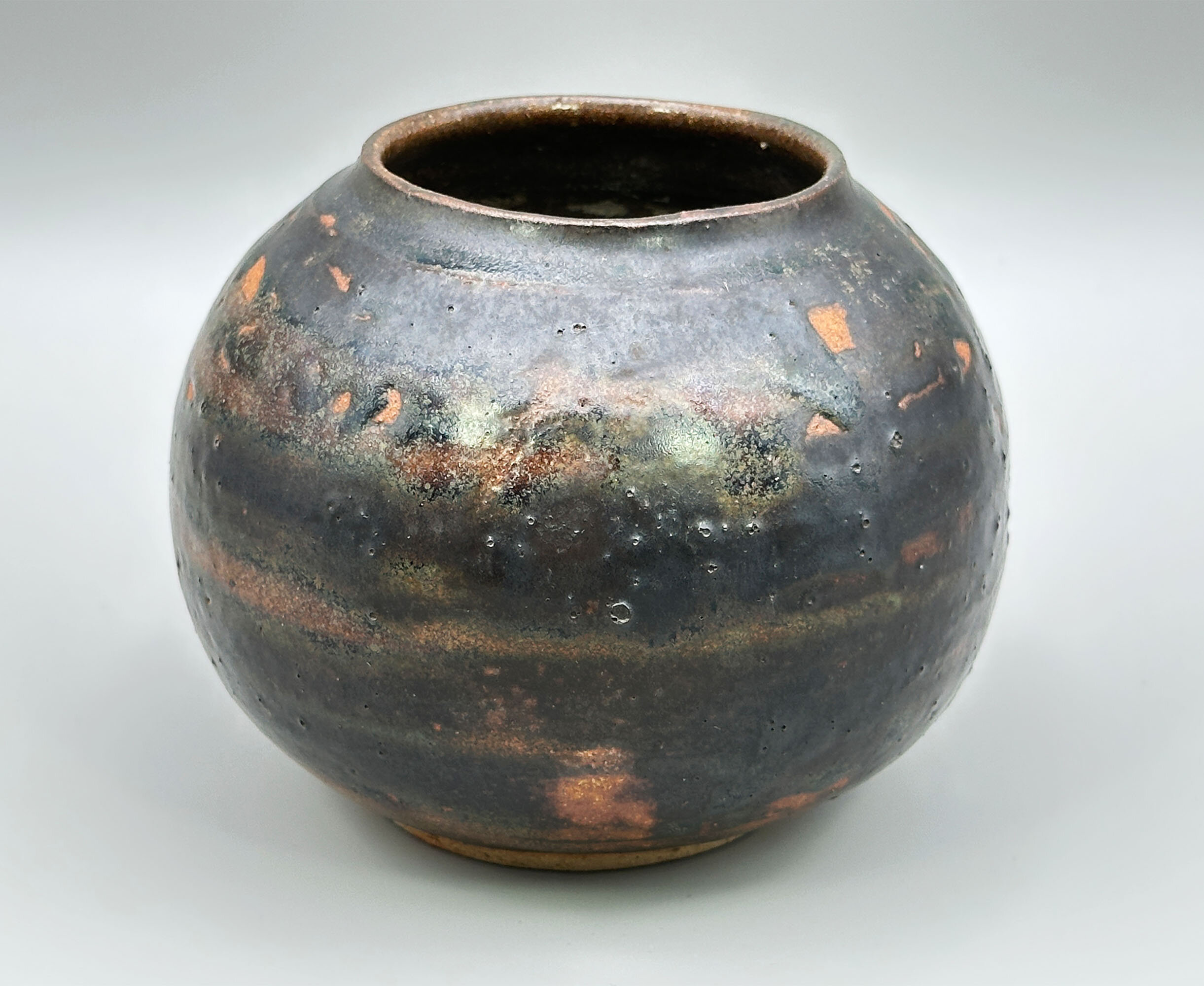
Oriental style studio pottery Jarlet signed HA, C20th
Price: £35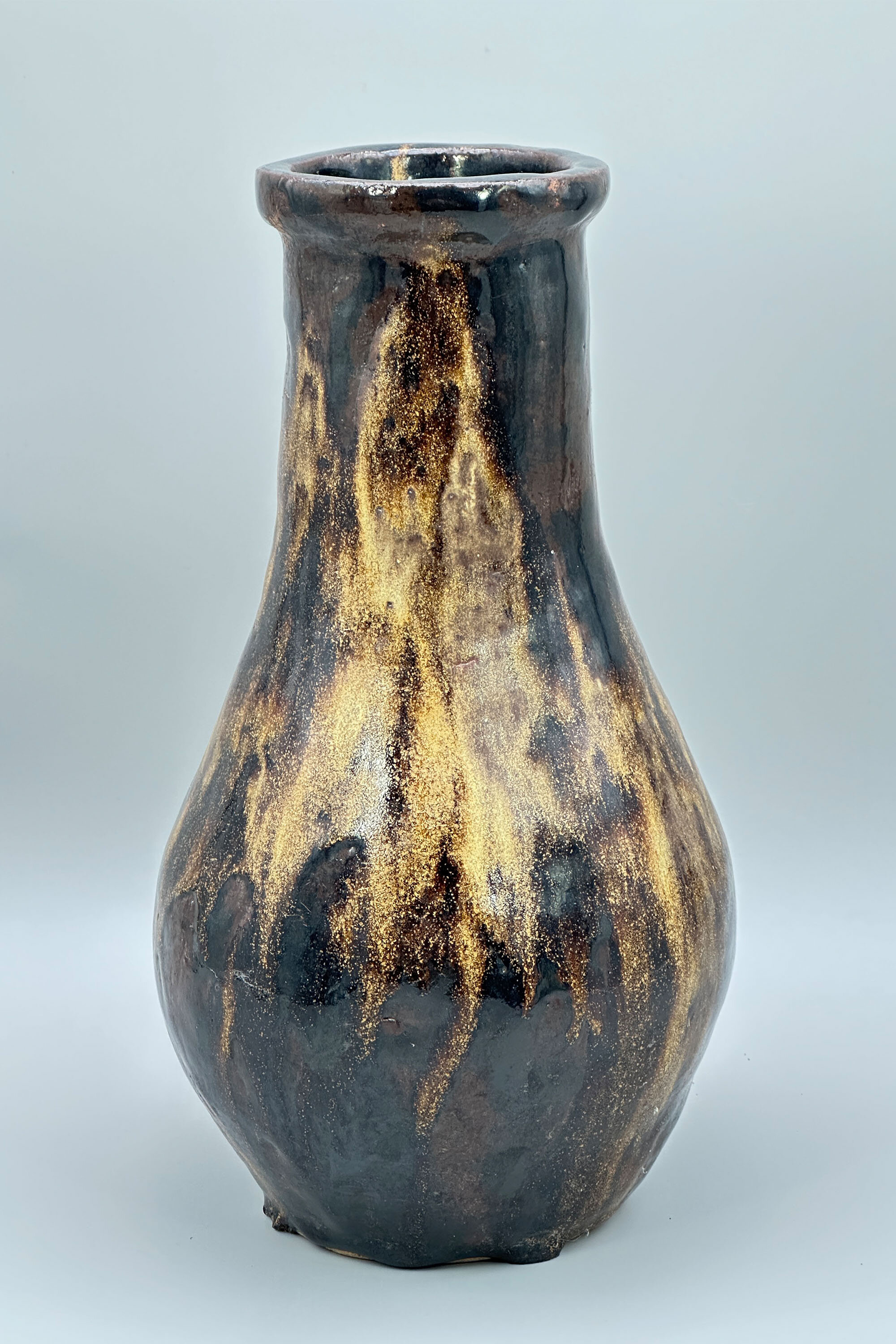
Studio Pottery Vase with Cizhou style glaze, signed JE possibly for John Egerton, C20th
Price: £55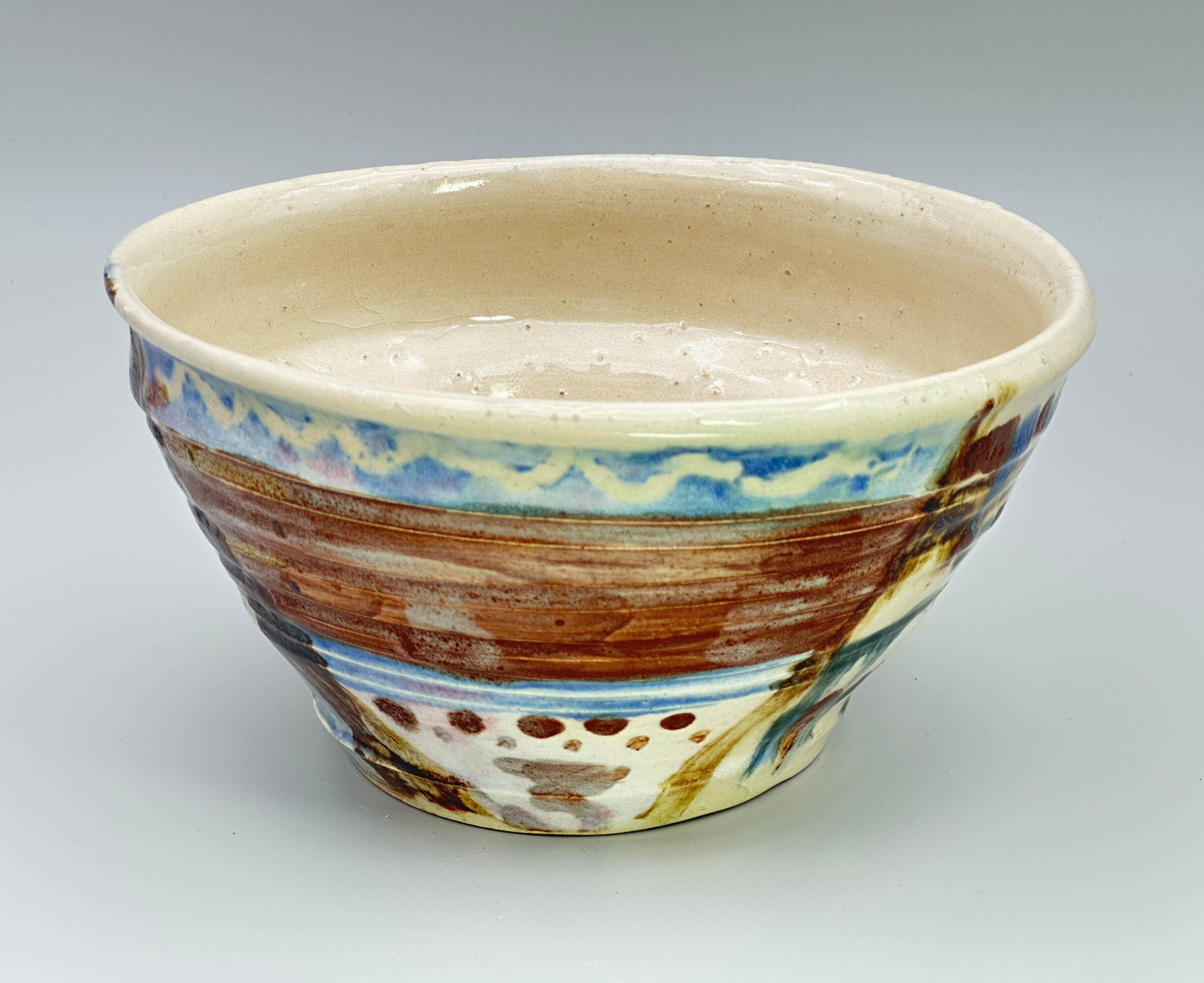
Experimental Bowl for glazes marked TESTS and signed JD
Price: £25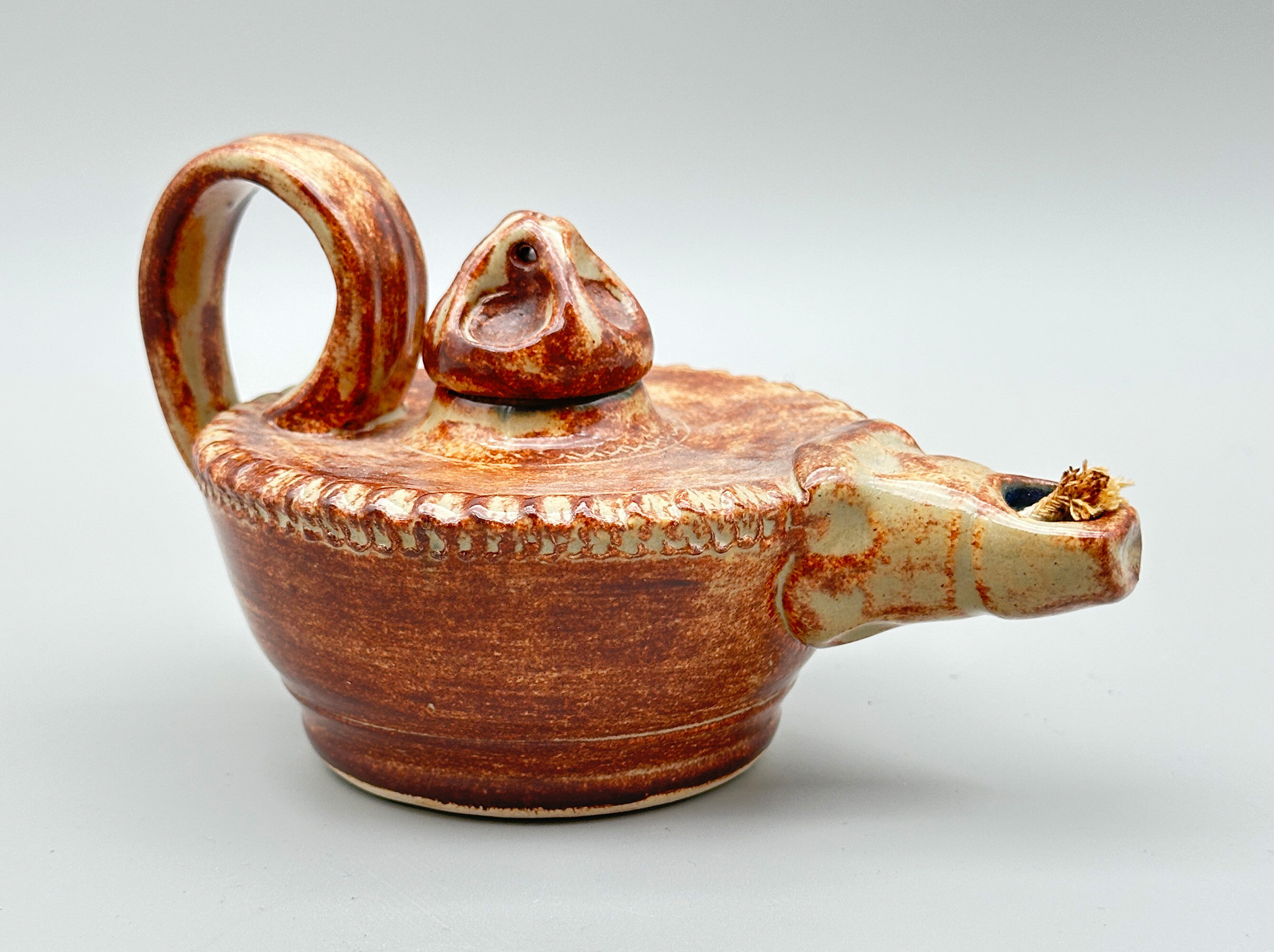
Studio Pottery Oil Lamp, signed MP and dated 2012
Price: £25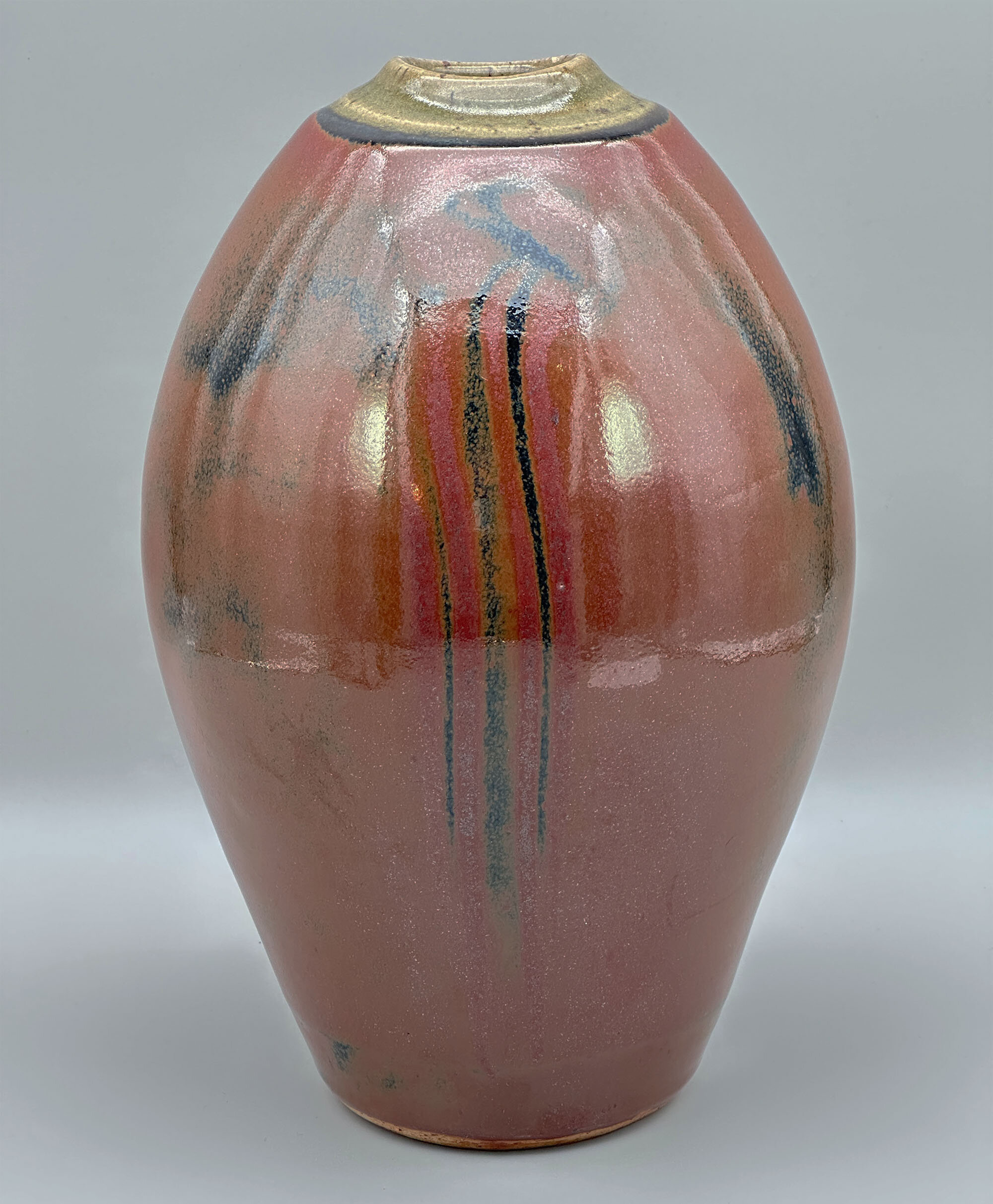
Studio Pottery Vase by John Jelfs, signed, late C20th
Price: £180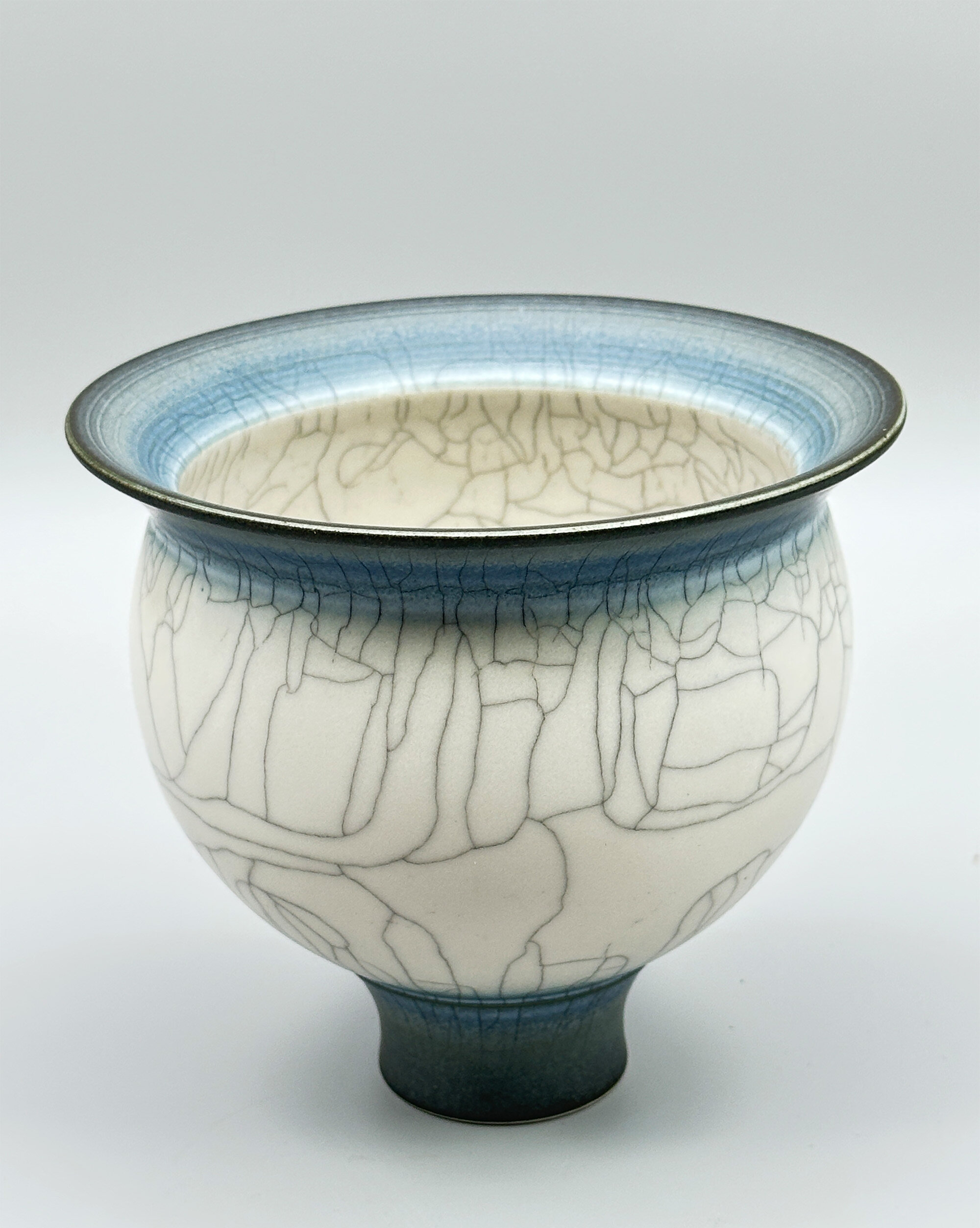
Studio Pottery Vessel by David White, signed DW, late C20th
Price: £180The mark is for David James White (1934-2011) who established Broadstairs Pottery with his wife in 1978 (see lot XXXX) and then sold this in 1983 to concentrate on his own work which focused on high-fired porcelain decorated with a blend of crackle glazes in a range of colours with a high sophistication of technique, see ‘British Studio Potters’ Marks’ by Eric Yates-Owen and Robert Fournier (2nd edition 2005 p534). This vessel, a form he produced in a variety of colourings of which this is perhaps one of the most pleasing, is an excellent example of his work which rivals some of the best creations of earlier Chinese potters in the standard of finish achieved.
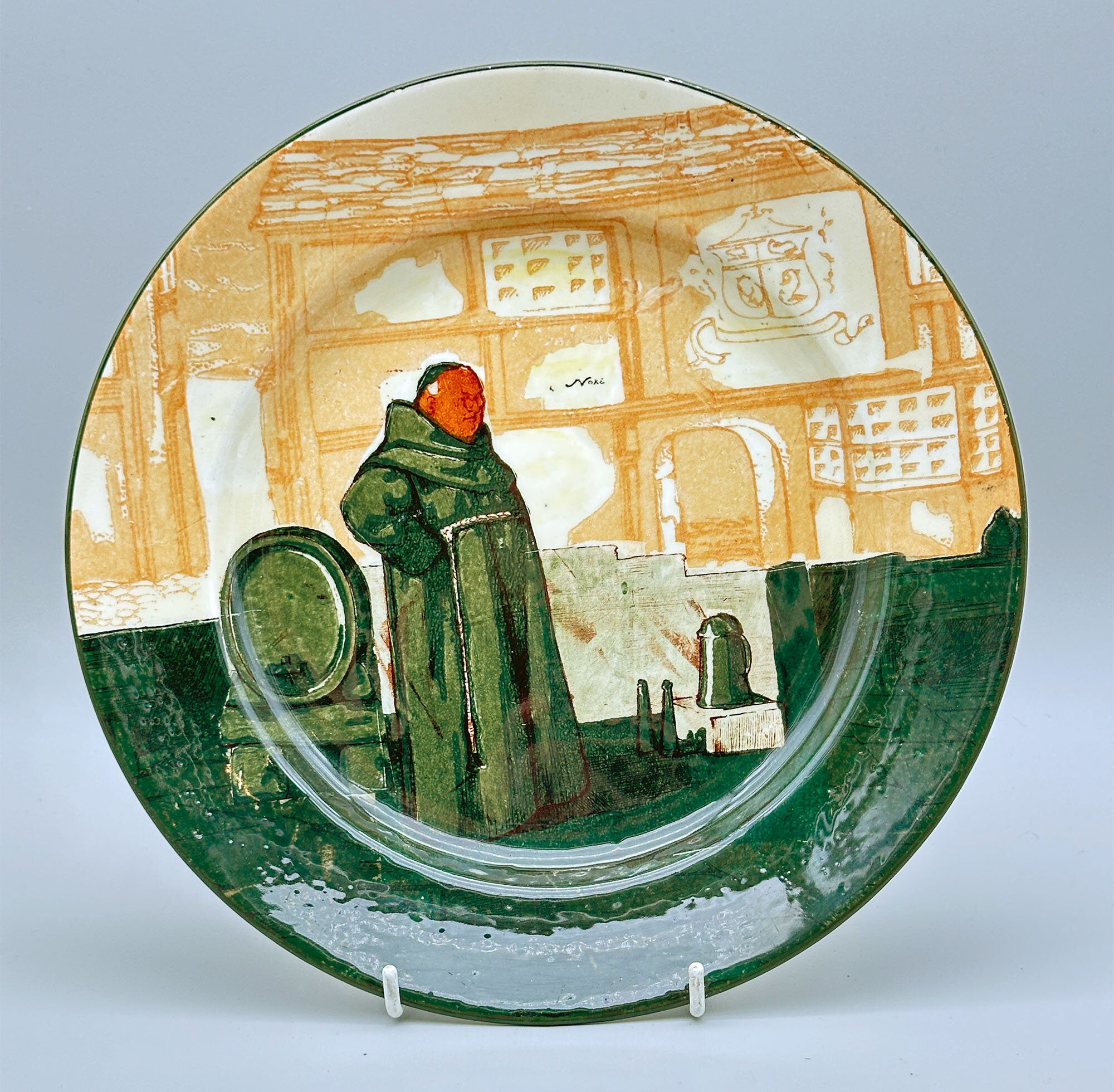
Doulton Plate from the Jackdaw of Rheims series, early C20th
Price: £45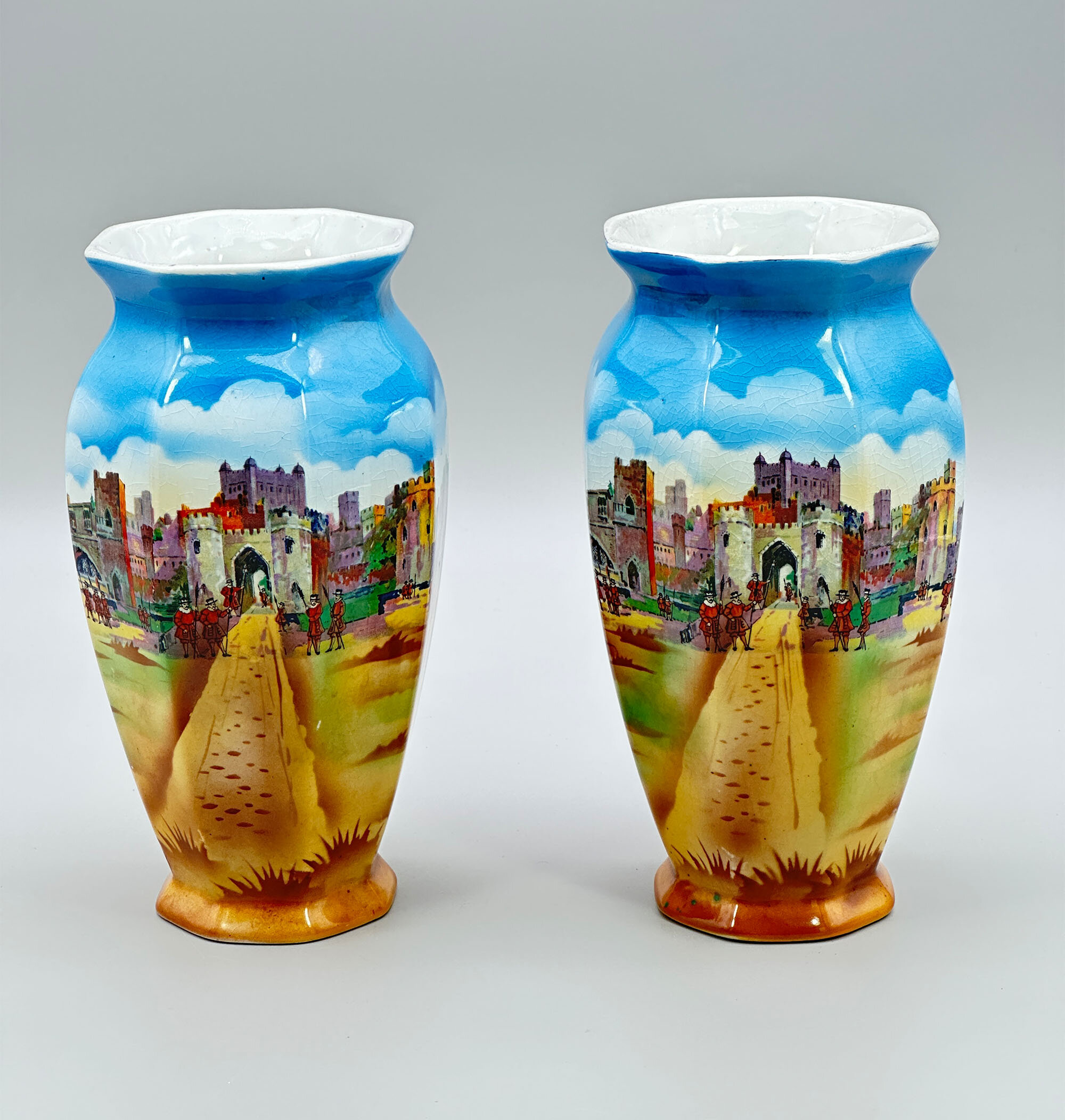
Pair of Tower of London Vases, New Hall Pottery, first half C20th
Price: £45The mark is for New Hall Pottery Co Ltd which traded in Hanley, Stoke-on-Trent, from 1899 to 1956. During the early years of the twentieth century, the firm was mainly known for the production of toilet sets and jugs, in 1908 producing and selling more than 50,000 toilet sets of the Waverley shape alone. After the First World War, demand for these pieces slackened and the firm turned towards producing dinner and hotel wares. Trading was difficult in the years before the Second World War but production was allowed to continue during it, mainly for supplying the armed forces, and was able to return to normal afterwards with an overseas trade nearly exceeding that of past years until the firm ceased trading in 1956.
A variety of marks were used of which the one seen here was the simplest version. Since it also appears on toilet sets, a similar date of production seems likely and perhaps these vases were a part of the attempt to diversify as the demand for the staple product of the business was beginning to decline. Certainly, while modest pieces in themselves, they do have something of an ‘Art Deco’ look and can be regarded as amusing decorative items today.
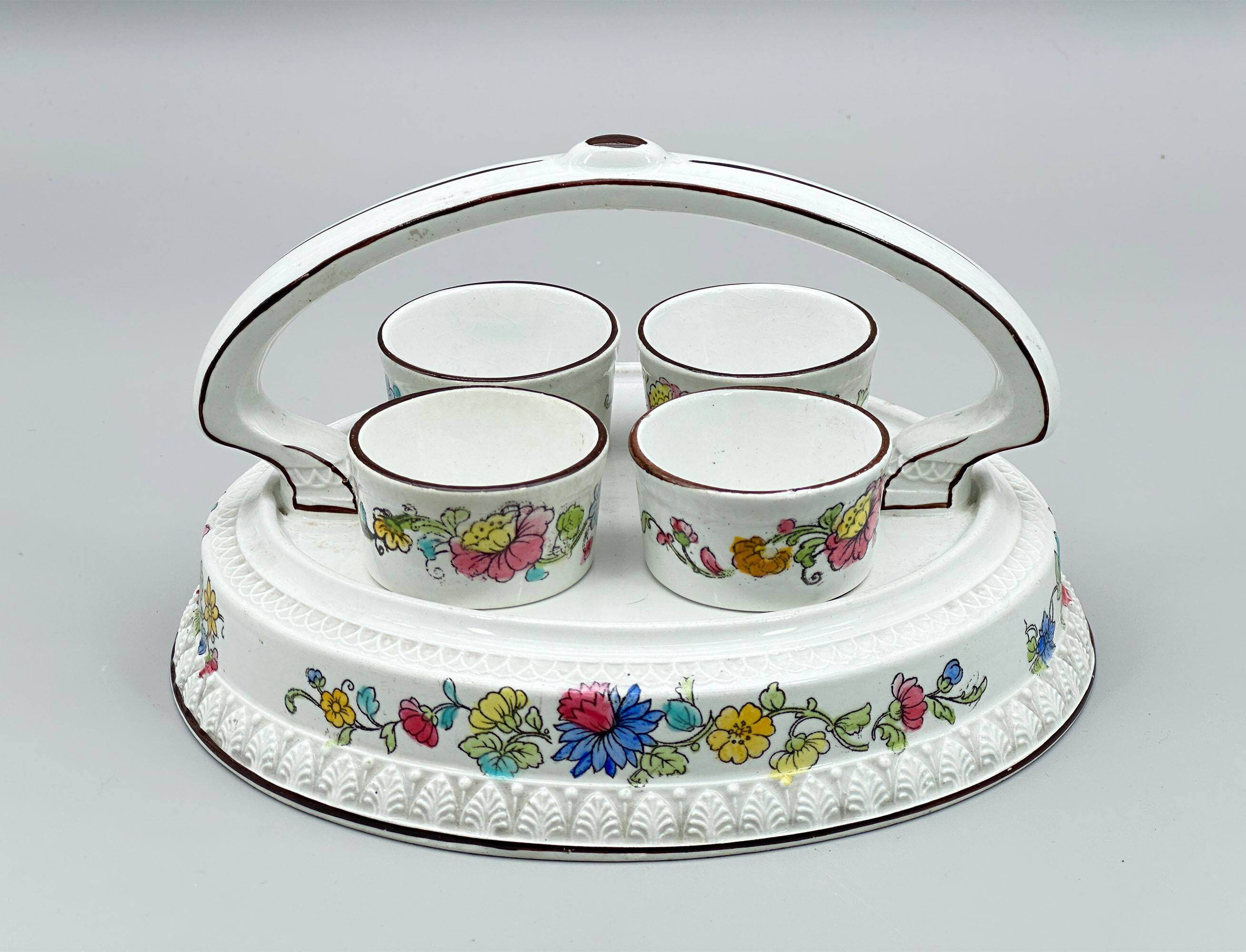
Egg cup holder, Royal Bonn Porcelain, Germany, marked, early C20th
Price: £55The firm Royal Bonn had its origins in the eighteenth century when by order of the Elector of Cologne, Clemens August of Cologne, the factory Kurfürstliche Fayencerie Poppelsdorf (Poppelsdorf Faience Fabrique) was founded in 1755 to discover the secret recipe of porcelain. Two years later, when no results had been achieved, Clemens August withdrew his support and there began a long period of multiple and varying ownerships of the business culminating in the involvement of the Mehlem brothers, Paul Joseph Mehlem and Everhard Joseph Mehlem, in 1836, who renamed the business after their own name, eventually using that of their Father, Franz Anton. After the death of the last remaining member of the family, Everhard, in 1865, the business was taken over yet again, still though retaining the family name, until it was sold to Villeroy and Boche in 1920. Shortly after this, the production of fine porcelain ceased and the factory closed in 1931.
The form of the mark here was used between 1885 and 1920 and this set was probably made in the early years of the twentieth century. The quality of the porcelain is easily appreciated and this is a highly decorative set which could also have a practical value today.
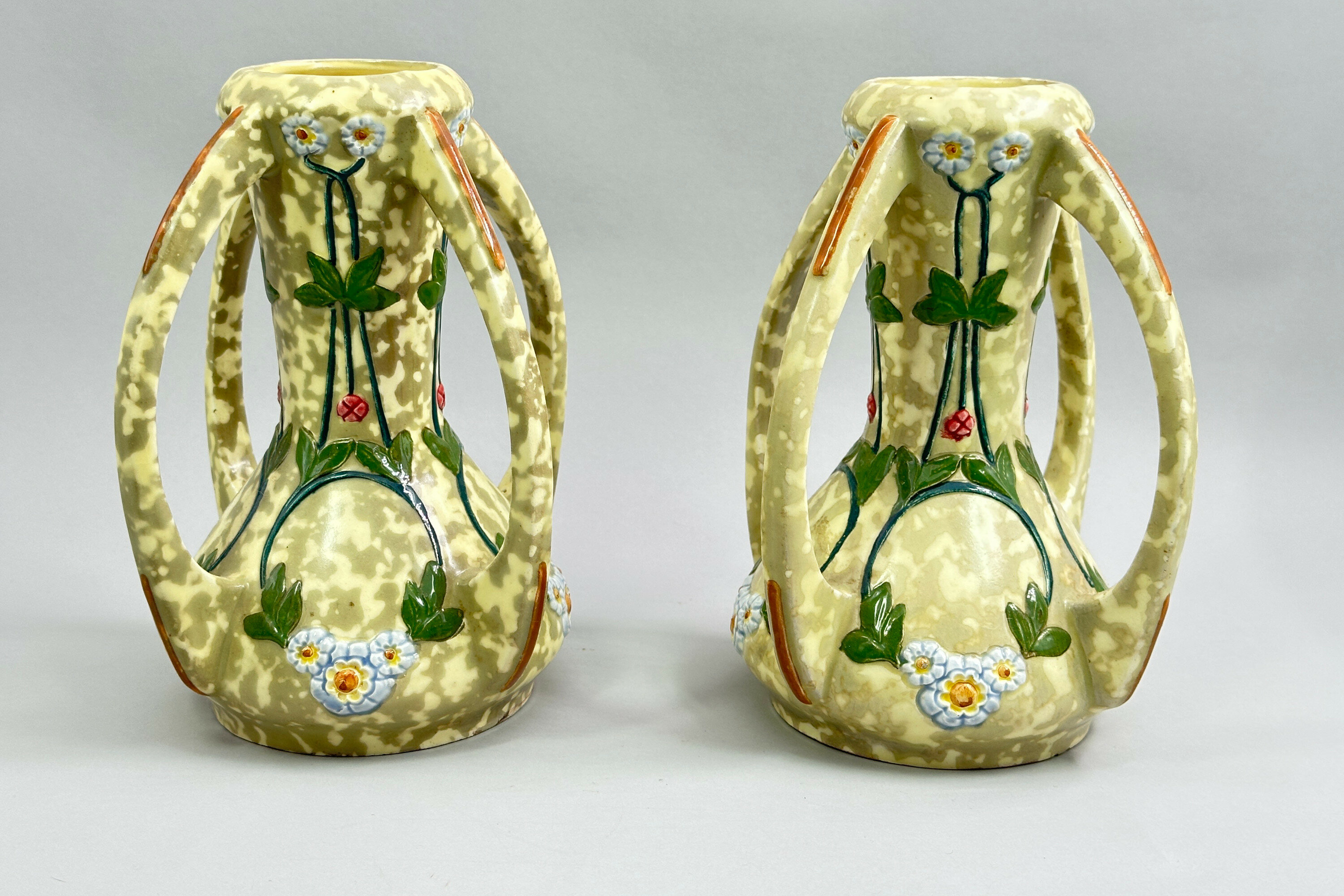
Pair of Royal Dux Secessionist Style Vases, 1930s
Price: £250
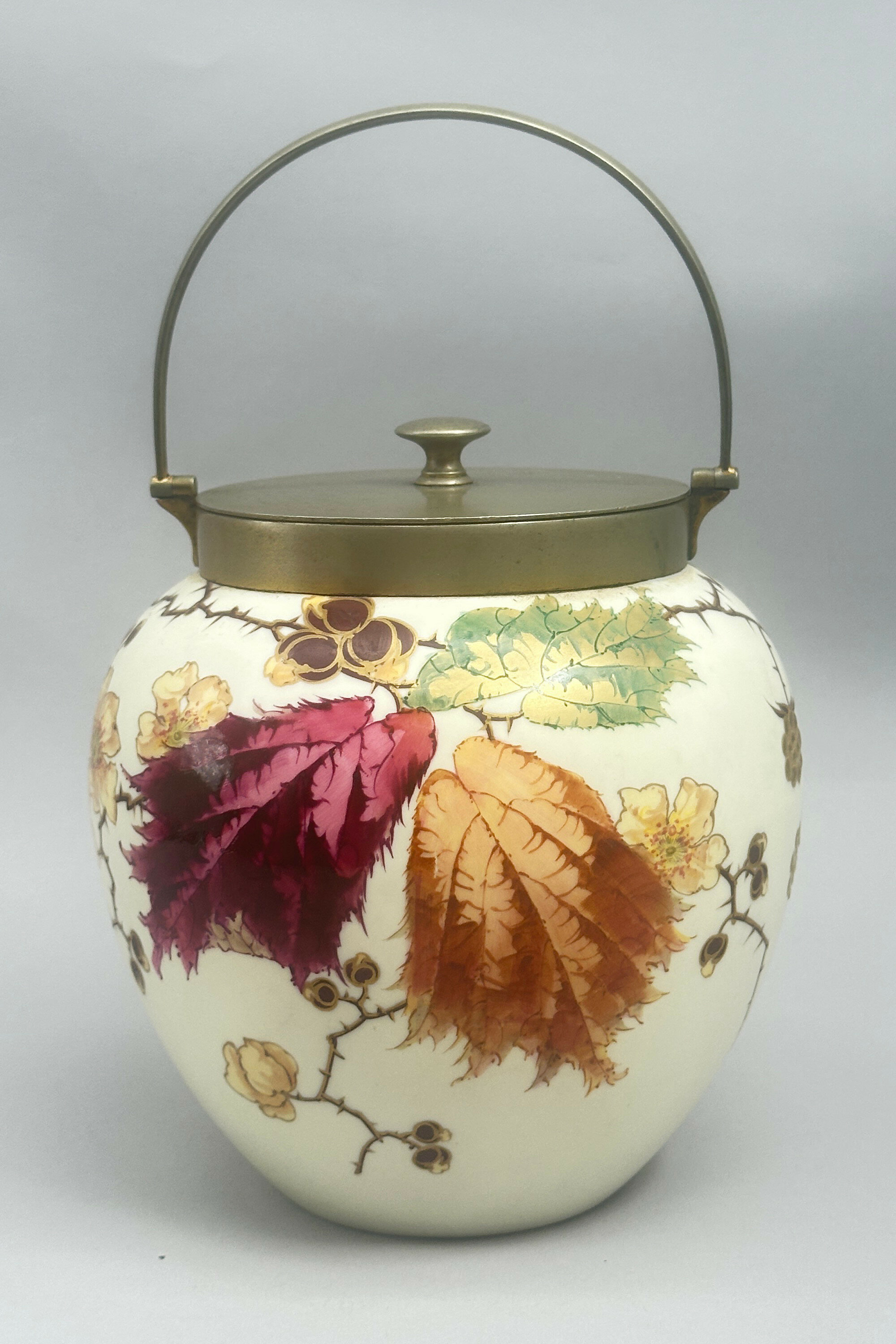
Wedgwood Biscuit Jar with brass handle and cover, marked, early C20th
Price: £55The naturalistic decoration here with its vivid and finely executed detail has elements of the Art Nouveau style to it and this is consistent with the format of the mark. The Wedgwood factory needs little introduction. Founded by Josiah Wedgwood in 1769 in Stoke-on-Trent, England and named after the Italian Etruria region to reflect its neoclassical designs, it rapidly became famous for its stoneware designs in the classical style but ceramic tablewares were produced as well and this biscuit barrel is a good example of the high quality wares produced in the early twentieth century. The inclusion of ‘ENGLAND’ indicates a dating after 1891 and the addition of three stars occurs after 1900 suggesting that this piece was made in the early 1900s The rather grand design is in keeping with the opulence of the Edwardian era and survives in excellent condition with the brass metal fittings undamaged and intact.
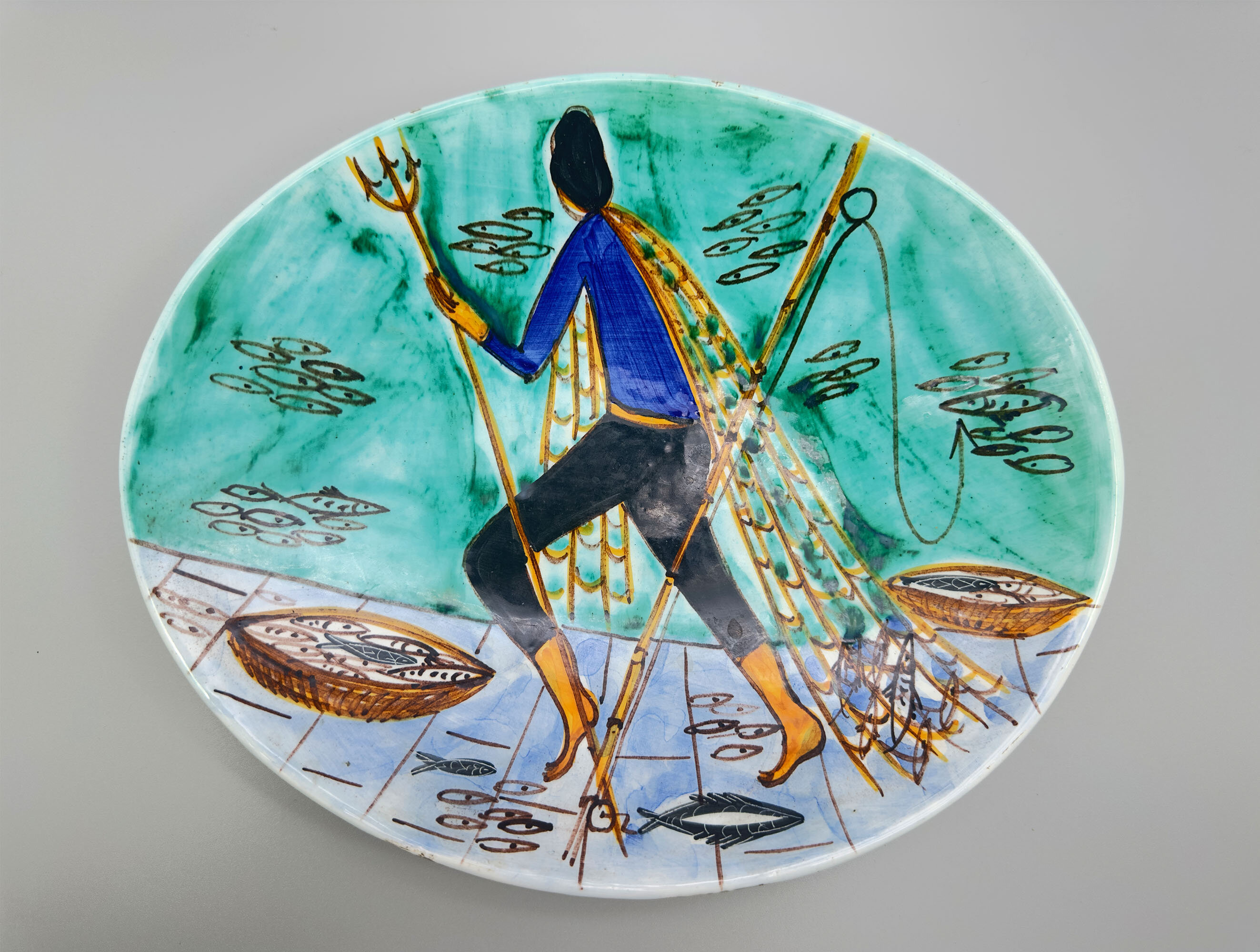
Italian oval dish decorated with a fisherman, S.IC.A. Vicenza, mid C20th
Price: £25There are similar plates found, all marked ‘Italy’ to the reverse and some with the lettering ‘SICA’ on the front. This stands for the ‘Società Italiana Ceramica Artistica’ which was founded in Nove, in the province of Vicenza, by G. Battista Cogo, Giovanni Grappiglia, Stefano Guzzo, and Angelo Perin in 1946 and concentrated on the production of modernist domestic earthenware. The style of decoration here and the bright colourings used are typical of the 1950s and this plate most likely dates to that time. There is a naif charm here which is most attractive and this decorative piece could also be used today for serving at the dinner table.
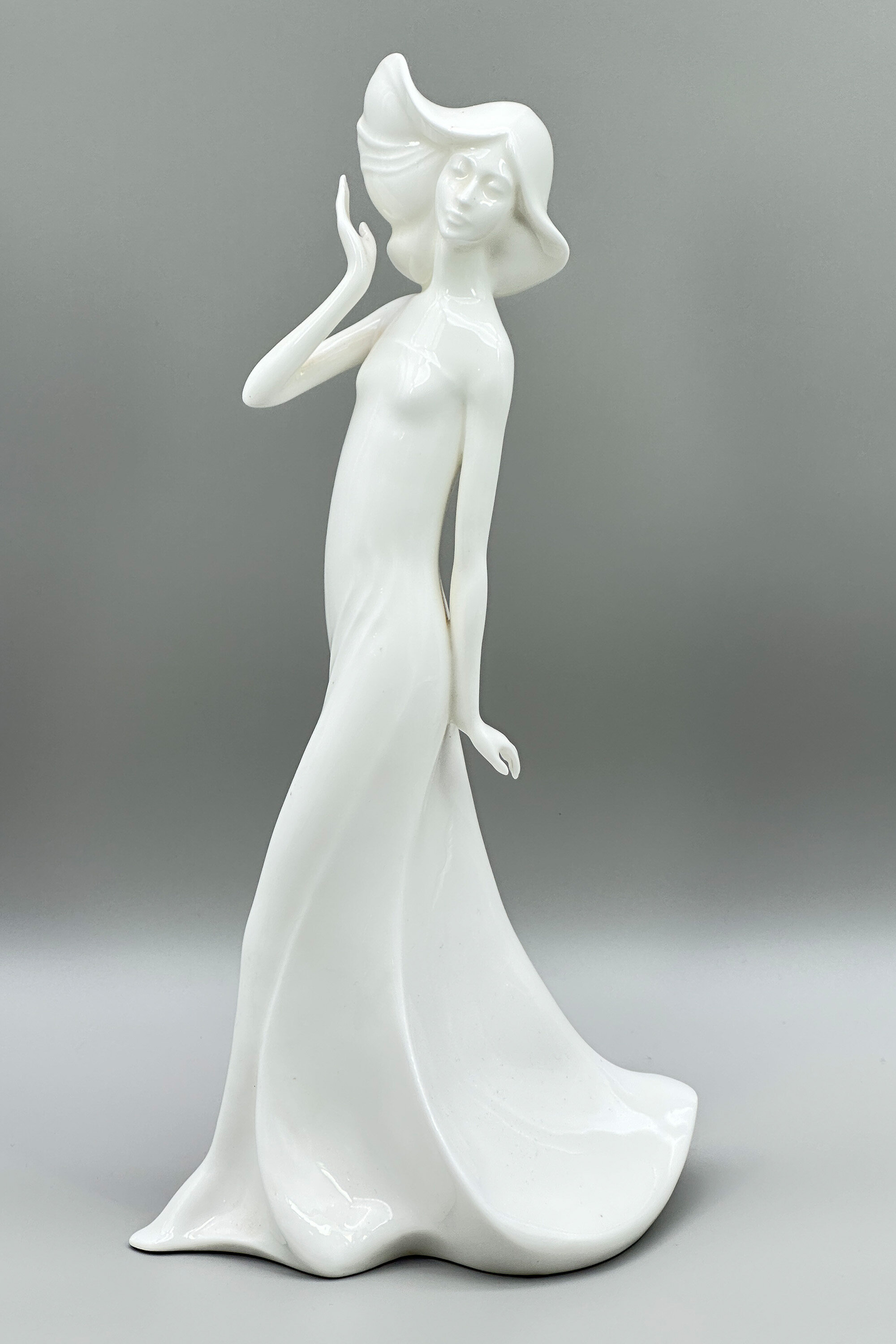
Royal Doulton figure of a lady, Images Collection – Carefree, 1980s
Price: £35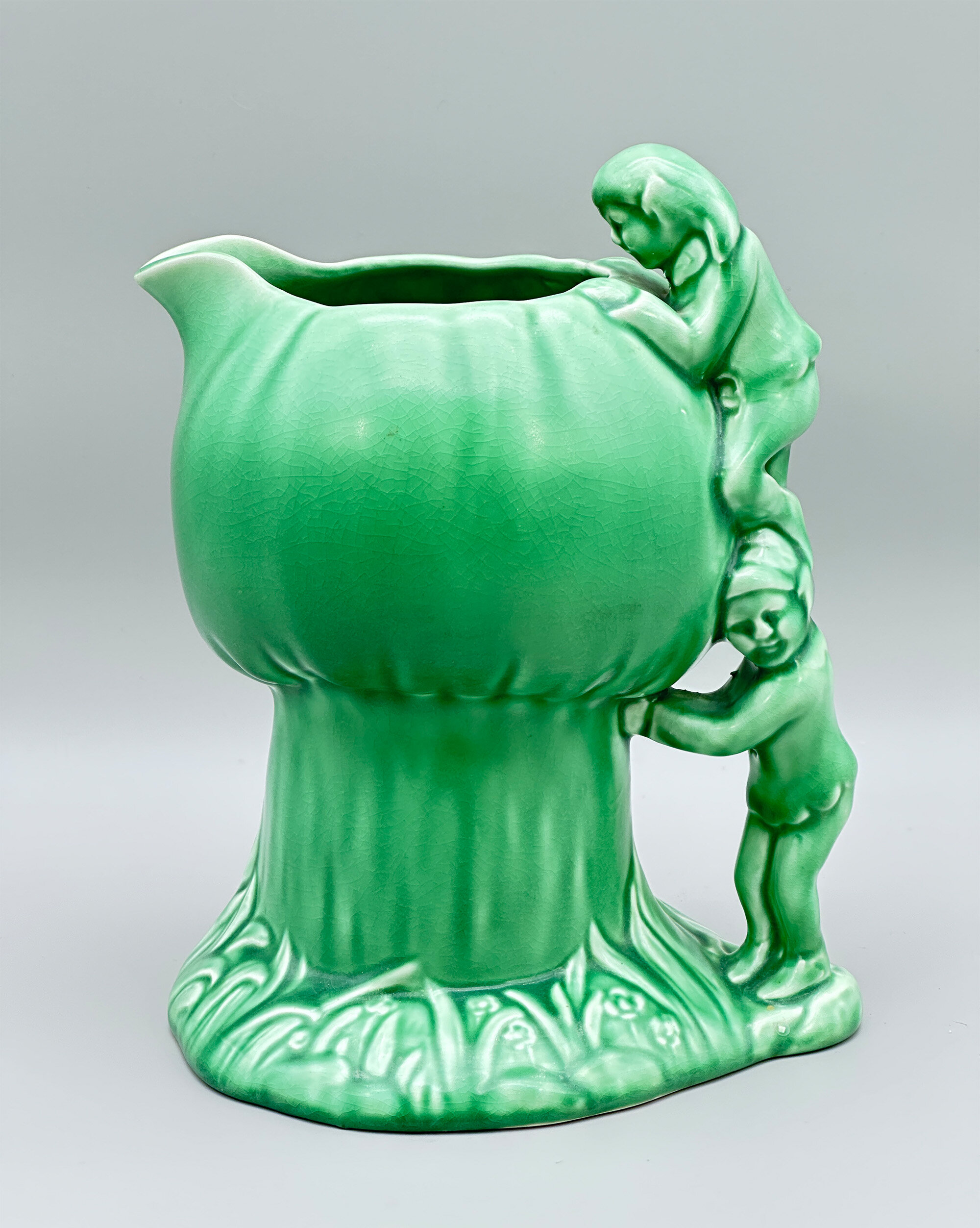
Sylvac Pixie Jug, Pattern No 1969, mid C20th
Price: £45‘SylvaC’ (the name was written with a capital ‘C’ after registration of the trademark in 1938) was a trade name of Shaw and Copestake, a company formed by Mr. William Shaw and a Mr. Copestake around 1900. Mr. Copestake sold his shares to a Mr. Richard Hull after about six months of business and this partnership continued until Mr. Hull’s death in 1935. He was succeeded by his son, Mr. Richard Hull junior. In the following year, the business became a limited company. Various mergers and acquisitions followed and in the 1950s new premises were built and production expanded considerably continuing until the early 1980s when changing markets and increased competition forced the company into liquidation.
Sylvac were known for imaginative glazed wares, particularly animals, and novelty pieces with a rustic twist of which this is a typical example. These were mainly produced in the early post war years and this jug most likely dates to the 1950s when demand was at its height. These jugs were made in a variety of colours but the green glaze here is the most characteristic of Sylvac pieces and probably the most attractive.
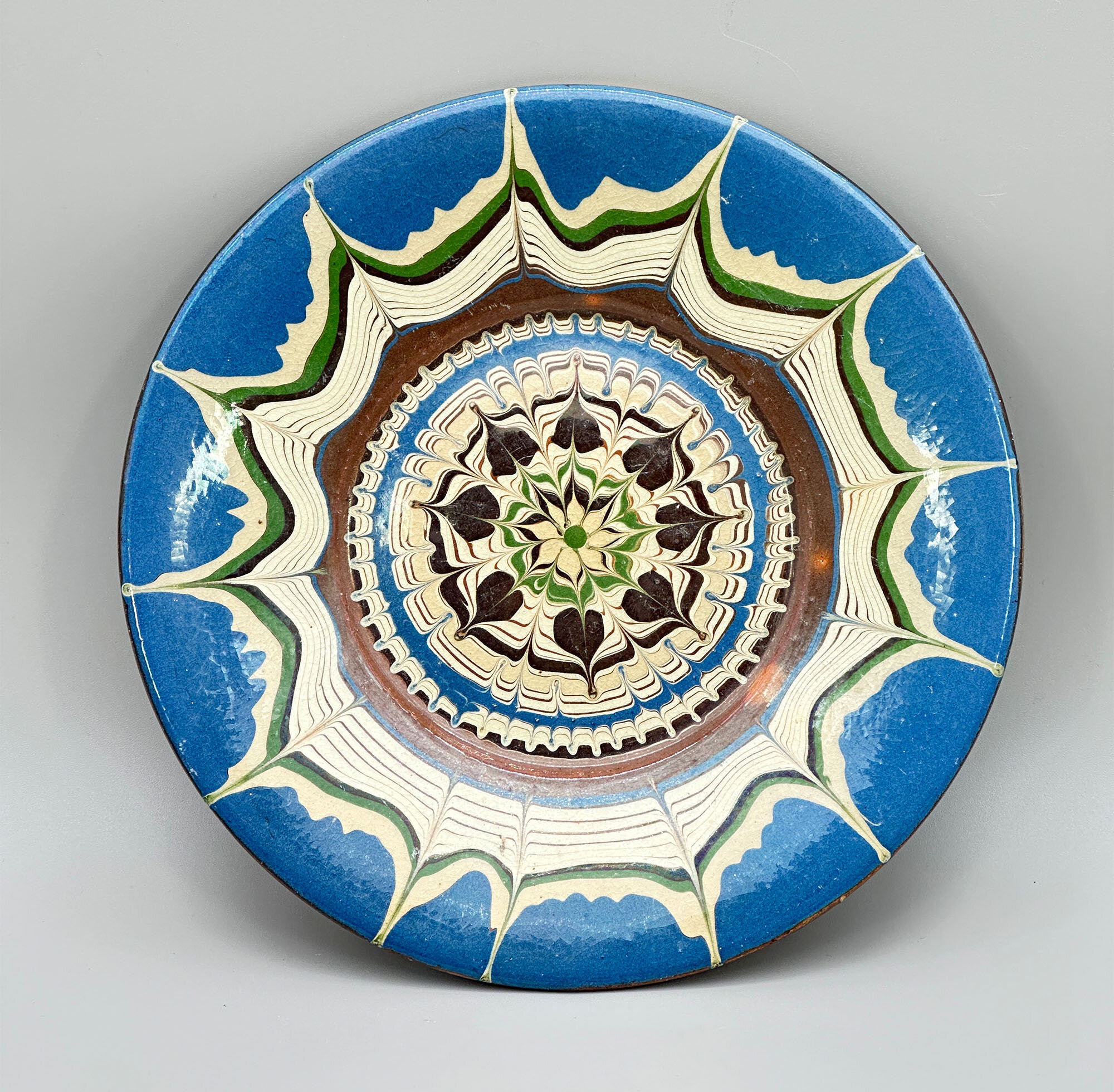
Ceramic Wall Plate, Keramika MIS Vbnj-Banja, Hungary, second half C20th
Price: £25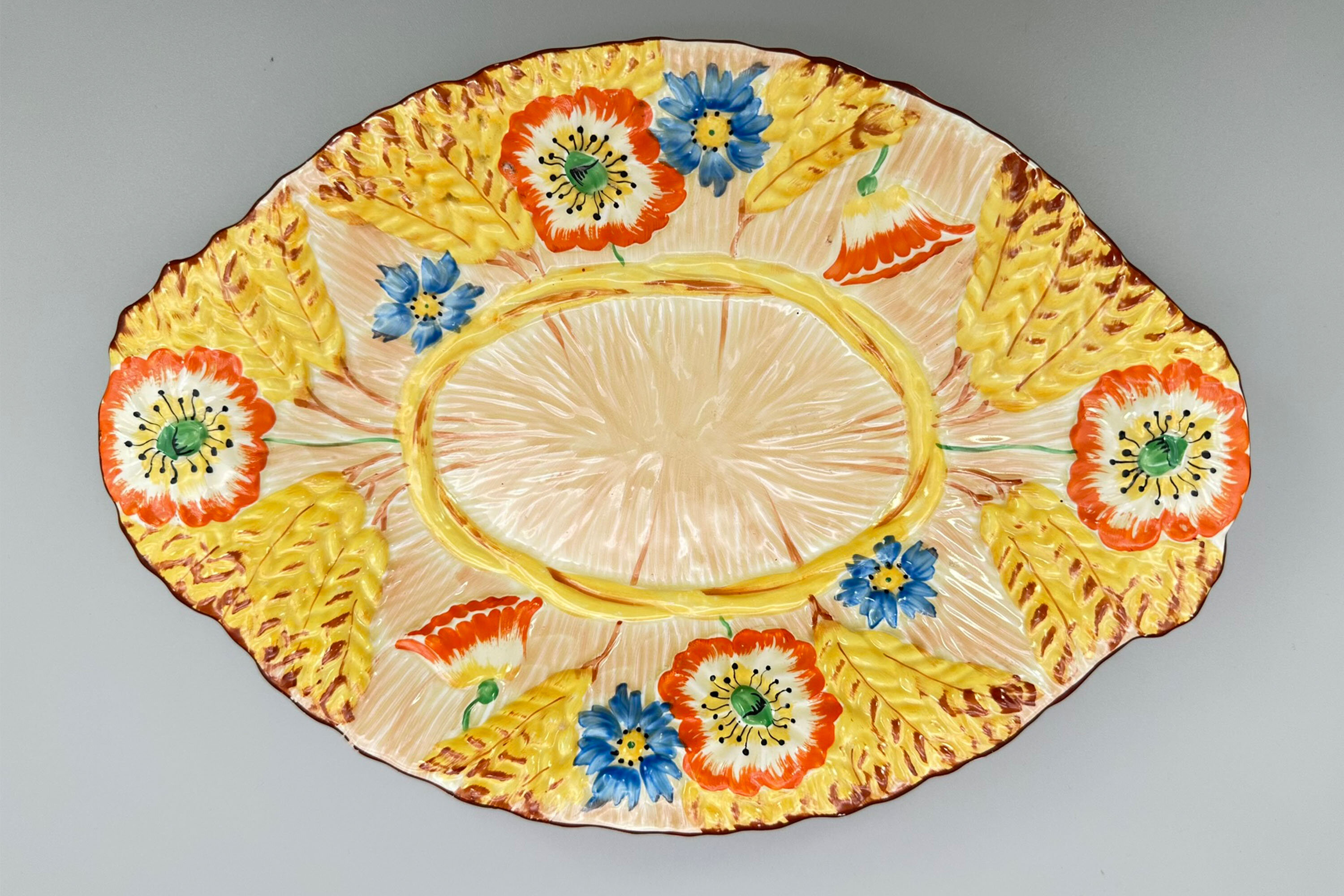
Falcon Ware oval serving Dish, J. H. Weatherby & Sons Ltd, 1930s
Price: £25Two Staffordshire potteries produced pieces with the trademark name ‘Falcon Ware’, Thomas Lawrence and J.H. Weatherby & Sons. The name derived from the Falcon Works at Hanley where both the ranges were made. John Henry Weatherby founded the business under his name in 1891 and moved to the Falcon Works one year later. Pieces marked ‘Falcon Ware’ were produced from the mid 1920s onwards and the addition of ‘Royal’ was introduced in the 1930s as a marketing tool. There was in no sense a Royal Warrant! Accordingly, the format of the mark on this dish dates it to the 1930s and it can be seen as a modest rival to the designs of Clarice Cliff, in particular her celebrated ‘Wheatsheaf’ pattern, which other factories imitated as well. The work is, in fact, in no way inferior making this an attractive if modest souvenir of a popular 1930s design.
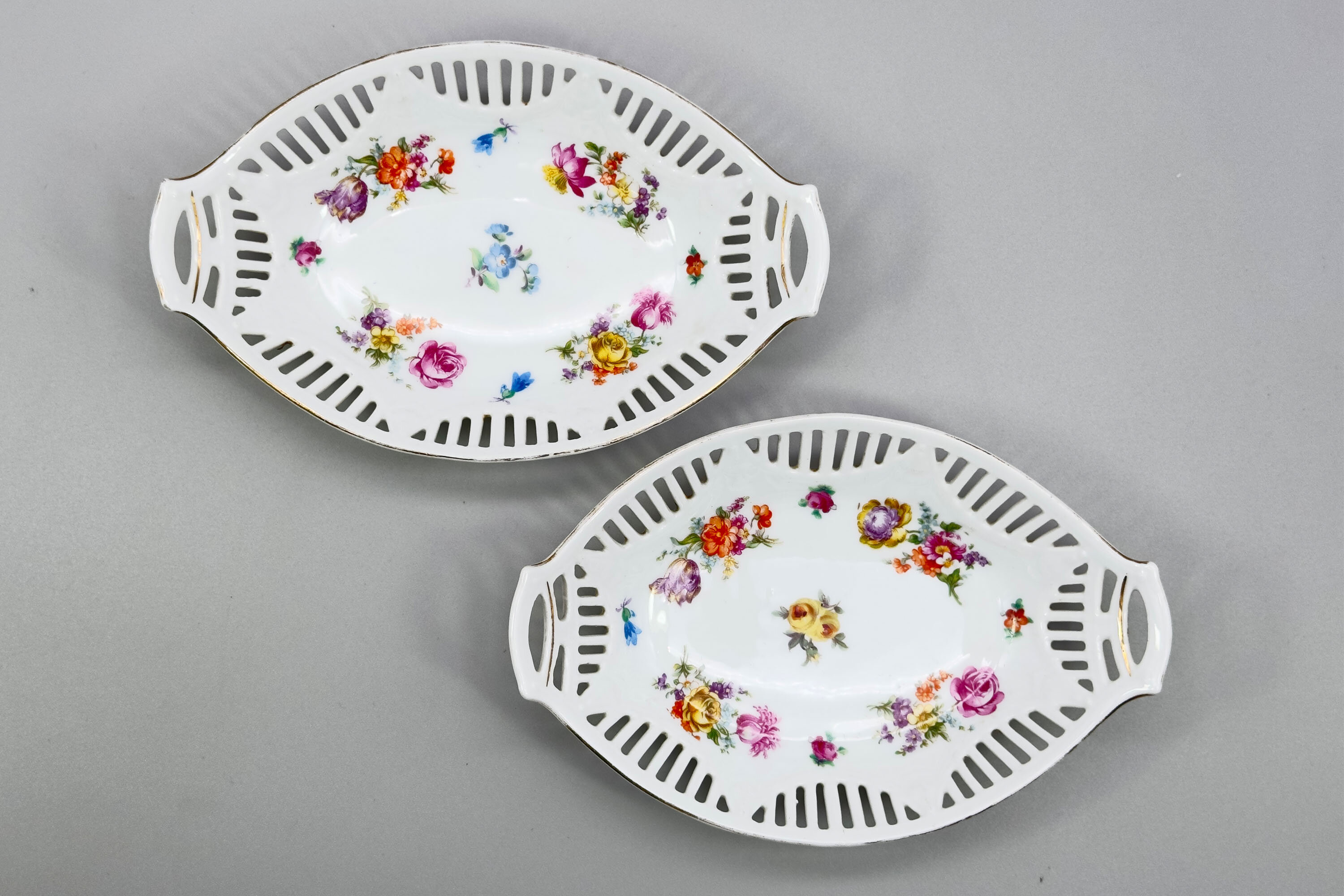
Pair of reticulated edge floral decorated Dishes, Schumann Bavaria, Germany 1920s
Price: £45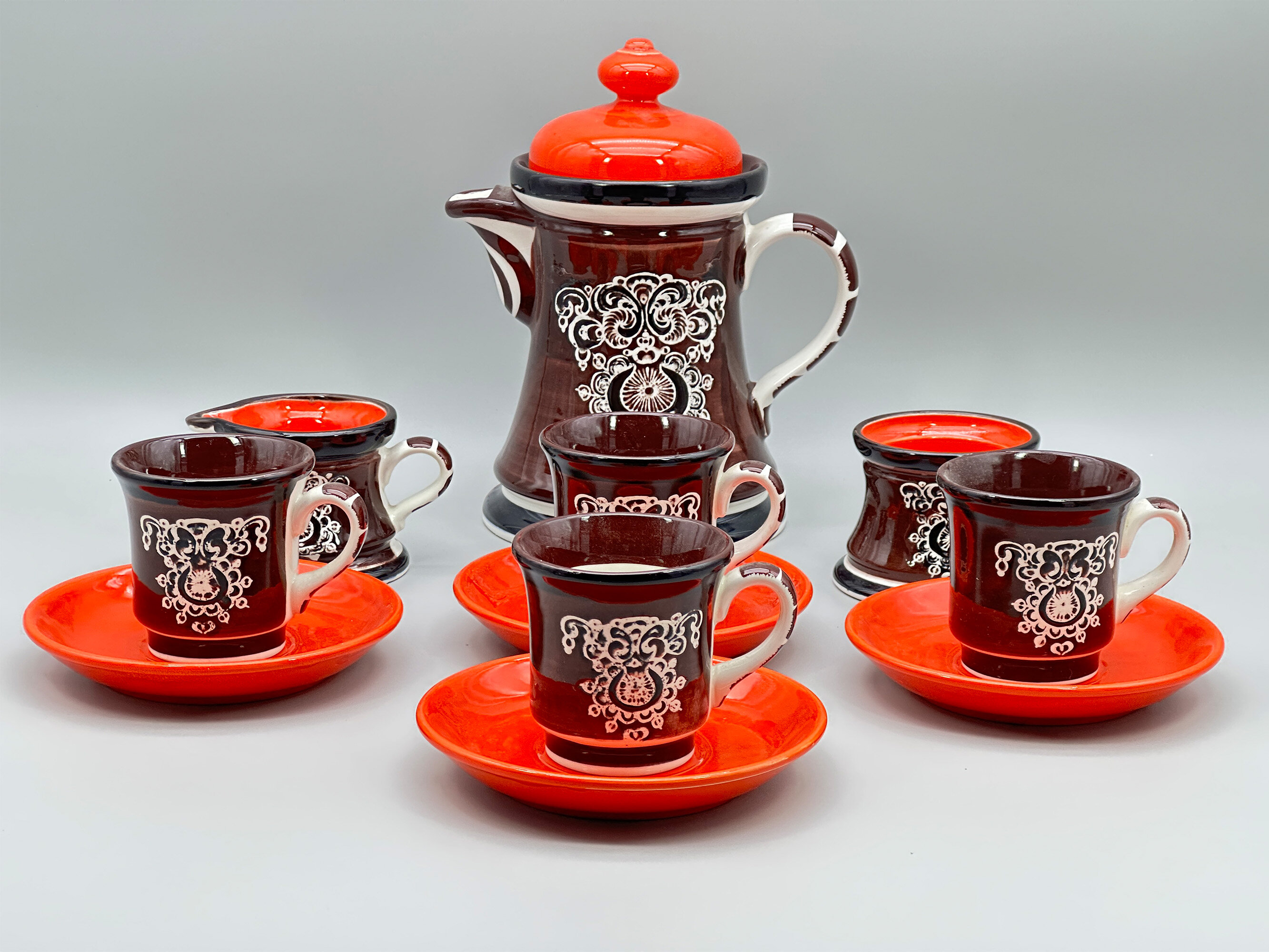
Coffee Service, Schramberger Majolikafabrik, Adlon pattern, 1960s
Price: £55Schramberg were best known for their colourful majolica pieces and worked with well known artists, notably the Hungarian Eva Zeisel, who created innovative designs on their behalf. The pattern here, Adlon, was first produced in the early twentieth century and shows the influence of Art Nouveau. It was reissued in the 1960s, which is the date of this set, and indeed the shapes and decoration equally complement that later era.
Size
(i) Coffee Pot : Ht (max) 23cm, Ht (pot) 17cm, Diam (top) 12cm, Width (max) 19cm, Base 14.6cm (ii) Milk Jug : Ht (max) 7cm, Width (max) 12cm, Base 9cm (iii) Sugar Basin : Ht (max) 7cm, Top diam 8.2cm, Base 9.7cm (iv) Cup : Ht 7.9cm, Width (max) 10cm, Top diam 8cm, Base 5.3cm (v) Saucer : Diam 15cm, Ht 2.5cm, Base 9.5cm
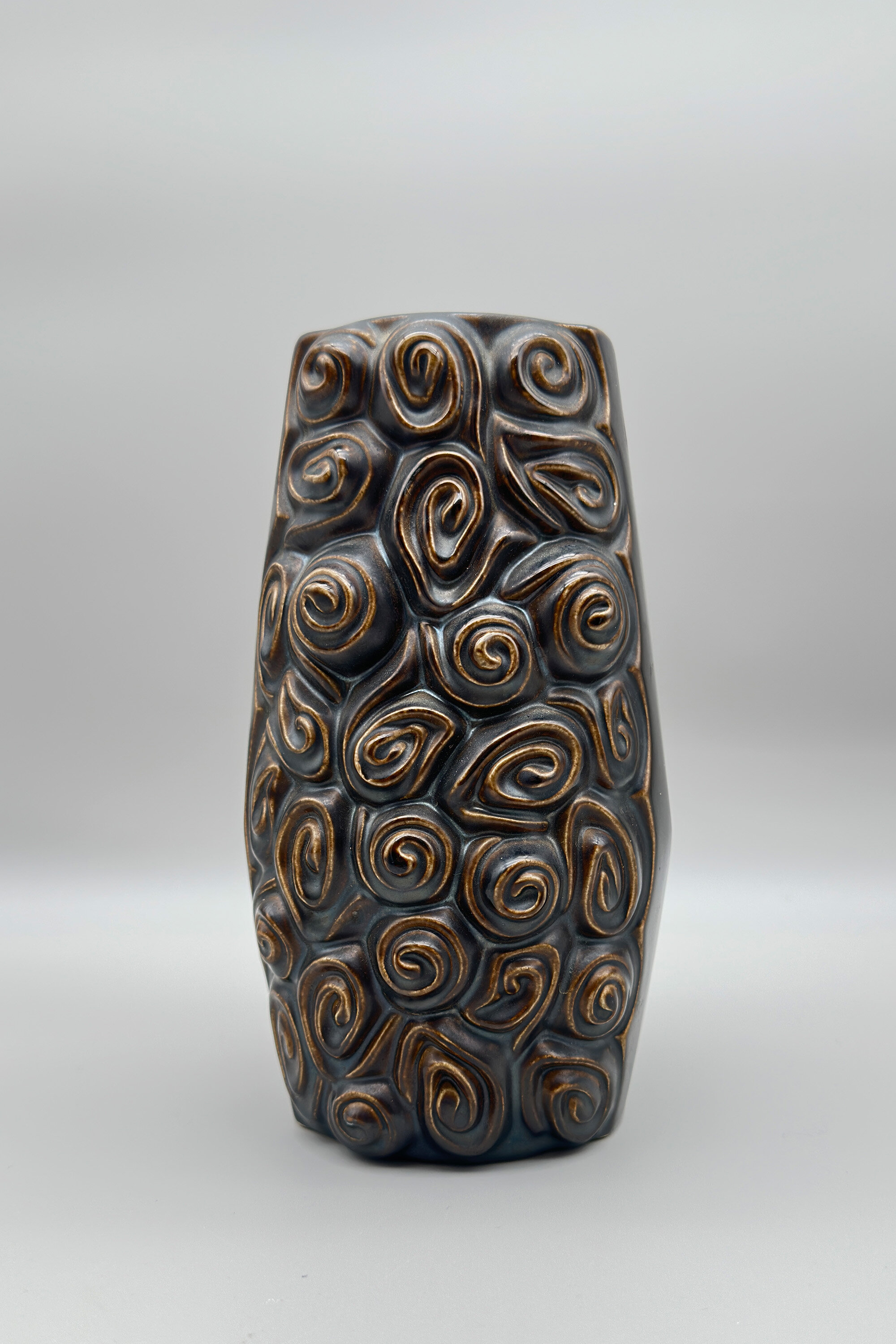
Sylvac Vase, Harmony range, 1960s
Price: £25‘SylvaC’ (the name was written with a capital ‘C’ after registration of the trademark in 1938) was a trade name of Shaw and Copestake, a company formed by Mr. William Shaw and a Mr. Copestake around 1900. Mr. Copestake sold his shares to a Mr. Richard Hull after about six months of business and this partnership continued until Mr. Hull’s death in 1935. He was succeeded by his son, Mr. Richard Hull junior. In the following year, the business became a limited company. Various mergers and acquisitions followed and in the 1950s new premises were built and production expanded considerably continuing until the early 1980s when changing markets and increased competition forced the company into liquidation.
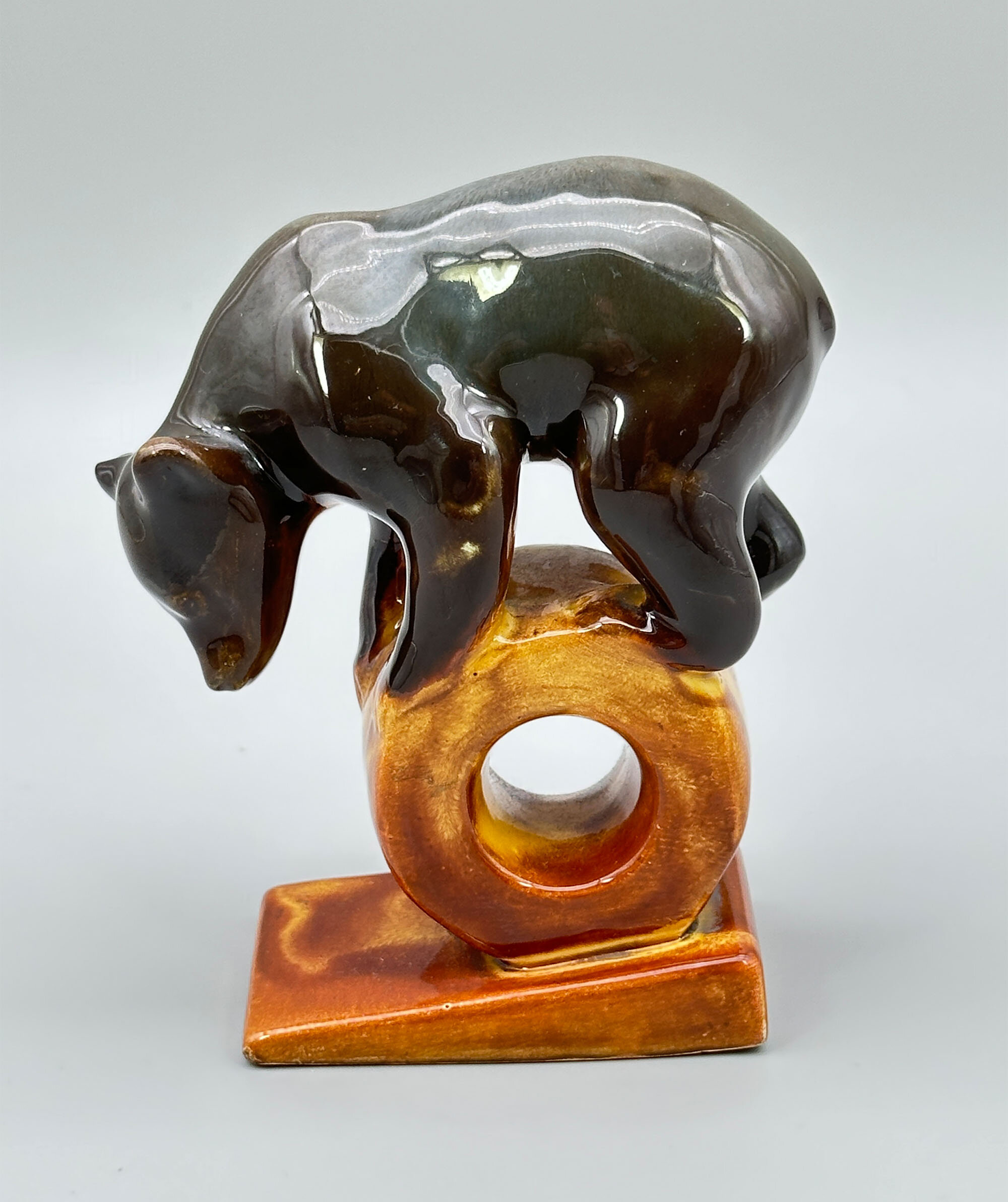
Figure of a Bear with hoop, Konakovo Faience Factory, USSR, marked, mid C20th
Price: £45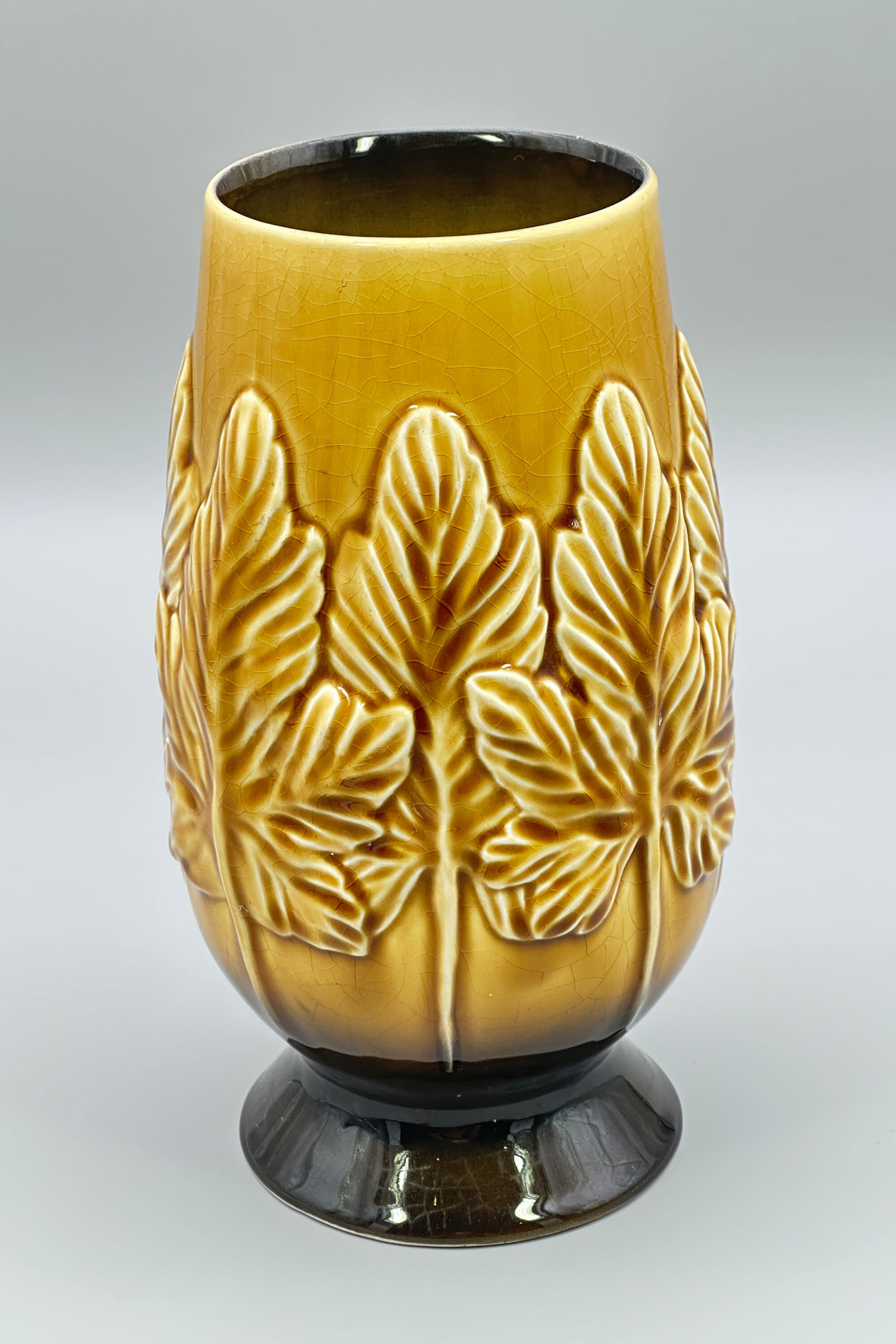
Sylvac sycamore leaf Vase, mid C20th
Price: £25This is an example of the naturalistic designs produced by Sylvac in the 1950s and 1960s. While they often chose to imitate tree bark, here they take their inspiration from the leaves themselves. The model occurs in various sizes and glazes including green and dark brown but the mustard colourings are, perhaps, the most pleasing. The smaller versions seem to be marked ‘4215’ as opposed to the numbers seen here ‘4206’.
‘SylvaC’ (the name was written with a capital ‘C’ after registration of the trademark in 1938) was a trade name of Shaw and Copestake, a company formed by Mr. William Shaw and a Mr. Copestake around 1900. Mr. Copestake sold his shares to a Mr. Richard Hull after about six months of business and this partnership continued until Mr. Hull’s death in 1935. He was succeeded by his son, Mr. Richard Hull junior. In the following year, the business became a limited company. Various mergers and acquisitions followed and in the 1950s new premises were built and production expanded considerably continuing until the early 1980s when changing markets and increased competition forced the company into liquidation.
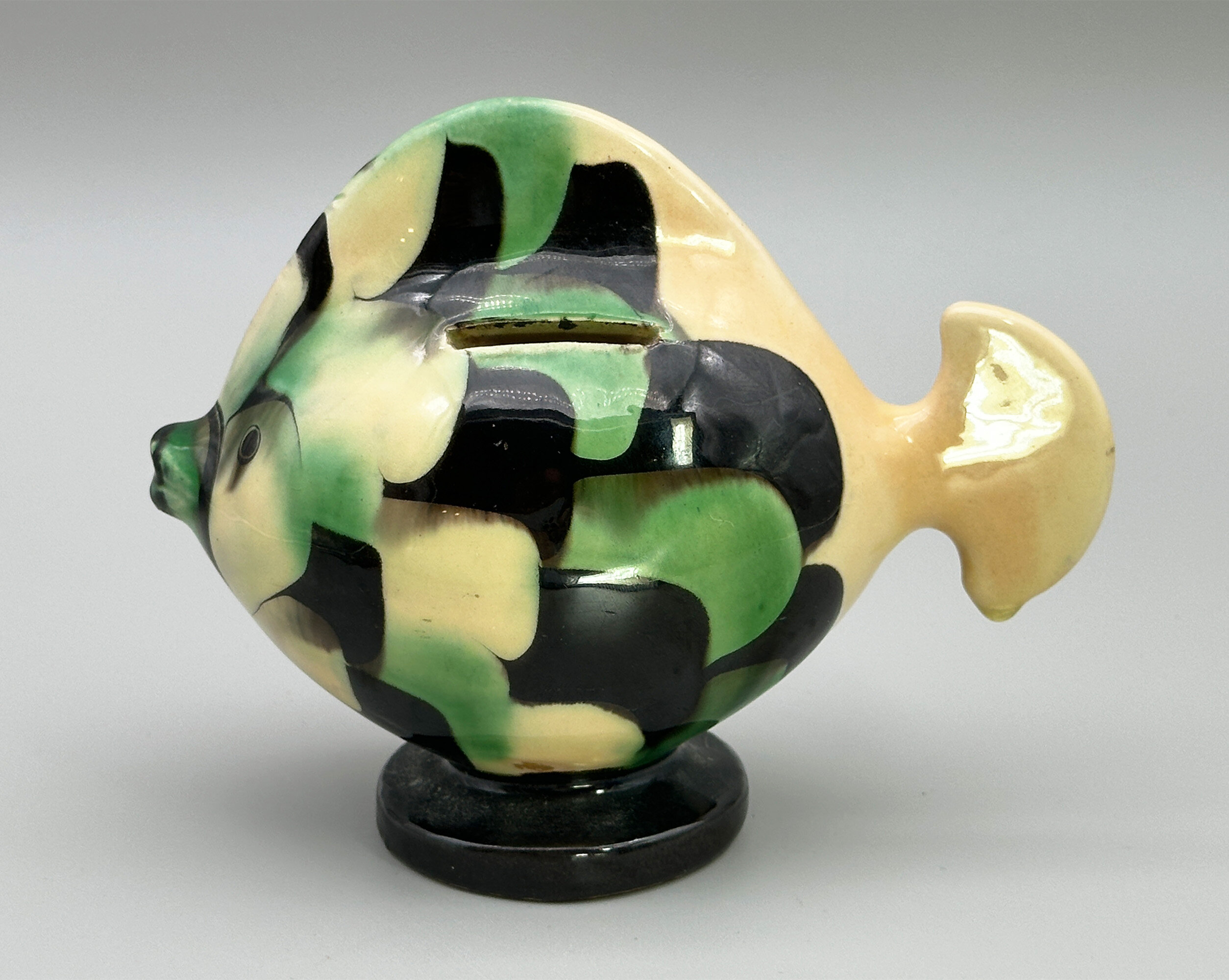
Money bank in the form of a Fish, marked HAK for Kähler Ceramics, Denmark, mid C20th
Price: £110The mark here shows that this piece was made by the celebrated Danish firm Kähler who have been producing ceramics for over one hundred and eighty years. Herman August Kähler was a Danish ceramic designer and manufacturer who ran the Kähler ceramic factory (Kählers Keramiske Værksted) in Næstved, Denmark which he took over from his Father with his brother in 1872, then running it himself from 1875 when he built a new factory on the town’s outskirts. Kähler was responsible for the introduction of a ruby red glaze which soon became extremely popular and the factory began to produce many well formed decorative pieces which enjoyed a wide reception and were exhibited at the Great Nordic Exhibition held in Copenhagen in 1888 and at the Exposition Universelle held the following year in Paris. Kähler died in 1917 but the firm continued, at first under the direction of his son Herman Hans Christian Kähler and then by future generations of the family who continued to use the cipher mark designed by their ancestor, Hermann August.
Kähler’s pieces naturally followed the fashions of the times and this fish has very much a mid century feel, probably dating therefore to the 1950s or 1960s. Although the designer is not known this model is highly collectible now but not necessarily of much practical value. While there is a clear entry point for coins, extracting them appears to involve breaking the container apart…
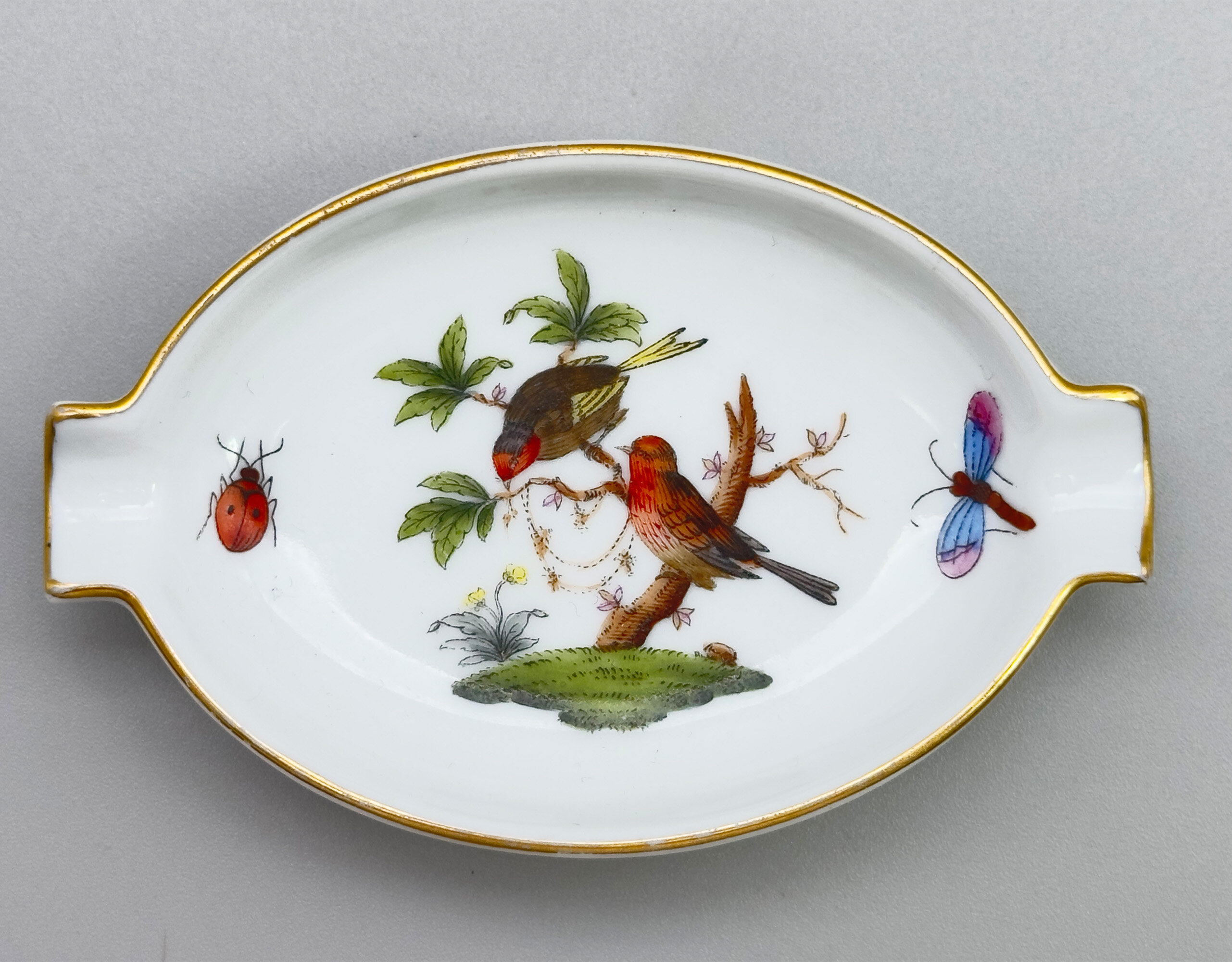
Herend porcelain Trinket dish/Ash tray, Rothschild Bird Pattern, early C20th
Price: £45This dish was made by the Herend Porcelain factory. Founded in Hungary in 1826 it almost immediately enjoyed enormous popularity with wealthy customers including members of the European aristocracy. Production continued into the twentieth century through nationalistion in 1948 and reprivatisation in 1993 and continues to the present day. Many of the patterns created in the nineteenth century are still reproduced. The design here is known as ‘Rothschild Bird’ doubtless from its first purchasers all those years ago. The format of the mark allows a fairly close dating to the years 1915-1930, making this an earlier version of the model than many others which appear on the market today.
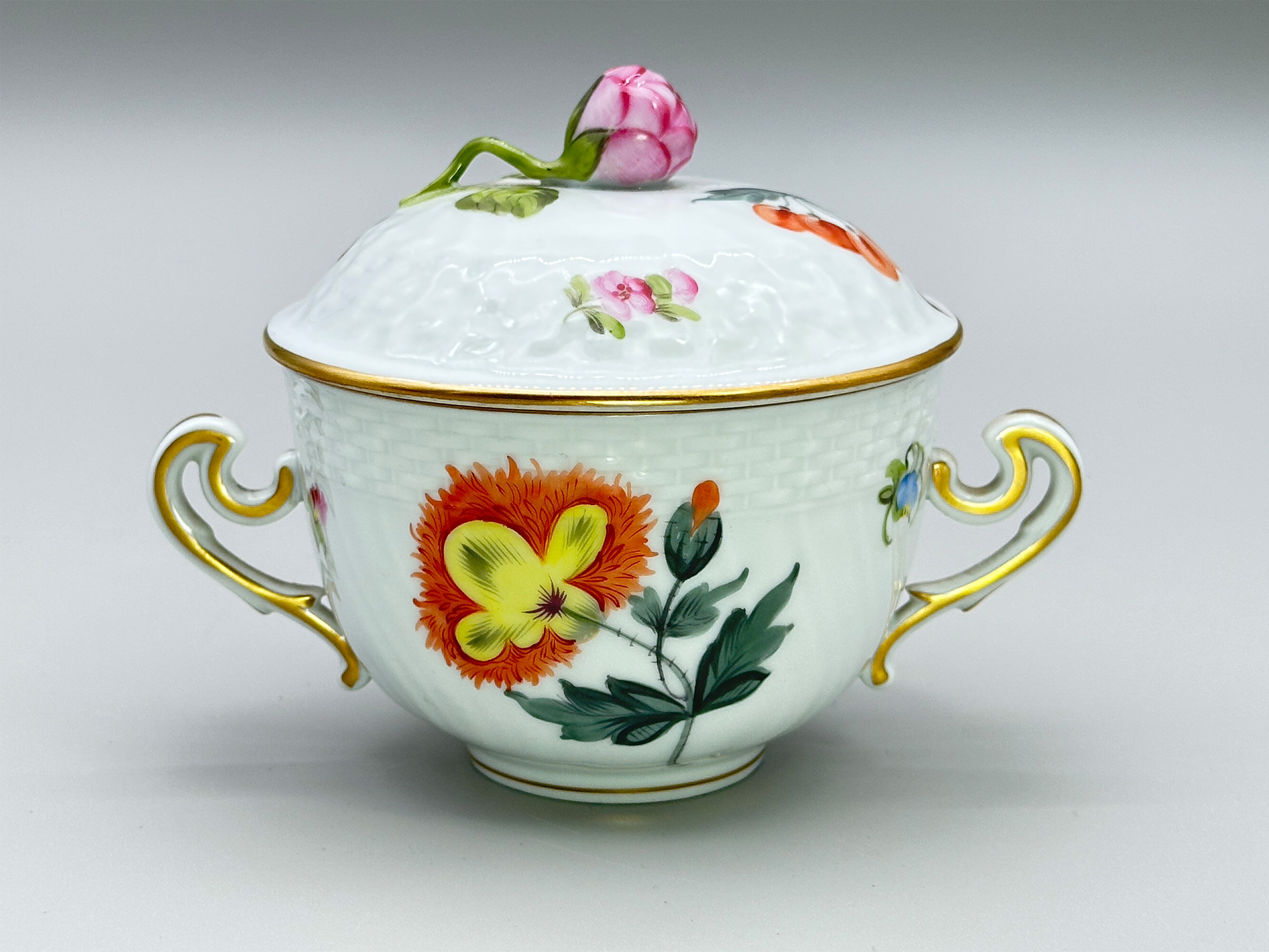
Herend écuelle and cover decorated flowers, marked, late C20th
Price: £75This écuelle and cover, possibly intended as a sugar bowl, was made by the Herend Porcelain factory. Founded in Hungary in 1826 it almost immediately enjoyed enormous popularity with wealthy customers including members of the European aristocracy. Production continued into the twentieth century through nationalistion in 1948 and reprivatisation in 1993 and continues to the present day. The designs produced in recent years often copy those of an earlier period and this is most likely the case here where resemblances can be seen to the nineteenth century productions from Meissen. The format of the mark indicates a fairly recent date of manufacture, probably in the later years of the twentieth century, but the quality of the execution is in no way diminished and the modelling of the finial in particular of the highest standard.
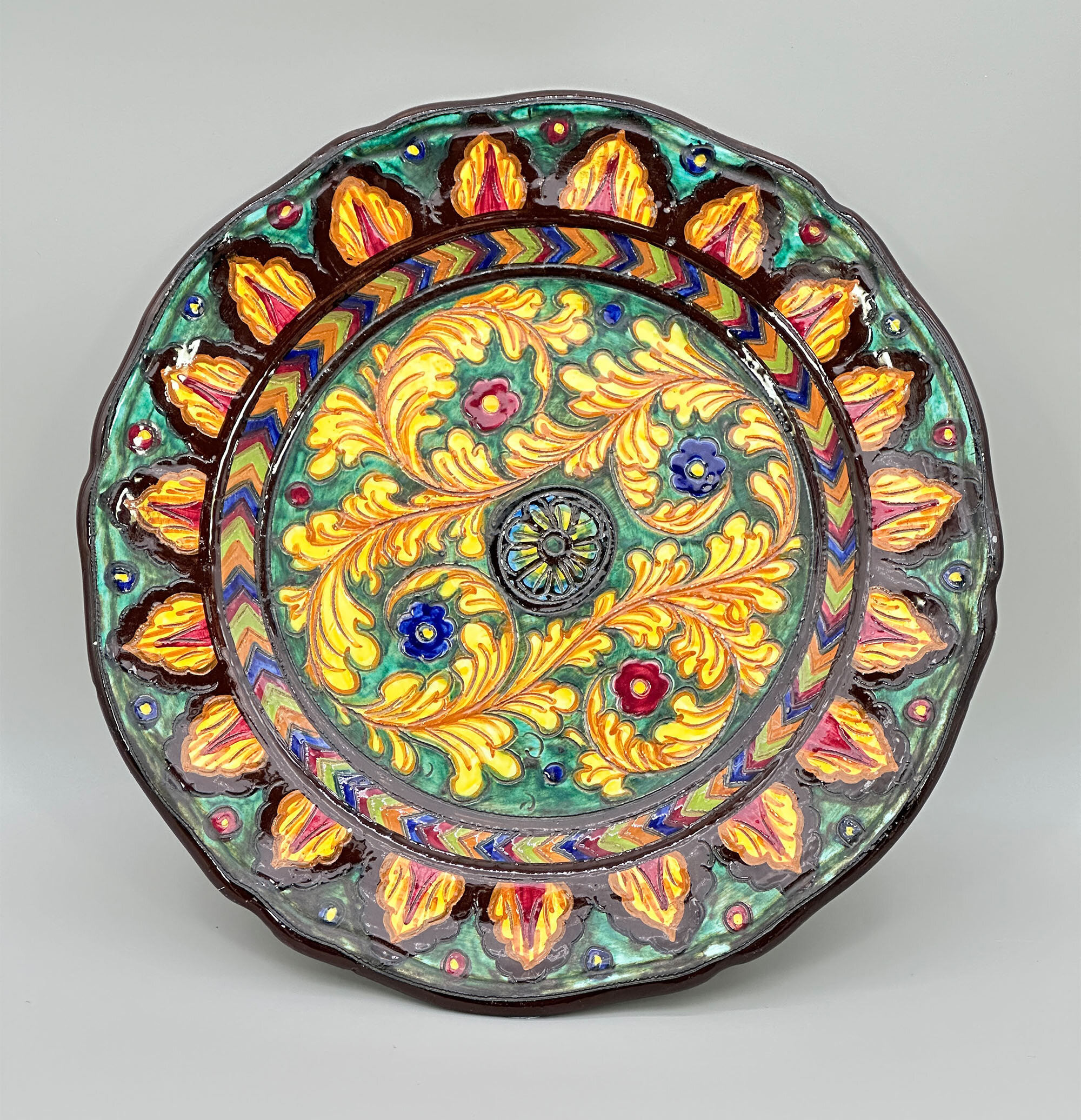
Majolica plate signed Mancinelli, Deruta, Italy, C20th
Price: £75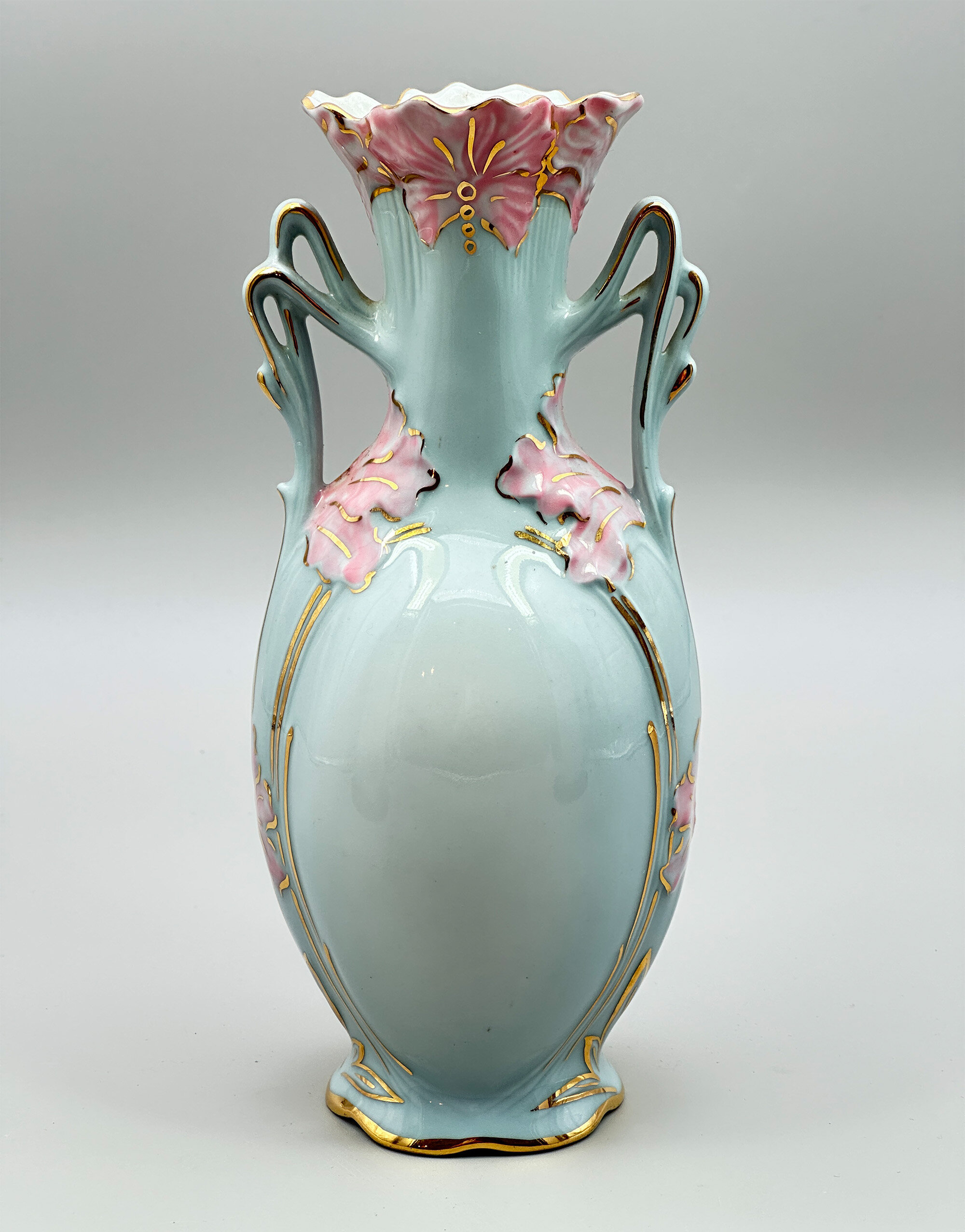
Art Nouveau style Vase, Royal Dux, late C20th
Price: £55Duxer Porzellanmanufaktur, or the Dux Porcelain Manufactory, was started in 1860 by Eduard Eichler in what was then Duchov, Bohemia, later to become part of Czechoslovakia. Production was to continue until the beginning of the second world war and beyond and their later pieces are now generally referred to by the abbreviated name, ‘Royal Dux’. The distinctive pink triangle plaque mark was first used in the late nineteenth century but appears on pieces from all dates, the version found here indicating late twentieth century work which is also confirmed by format of the stamped blue mark.
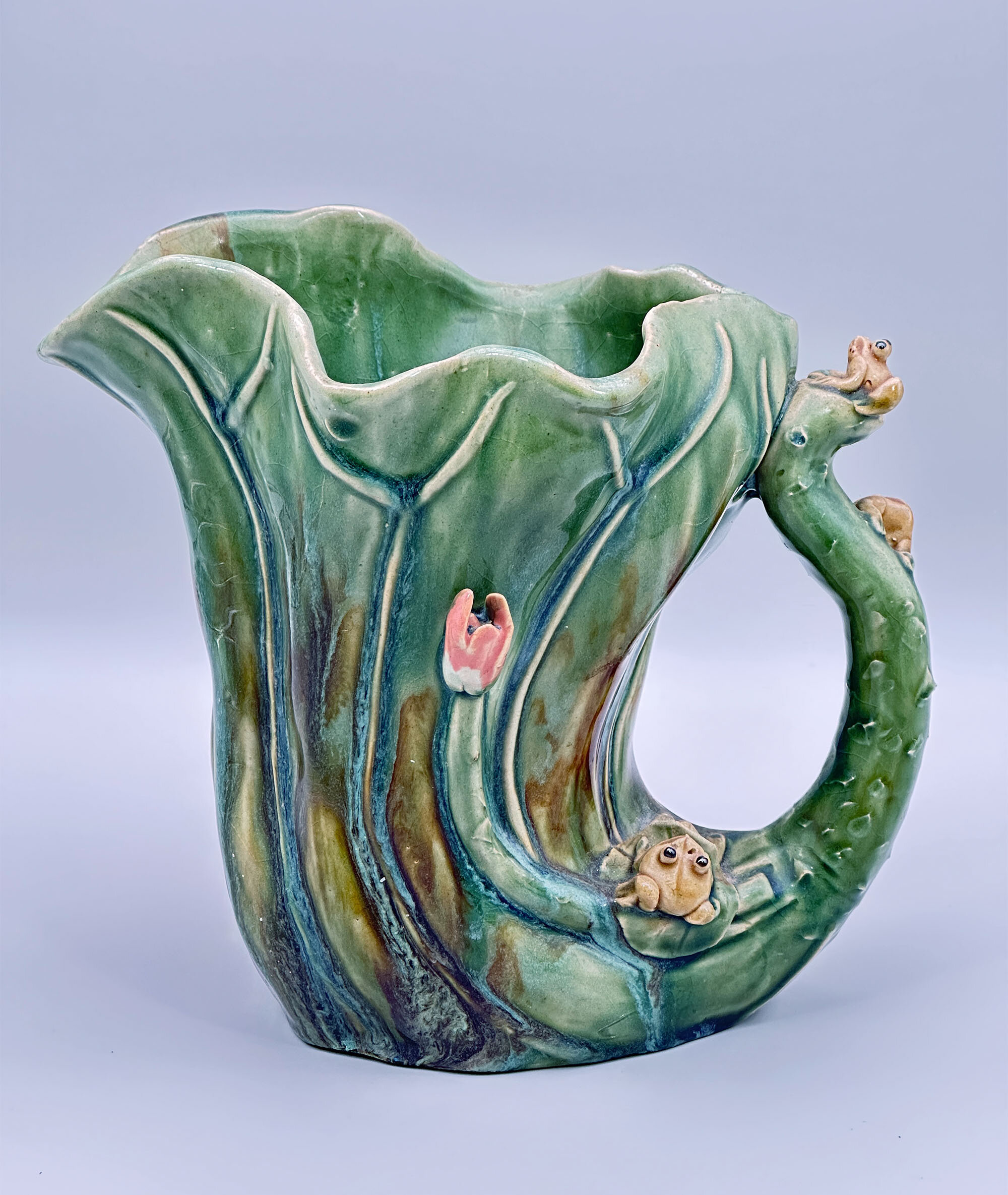
Majolica Jug decorated with Frogs, probably Portuguese, C20th
Price: £45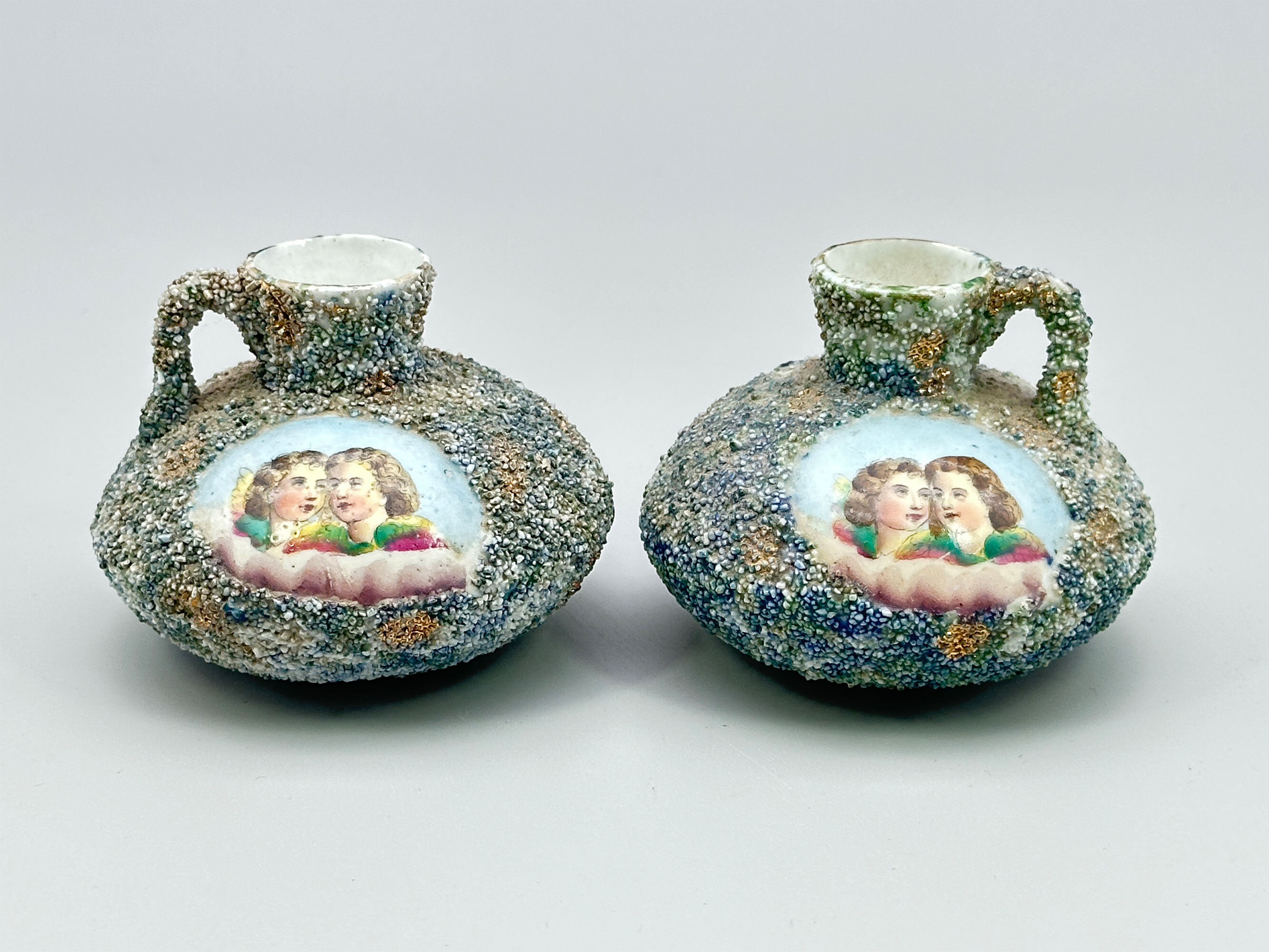
Pair of Palissy style Ewers, probably continental, first half C20th
Price: £35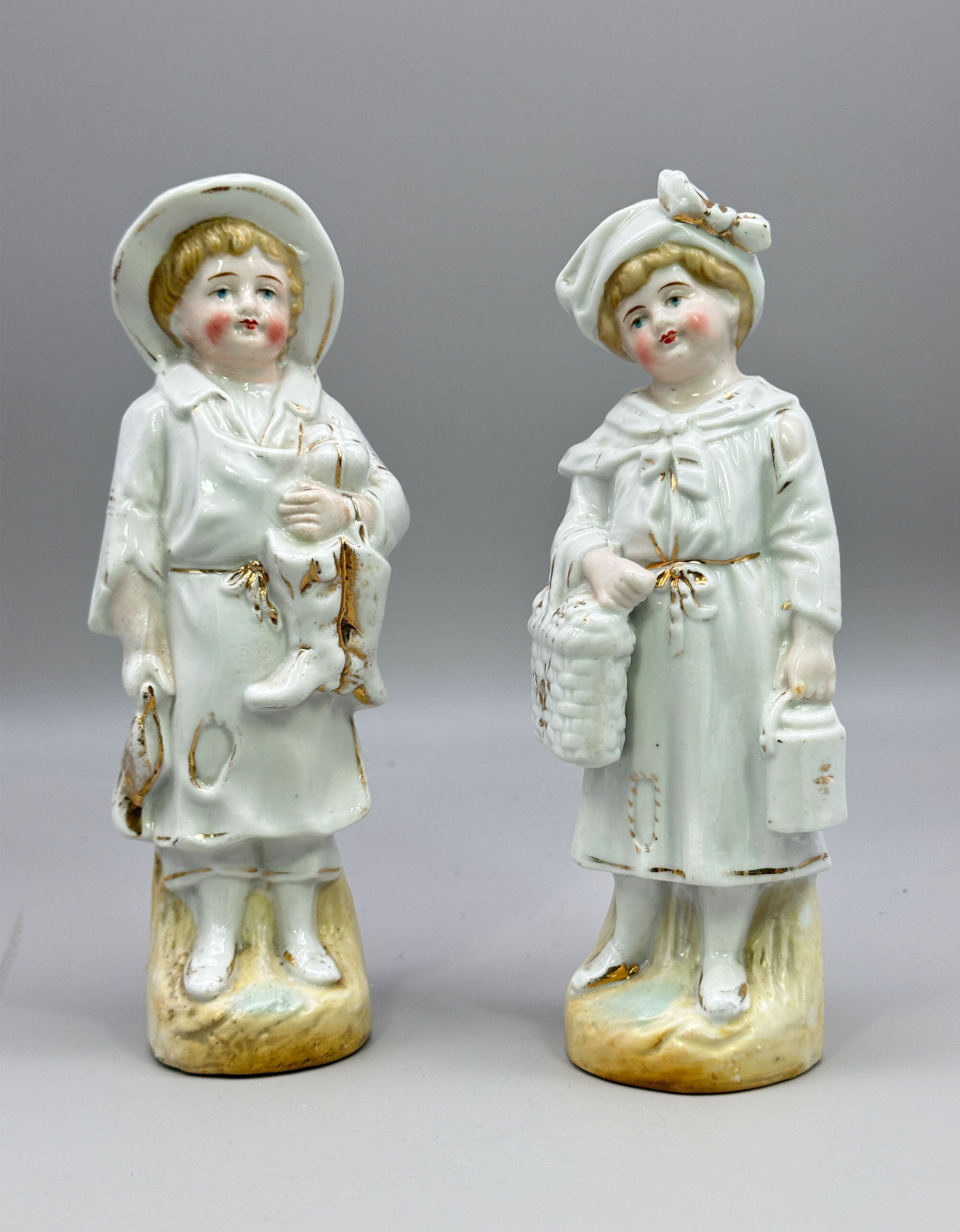
Pair of Staffordshire style figures, Boy and Girl, probably German, late C19th
Price: £75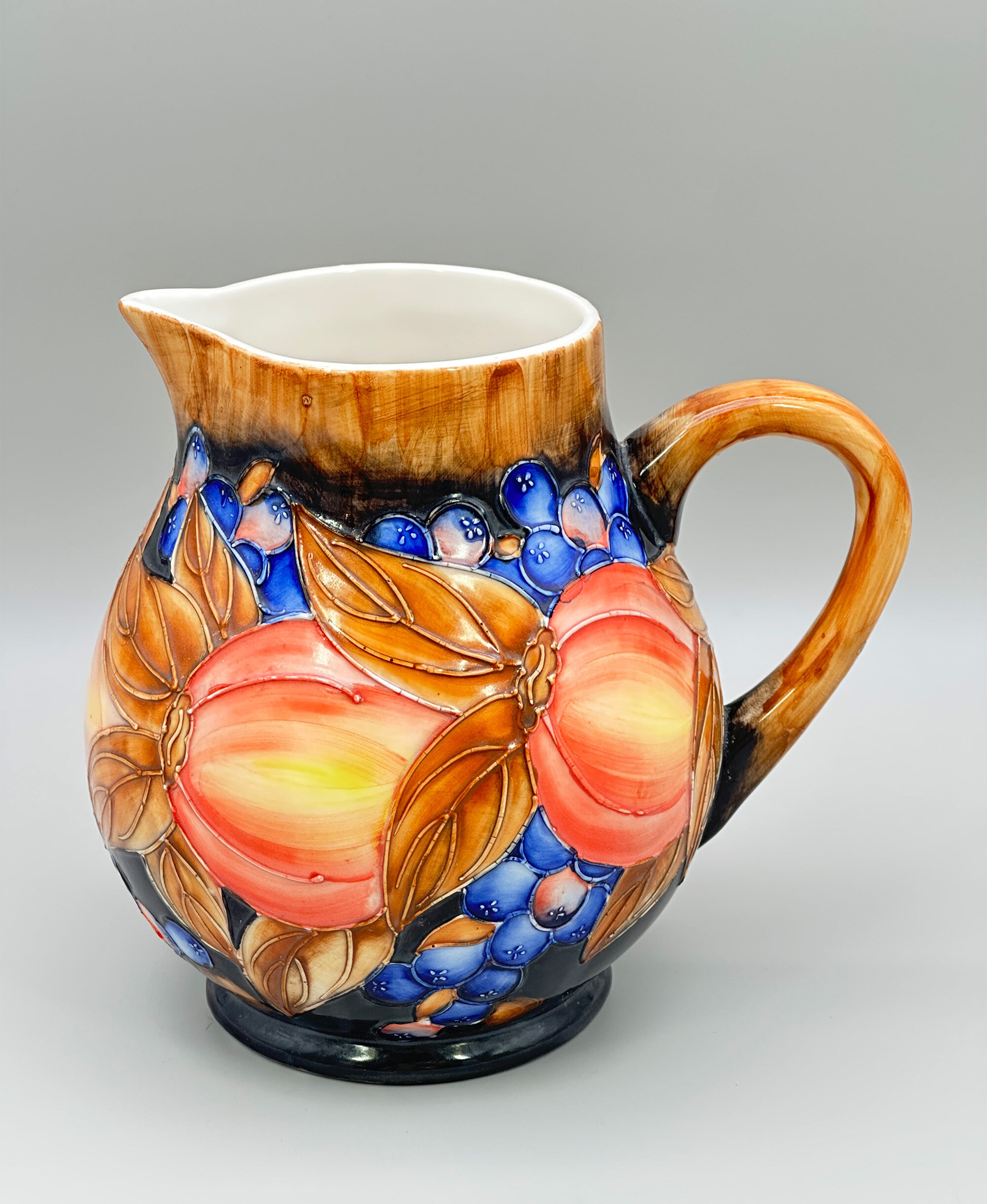
Old Tupton Ware jug with tubular floral design, Crown mark, early C21st
Price: £30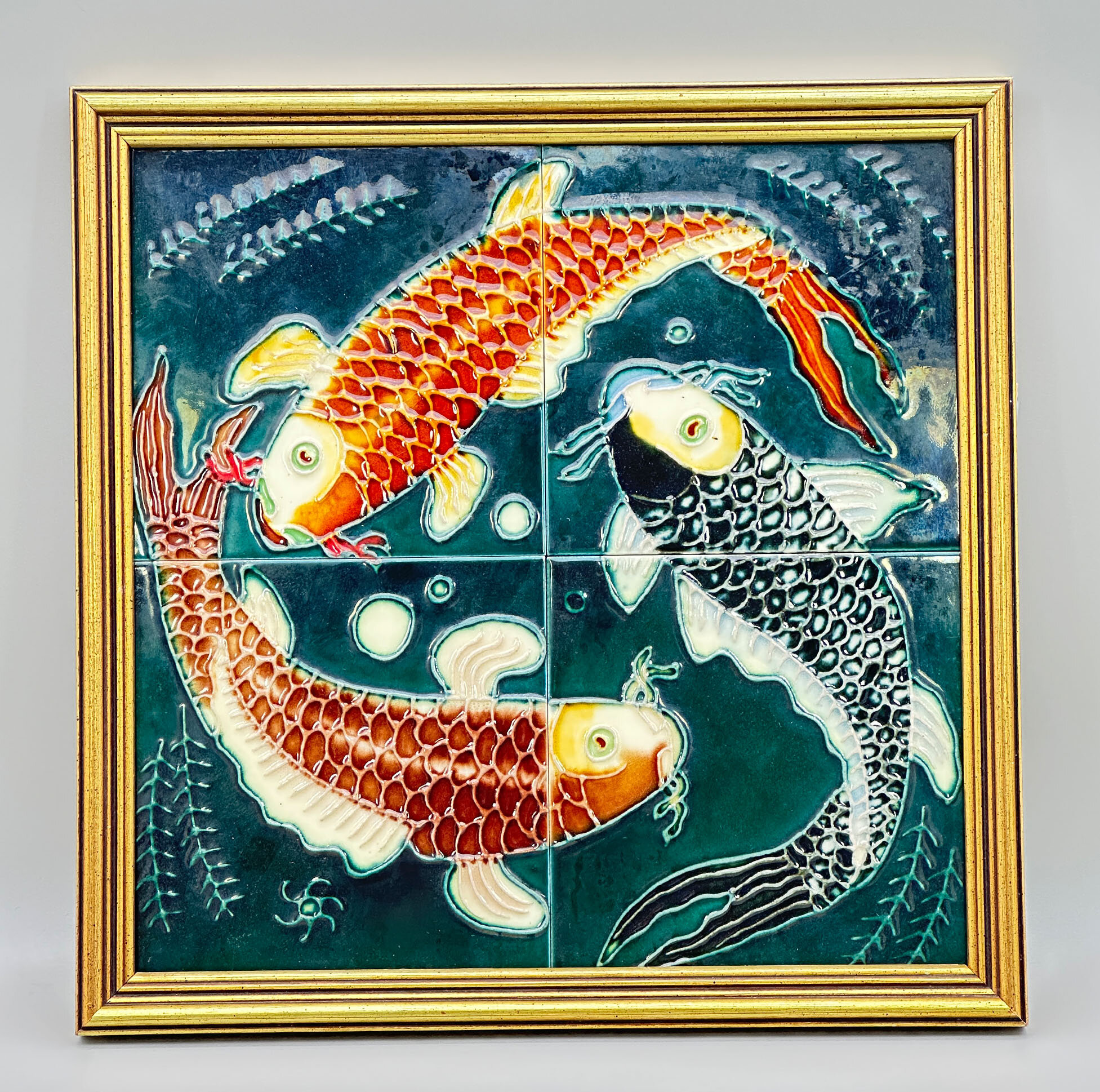
Decorative tile panel with three Koi Carp, C20th
Price: £75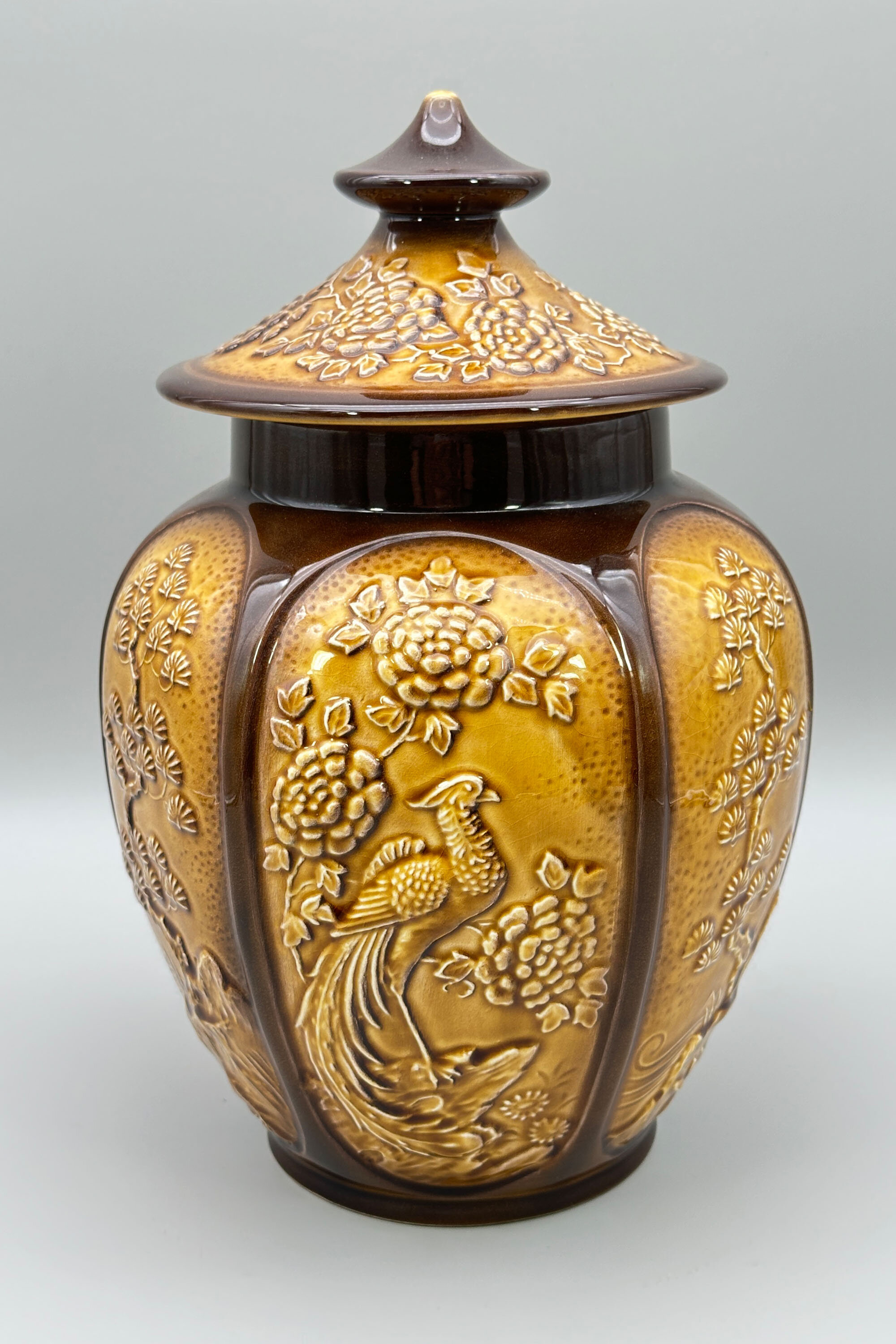
Exceptionally large Sylvac Jar and Cover, Canton pattern, 1970s
Price: £75The format of the label (the complete version can be seen in image 9) dates this piece to the 1970s The design here with its Oriental influence and often termed ‘Canton’ was one of the most successful produced by Sylvac in the post war years. It was made in a variety of colourings and a variety of sizes, this example being exceptionally and unusually large making it a striking decorative accessory for a modern interior.
‘SylvaC’ (the name was written with a capital ‘C’ after registration of the trademark in 1938) was a trade name of Shaw and Copestake, a company formed by Mr. William Shaw and a Mr. Copestake around 1900. Mr. Copestake sold his shares to a Mr. Richard Hull after about six months of business and this partnership continued until Mr. Hull’s death in 1935. He was succeeded by his son, Mr. Richard Hull junior. In the following year, the business became a limited company. Various mergers and acquisitions followed and in the 1950s new premises were built and production expanded considerably continuing until the early 1980s when changing markets and increased competition forced the company into liquidation.
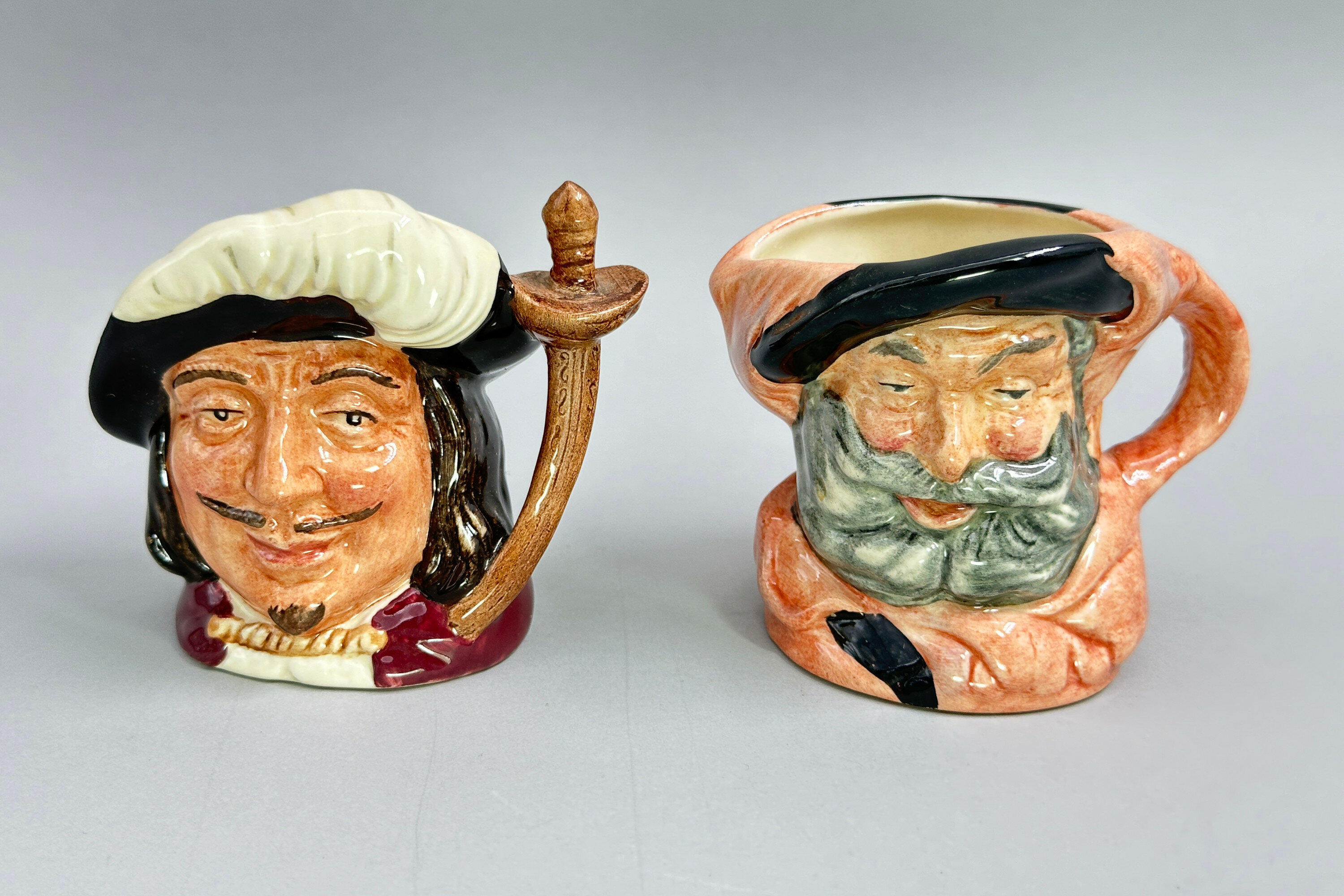
Two Royal Doulton miniature Toby mugs - Porthos and Falstaff, 1940s
Price: £20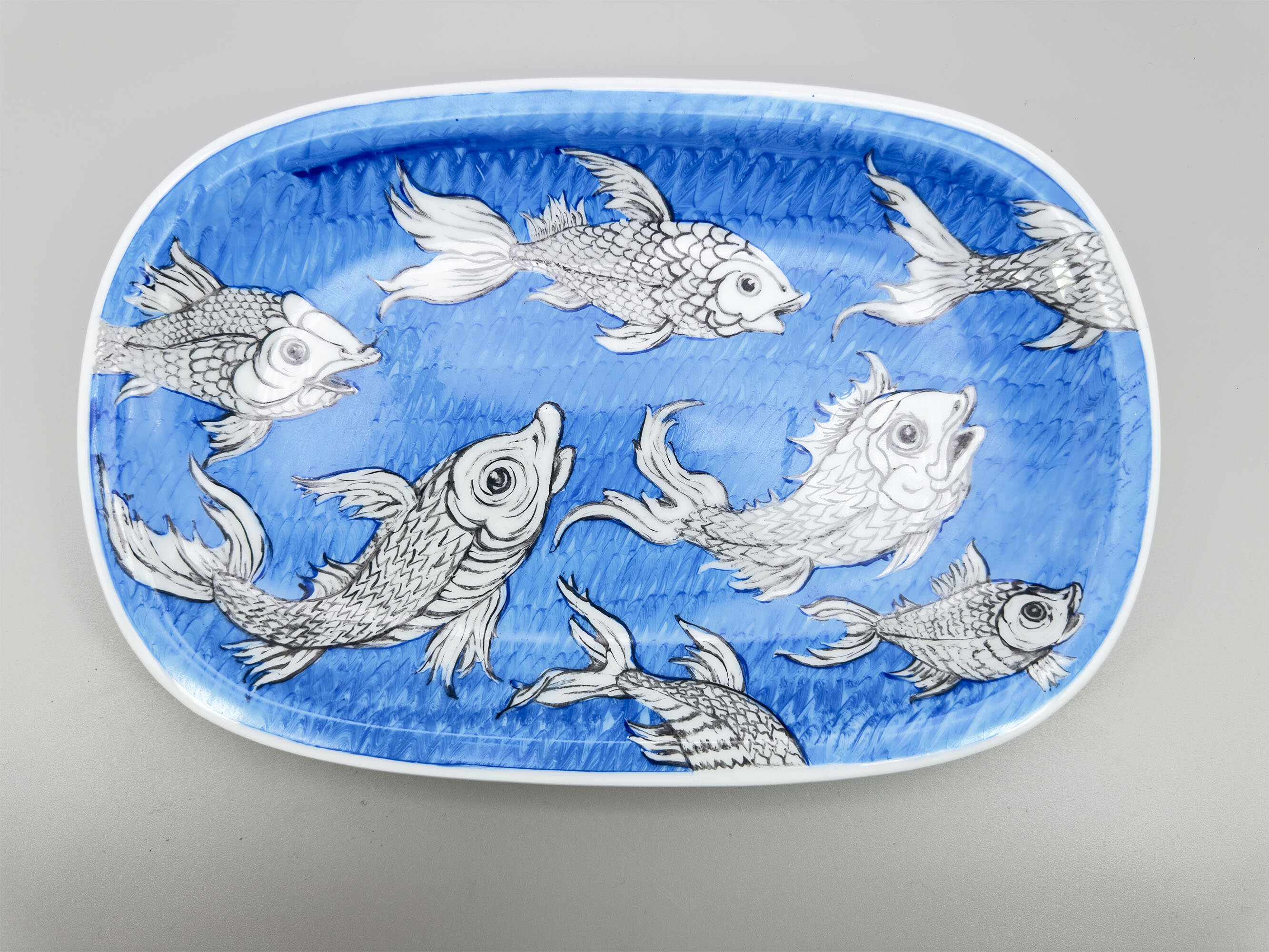
Oblong Dish decorated Fish, Bareuther Waldwassen, Germany, dated 1995
Price: £25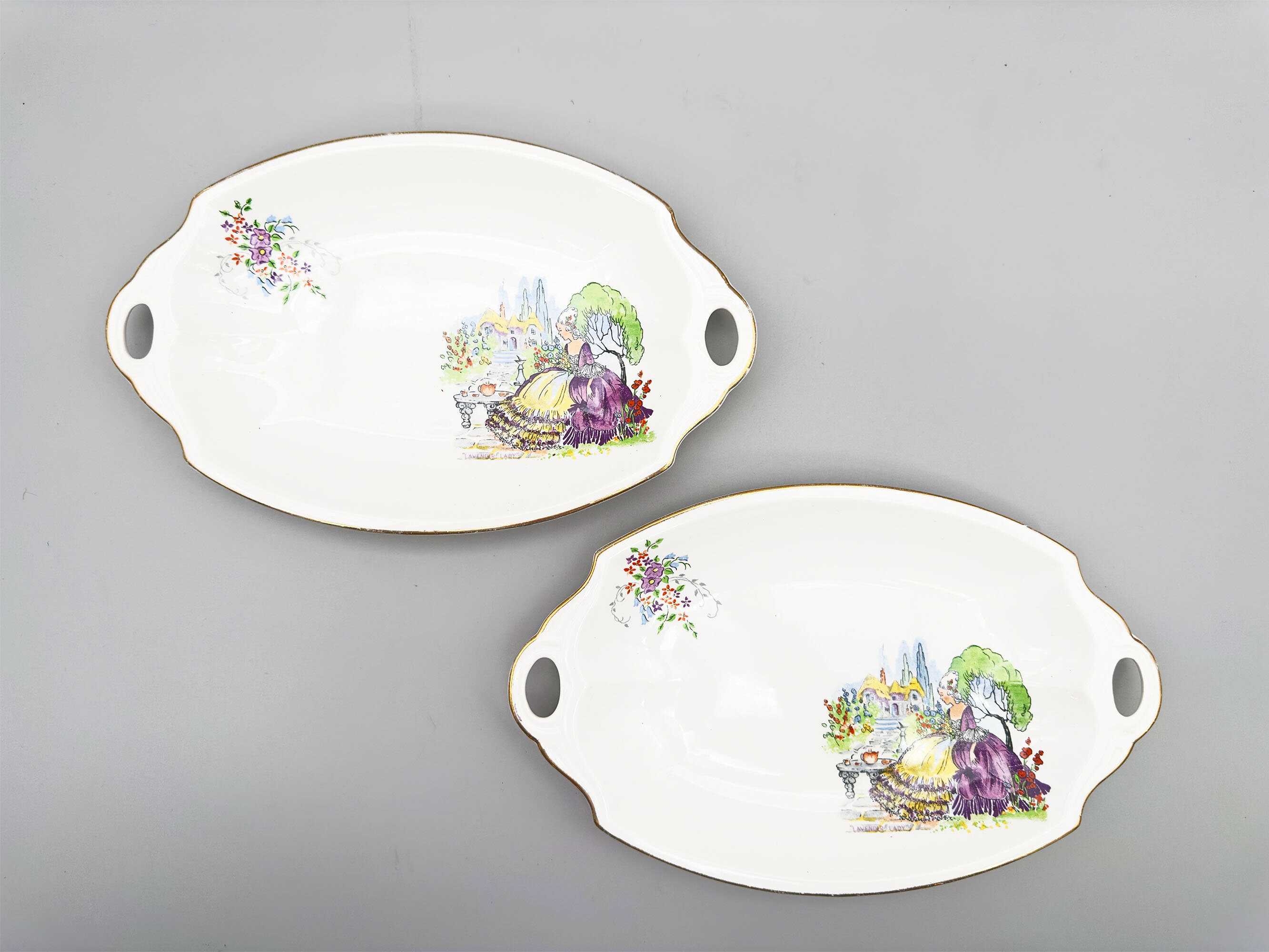
Pair of oval dishes with handles decorated lady in crinoline dress, English mid C20th
Price: £25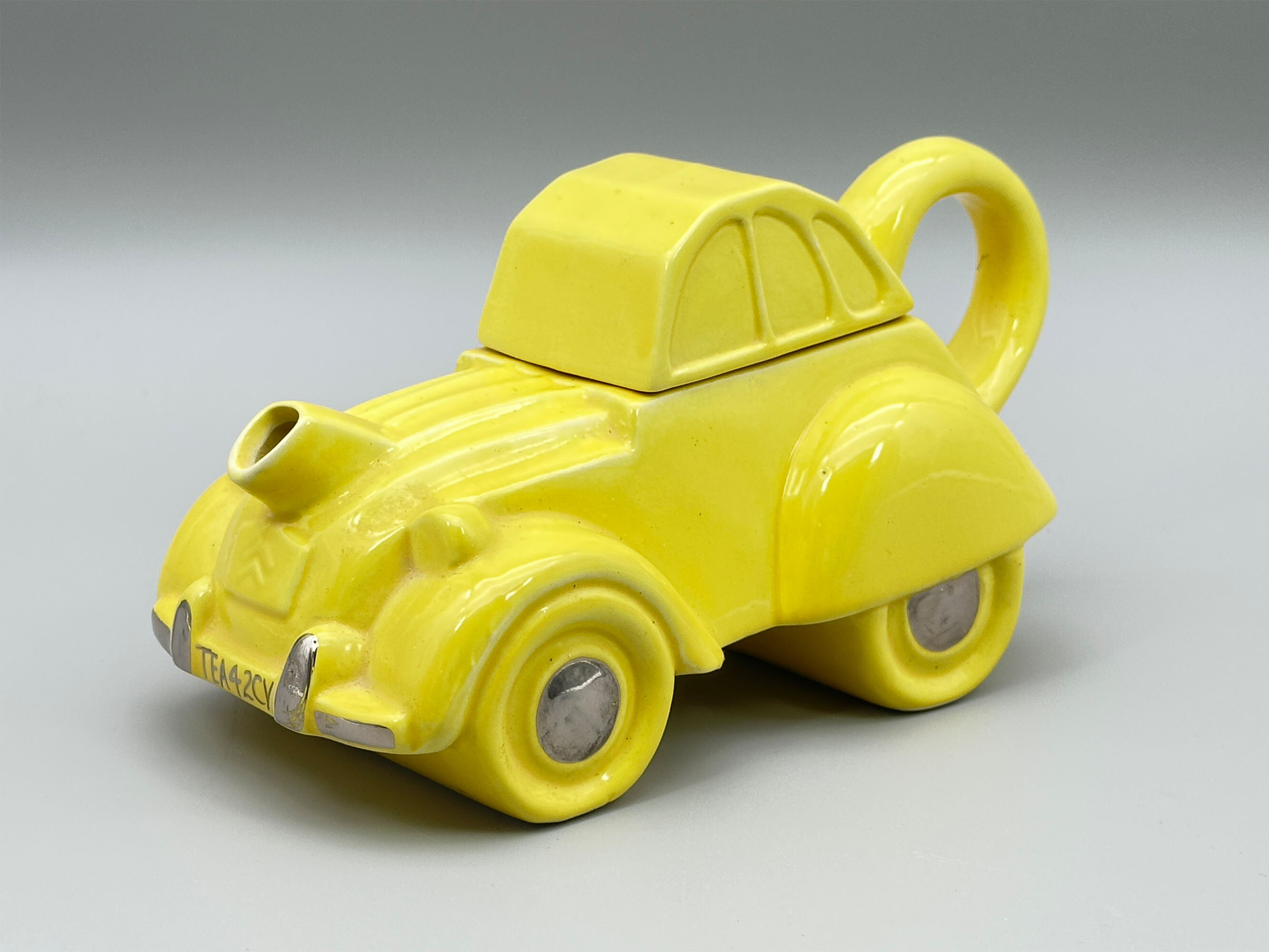
Yellow Citroen 2CV Teapot by Andy Titcomb, signed and dated, 1990
Price: £55‘I worked with Paul Cardew in his first business Sunshine Ceramics from 1978 to 1983. After a number of years making and decorating all manner of odd shaped ashtrays, punk mugs and Nat West piggy banks, I left to concentrate on my own work. I made a range of brooches which were selected by the Design Centre. In 1983 with a converted pigsty as a workshop, I made my first teapot...a black and white harlequin. Encouraged by The Teahouse in Covent Garden London I began to make many more teapots.’
By 1990, he had deserted the pigsty and had a studio in North Cornwall where he continued production until 2016 when ‘I decided that there was too much “stuff” in the world without me adding to it, so I retired from all things ceramic and gave my materials and other equipment to other potters.’
Titcomb’s grandmother owned a yellow ‘Sadler’ racing car teapot, a classic design from the 1930s which is much sought after today (see image 11) and this inspired him to make his own version in the form of a Citroen 2CV, although he also produced a model copying the Volkswagen ‘Beetle’. This reinterpretation of the 1930s original, made in 1990 soon after the move to Cornwall has great charm of its own and is as equally collectible as its prototype.