Figure of a Bear with hoop, Konakovo Faience Factory, USSR, marked, mid C20th
Price: £45
Egg cup holder, Royal Bonn Porcelain, Germany, marked, early C20th
Price: £55The firm Royal Bonn had its origins in the eighteenth century when by order of the Elector of Cologne, Clemens August of Cologne, the factory Kurfürstliche Fayencerie Poppelsdorf (Poppelsdorf Faience Fabrique) was founded in 1755 to discover the secret recipe of porcelain. Two years later, when no results had been achieved, Clemens August withdrew his support and there began a long period of multiple and varying ownerships of the business culminating in the involvement of the Mehlem brothers, Paul Joseph Mehlem and Everhard Joseph Mehlem, in 1836, who renamed the business after their own name, eventually using that of their Father, Franz Anton. After the death of the last remaining member of the family, Everhard, in 1865, the business was taken over yet again, still though retaining the family name, until it was sold to Villeroy and Boche in 1920. Shortly after this, the production of fine porcelain ceased and the factory closed in 1931.
The form of the mark here was used between 1885 and 1920 and this set was probably made in the early years of the twentieth century. The quality of the porcelain is easily appreciated and this is a highly decorative set which could also have a practical value today.
Stoneware Goblet, Tremar Pottery, signed, 1960s/1970s
Price: £25Tremar Pottery was started in the early 1960’s by Roger and Doreen Birkett and is named after the village it was situated in, situated in East Cornwall. The pieces produced were rustic in effect and drew on the inspiration of earlier Celtic work native to the region but also displayed dexterity of craftsmanship. Demand was strong and the business grew and expanded until the recession of the early 1980s forced it to close. Nearly all the pieces were marked and it is the earlier ones that have the impressed mark seen here, dating this goblet with its clear links to the Celtic style to the 1960s or early 1970s. Perhaps part of an original set with a matching jug, it remains as a modest reminder of a short lived but highly successful Cornish firm.
Ewenny Pottery Beaker, signed, late C20th
Price: £25There has been a pottery at the small Welsh town of Ewenny since 1610, the area around being, at the time, a fertile source of clay. In the early 1800s Evan Jenkins married Mary, the daughter of then owner John Morgan, and this began a period of ownership by the Jenkins family which continues today, the studio and shop being run by Alun Jenkins and his daughter Caitlin, who is the eighth generation member of the business. Their mark can be seen at ‘British Studio Potters’ Marks’ by Eric Yates-Owen and Robert Fournier (2nd edition 2005 p157). Production has tended to concentrate on modest utilitarian items, hand potted and finished with the distinctive glazes for which the studio is known which involve dipping the pot in one glaze adding another with the splash technique and firing the item so that the two glazes fuse. The effects seen on this beaker are typical of their work as is also the clear evidence of hand throwing. Ewenny pieces are made and sold today, but the current catalogue does not list items exactly similar to this, so a late twentieth century dating is the most likely.
Primitive studio pottery Flask and Cover, signed, possibly Allison Weightman, C20th
Price: £45
Broadstairs Pottery Bowl and Cover, signed, 1968-1983
Price: £45Broadstairs Pottery was founded by David White in 1968 as a successor to an earlier firm Thanet Pottery. For the mark, see ‘British Studio Potters’ Marks’ by Eric Yates-Owen and Robert Fournier (2nd edition 2005 p534). White worked there with assistants, some of whose initials appear on the pieces produced, until 1983 when he closed to business to concentrate on his own work, an example of which can be seen elsewhere in this sale. Both the incised geometric bands and the pronounced ridging effects are hallmarks of the firm’s output and this bowl and cover, marked only with the factory name, is a classic example of its productions.
Ewenny Pottery Jug, signed, late C20th
Price: £25There has been a pottery at the small Welsh town of Ewenny since 1610, the area around being, at the time, a fertile source of clay. In the early 1800s Evan Jenkins married Mary, the daughter of then owner John Morgan, and this began a period of ownership by the Jenkins family which continues today, the studio and shop being run by Alun Jenkins and his daughter Caitlin, who is the eighth generation member of the business. Their mark can be seen at ‘British Studio Potters’ Marks’ by Eric Yates-Owen and Robert Fournier (2nd edition 2005 p157). Production has tended to concentrate on modest utilitarian items, hand potted and finished with the distinctive glazes for which the studio is known which involve dipping the pot in one glaze adding another with the splash technique and firing the item so that the two glazes fuse. The effects seen on this jug are typical of their work as is also the clear evidence of hand throwing. Ewenny pieces are made and sold today, but the current catalogue does not list items exactly similar to this, so a late twentieth century dating is the most likely.
Ewenny small vase
Price: £45There has been a pottery at the small Welsh town of Ewenny since 1610, the area around being, at the time, a fertile source of clay. In the early 1800s Evan Jenkins married Mary, the daughter of then owner John Morgan, and this began a period of ownership by the Jenkins family which continues today, the studio and shop being run by Alun Jenkins and his daughter Caitlin, who is the eighth generation member of the business. Their mark can be seen at ‘British Studio Potters’ Marks’ by Eric Yates-Owen and Robert Fournier (2nd edition 2005 p157). Production has tended to concentrate on modest utilitarian items, hand potted and finished with the distinctive glazes for which the studio is known which involve dipping the pot in one glaze adding another with the splash technique and firing the item so that the two glazes fuse. The effects seen on this vase are typical of their work as is also the clear evidence of hand throwing. Ewenny pieces are made and sold today, but the current catalogue does not list items exactly similar to this, so a late twentieth century dating is the most likely.
French faience style amphora form Vase marked Squire Noyers, late C20th
Price: £45
Studio Pottery Bowl with Yukishino style glaze, signed M Lazenbury, C20th
Price: £35
Studio Pottery Shallow Bowl with handles, signed MJ, possibly French C20th
Price: £55
Majolica Jug decorated with Frogs, probably Portuguese, C20th
Price: £45
Doulton Lambeth Ewer, marked, late C19th
Price: £55
Sylvac sycamore leaf Vase, mid C20th
Price: £25This is an example of the naturalistic designs produced by Sylvac in the 1950s and 1960s. While they often chose to imitate tree bark, here they take their inspiration from the leaves themselves. The model occurs in various sizes and glazes including green and dark brown but the mustard colourings are, perhaps, the most pleasing. The smaller versions seem to be marked ‘4215’ as opposed to the numbers seen here ‘4206’.
‘SylvaC’ (the name was written with a capital ‘C’ after registration of the trademark in 1938) was a trade name of Shaw and Copestake, a company formed by Mr. William Shaw and a Mr. Copestake around 1900. Mr. Copestake sold his shares to a Mr. Richard Hull after about six months of business and this partnership continued until Mr. Hull’s death in 1935. He was succeeded by his son, Mr. Richard Hull junior. In the following year, the business became a limited company. Various mergers and acquisitions followed and in the 1950s new premises were built and production expanded considerably continuing until the early 1980s when changing markets and increased competition forced the company into liquidation.
Pair of Tower of London Vases, New Hall Pottery, first half C20th
Price: £45The mark is for New Hall Pottery Co Ltd which traded in Hanley, Stoke-on-Trent, from 1899 to 1956. During the early years of the twentieth century, the firm was mainly known for the production of toilet sets and jugs, in 1908 producing and selling more than 50,000 toilet sets of the Waverley shape alone. After the First World War, demand for these pieces slackened and the firm turned towards producing dinner and hotel wares. Trading was difficult in the years before the Second World War but production was allowed to continue during it, mainly for supplying the armed forces, and was able to return to normal afterwards with an overseas trade nearly exceeding that of past years until the firm ceased trading in 1956.
A variety of marks were used of which the one seen here was the simplest version. Since it also appears on toilet sets, a similar date of production seems likely and perhaps these vases were a part of the attempt to diversify as the demand for the staple product of the business was beginning to decline. Certainly, while modest pieces in themselves, they do have something of an ‘Art Deco’ look and can be regarded as amusing decorative items today.
Oriental style studio pottery Jarlet signed HA, C20th
Price: £35
Studio Pottery Vase with Cizhou style glaze, signed JE possibly for John Egerton, C20th
Price: £55
Experimental Bowl for glazes marked TESTS and signed JD
Price: £25
Money bank in the form of a Fish, marked HAK for Kähler Ceramics, Denmark, mid C20th
Price: £110The mark here shows that this piece was made by the celebrated Danish firm Kähler who have been producing ceramics for over one hundred and eighty years. Herman August Kähler was a Danish ceramic designer and manufacturer who ran the Kähler ceramic factory (Kählers Keramiske Værksted) in Næstved, Denmark which he took over from his Father with his brother in 1872, then running it himself from 1875 when he built a new factory on the town’s outskirts. Kähler was responsible for the introduction of a ruby red glaze which soon became extremely popular and the factory began to produce many well formed decorative pieces which enjoyed a wide reception and were exhibited at the Great Nordic Exhibition held in Copenhagen in 1888 and at the Exposition Universelle held the following year in Paris. Kähler died in 1917 but the firm continued, at first under the direction of his son Herman Hans Christian Kähler and then by future generations of the family who continued to use the cipher mark designed by their ancestor, Hermann August.
Kähler’s pieces naturally followed the fashions of the times and this fish has very much a mid century feel, probably dating therefore to the 1950s or 1960s. Although the designer is not known this model is highly collectible now but not necessarily of much practical value. While there is a clear entry point for coins, extracting them appears to involve breaking the container apart…
Herend porcelain Trinket dish/Ash tray, Rothschild Bird Pattern, early C20th
Price: £45This dish was made by the Herend Porcelain factory. Founded in Hungary in 1826 it almost immediately enjoyed enormous popularity with wealthy customers including members of the European aristocracy. Production continued into the twentieth century through nationalistion in 1948 and reprivatisation in 1993 and continues to the present day. Many of the patterns created in the nineteenth century are still reproduced. The design here is known as ‘Rothschild Bird’ doubtless from its first purchasers all those years ago. The format of the mark allows a fairly close dating to the years 1915-1930, making this an earlier version of the model than many others which appear on the market today.
Old Tupton Ware jug with tubular floral design, Crown mark, early C21st
Price: £30
Bursley Ware Coffee Service, Bacchus pattern, 1920s
Price: £220Bursley Ltd was the creation of Frederick Read who, in collaboration with Harry Wood, bought the Crown Pottery works in 1920 and began manufacturing art pottery there under this new name. Previous to this Read had been employed as the Art Director for Wood and Sons, a firm which traced its origins back to the mid nineteenth century and of which Harry Wood, a descendant of the founders, was to become Chairman in 1921. Bursley Ltd, while independent, was a subsidiary of Wood and Sons who also had associations with other potteries in the area. Frederick Read was soon joined by his daughter Charlotte, whose designs became famous, but the designs and pattern here may well have been his own creation. Since the marks include the wording ‘registration applied for’, this service must have been one of Bursley’s first productions and it may have been taken over from Wood and Sons themselves since other pieces are found in identical shapes and decoration and titled ‘Bacchus’ but with a mark for H.H.&Co Ltd, the early name, used from 1913 to 1922 of the firm Hales Hancock and Godwin who were agents and retailers for various of the Staffordshire potteries including Wood and Sons.
There is, then, a slightly complex history here but we most likely have an early example of Read’s designs for his newly established business which went on, with the help of his daughter, to produce many innovative pieces of art pottery in the 1920s and 1930s.
Sizes
(i) Coffee Pot : Ht (max) 20.3cm, Width (max) 19cm, Depth (max) 10.5cm, Base 8cm (ii) Sugar Basin : Ht (max) 6cm, Width (max) 10cm, Depth (max) 7.5cm, Base 5.6cm (iii) Milk Jug : Ht (max) 11.5cm, Width (max) 10.5cm , Depth (max) 6cm, Base 5cm (iv) Coffee Can : Ht 5.2cm, Diam 5.2cm, Width (max) 7cm [One with three minute chips at the top] (v) Saucer : Diam 11.5cm, Ht 1.8cm, Base 4.5cm
Pair of Nodding Head Figures, Chinese Emperor and Empress, Germany circa 1900
Price: £350……………………………………………………………………………………………………...................................................................................
A pair of ceramic figures depicting two Chinese figures seated cross legged, usually termed an Emperor and an Empress. They are modelled dressed in colourful and patterned robes fastened with sashes at the waist and with frill collars. The lady holds a fan and the gentleman a pipe and both hold parasols fitted to their hands by wire and with decoration to the undersides. The heads are made separately, weighted at the bottom (see images 7, 13) and have wire supports to the side which rest on wires on each side of the top interior which are secured through holes on the exterior at the front and back. When pushed, the heads then move in a most lifelike fashion. The hollow interiors are glazed white with an unglazed foot rim, but there are no marks.
So called ‘nodding head’ figures began to be exported from China to the West in the mid eighteenth century following a tradition which dated back many years before. The figures were drawn from the Court or Chinese high society and at first were made from clay or wood with painted decoration, necessarily rather delicate interior accessories. A pair can be seen in the background of a picture painted by Zoffany of Queen Charlotte (1744-1818) with her two eldest Sons depicting an interior at Buckingham house (now Buckingham Palace) and dated to 1764 (see image 15). Rather larger models, almost life size, were displayed in the Gallery of the Brighton pavilion, reflecting the passion of the Prince Regent, George IV (1762–1830) for Chinoiserie in general.
But the form was also taken up by the kilns at Jingdezhen and the decorators at Canton and ceramic ‘nodding head’ figures were soon exported too, brightly painted in the popular ‘Famille Rose’ enamels (see image 16 for a typical example from the Qianlong period, 1736-1795). Sensing the popularity of the type, European manufacturers too began to produce their own versions, rather different from the Chinese originals and usually depicting the figures seated which was much less common for the Eastern examples. The most well known examples were made by Meissen and tended to have both moving heads and hands as well (see image 17) but a less expensive version of these (see image 18) was made by the firm Ernst Bohne & Sohne, prolific manufacturers of modest ceramic ornaments for the domestic interior including the well known ‘fairing’ figurines, examples of which can be seen elsewhere on this site. There are also figures with their mark which exactly resemble the model type offered in this sale, complete with the parasol, so it is a reasonable assumption that this pair of figures can be attributed to them as well. While perhaps less grand than their companions, this pair of eastern potentates have a charm of their own and, when set in motion, are uncannily lifelike. Gilbert and Sullivan for the 21st century!
Doulton Plate from the Jackdaw of Rheims series, early C20th
Price: £45
Studio Pottery Oil Lamp, signed MP and dated 2012
Price: £25
Porcelain Figure of a Spaniel, Lomonosov, USSR late C20th
Price: £25
Studio Pottery Vase by John Jelfs, signed, late C20th
Price: £180
Studio Pottery Vessel by David White, signed DW, late C20th
Price: £180The mark is for David James White (1934-2011) who established Broadstairs Pottery with his wife in 1978 (see lot XXXX) and then sold this in 1983 to concentrate on his own work which focused on high-fired porcelain decorated with a blend of crackle glazes in a range of colours with a high sophistication of technique, see ‘British Studio Potters’ Marks’ by Eric Yates-Owen and Robert Fournier (2nd edition 2005 p534). This vessel, a form he produced in a variety of colourings of which this is perhaps one of the most pleasing, is an excellent example of his work which rivals some of the best creations of earlier Chinese potters in the standard of finish achieved.
Art Nouveau style Vase, Royal Dux, late C20th
Price: £55Duxer Porzellanmanufaktur, or the Dux Porcelain Manufactory, was started in 1860 by Eduard Eichler in what was then Duchov, Bohemia, later to become part of Czechoslovakia. Production was to continue until the beginning of the second world war and beyond and their later pieces are now generally referred to by the abbreviated name, ‘Royal Dux’. The distinctive pink triangle plaque mark was first used in the late nineteenth century but appears on pieces from all dates, the version found here indicating late twentieth century work which is also confirmed by format of the stamped blue mark.
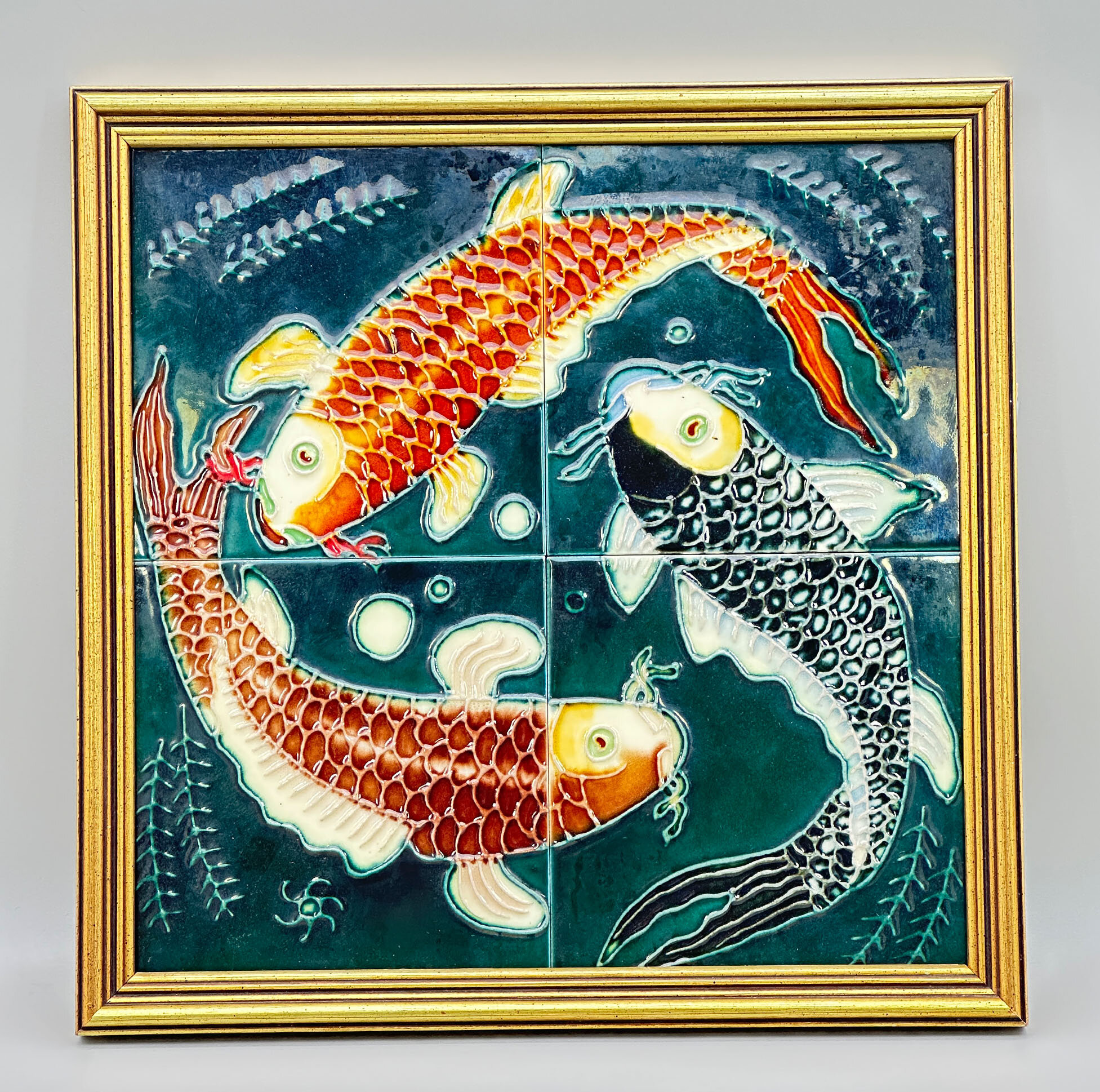
Decorative tile panel with three Koi Carp, C20th
Price: £75
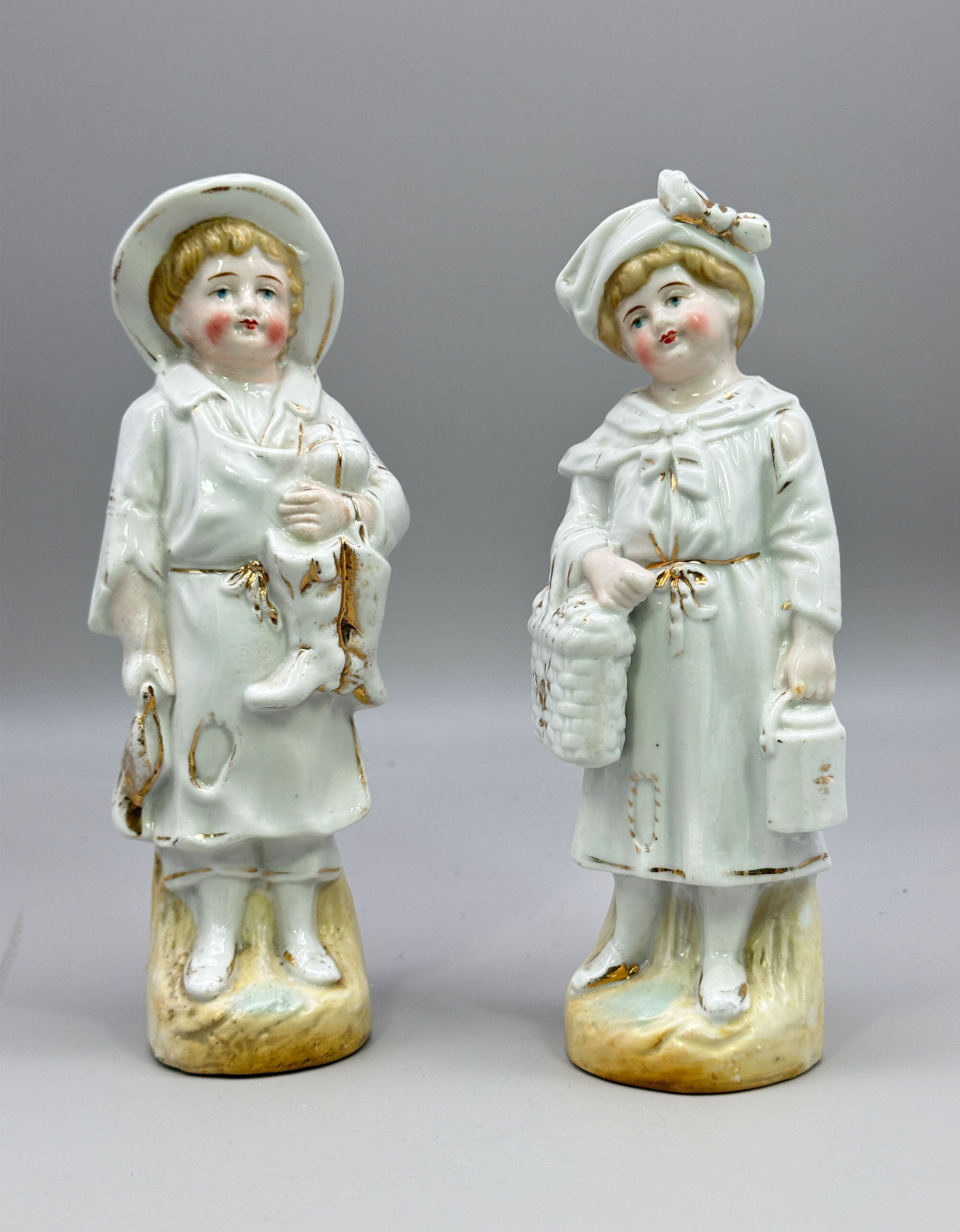
Pair of Staffordshire style figures, Boy and Girl, probably German, late C19th
Price: £75
Beswick Wall Plaque, Lady in a Hat, impressed mark 314, 1930s
Price: £150Founded in 1894 by James Beswick and his sons, the company John Bewsick Ltd became known for its output of figurines after the introduction of high fired bone china in 1934, eventually securing the rights to producing characters from the novels of Beatrix Potter and the films of Walt Disney. It was sold to Royal Doulton in 1969 who continued production until 2002, selling the pottery premises in 2003 and the rights to the name in 2004 when they were bought by Dartington Crystal who still manufacture pieces carrying the Beswick name.
This mask head bears all the characteristics of the Art Deco style and was produced in the 1930s alongside other plaques with different ladies’ head designs. Some see the actress Marlene Dietrich here, which may be fanciful. Others use the description ‘ice cream lady’ because of the twisting cut of the hair which almost resembles ice cream cones. But however described, this is a striking composition almost timeless in its appeal and survives in excellent condition with the glaze clear and free from crazing and the colours, really the most attractive of the different versions produced, bright and intact.
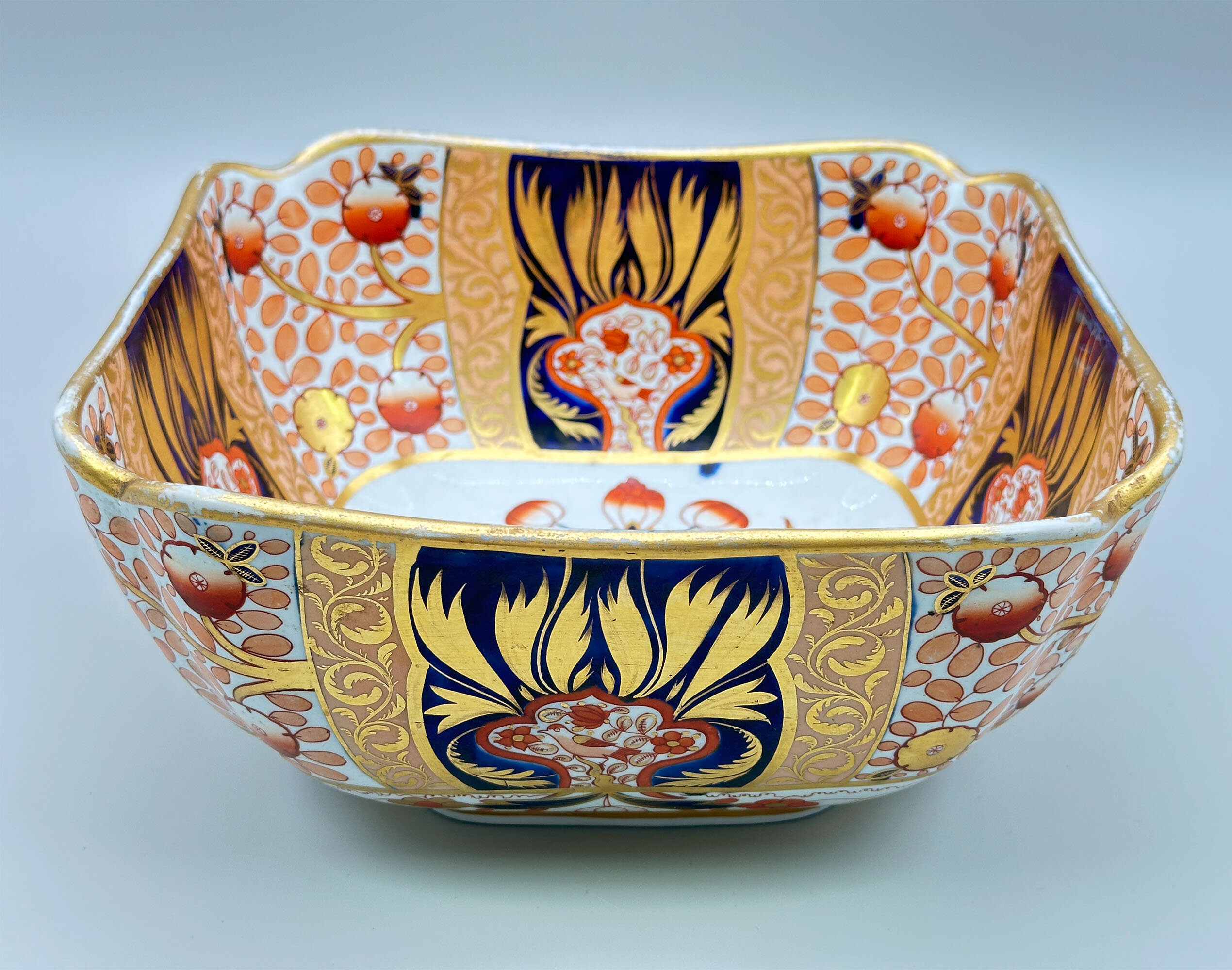
Spode Imari Salad Bowl, pattern no 1409, early C19th
Price: £450The bowl featured here is indeed marked ‘1409’ (see image 8) alongside a form of the name ‘Spode’ which dates to before 1821 (Leonard Whiter : Spode p224). It most likely derives from the service which Whiter once saw complete but has now, presumably, been dispersed. The pattern with its vivid palette of red, blue and gold and floral decoration is a lavish reinterpretation of the ‘Imari’ wares which had been exported to the West in great quantities by the Chinese in the eighteenth century and the Japanese before them. These pieces took their name from their port of export in Japan, Imari; they were actually made at Arita in the former Hizen province. Amongst the wares exported by the Chinese were extensive dinner services and their popularity caused them to be copied and imitated by many of the English potteries from early 1800s onwards, indeed a near identical and contemporary version of this pattern was produced by Coalport.
The square form bowl, indented at the corners and curving inwards towards the base, was a classic Chinese form and is usually referred to as a salad bowl. The standard Chinese dinner service would have had a pair of these, but the shape is rarely found in the English dinner wares made in imitation. Its occurrence here combined with a firmly dateable early nineteenth century pattern in an opulent design which has survived in a remarkable state of preservation makes this very much a ‘one off’ piece and a highly desirable addition to a collection of nineteenth century decorative ceramics.
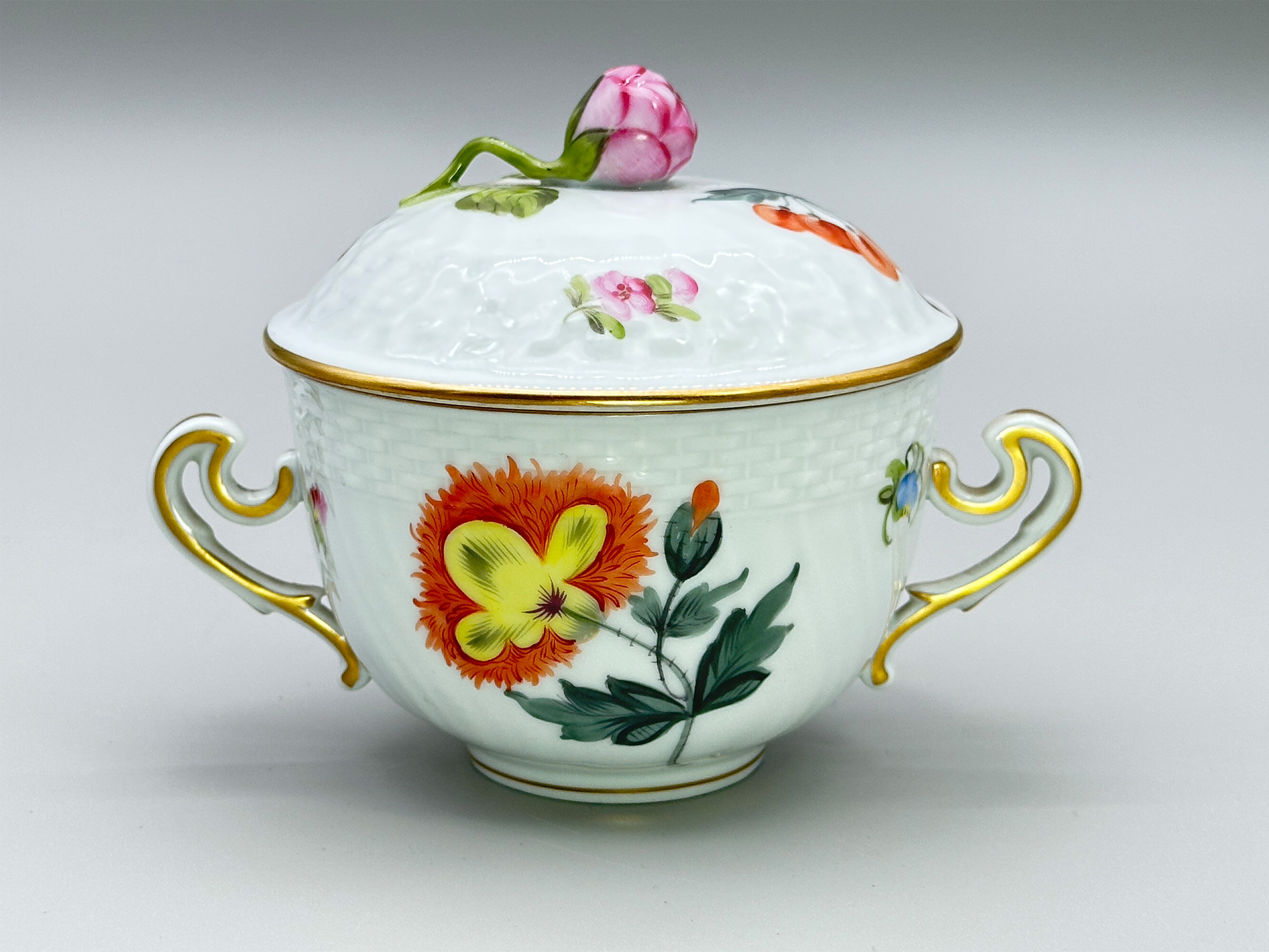
Herend écuelle and cover decorated flowers, marked, late C20th
Price: £75This écuelle and cover, possibly intended as a sugar bowl, was made by the Herend Porcelain factory. Founded in Hungary in 1826 it almost immediately enjoyed enormous popularity with wealthy customers including members of the European aristocracy. Production continued into the twentieth century through nationalistion in 1948 and reprivatisation in 1993 and continues to the present day. The designs produced in recent years often copy those of an earlier period and this is most likely the case here where resemblances can be seen to the nineteenth century productions from Meissen. The format of the mark indicates a fairly recent date of manufacture, probably in the later years of the twentieth century, but the quality of the execution is in no way diminished and the modelling of the finial in particular of the highest standard.