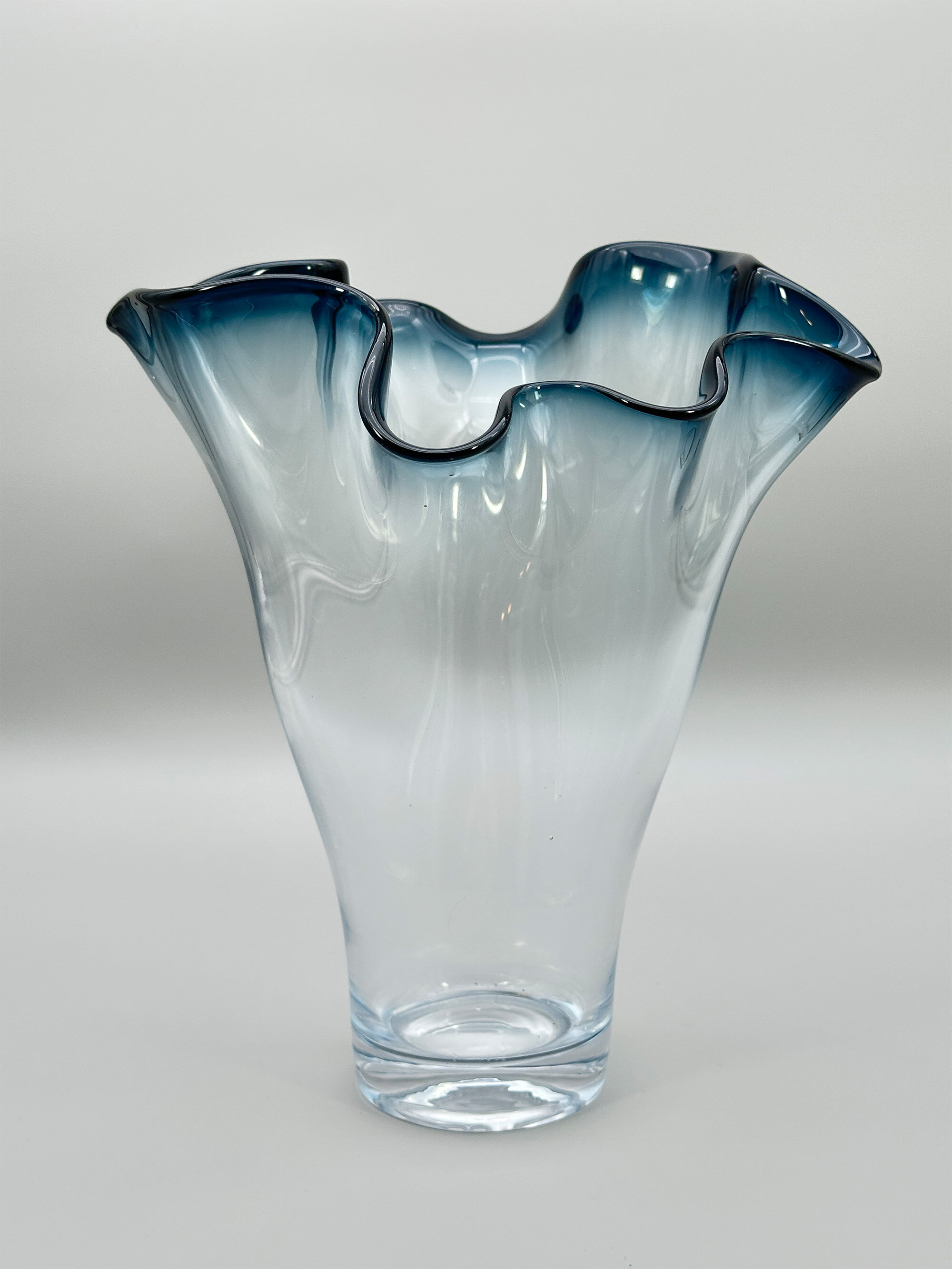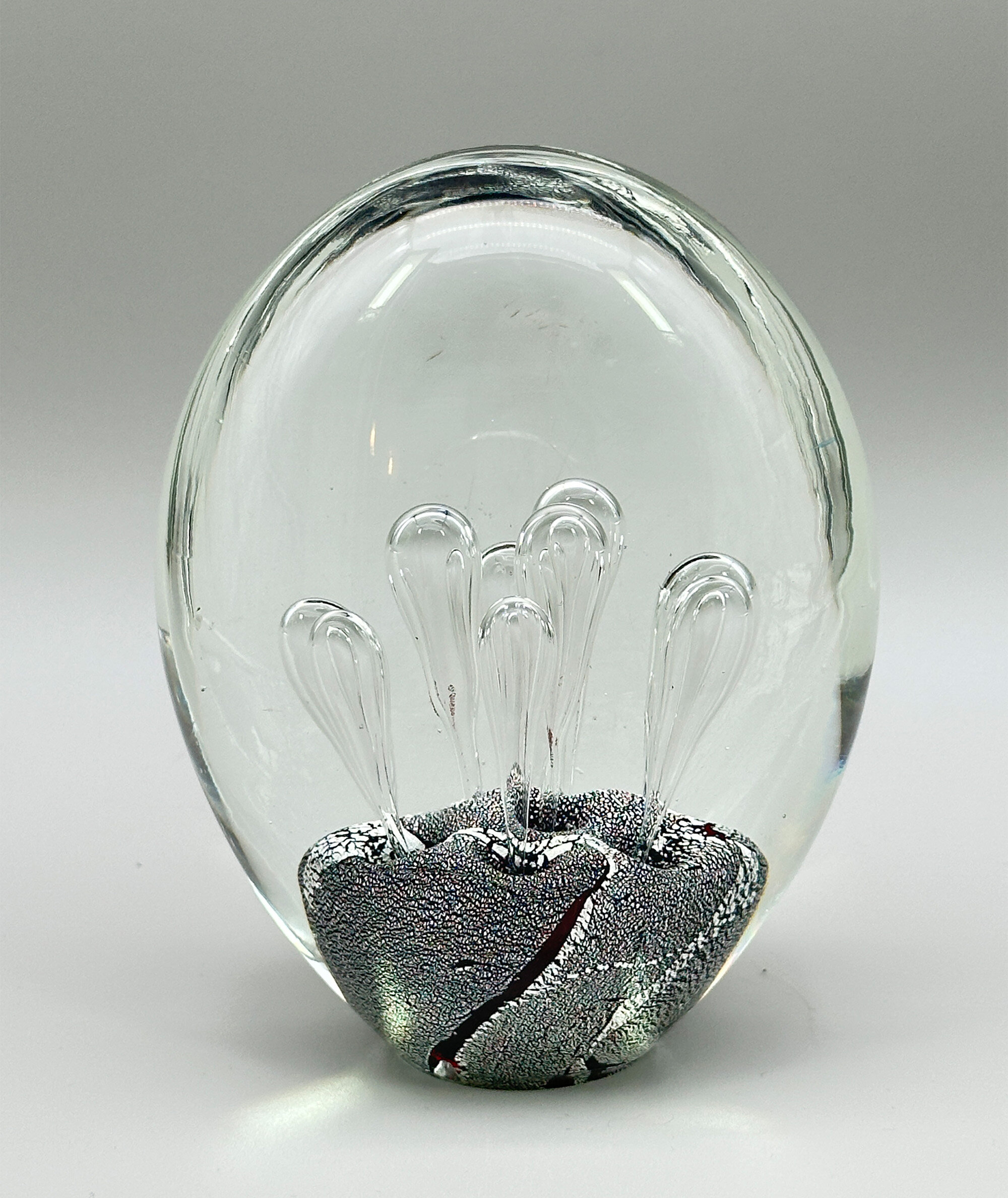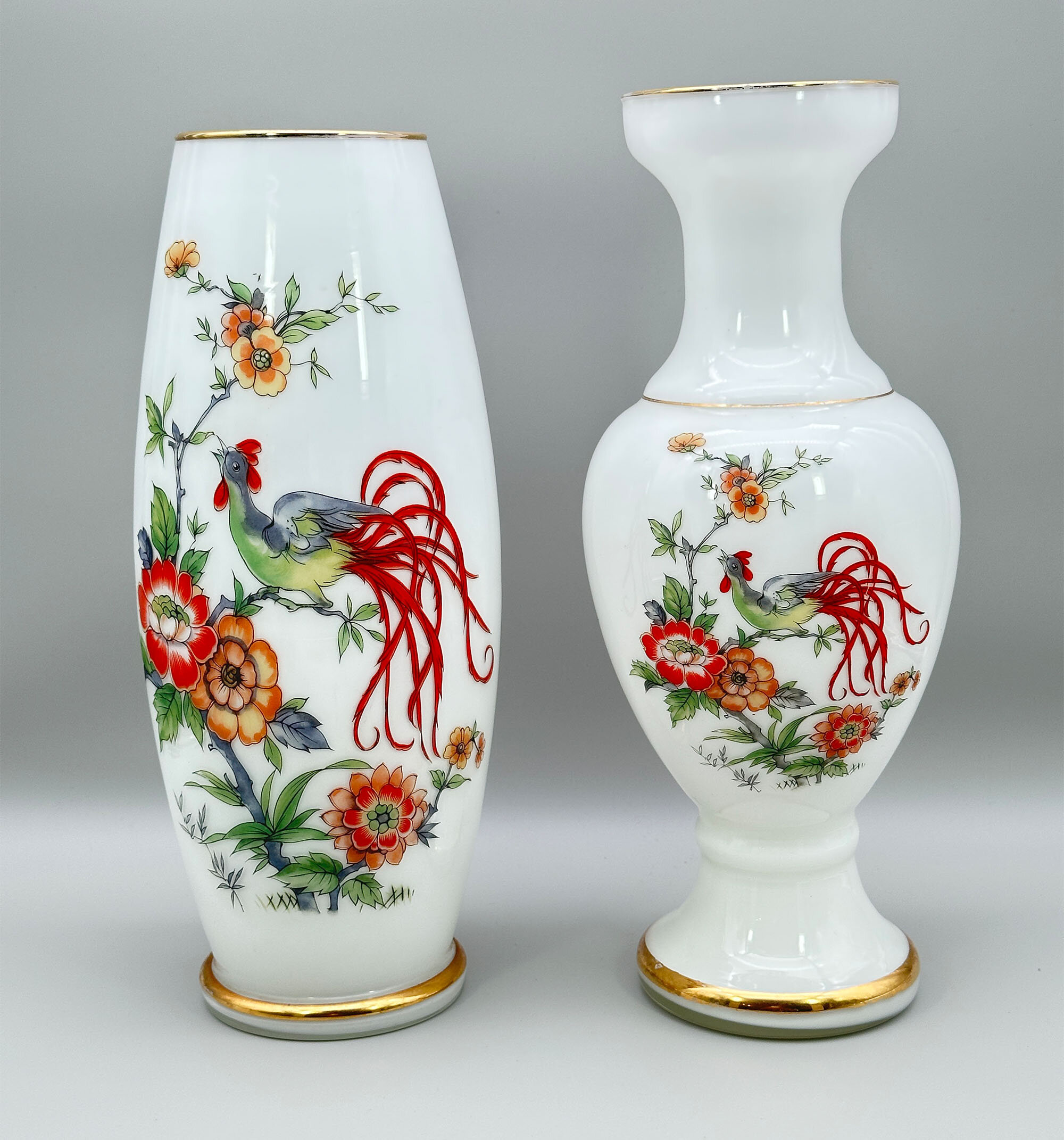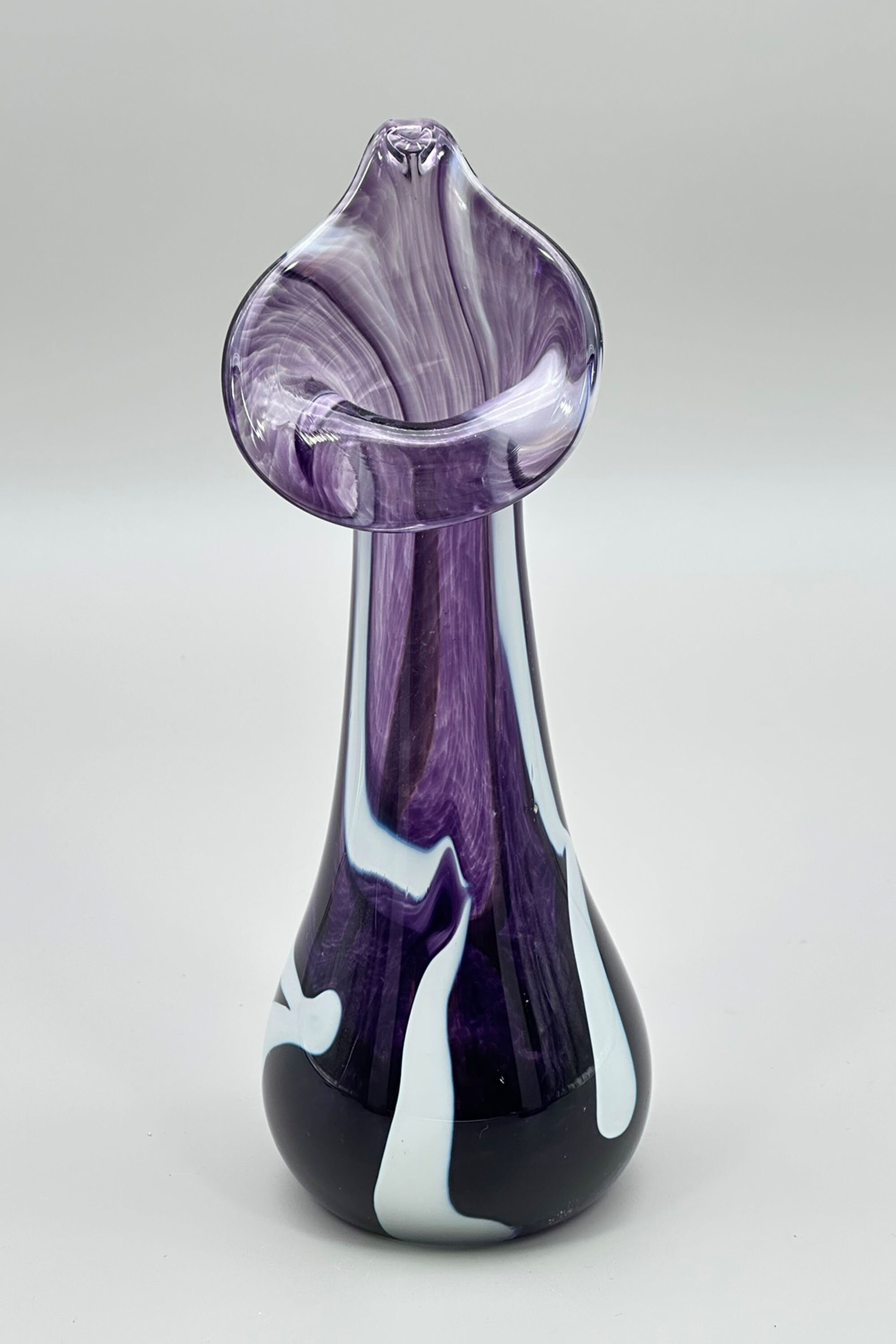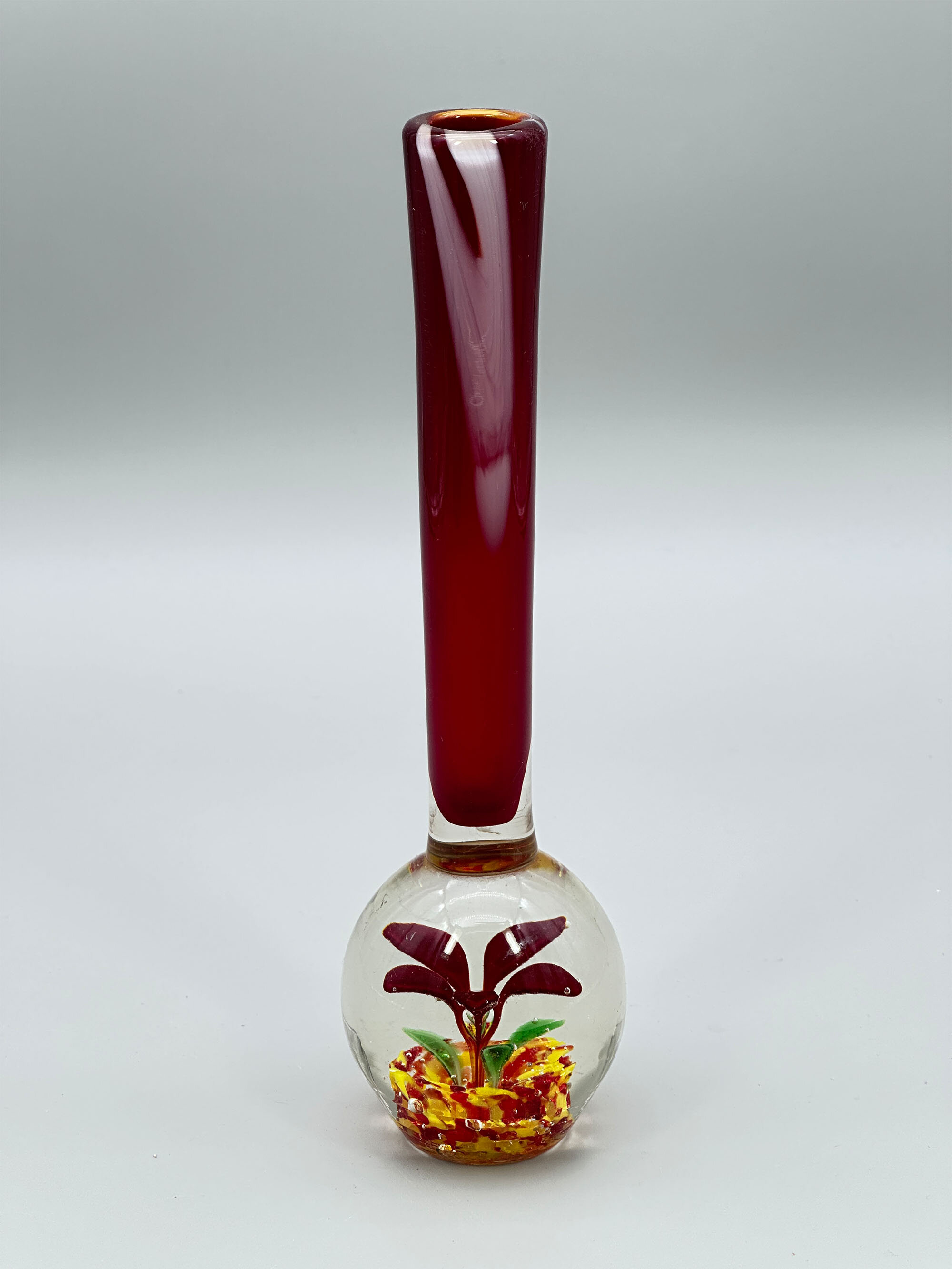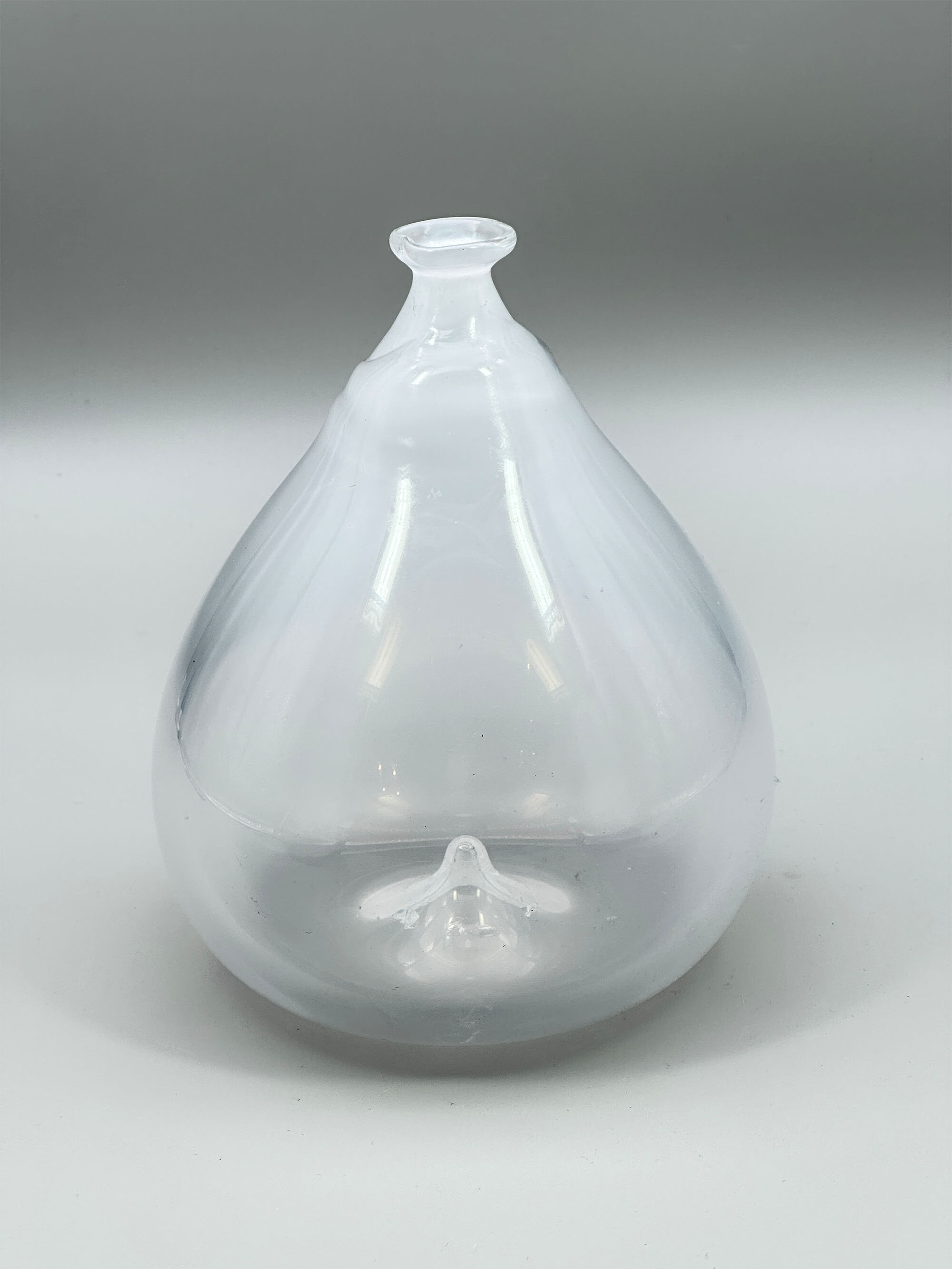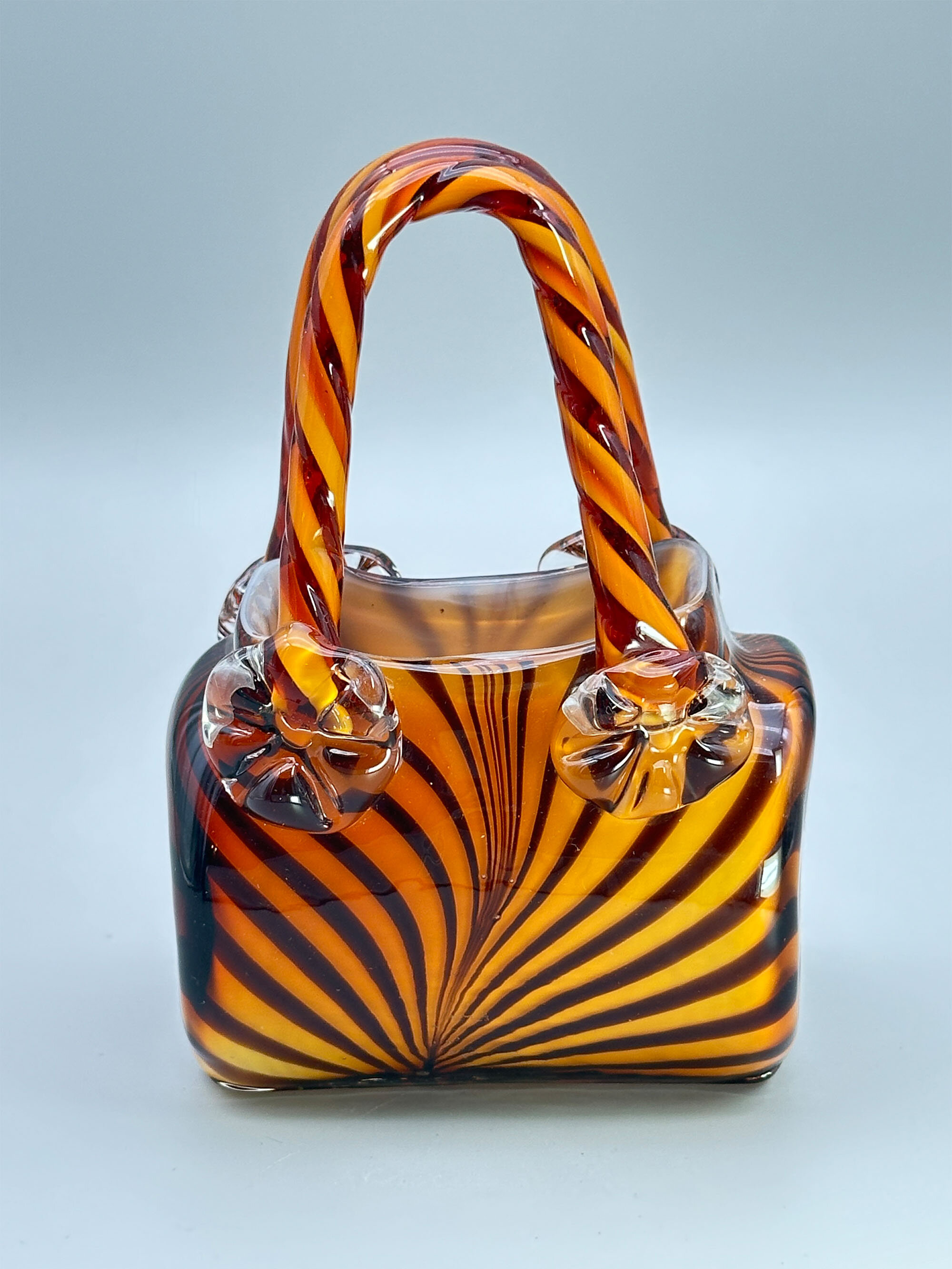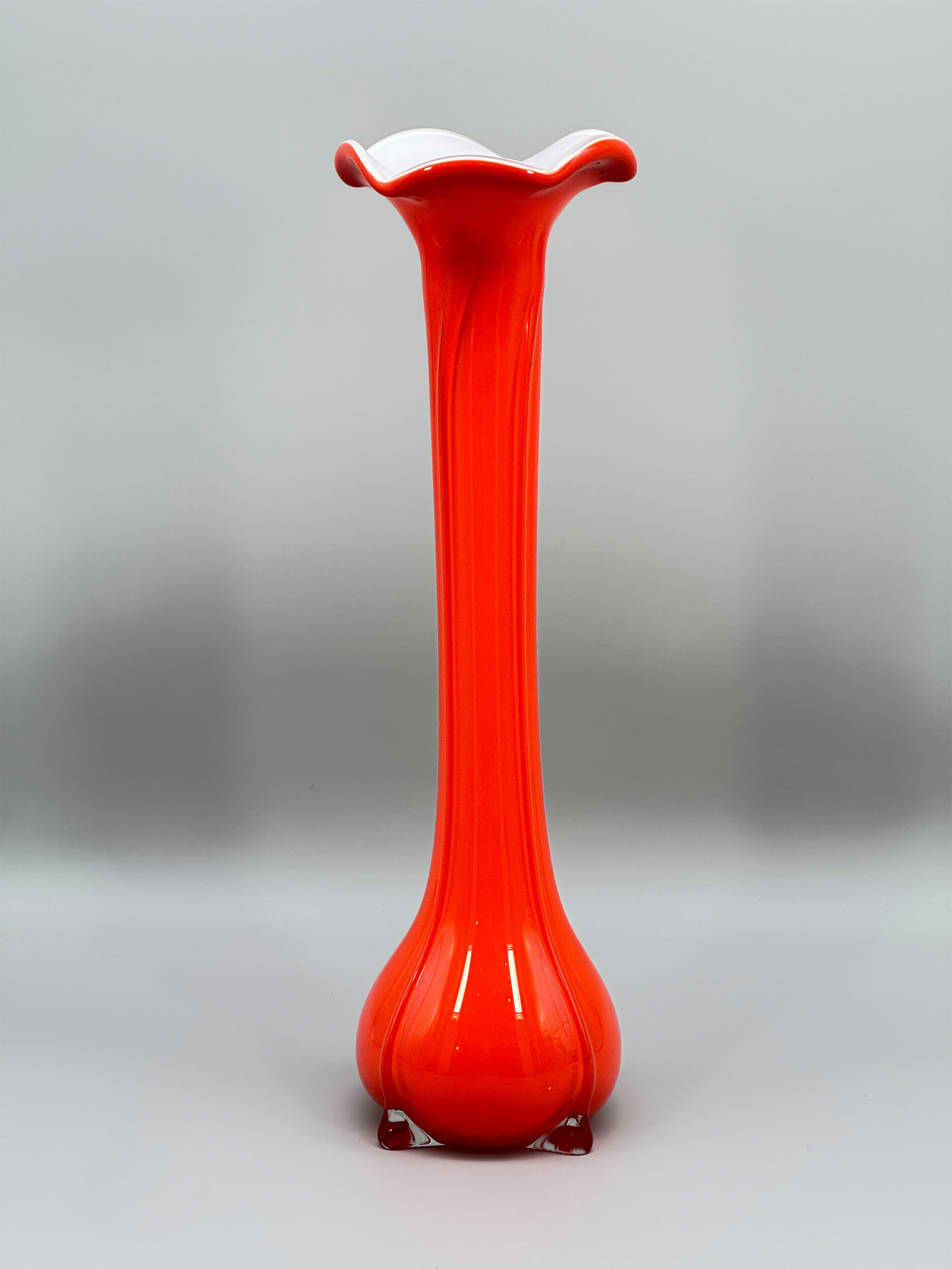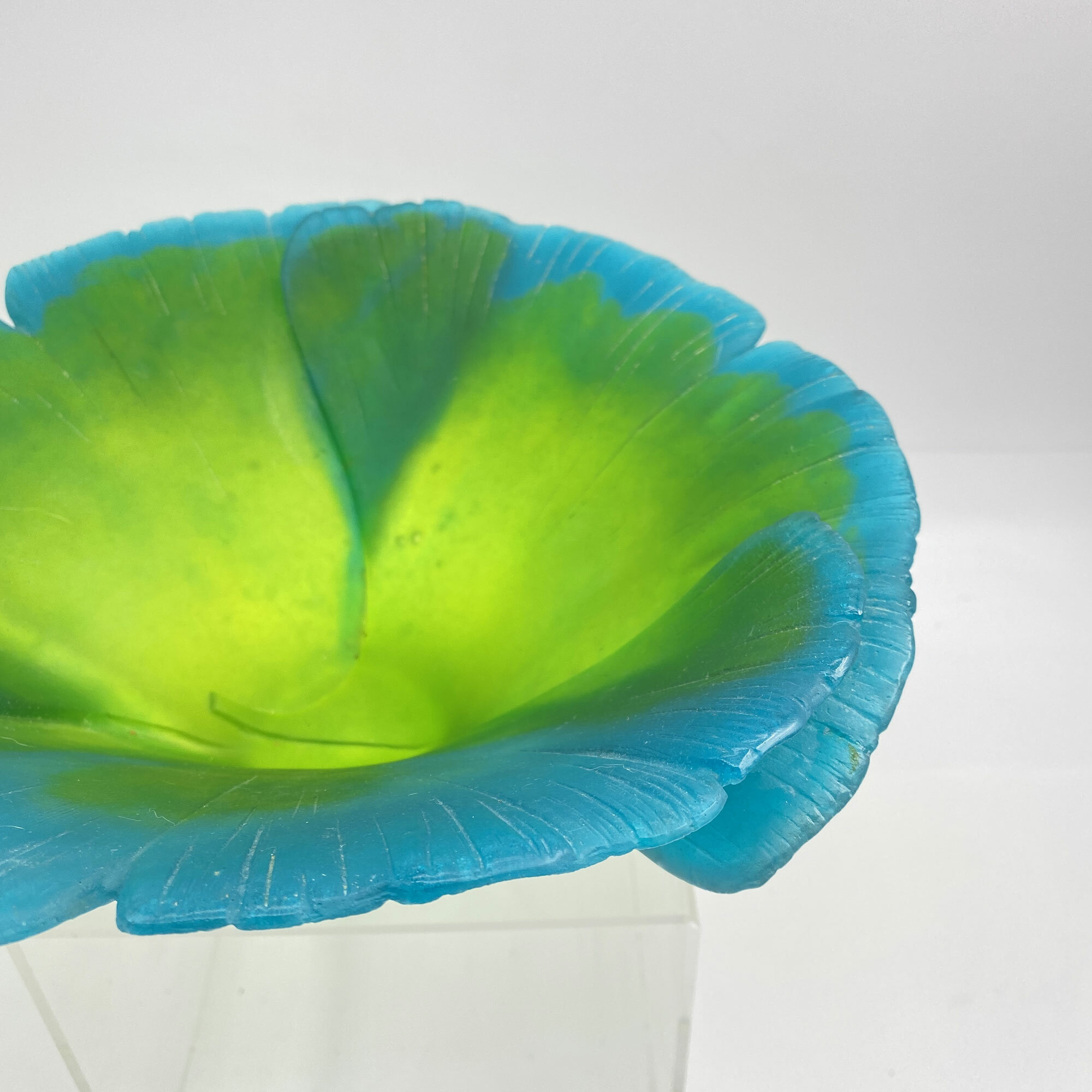
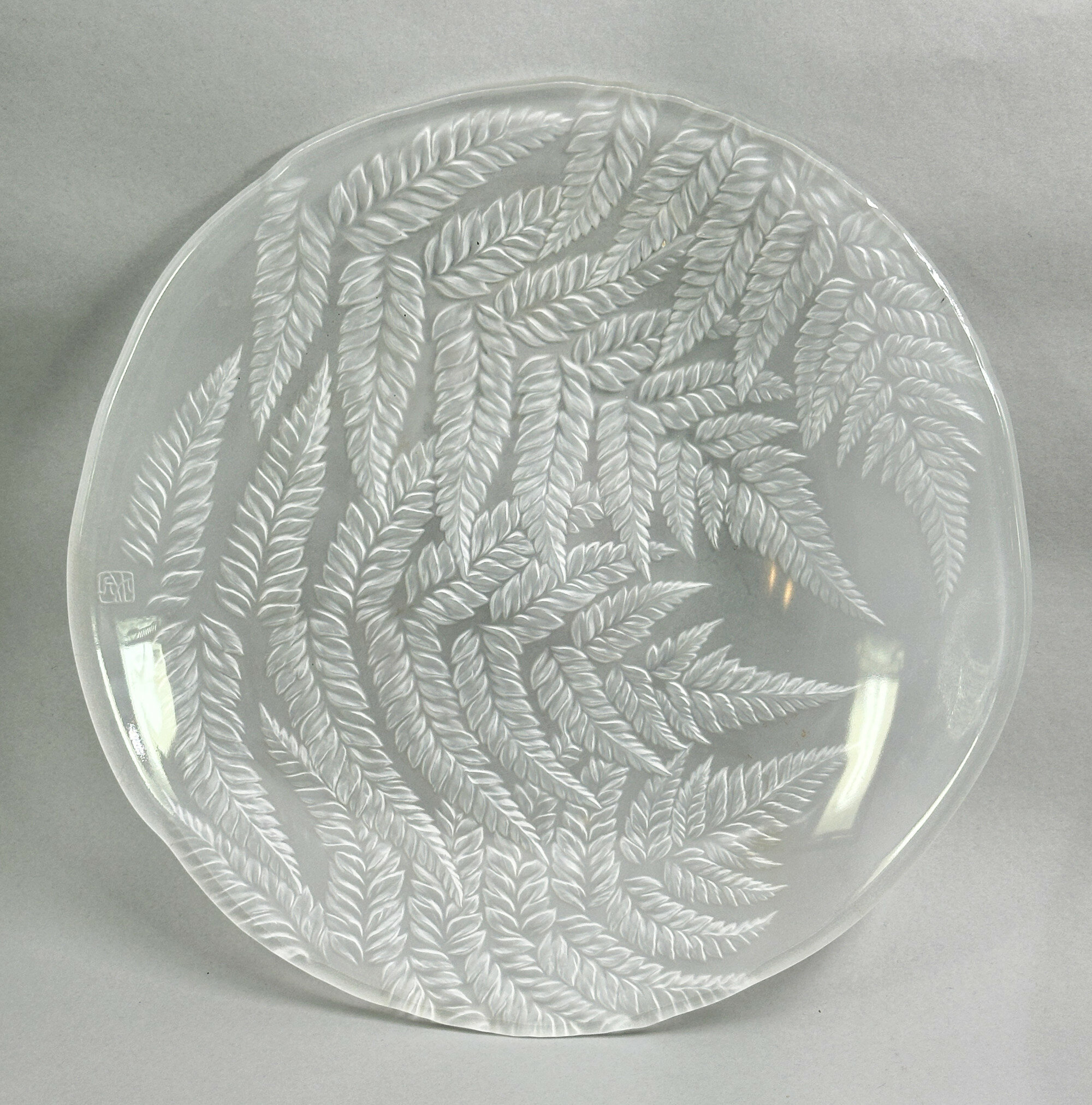
Daum pate de verre bowl, Gingko
Price: £750
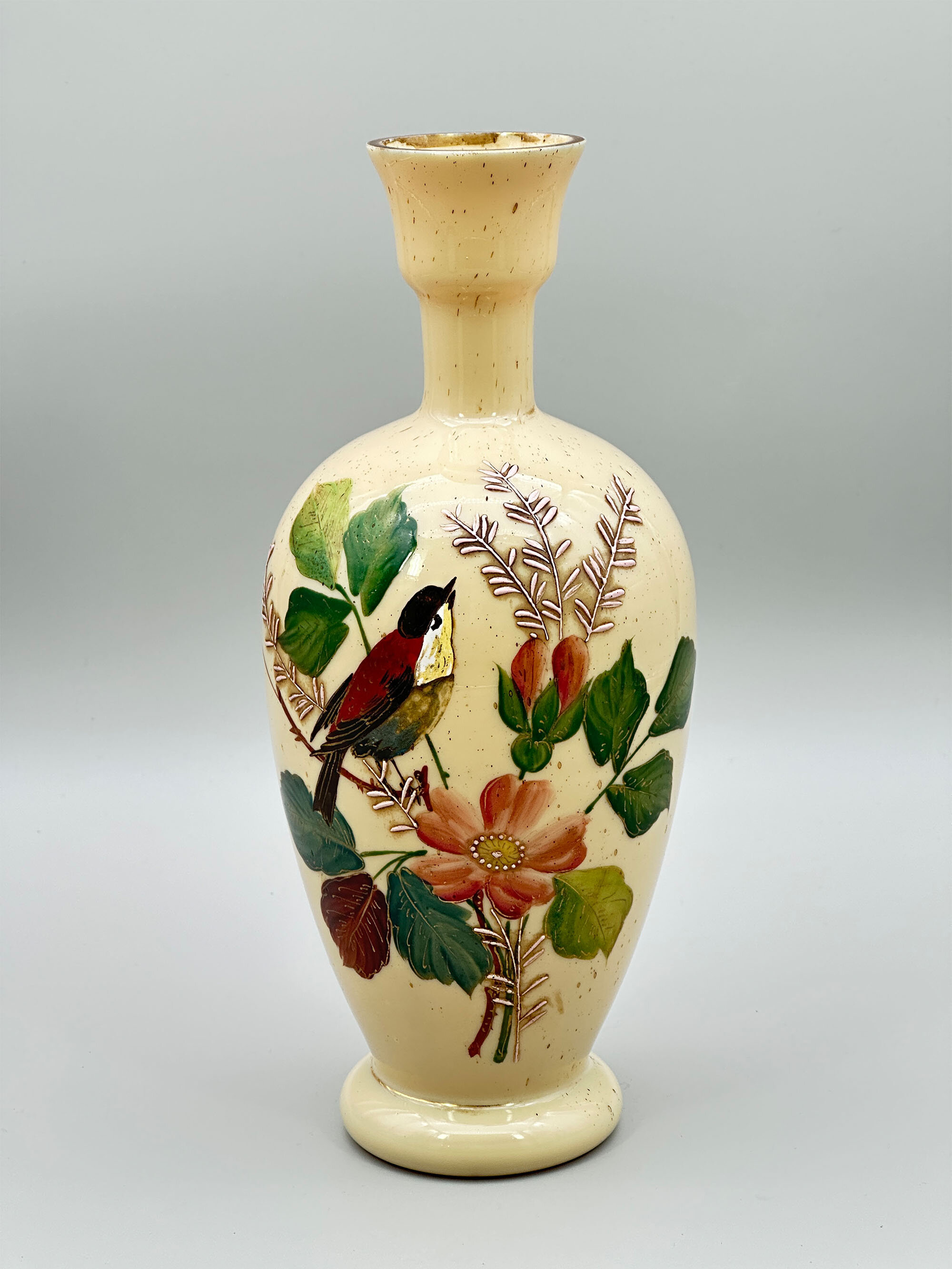
Beautiful Victorian ruby glass scent bottle, circa 1880
Price: £350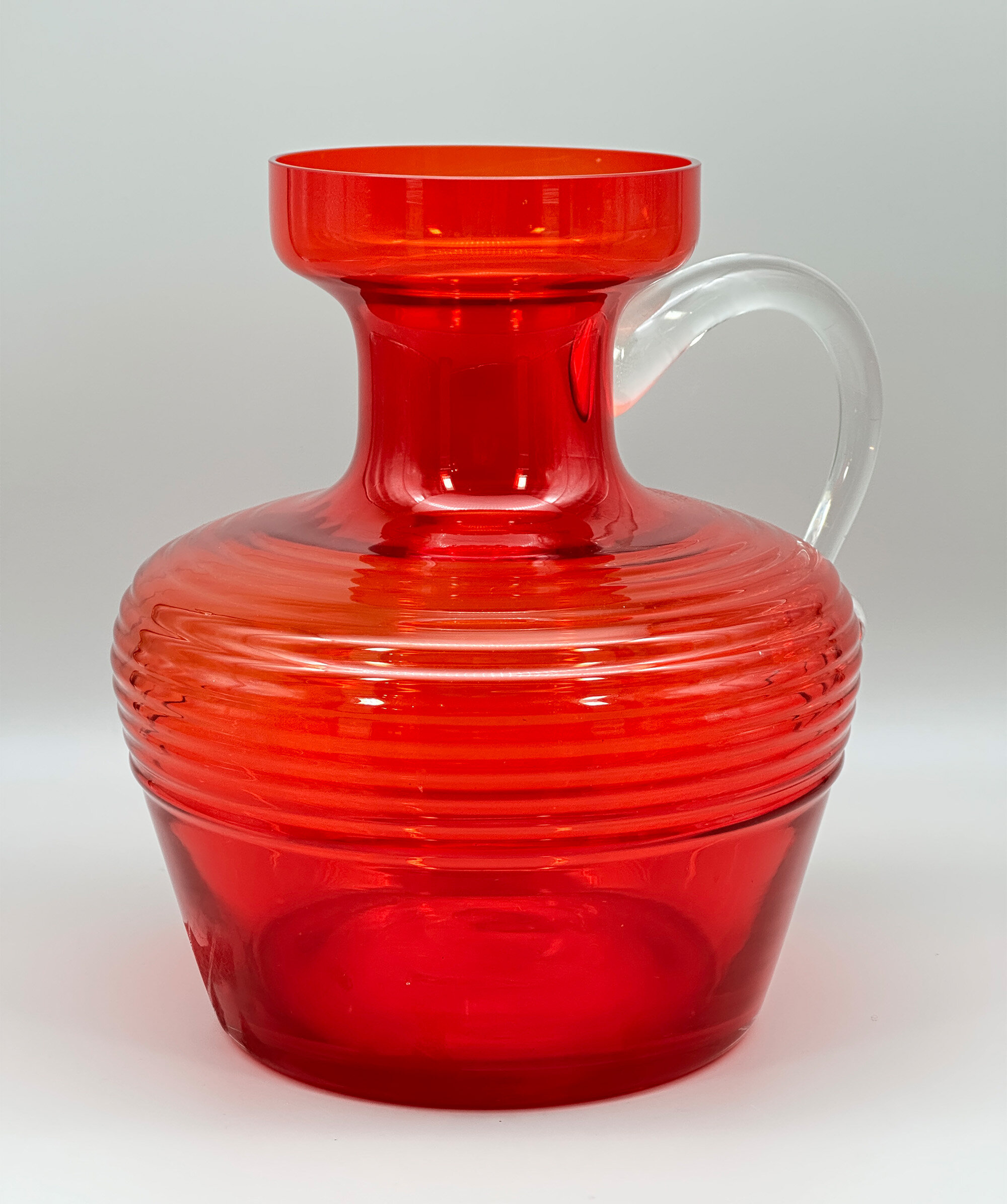
Red glass jug, Cleopatra range, Tamara Aladin for Riihimäen Lasi, Finnish 1970s
Price: £55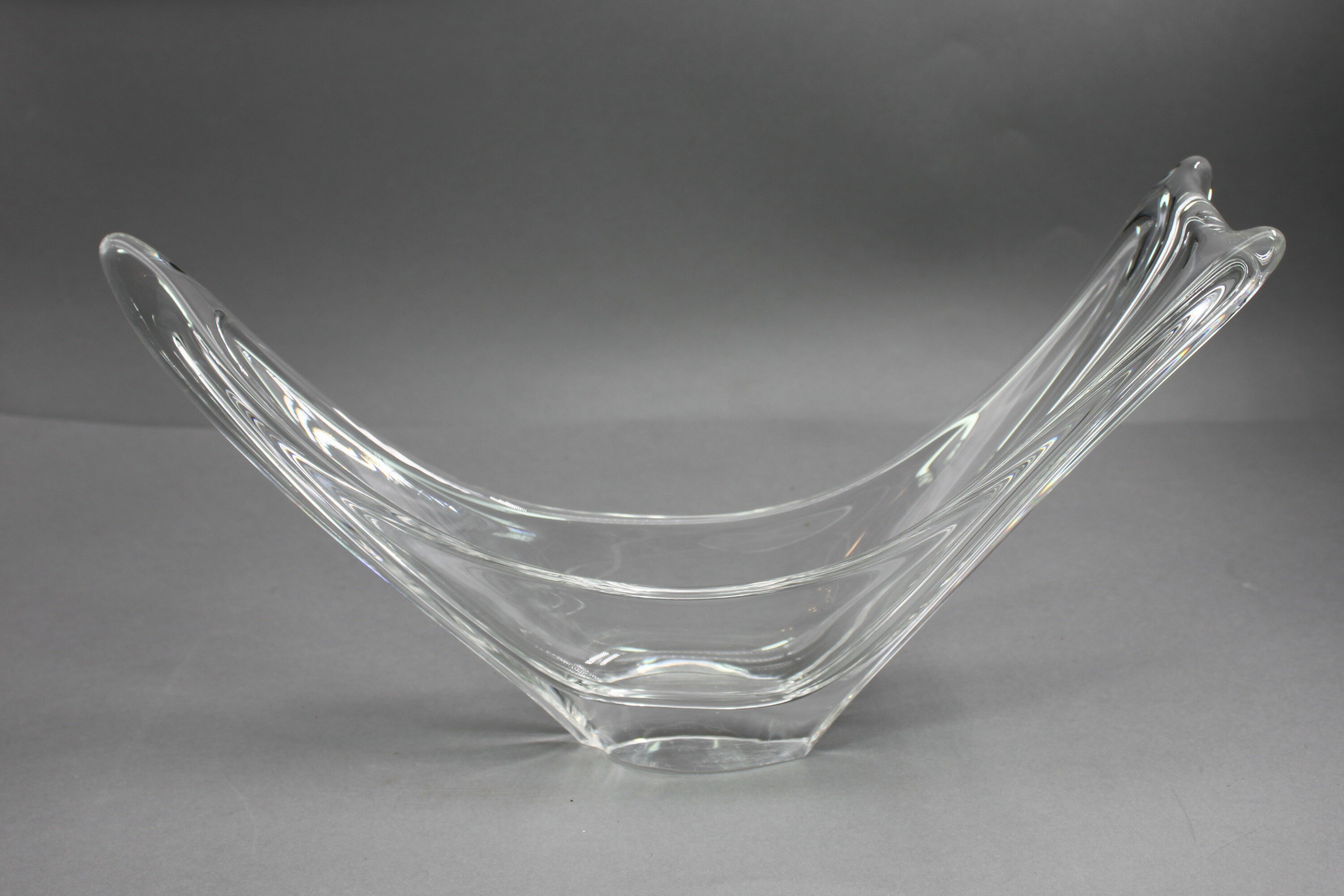
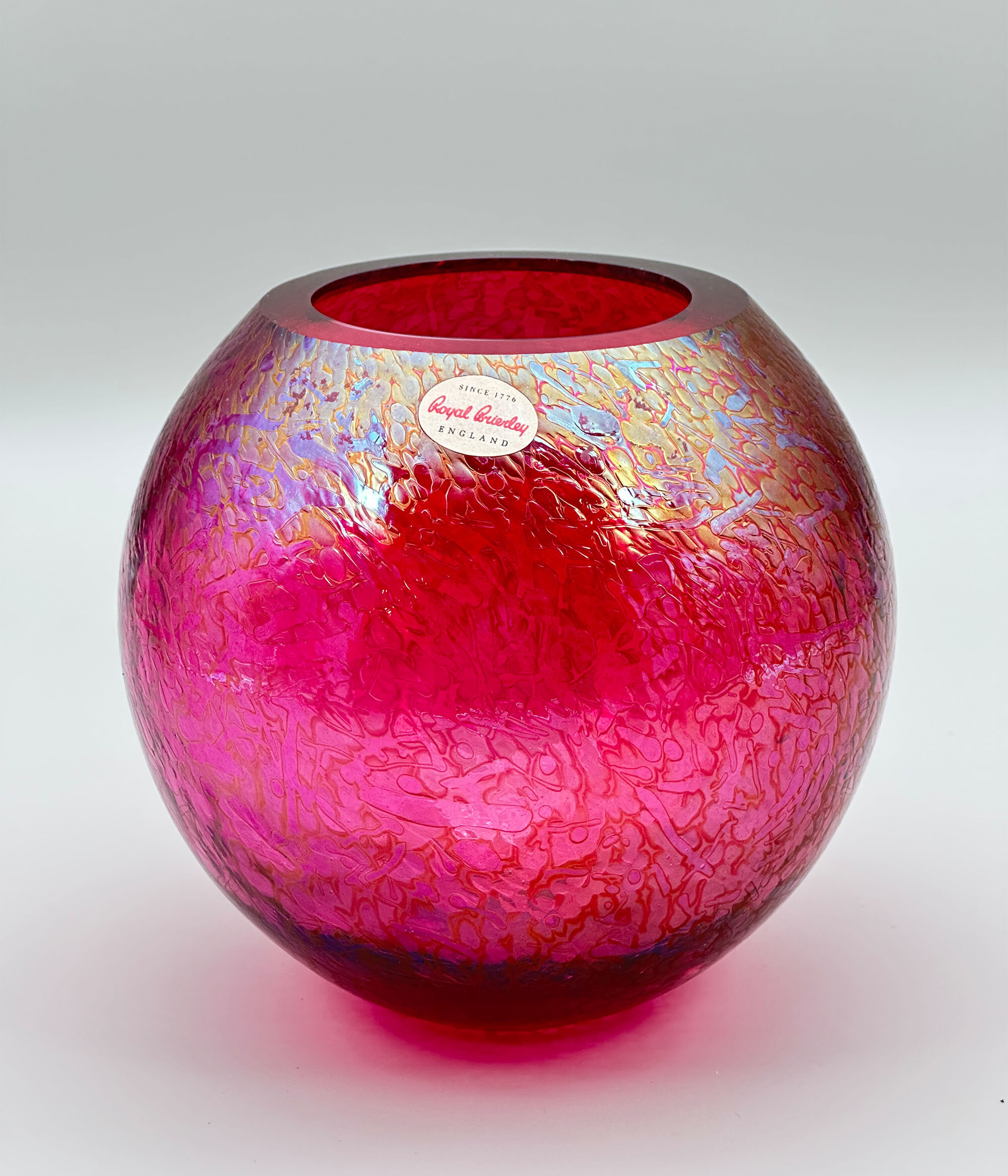
Daum Crystal Glass Swallowtail Bowl, signed Daum-France circa 1960
Price: £150Vases in this form were produced by the well known French maker Daum in the 1950s and the 1960s. The sizes and designs can vary with some examples measuring up to two feet and intended as table ornaments. This piece is rather smaller and perhaps more elegant. The crystal glass is of extremely high quality and reflects the light in a very attractive way. The weight is good and the glass itself is thickly blown and expertly formed, The flat base shows signs of bevelled edging at the exterior and one of the sides bears the typical etched Daum mark with 'Daum' and 'France' separated by a device comprising an upright line with two crosses.
The more petite size and the quality of the manufacture and design make this a most appealing example of Daum's work at its best. Dating can be assumed to be around 1960 if not slightly before. A desirable piece indeed for collectors of twentieth century art glass.
Scandinavian Glass Dish, probably Kosta Boda, 1970s
Price: £45Kosta Boda, previously known as Kosta Glasbruk, is a Swedish glassmaking company founded by two foreign officers in Charles XII's army, Anders Koskull and Georg Bogislaus Staël von Holstein, in 1742.It is located in Kosta, Sweden. Early production consisted of window glass, chandeliers and drinking glasses. From the 1840s, the factory was at the forefront of new trends and technical developments, producing pressed glass, and in the 1880s setting up a new glass-cutting workshop. In 1903, the company merged with the Reijmyre glassworks but both retained their own names and Kosta went on to maintain its reputation as one of the leading Swedish manufacturers with a range of fine art glass and tableware by distinguished designers such as Vicke Lindstrand, artistic director from 1950-1973.
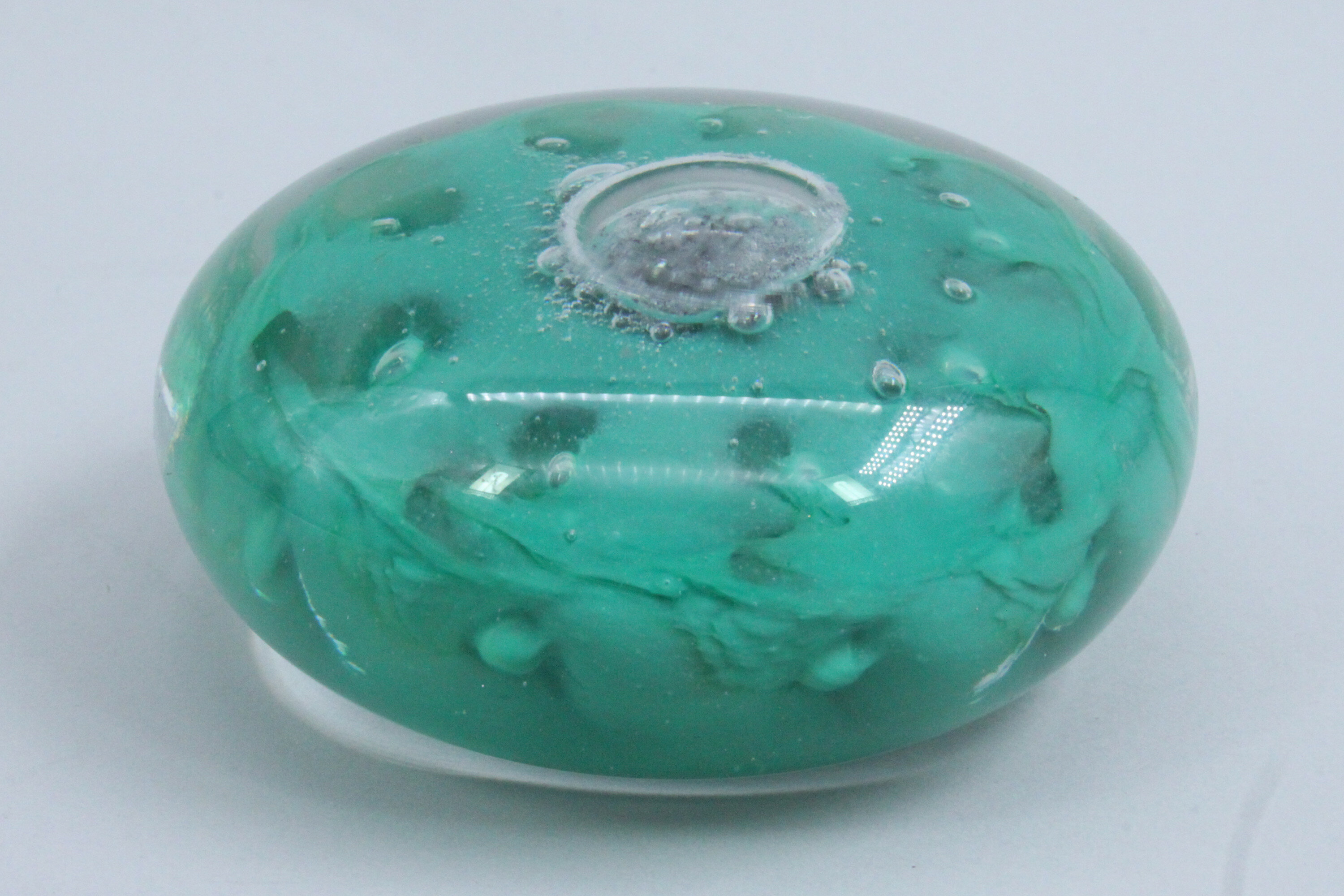
A green glass paperweight, Tweedsmuir Glass, Chris Dodds, late C20th
Price: £25It is sold with a matching contemporary illuminated stand which enhance the decorative effect considerably and provides a modest light display installation for the home (see image 6).
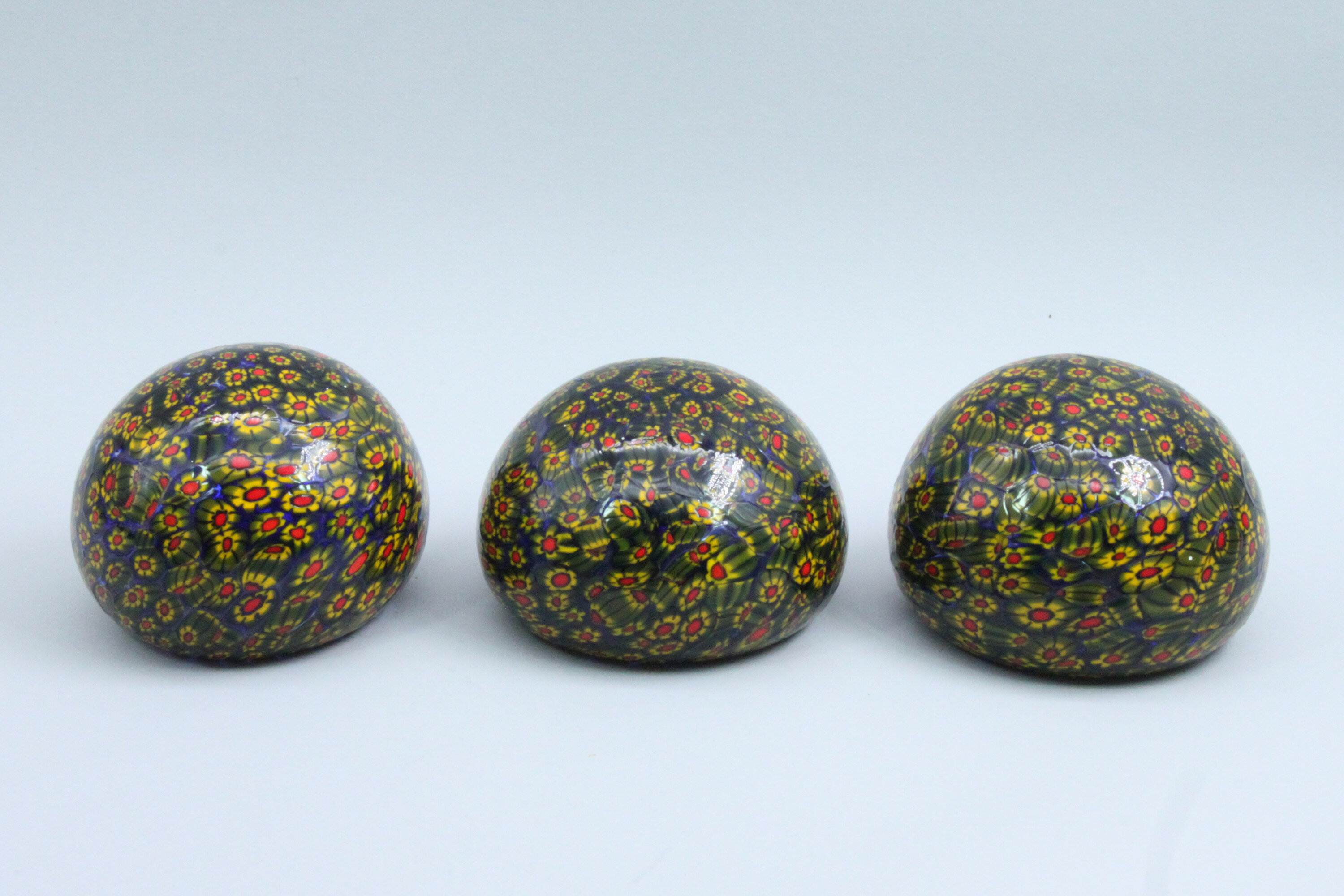
A set of three Millefiori Glass Paperweights, possibly Italian Murano, late C20th
Price: £75This set is sold with matching contemporary illuminated stands which enhance the decorative effect considerably and provide a modest light display installation for the home (see illustrations 5 and 6).
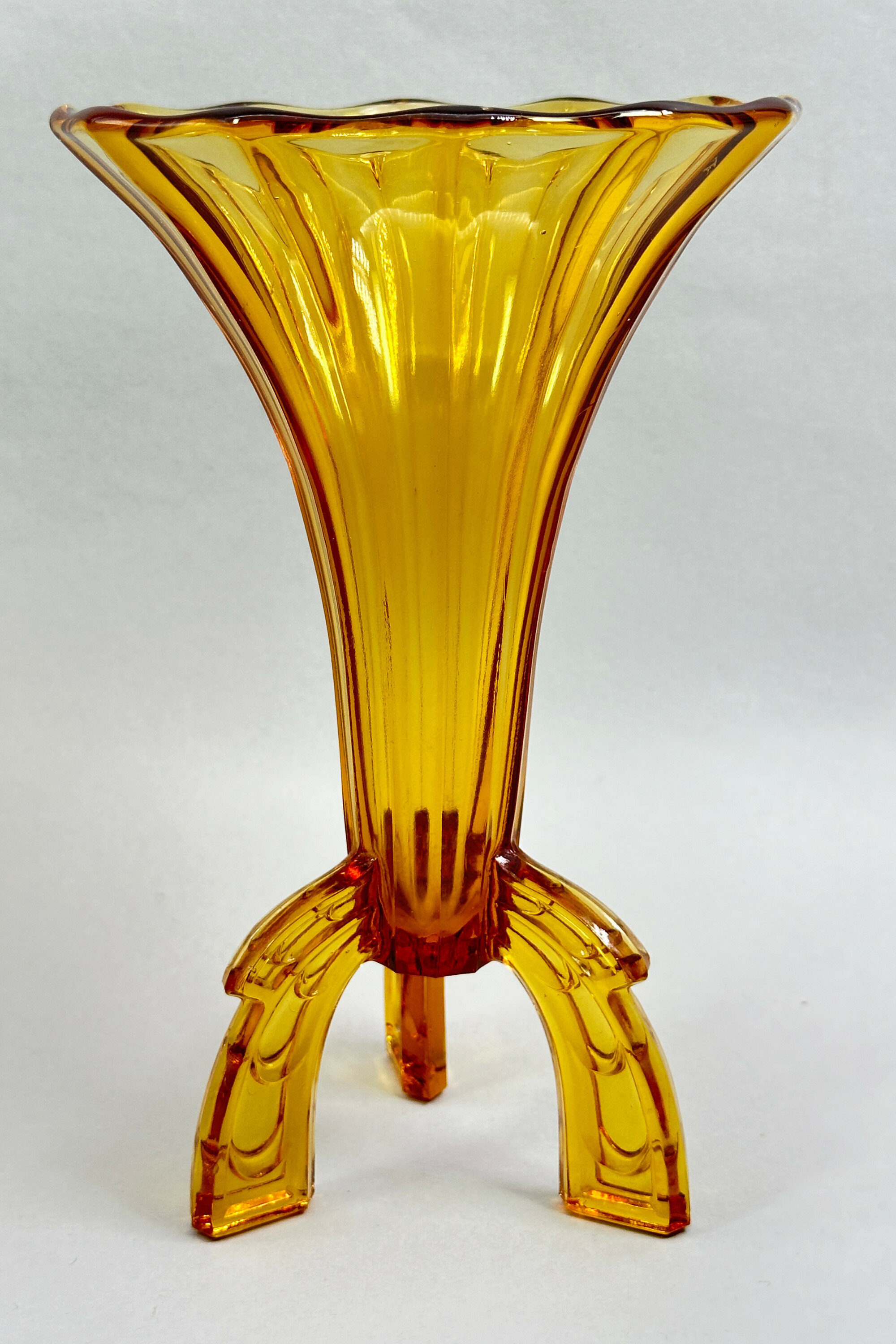
Art Deco style Amber Glass Rocket Vase, probably Czech Rosice 1930s
Price: £45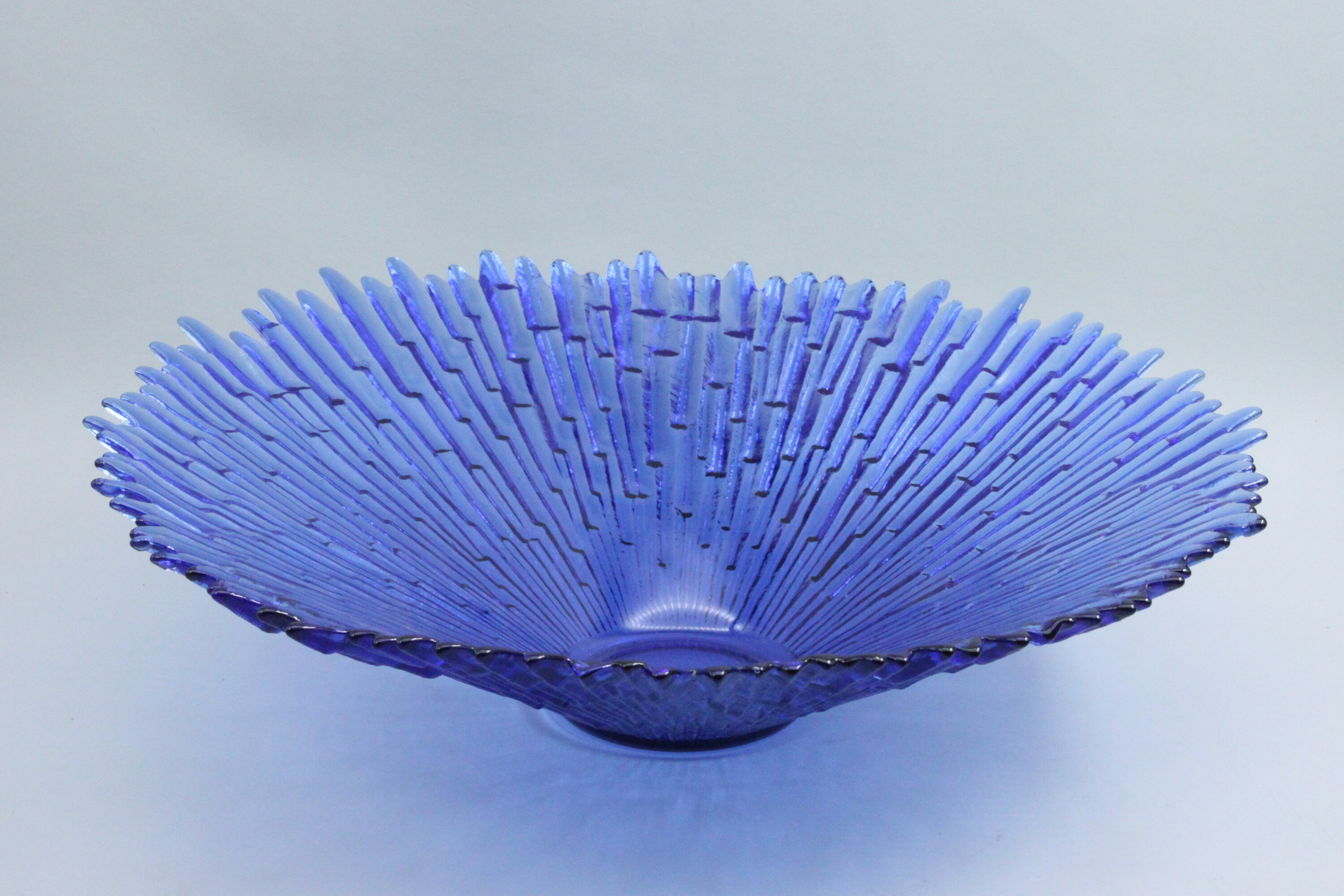
A Blue Glass Icicle Bowl, designed by Tauno Wirkalla for Humppila Finland, late C20th
Price: £150Tauno Wirkalla was the brother of the celebrated Finnish designer Tappio Wirkalla and like him favoured an ‘ice glass’ effect in his designs. He was one of the designers for the Humpilla Glassworks in Finland which was founded by the Helander brothers in 1952 and was then subject to various takeovers, finally being acquired by the firm Nuutajarvi (for whom the Helander brothers had originally worked) in 1986. Wirkalla produced many ‘ice glass’ designs for Humppila, some of which are signed and some still surviving with their factory labels, which is not the case here. This bowl is of an exceptionally large size and has miraculously survived undamaged with all its pointed edges intact. A truly distinctive centrepiece recreating the style of an earlier era.
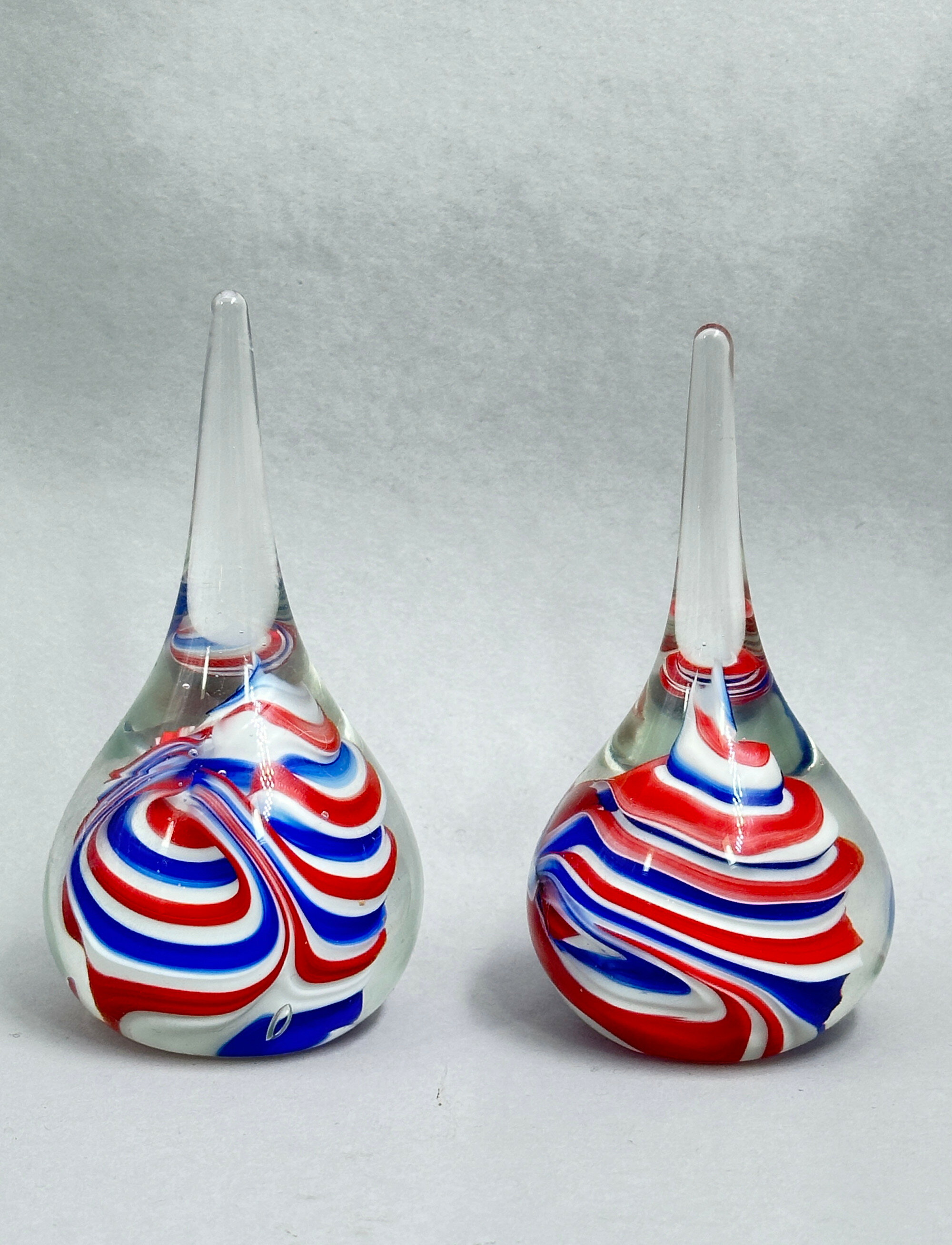
A Pair of Glass Vases or Paperweights, probably Selkirk Glass, Scotland, 1980s/1990s
Price: £25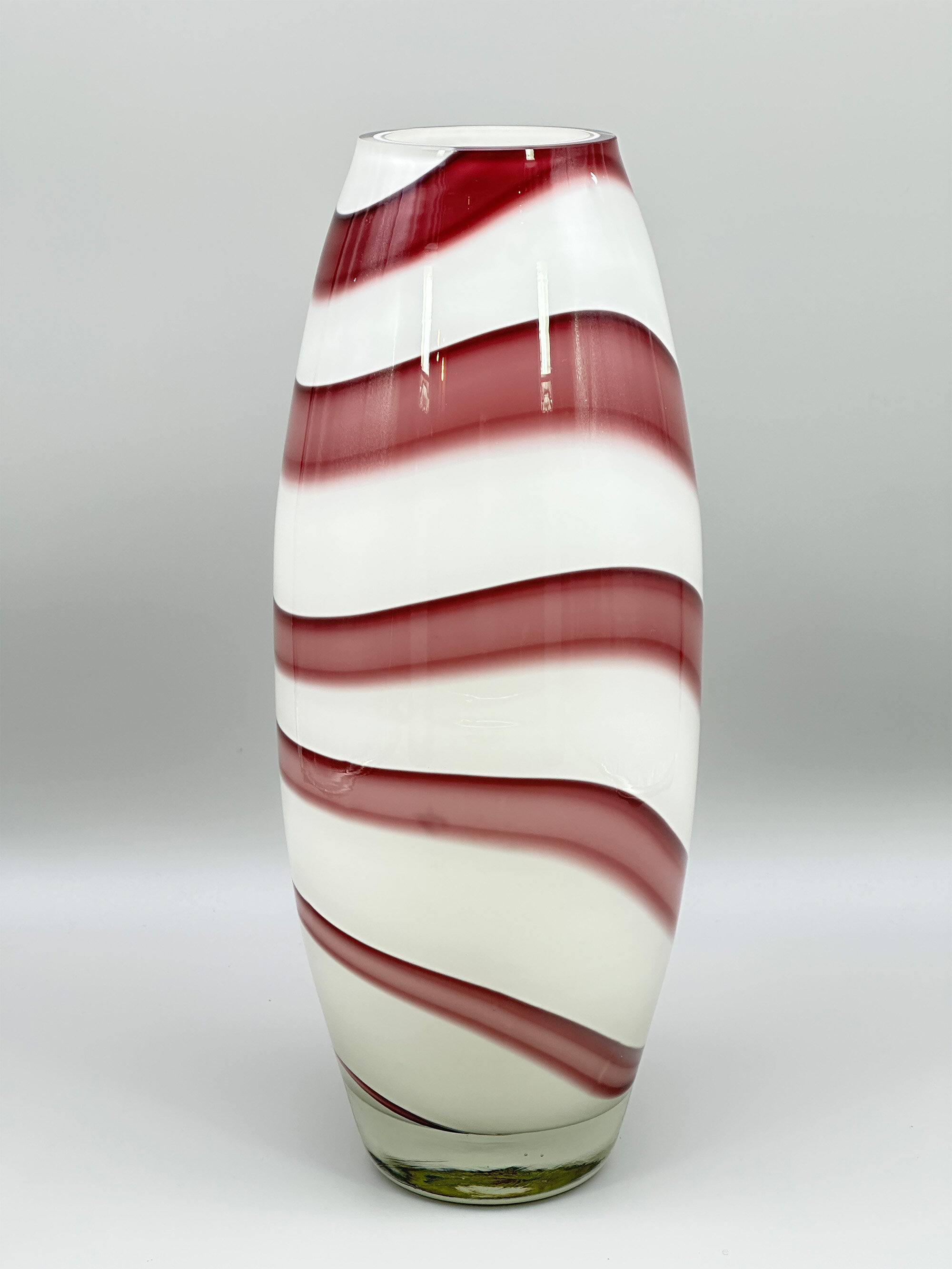
Purple and white swirl pattern art glass Vase, Made in Poland label, Mid C20th
Price: £45
Four Art Deco style small Glass Vases with silver decoration, possibly Murano 1930s
Price: £55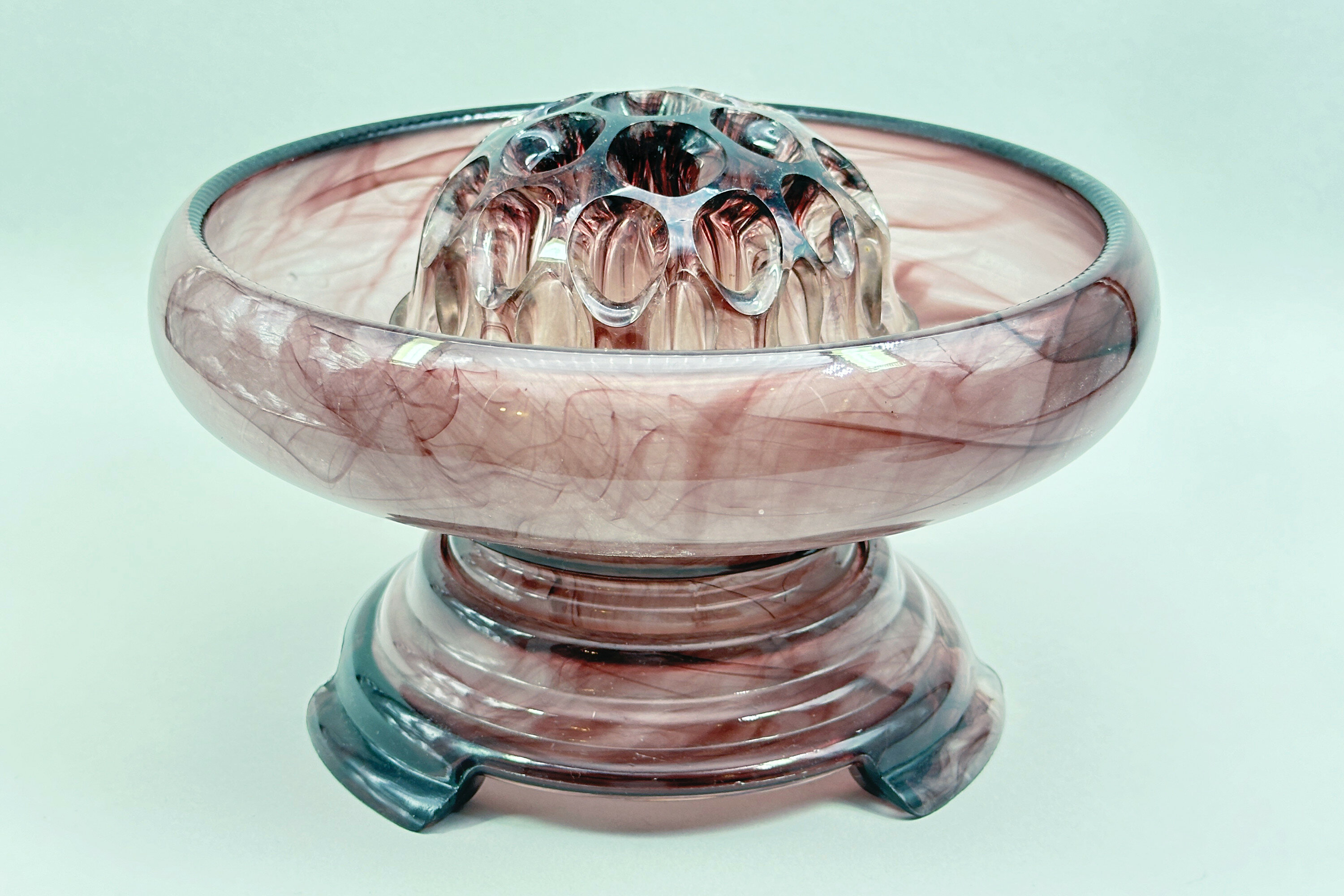
Art Deco Davidson purple cloud glass bowl, stand and frog, 1930s
Price: £55This model can be seen in the firm's catalogue for 1931 where the bowl and stand are combined with a separate pierced flower holder in the same style. No doubt the size of the ‘frog’ was up to the purchaser who could choose from a range of dimensions which probably explains the slightly different proportions here to the catalogue image which otherwise illustrates our example extremely well, even down to the milled edging to the rim of the bowl. With its archetypal shape and colouring this piece would be an excellent addition to any Art Deco collection as well as providing a striking and decorative item for a contemporary interior.
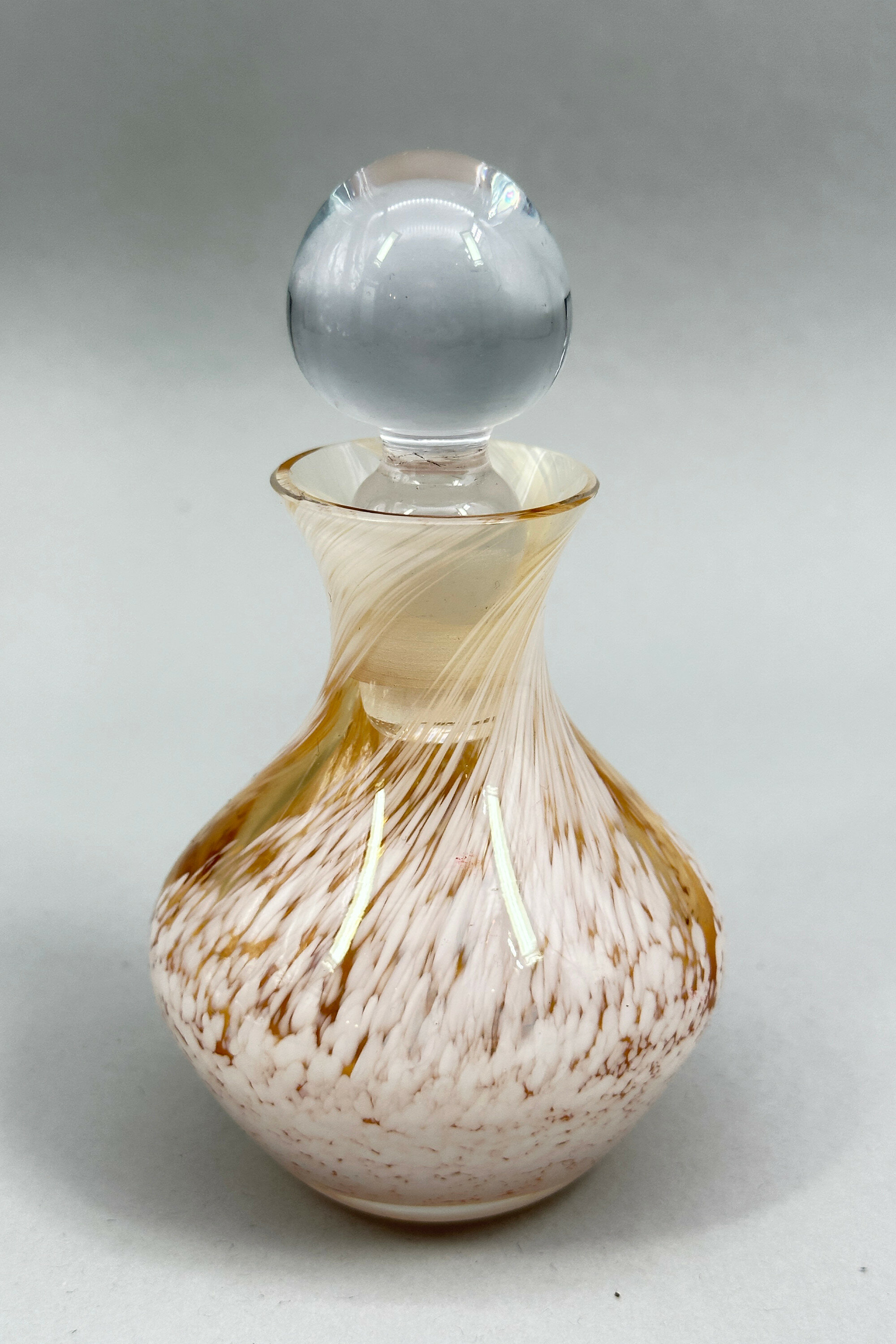
Perfume Bottle and Stopper, Island Studio, Guernsey, late C20th
Price: £30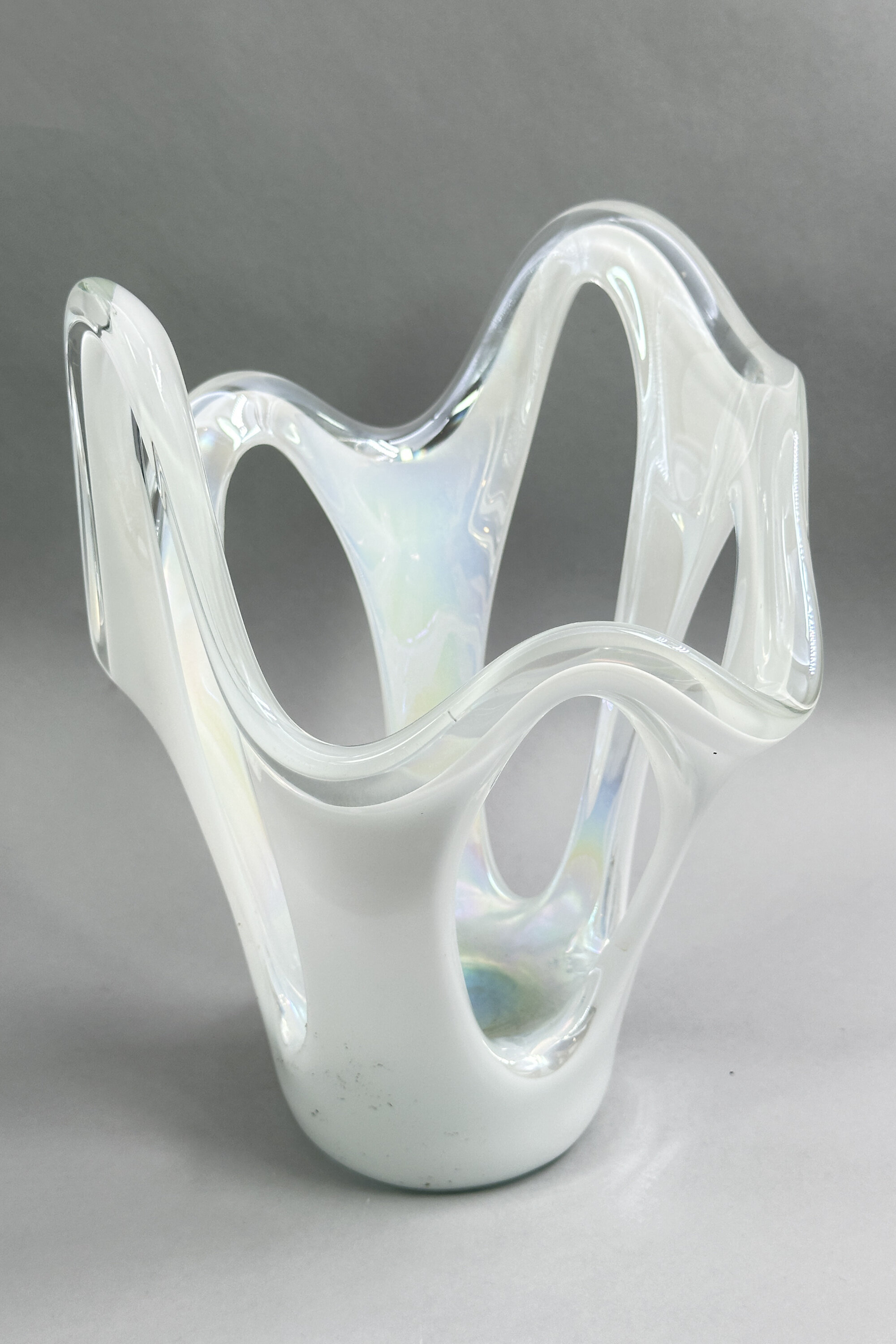
Murano White Glass Vase of abstract organic form, 1960s
Price: £55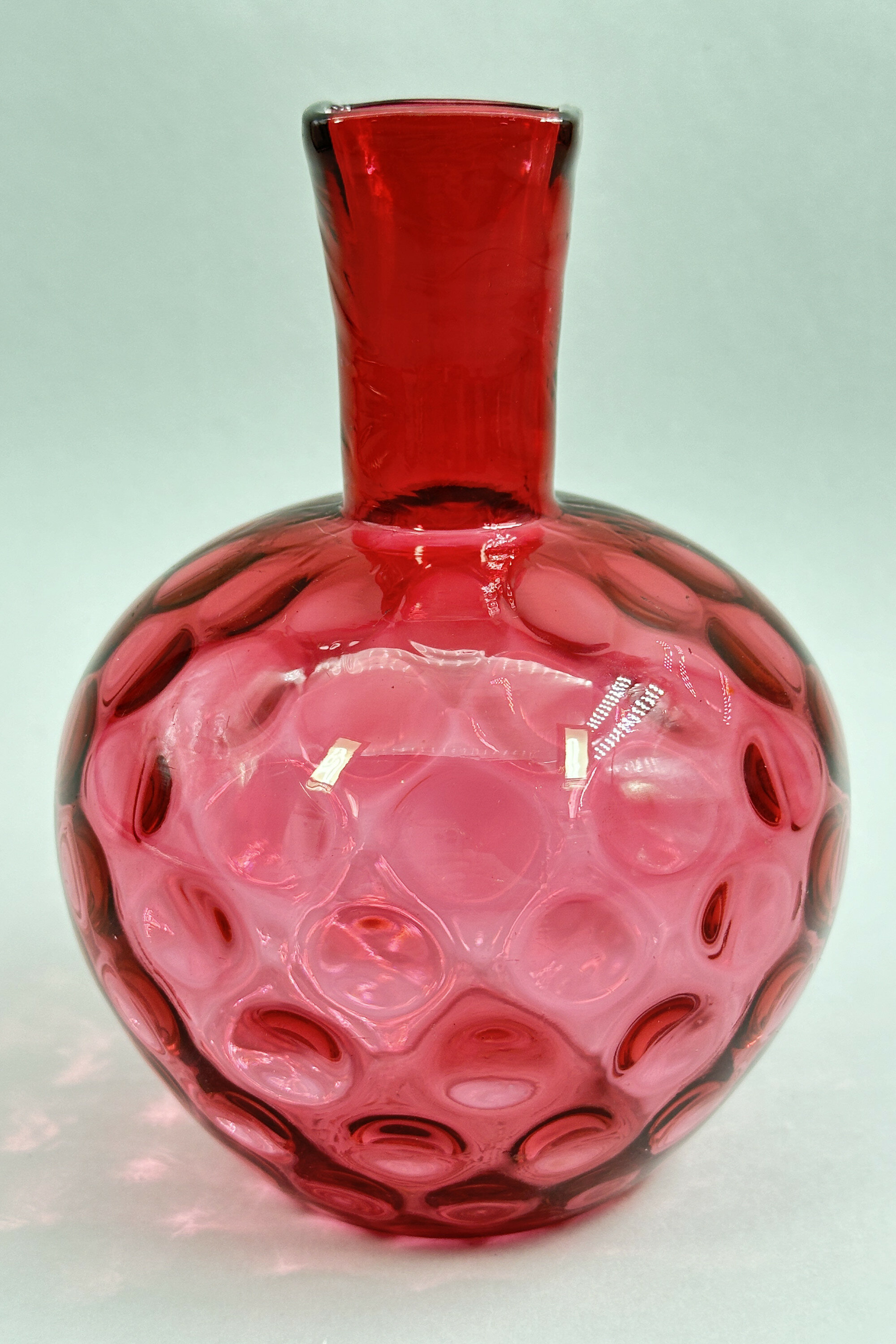
Cranberry Glass Vase circa 1900
Price: £30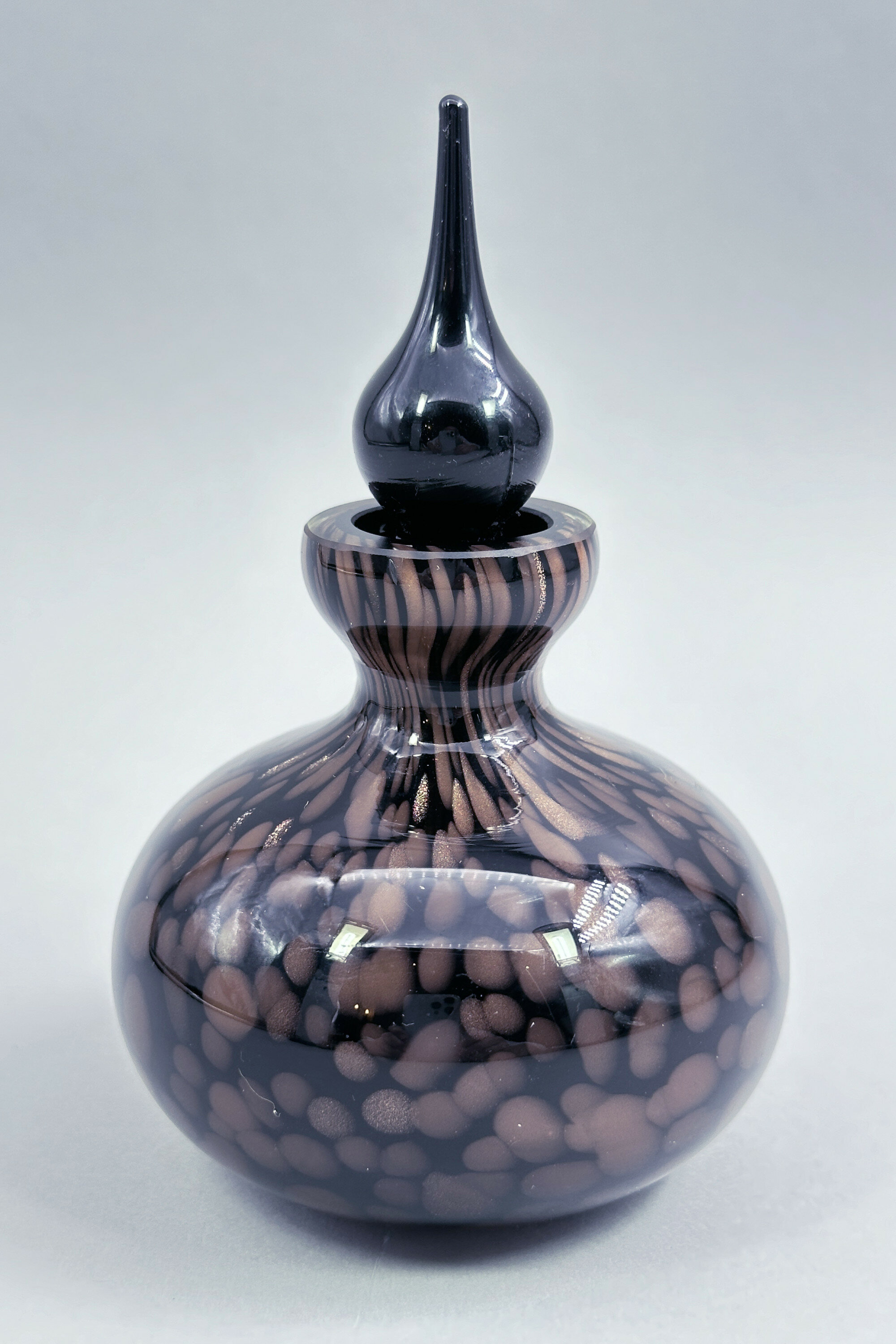
Black and Gold Copper Glitter Art Glass Scent Bottle, probably Murano late C20th
Price: £55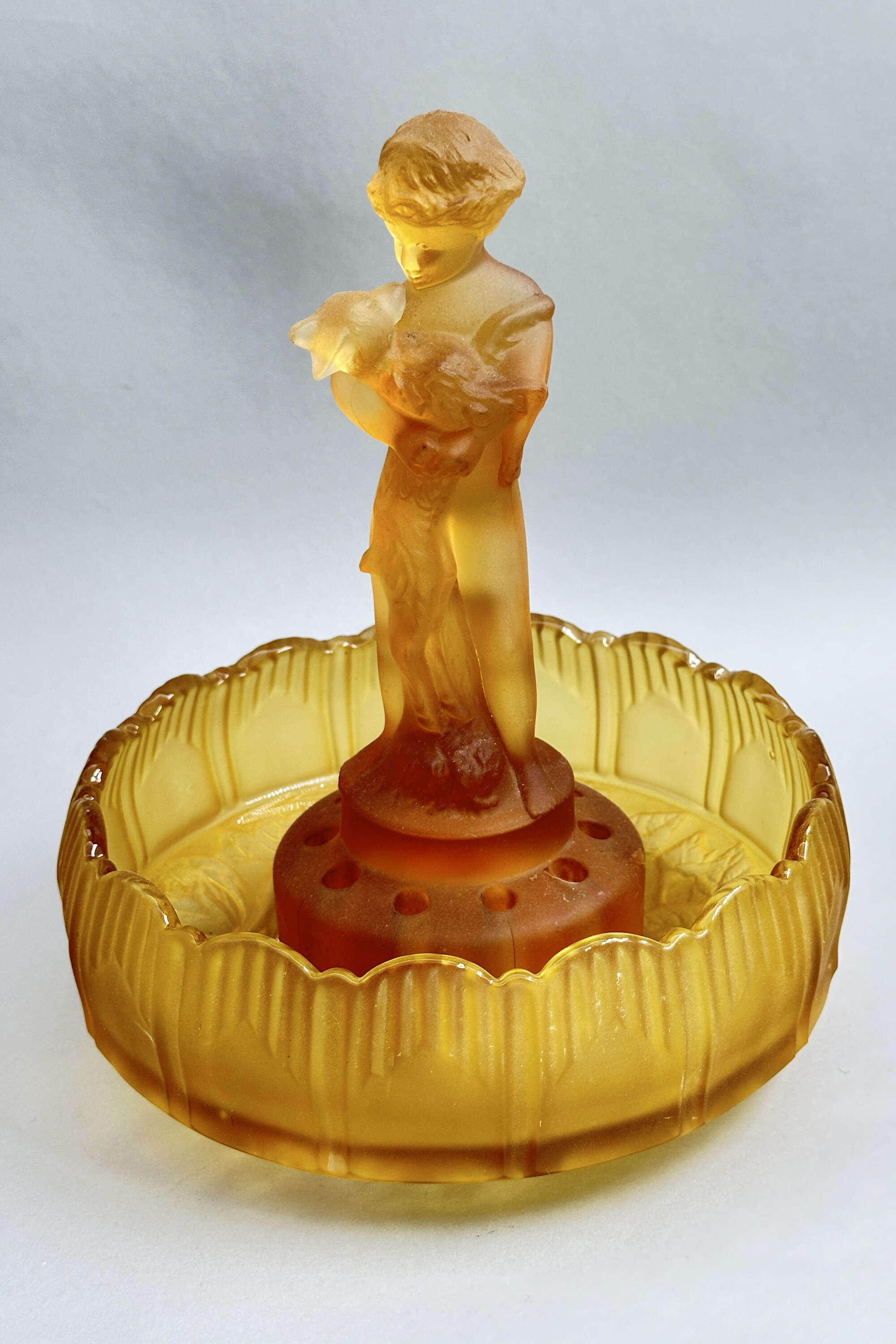
Sowerby Amber Glass Centrepiece circa 1930
Price: £75The Sowerby family came from the North West of England near Carlisle and settled in Gateshead in the late eighteenth century. The firm Sowerby Glassworks is known from 1807 onwards and continued production until 1972, concentrating on pressed glass. Catalogues of their wares still exist and they produced pieces in a wide variety of styles and shapes which retain their popularity today.
The centrpiece figurine, which was intended as a flower holder or ‘frog’, is rather unusual; normally the figures are female but the style of the modelling is identical. Similar designs to the bowl can be found in a 1936 catalogue but versions of it even appear in another catalogue from 1882. Many centrepiece/bowl combinations are found and some of them are not always original. This may possibly be the case here but if so the ‘match’ is extremely pleasing to the eye and the two elements set one another off perfectly to produce a striking example of Art Deco decorative design.
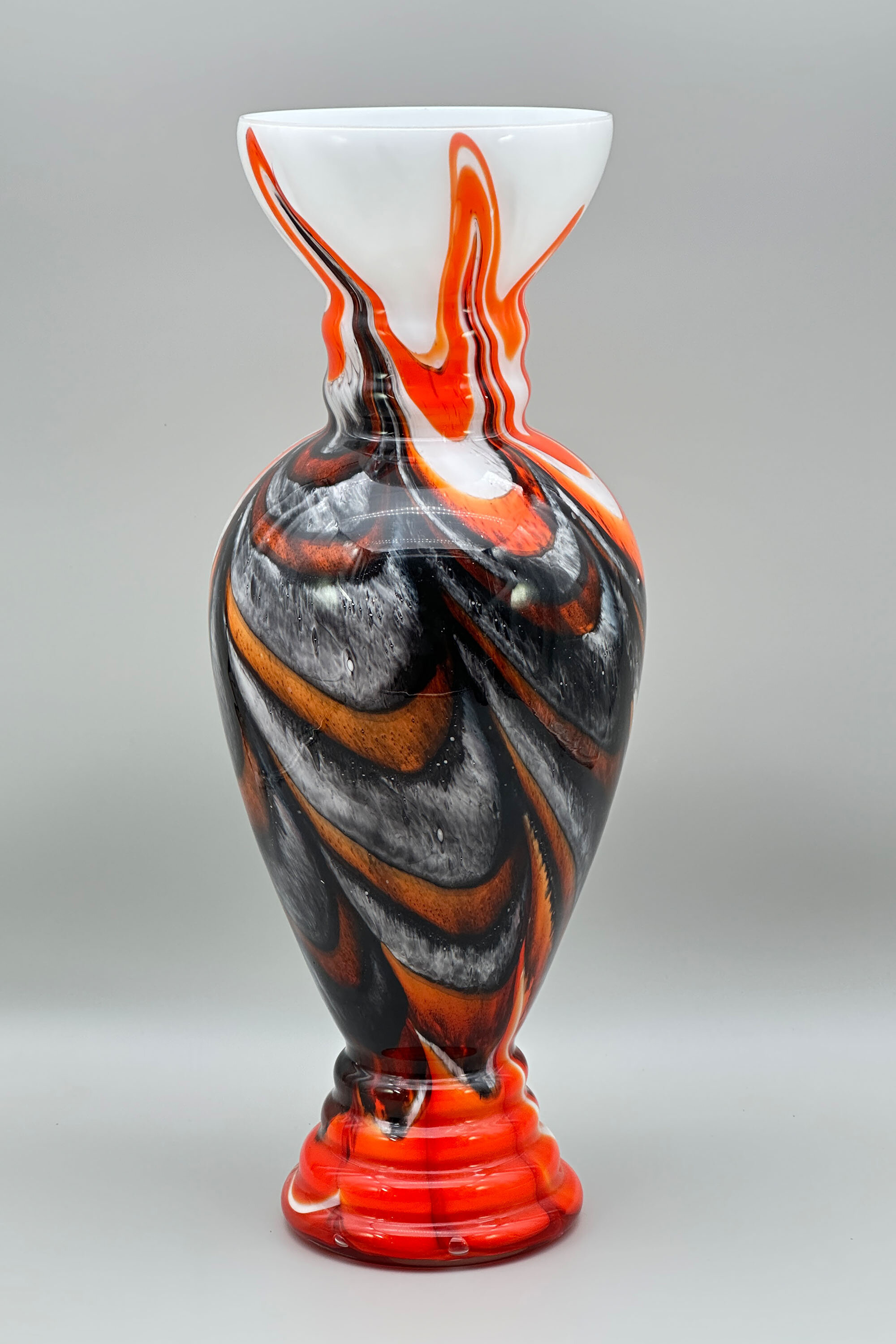
Tall glass vase with orange, grey and black swirls, probably by Carlo Moretti, Italian 1970s
Price: £180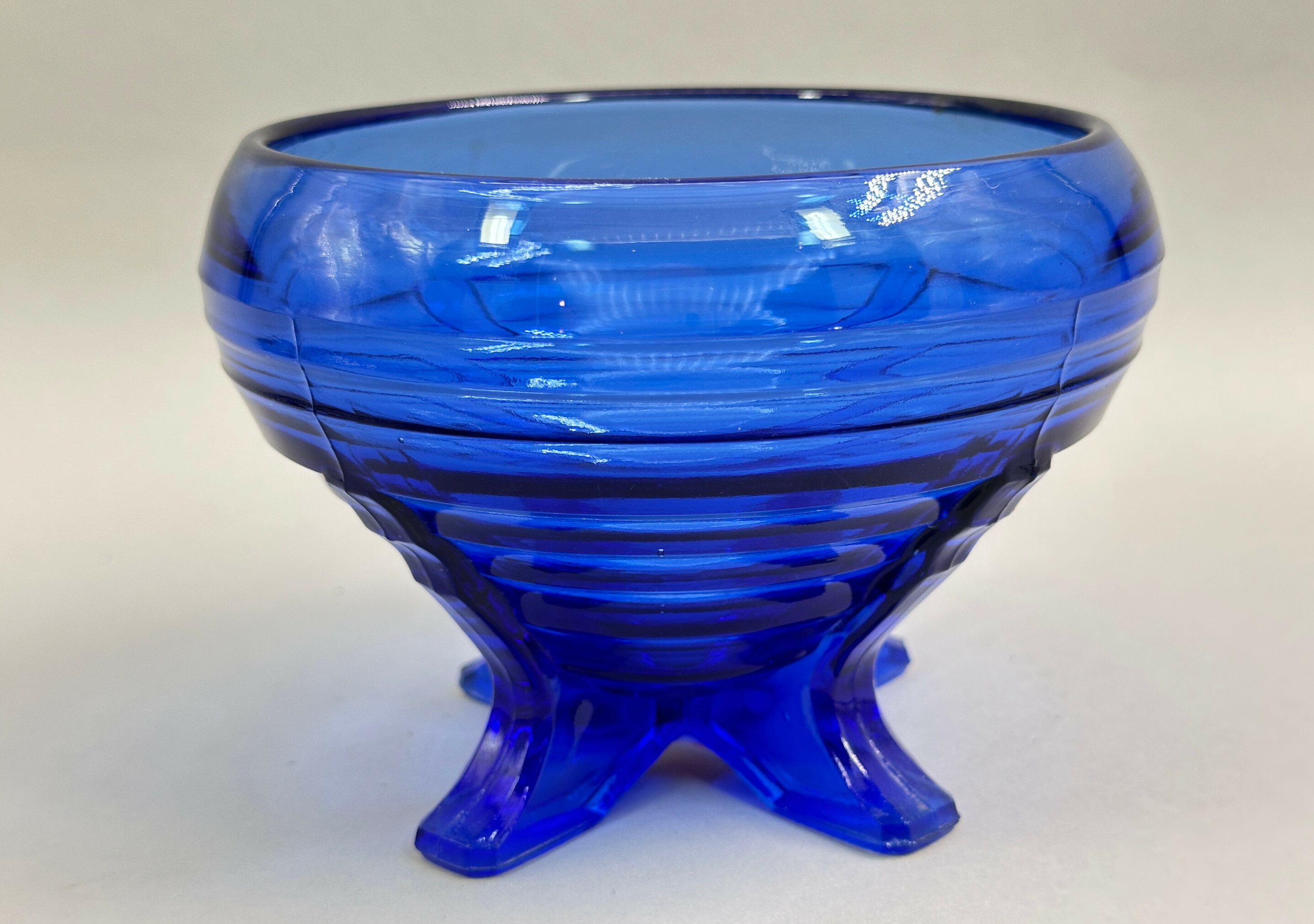
Sowerby Blue Glass Footed Bowl, 1930s/1940s
Price: £25The Sowerby family came from the North West of England near Carlisle and settled in Gateshead in the late eighteenth century. The firm Sowerby Glassworks is known from 1807 onwards and continued production until 1972, concentrating on pressed glass. Catalogues of their wares still exist and they produced pieces in a wide variety of styles and shapes which retain their popularity today.
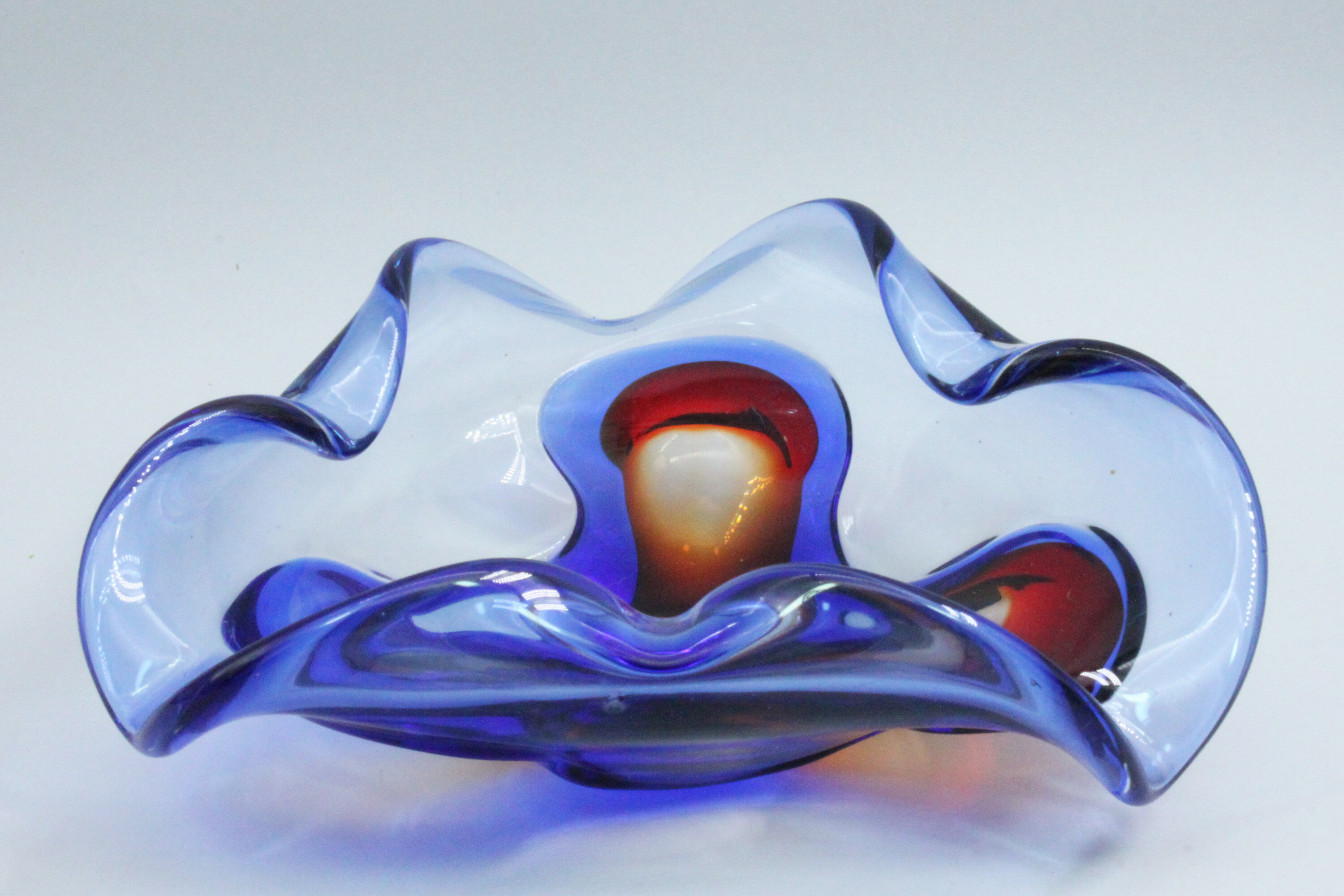
Murano Art Glass Dish, 1960s
Price: £55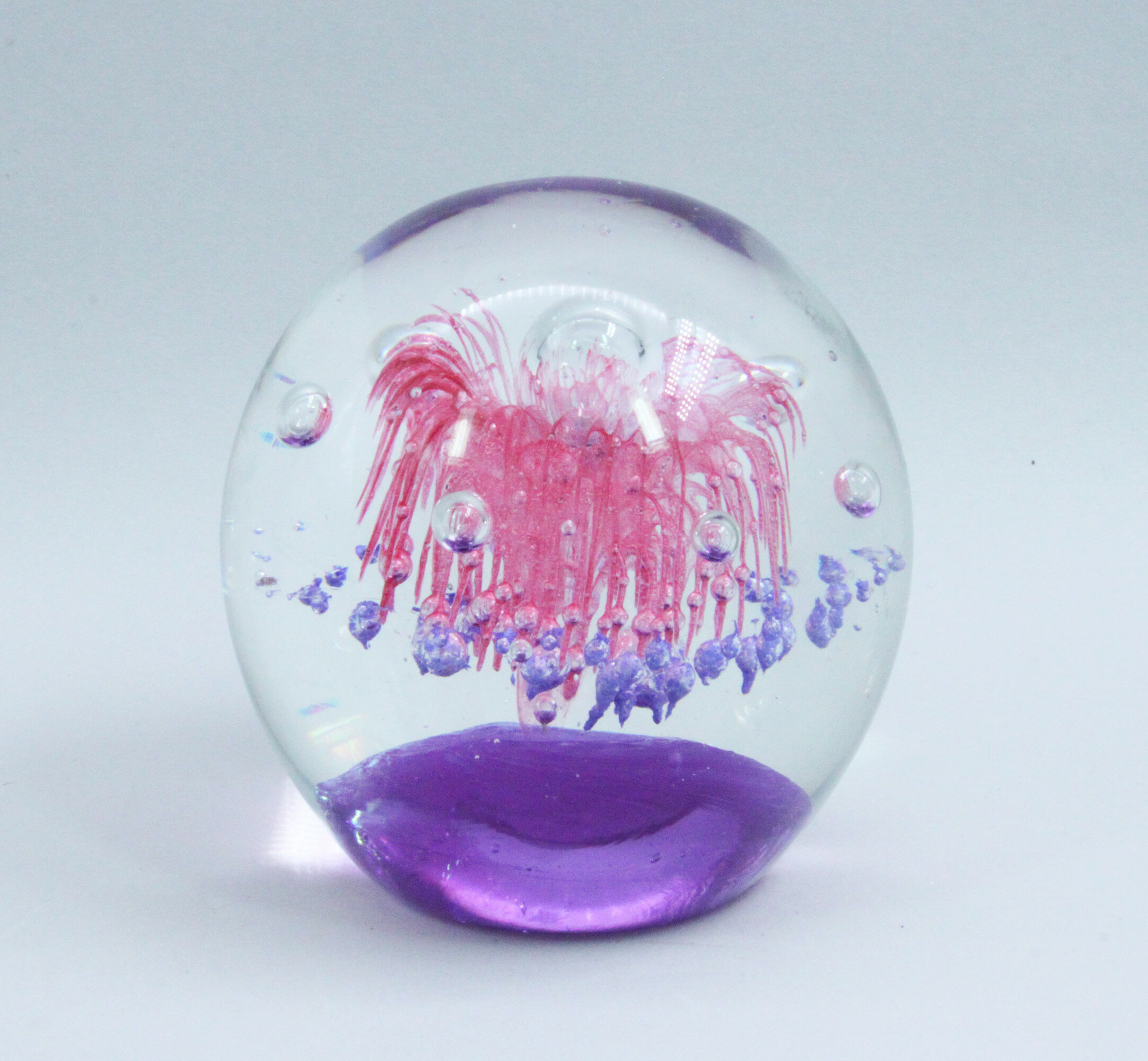
Art Glass Doorstop with Starburst and Bubble designs, perhaps British, late C20th
Price: £45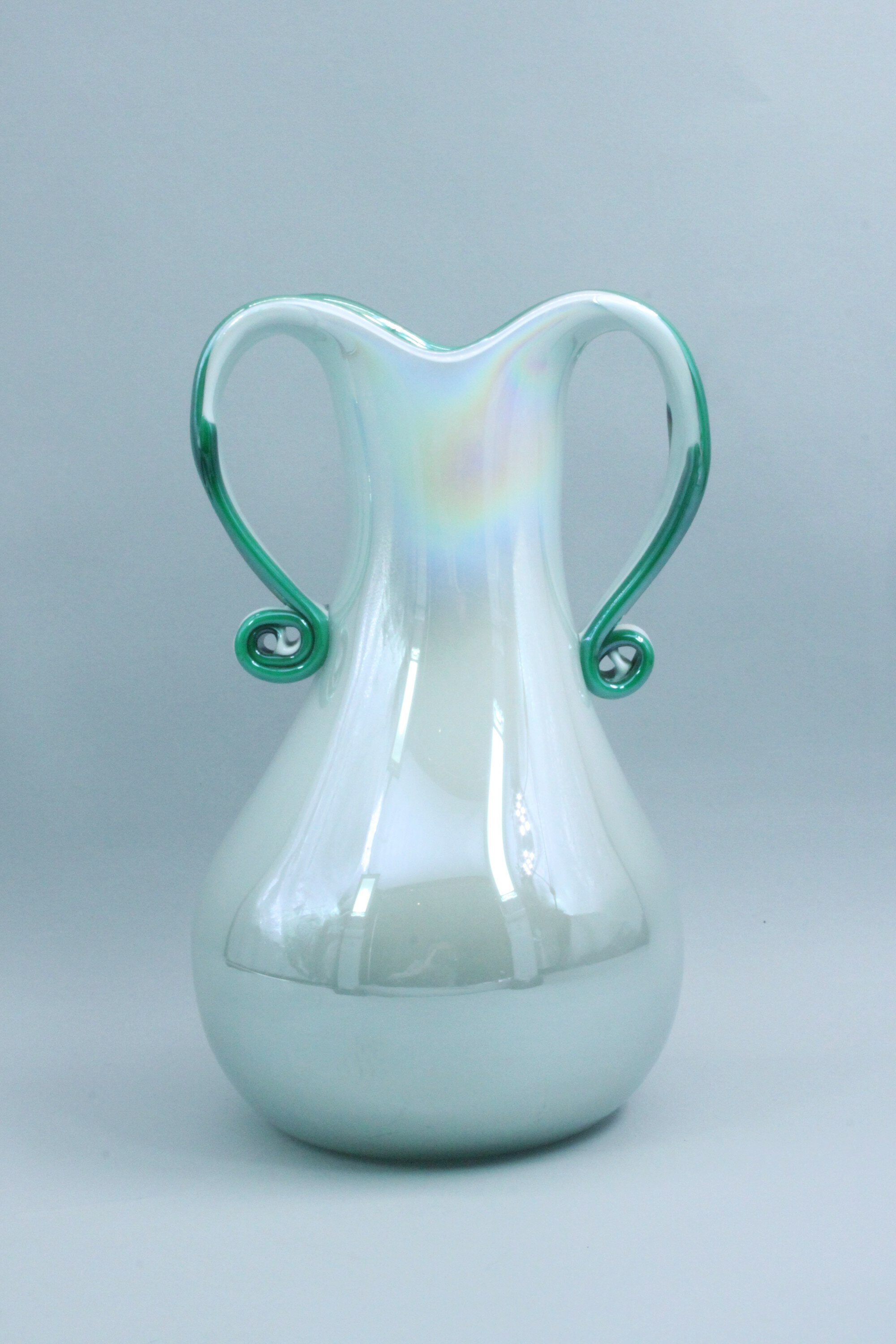
Iridescent art glass Vase with loop handles, possibly continental 1950s
Price: £45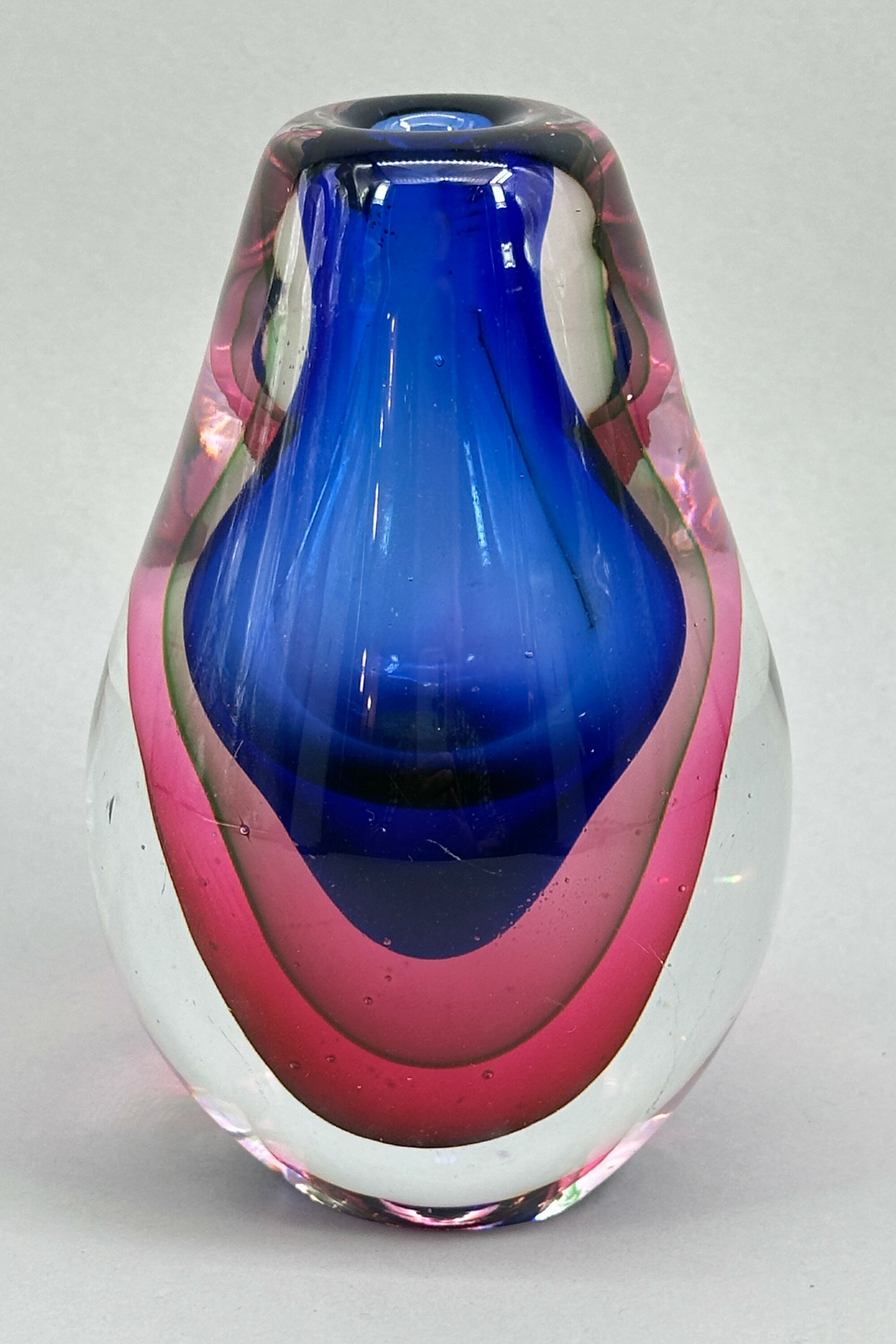
Murano glass four layer Sommerso tear drop shape Vase, 1960s
Price: £55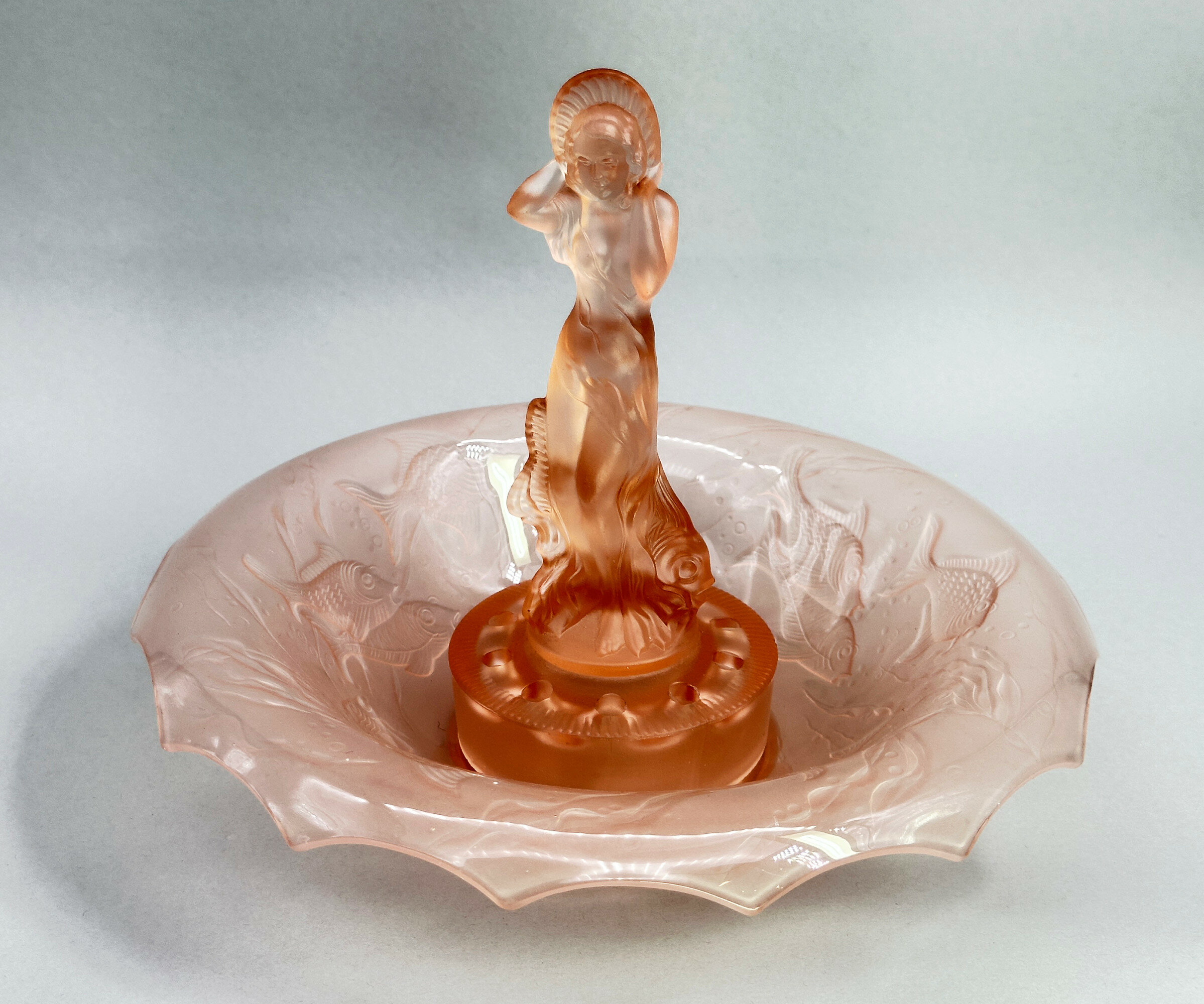
Pink Glass Centrepiece Set, Arabella, Walter and Sohne, 1930s
Price: £55The influence of Art Deco style of this piece is clear and it does indeed date to the 1930s. The model, termed ‘Arabella’ can apparently be seen in the 1934 catalogue of the German glass manufacturers Walther and Sohne, founded by August Walther in 1888 at Ottendorf-Akrilla near Dresden. In the 1930s the firm was famous for its Art Deco designs and also produced a version of ‘cloud glass’ which at one time was held to be exclusive to the English manufacturer Davidson. But some of the English glass makers also drew on their German rival’s work such that Walther and Sohne patented some of their designs in the UK in 1937, presumably to protect their work. This centrepiece set is a classic example of Walther and Sohne’s pre war productions and a distinctive example of Art Deco glassware.
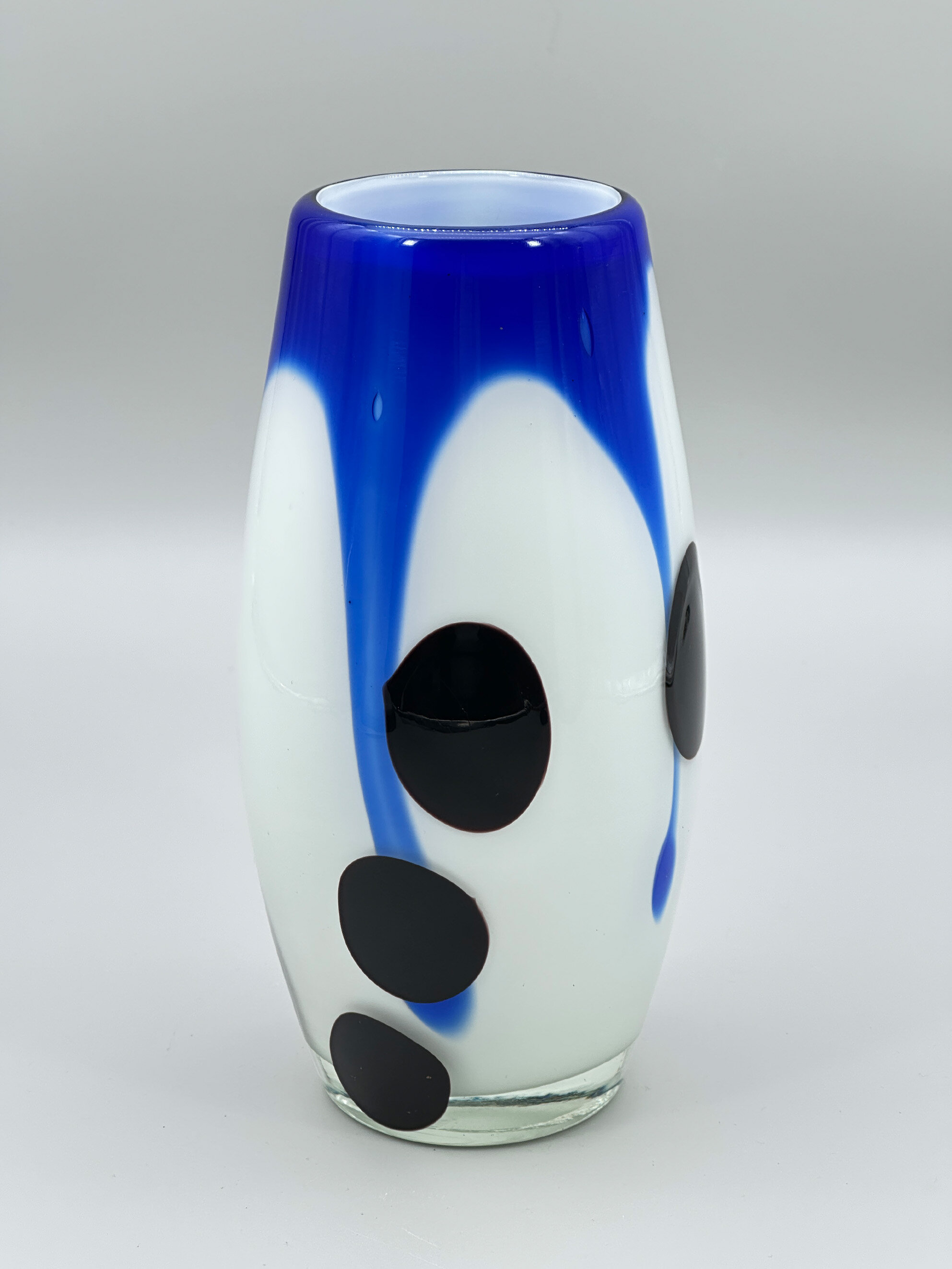
Art Glass Vase probably designed by Joanna Jellinek for IKEA, Swedish early C21st
Price: £35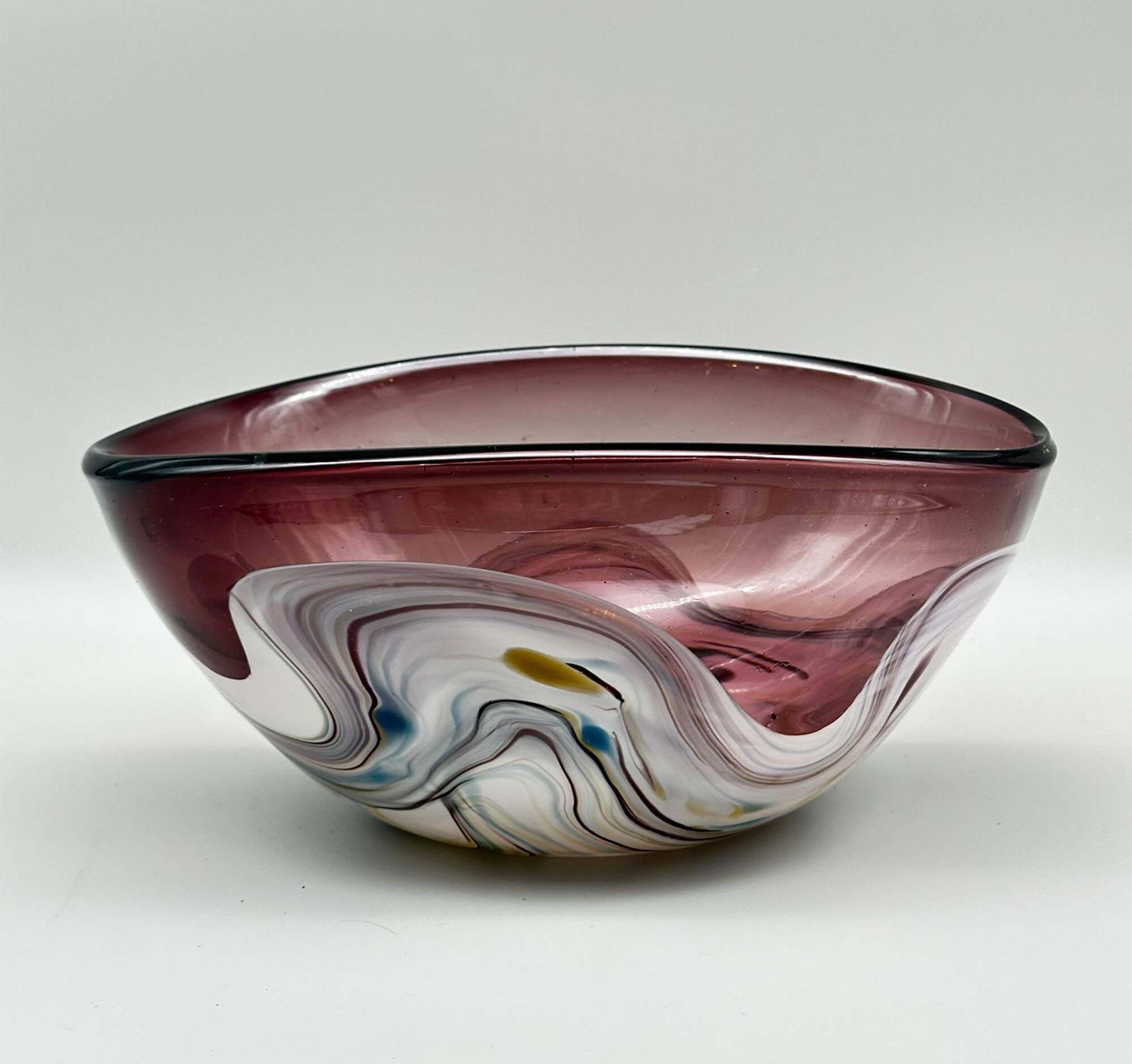
Purple art glass bowl with a streaky wave design, probably Italian late C20th
Price: £75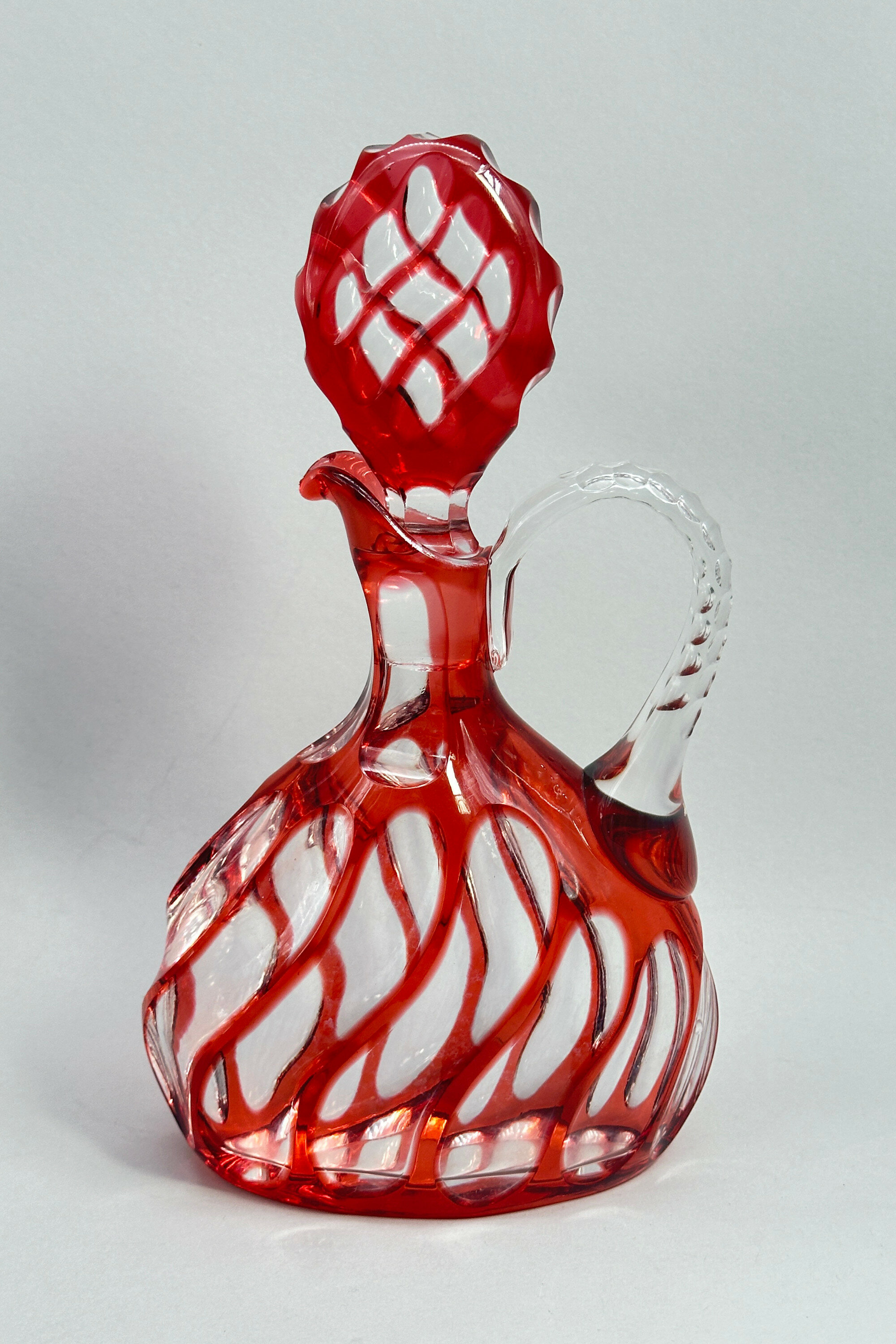
Swirl design Cranberry glass Decanter and Stopper, probably Italian mid C20th
Price: £45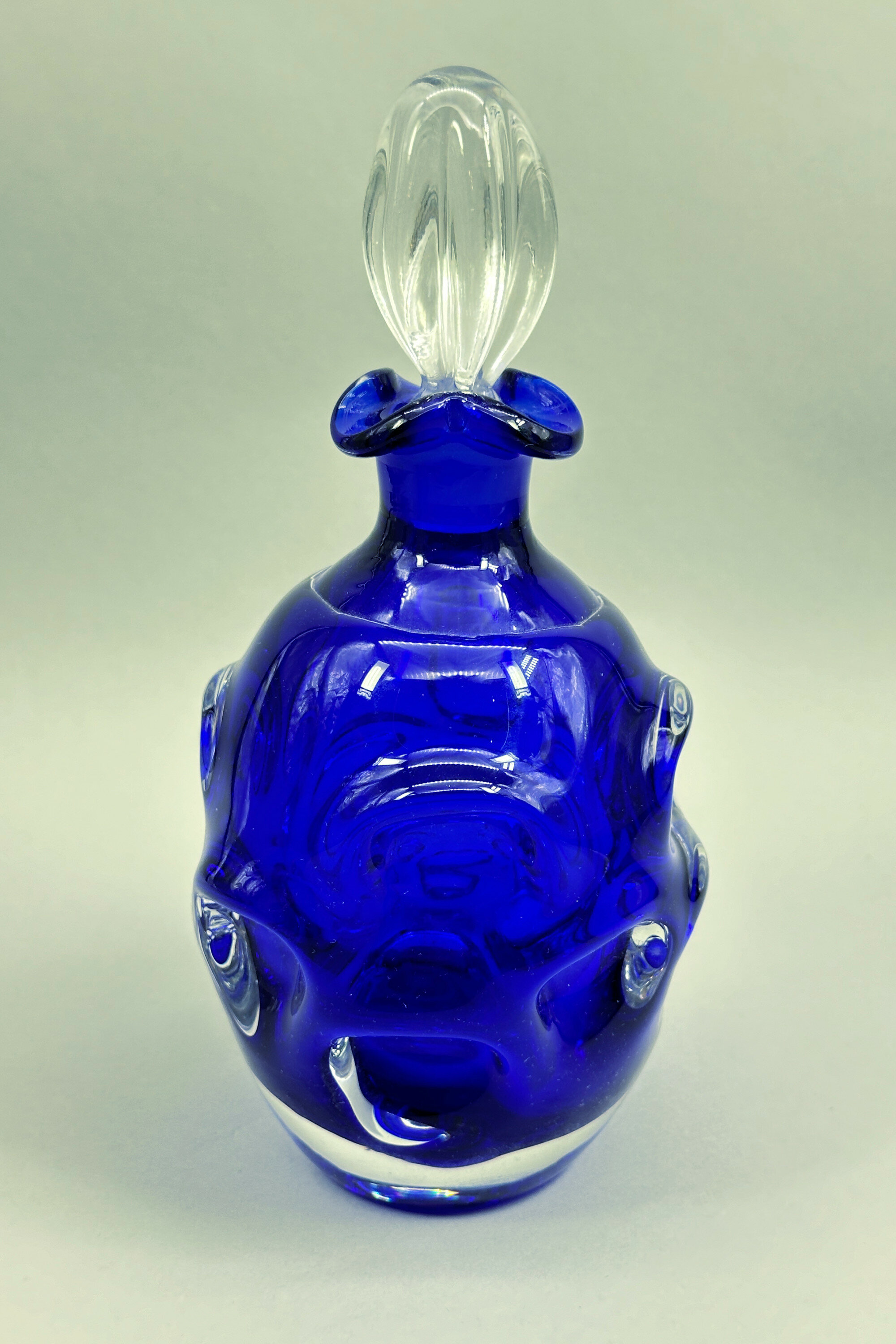
Aseda Glasbruk Blue Glass Bottle and Stopper by Bo Borgstrom, 1960s
Price: £55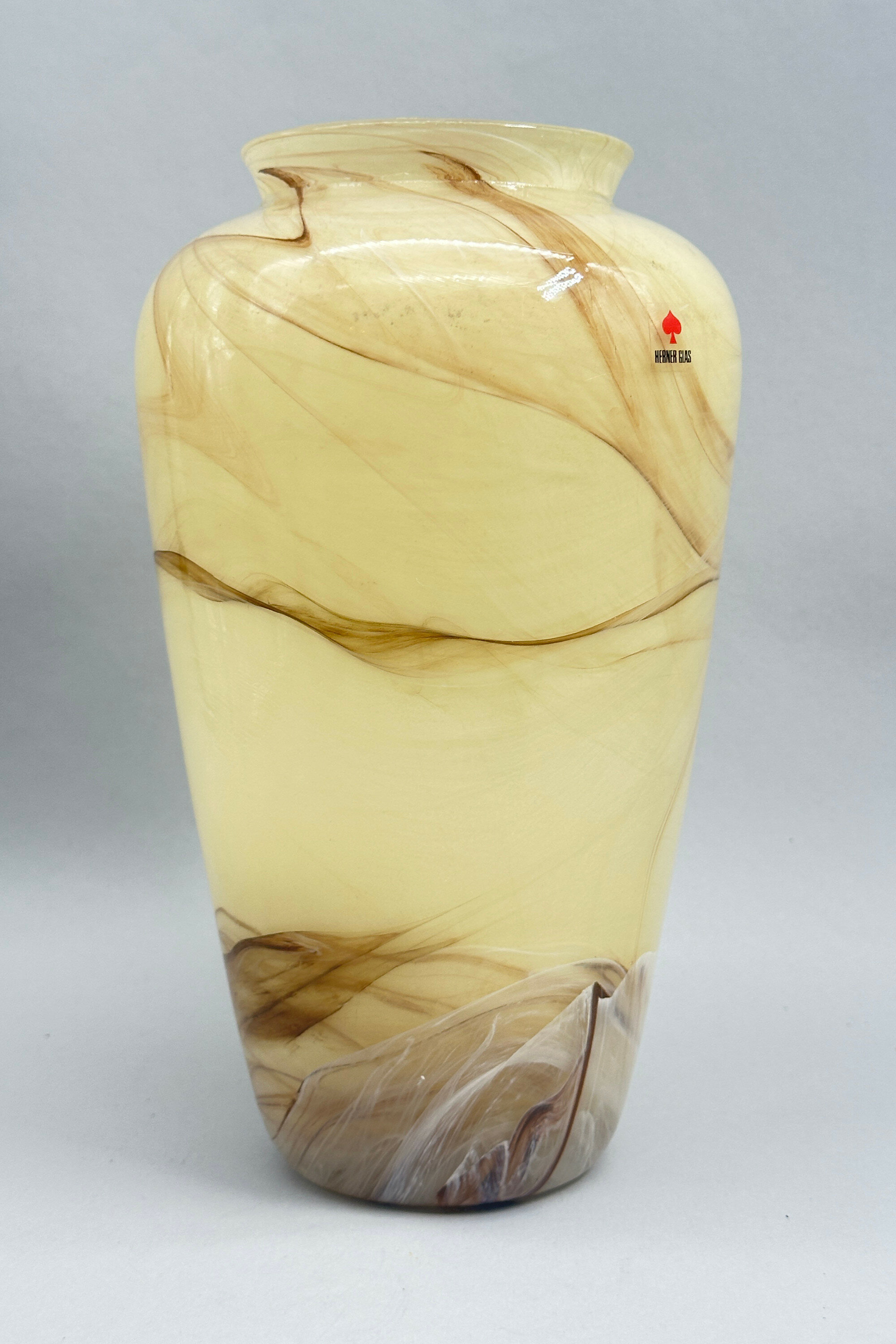
Tall glass swirl design Vase, Herner Glas Germany, late C20th
Price: £35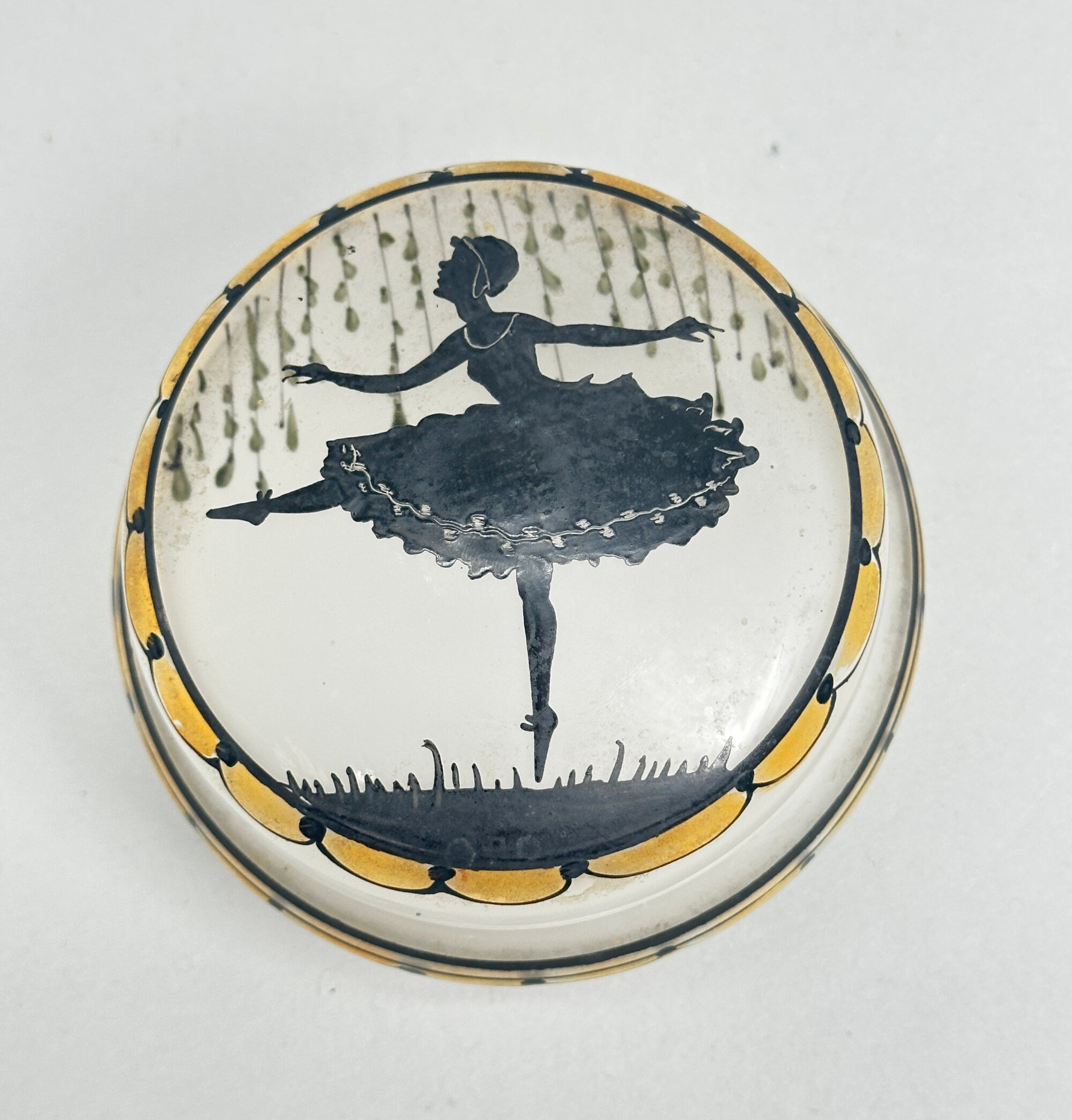
Art Deco style Glass Box and Cover decorated with a dancing Ballerina, mid C20th
Price: £35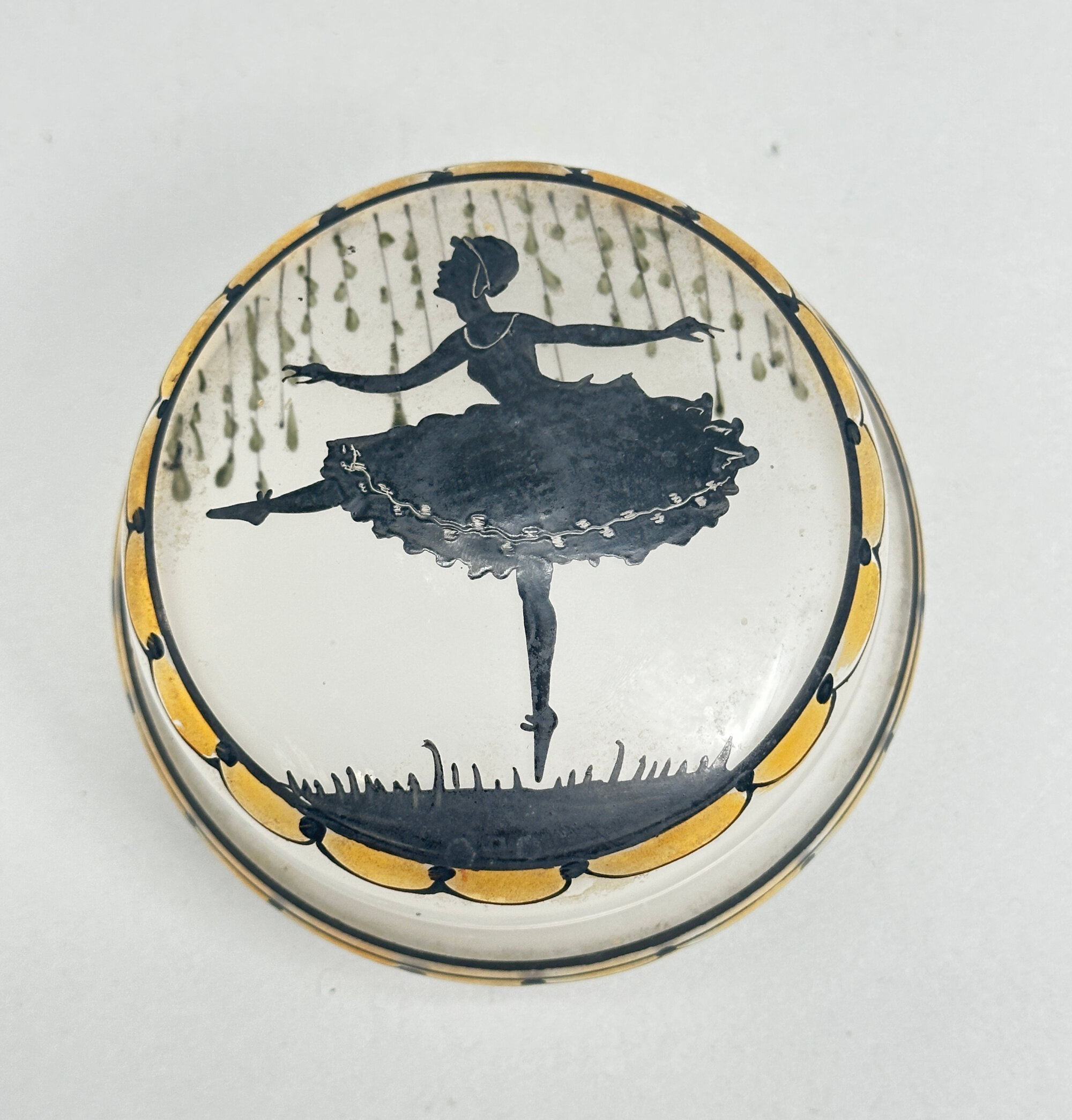
Art Deco style Glass Box and Cover decorated with a dancing Ballerina, mid C20th
Price: £35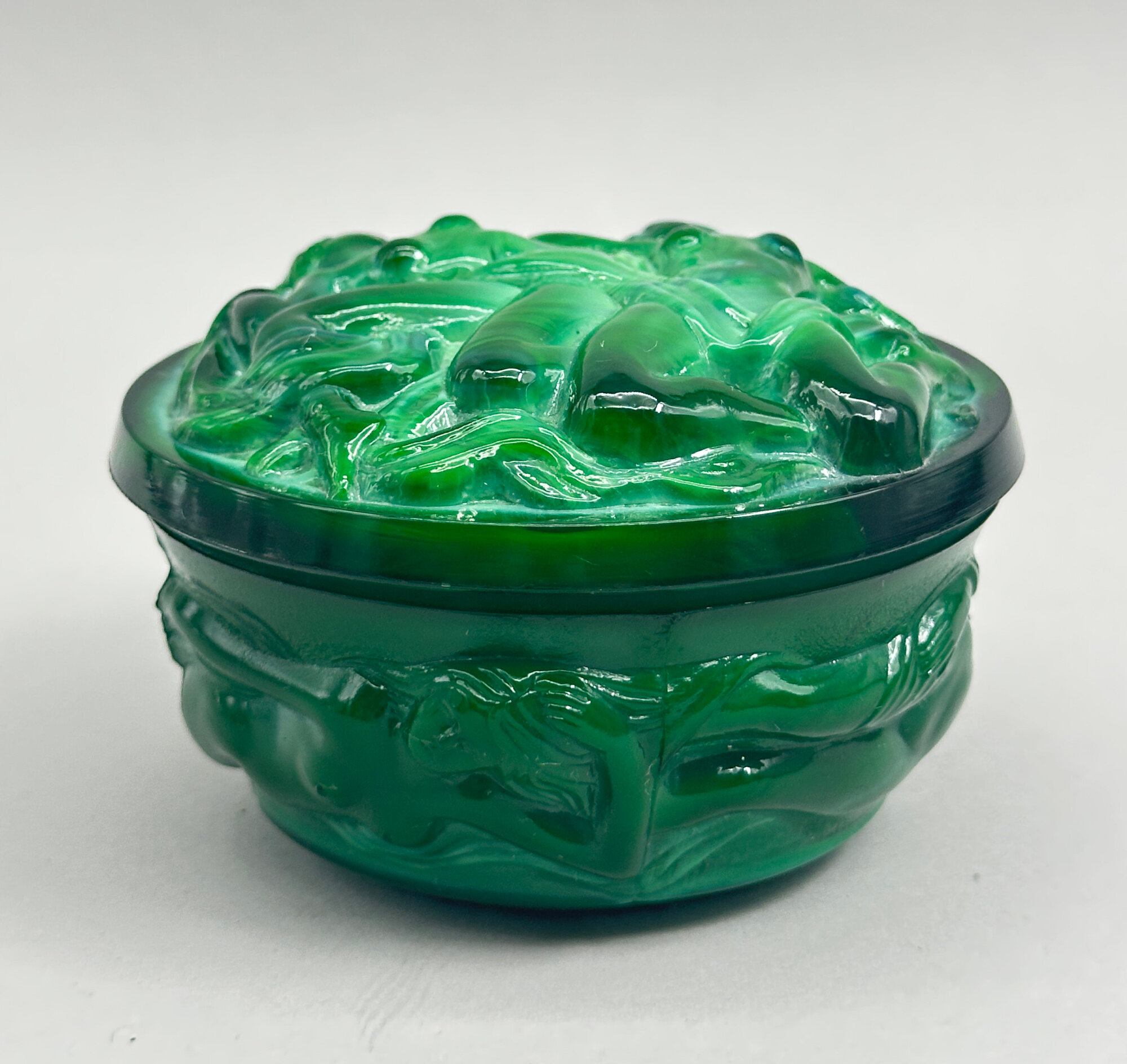
Art Deco Style Malachite Glass Box and Cover, Hoffmann & Schlevogt, C20th
Price: £55Heinrich Hoffmann (1875 – 1939) and Henry Schlevogt (1904 – 1984) were relatives as well as business partners, Schlevogt having married Hoffman’s daughter. They worked together on a variety of designs and from the moulds they produced came pieces exclusively pressed by the family glassworks of Josef Riedel established in Polaun (Polubný), Bohemia. The collection was marketed under the brand name ‘Ingrid’ and had an immediate success in Europe and the United States, being introduced at the Spring Trade Fair in Leipzig in 1934 and later in the same year presented at the Chicago World’s Fair. Hoffmann died around the time of the beginning of the second world war but Schlevogt remained in Bohemia until his capture by the invading Red Army in 1944. Eventually rescued through the intervention of influential friends, he settled in Paris and in the 1950s founded a highly successful wholesale business trading in crystals and glassware which he sold in 1972. The Czechoslovak government meanwhile nationalised the glass industry after World War II and some of Schlevogt’s moulds were reused with pressings known from the 1970s made as before at the glassworks of Josef Riedel.
Dating of the pieces is extremely difficult since the later versions resemble the earlier ones so closely and there are few firm guidelines. But the example here, even if there is the possibility that it does not date to the 1930s, is an extremely accurate reflection of the model types produced. The design is striking with the malachite effect glass formed into a two section box the deep base fitted with a shallow domed lid and both parts decorated with naked ladies swimming amidst waves in a swirling design of life and movement. The joins of the moulds can be clearly seen at the sides (see images 8 & 9). The style is quintessentially Art Deco and this is a ‘must have’ for collectors of pieces from that era.
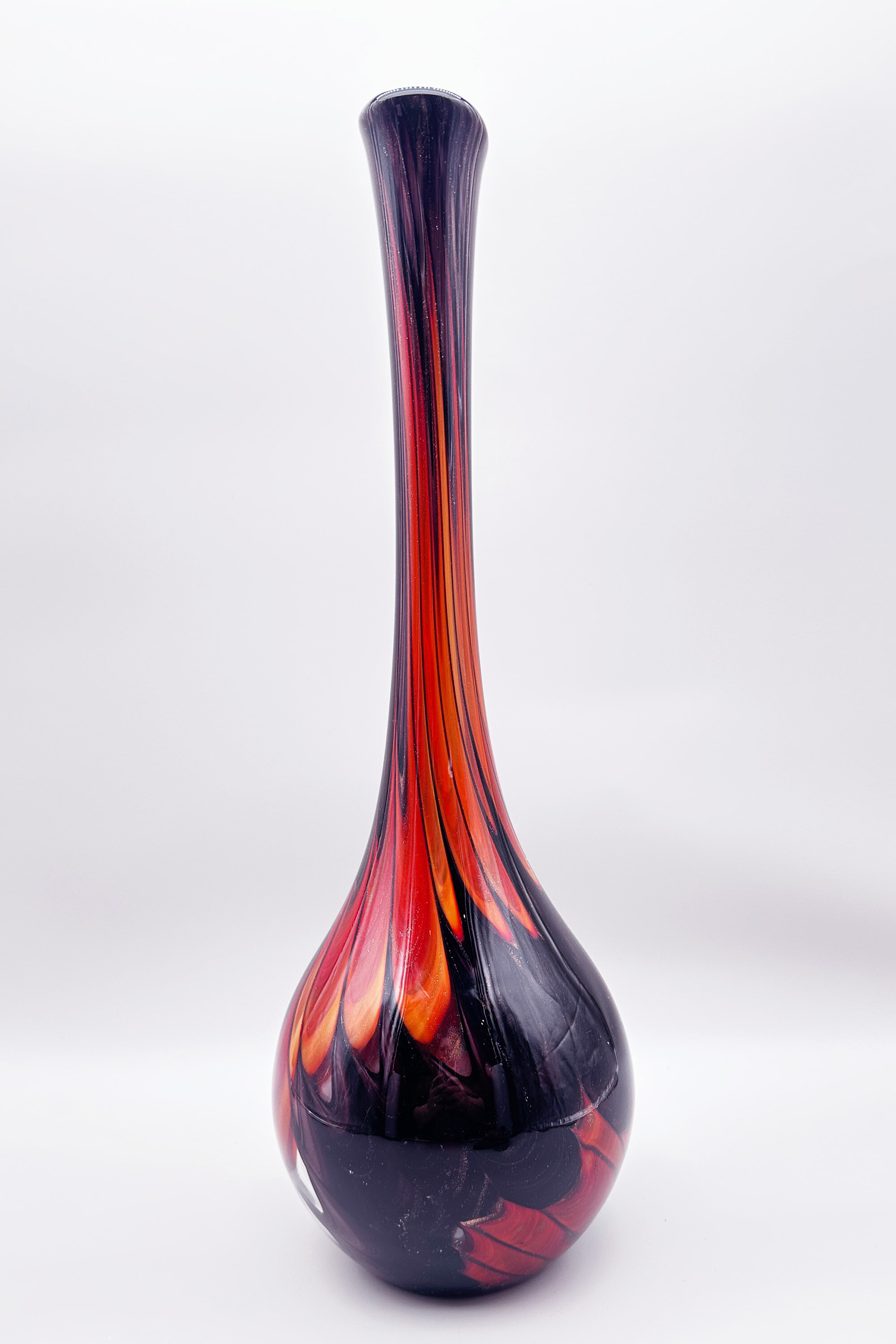
Tall Murano style bottle vase, second half C20th
Price: £150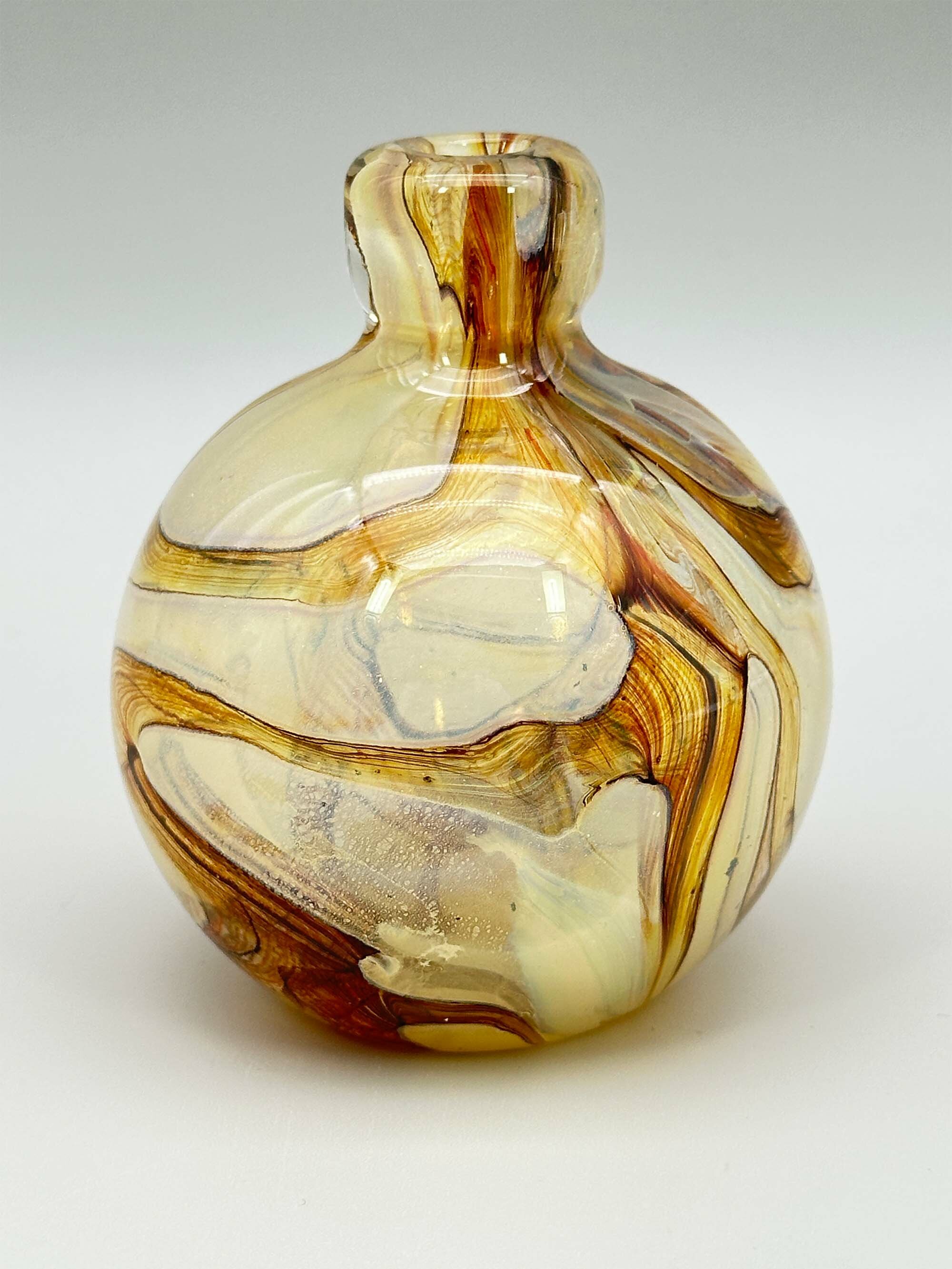
Mdina glass globular bottle vase, Earthtones pattern, second half C20th
Price: £25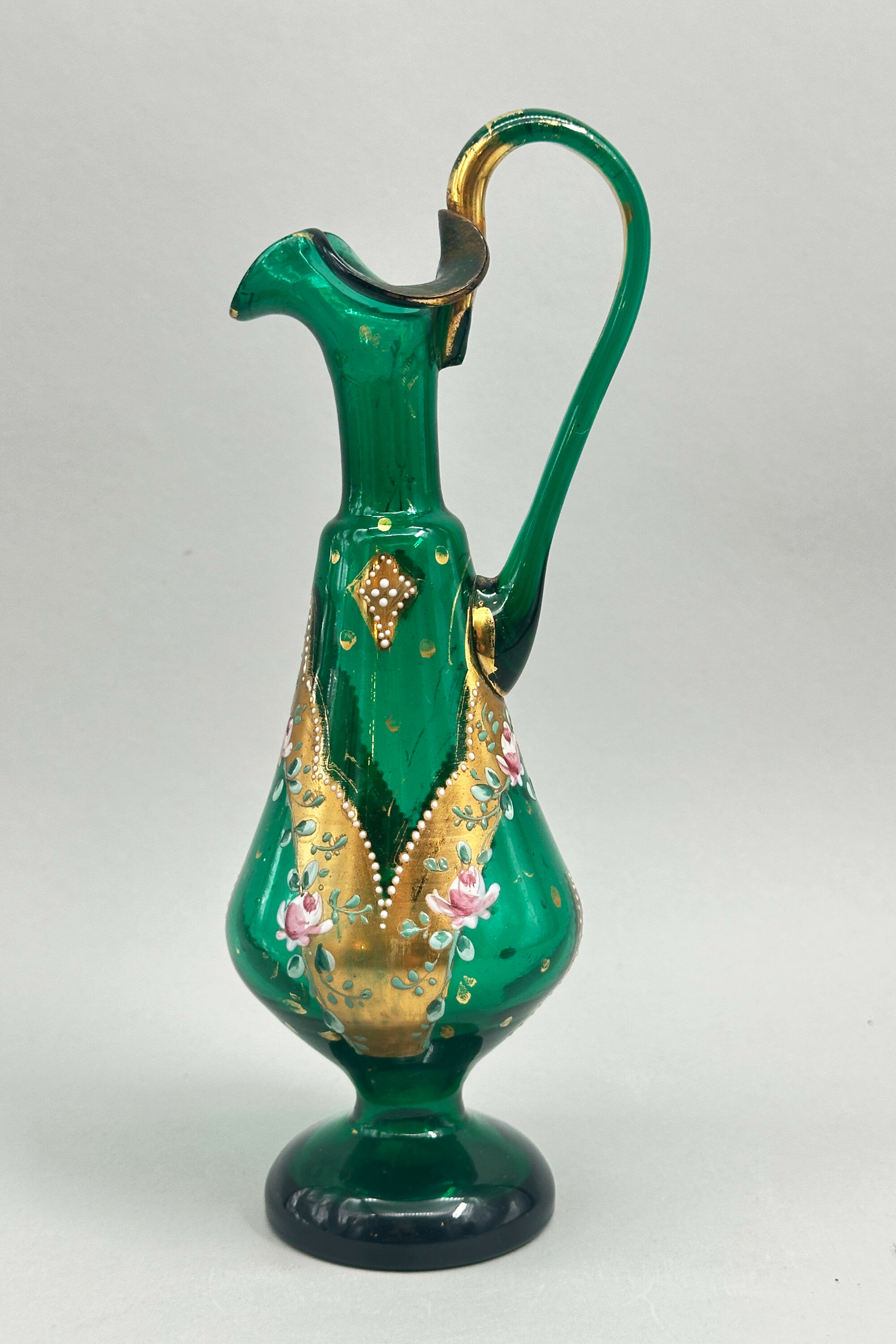
Bohemian Green Glass Moser style Ewer, late C19th
Price: £35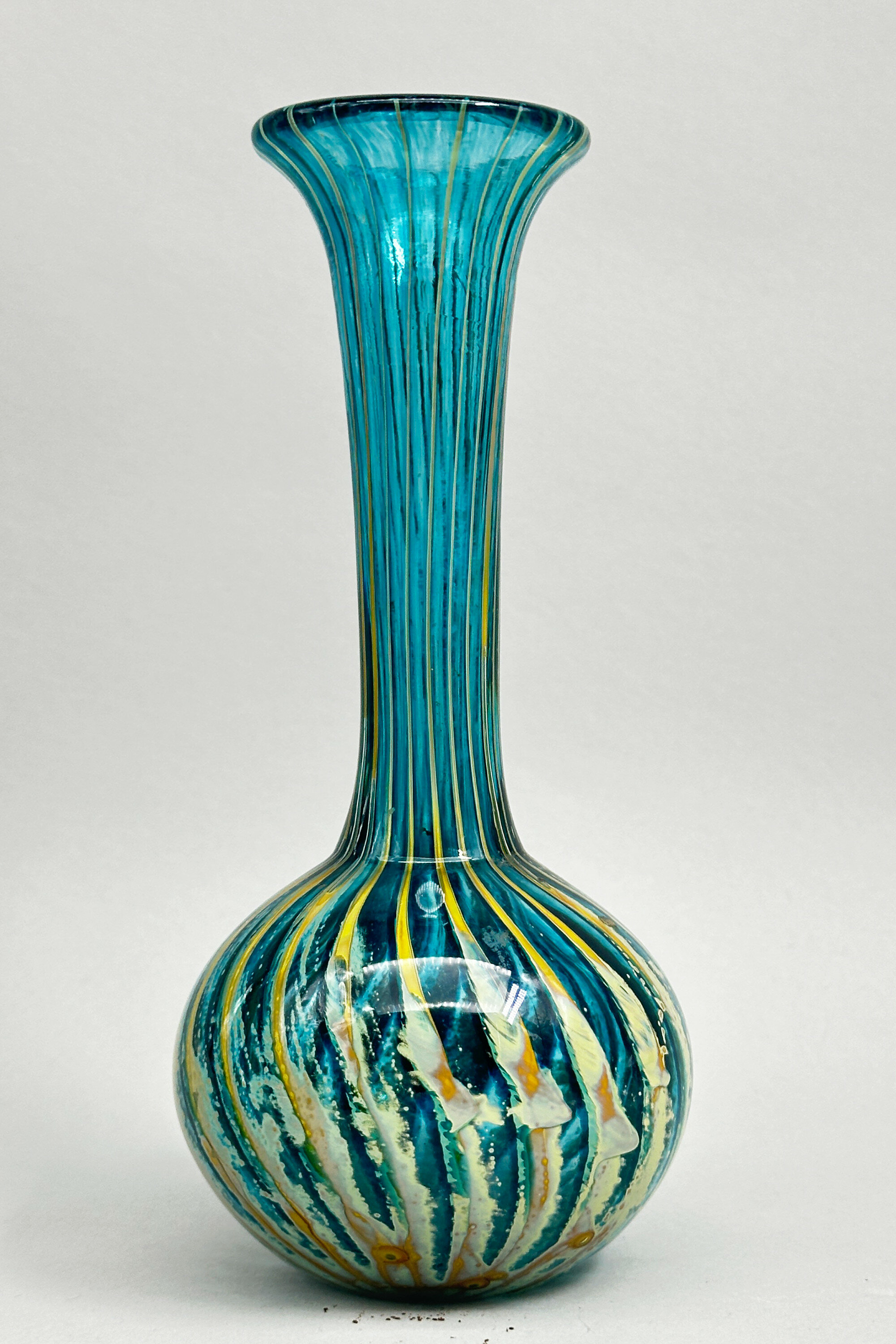
Phoenician Glass Vase, signed, late C20th
Price: £45Phoenician Glass was founded on Manoel Island, Malta in the 1980s by Leonard Sullivan, who had worked previously at Mdina Glass and many of his designs resembled those of his old employers. Certainly, the influence of Mdina and perhaps that of one of its founders, Michael Harris, can be seen here. Phoenician Glass took its name from the ancient Phoenician civilisation, which colonised Malta during the first millenium BC.
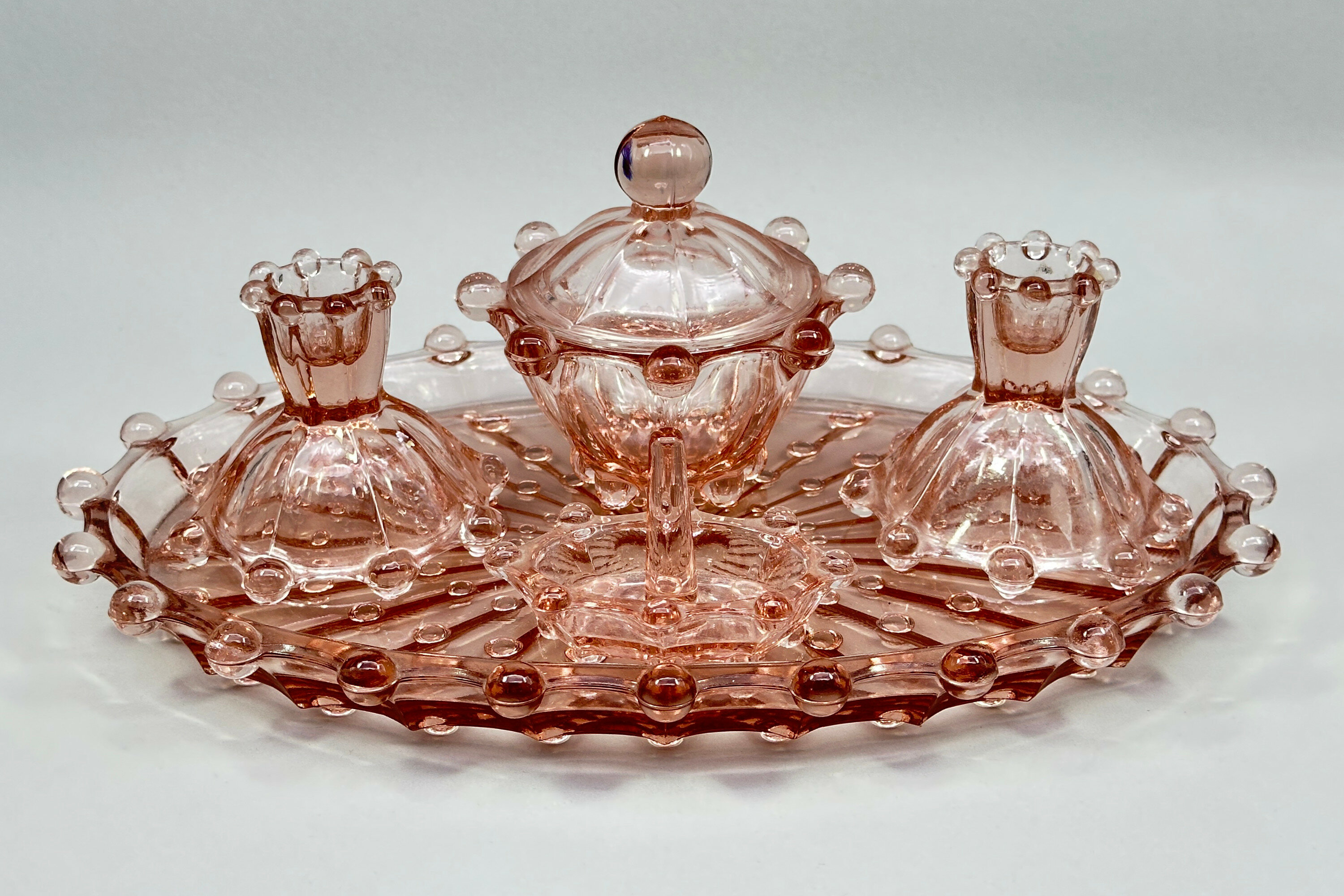
Pink pressed glass dressing table set, Libochoviche, Czech, 1950s
Price: £35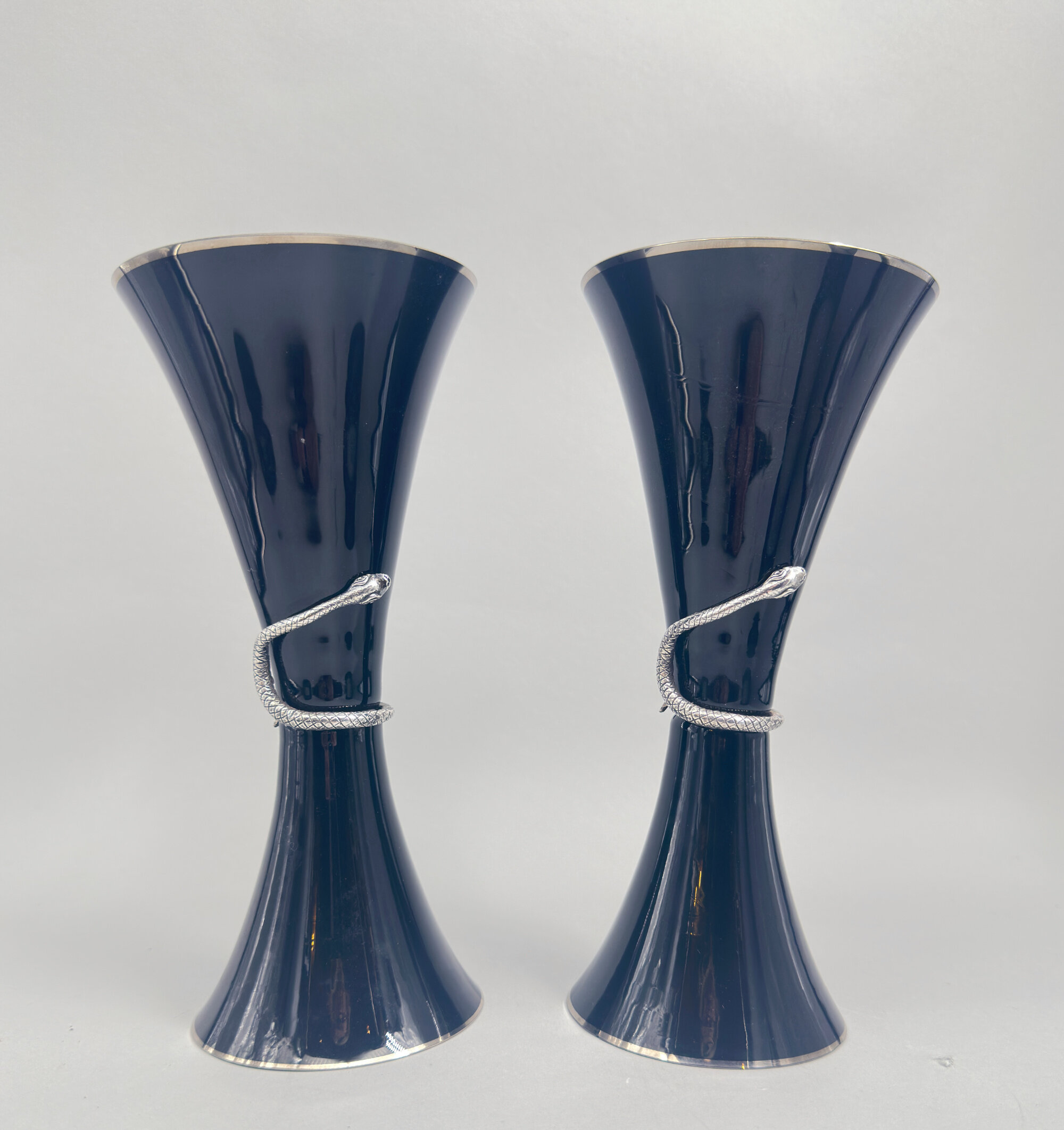
Pair of Art Deco glass Vases with applied silver snakes, 1930s
Price: £95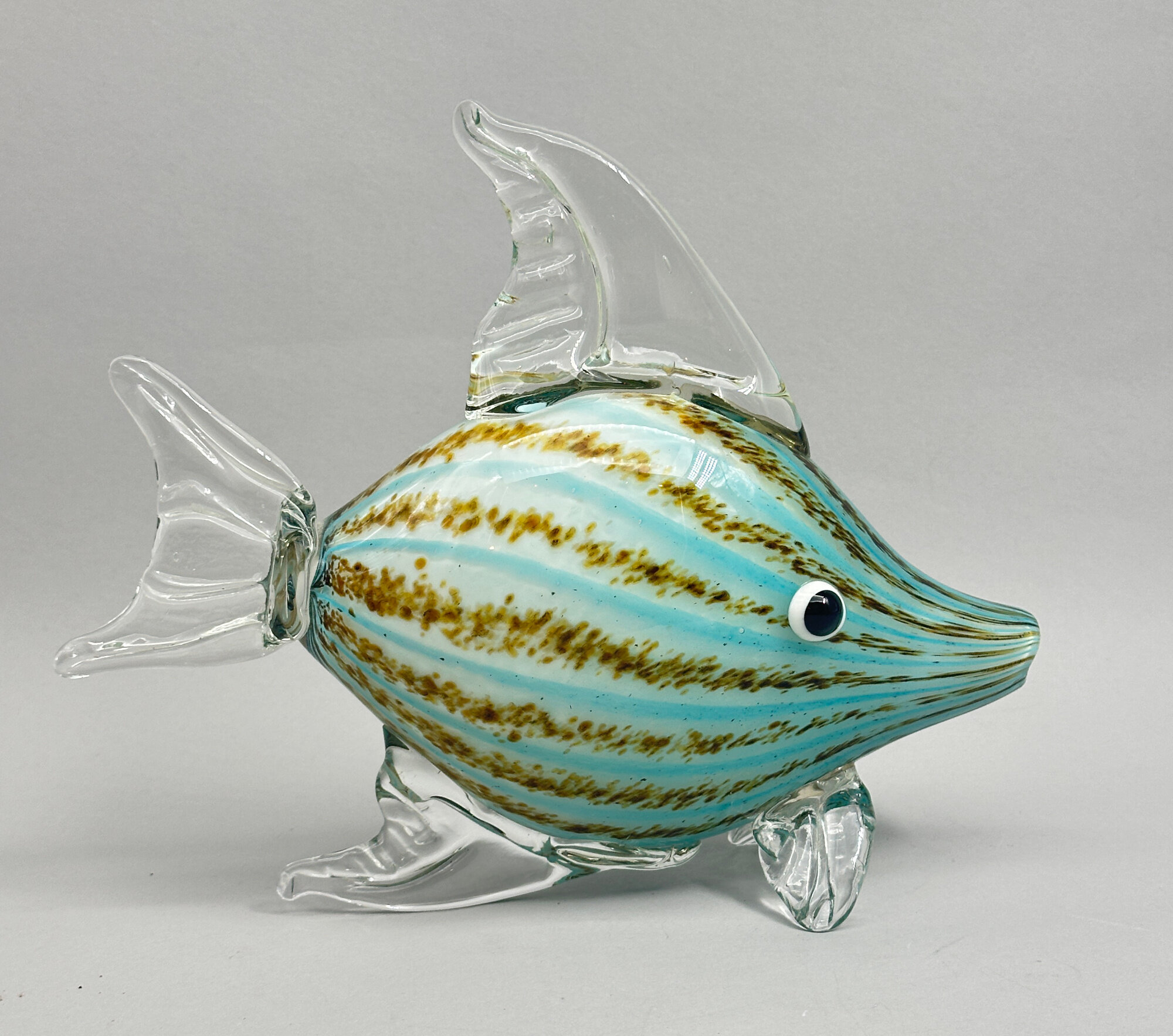
Murano Glass Fish, second half C20th
Price: £55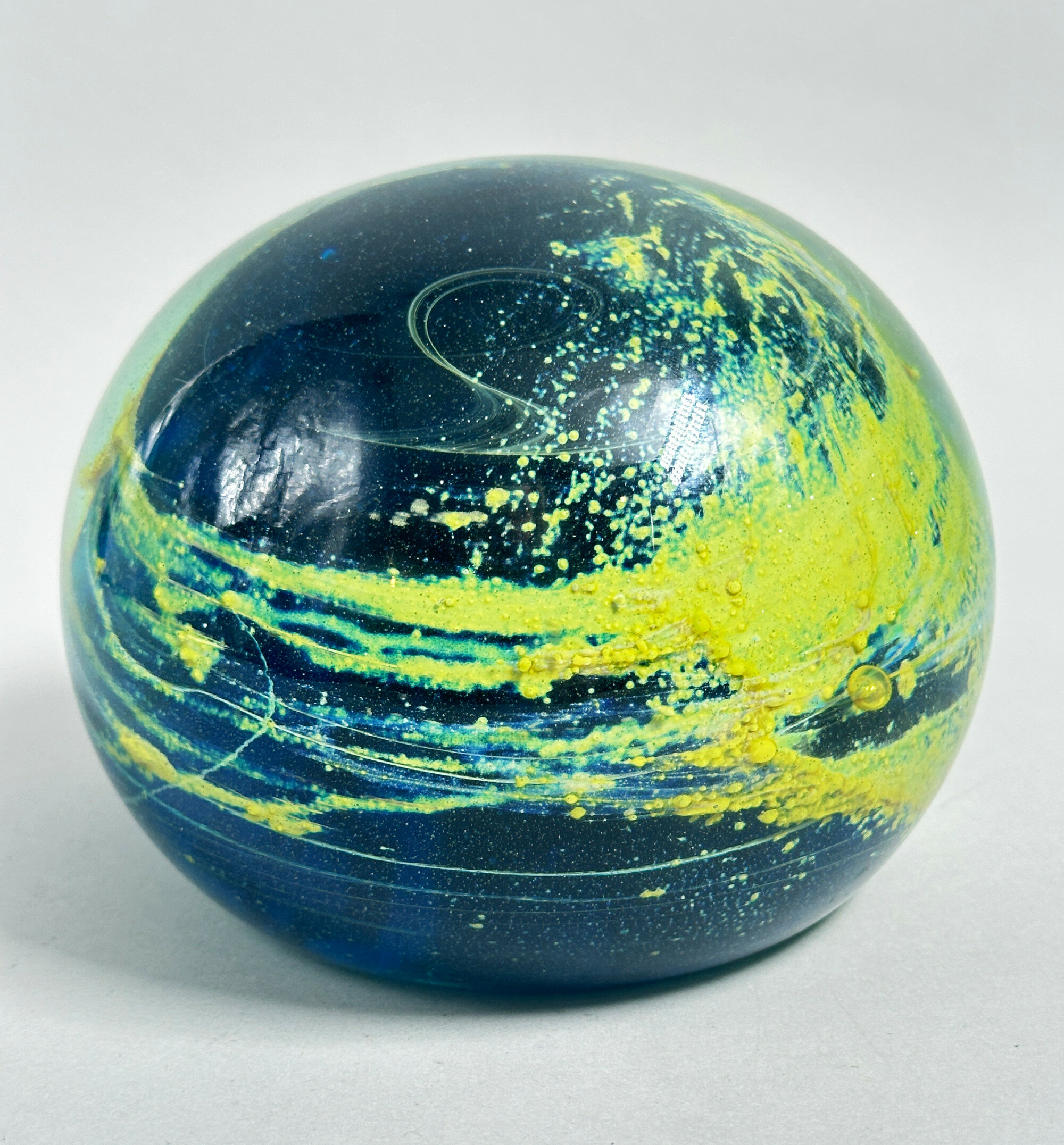
Large Mdina Glass Paperweight/Doorstop, late C 20th
Price: £55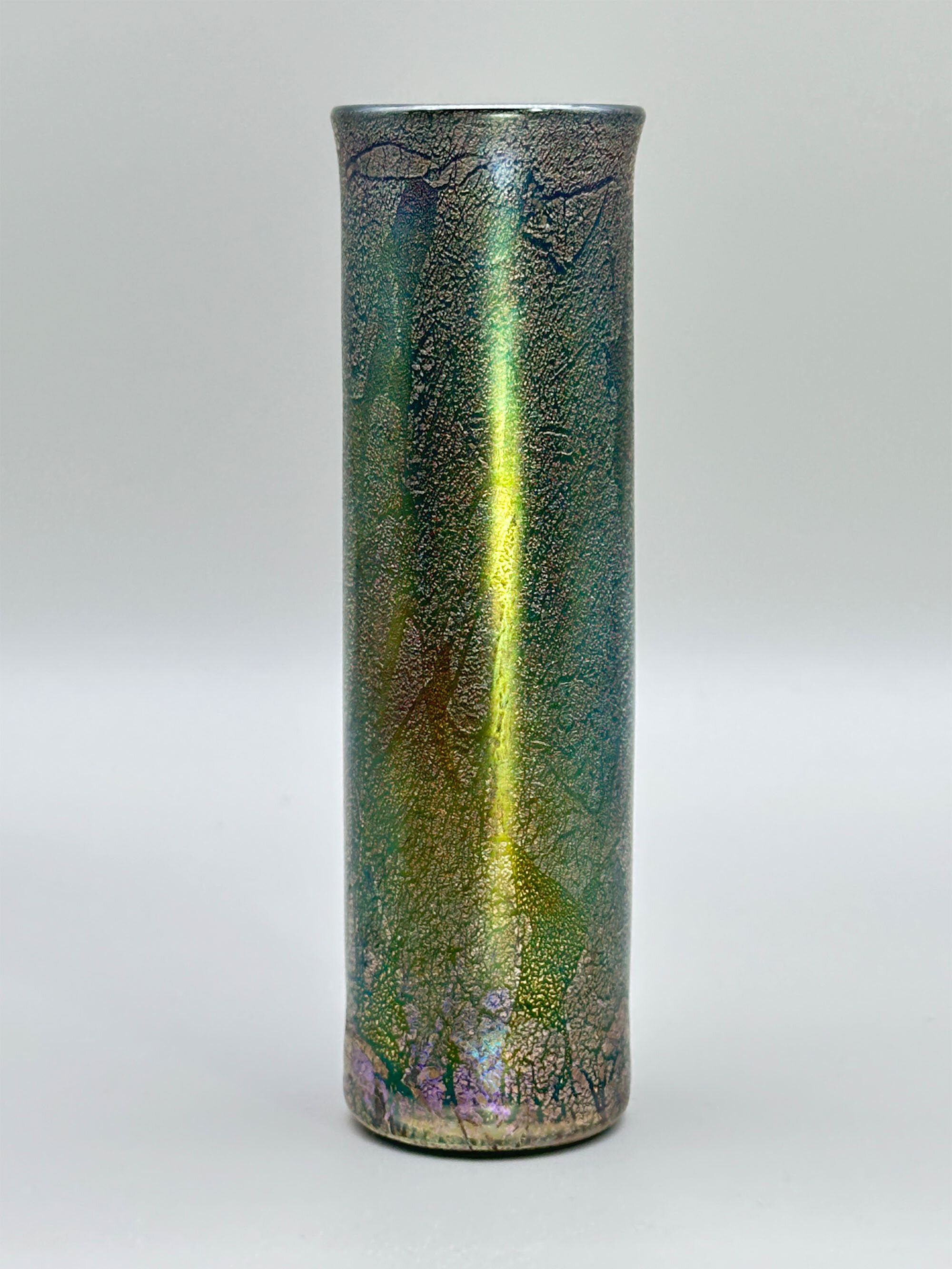
Iridescent glass spill vase, Isle of Wight Glass, second half C20th
Price: £55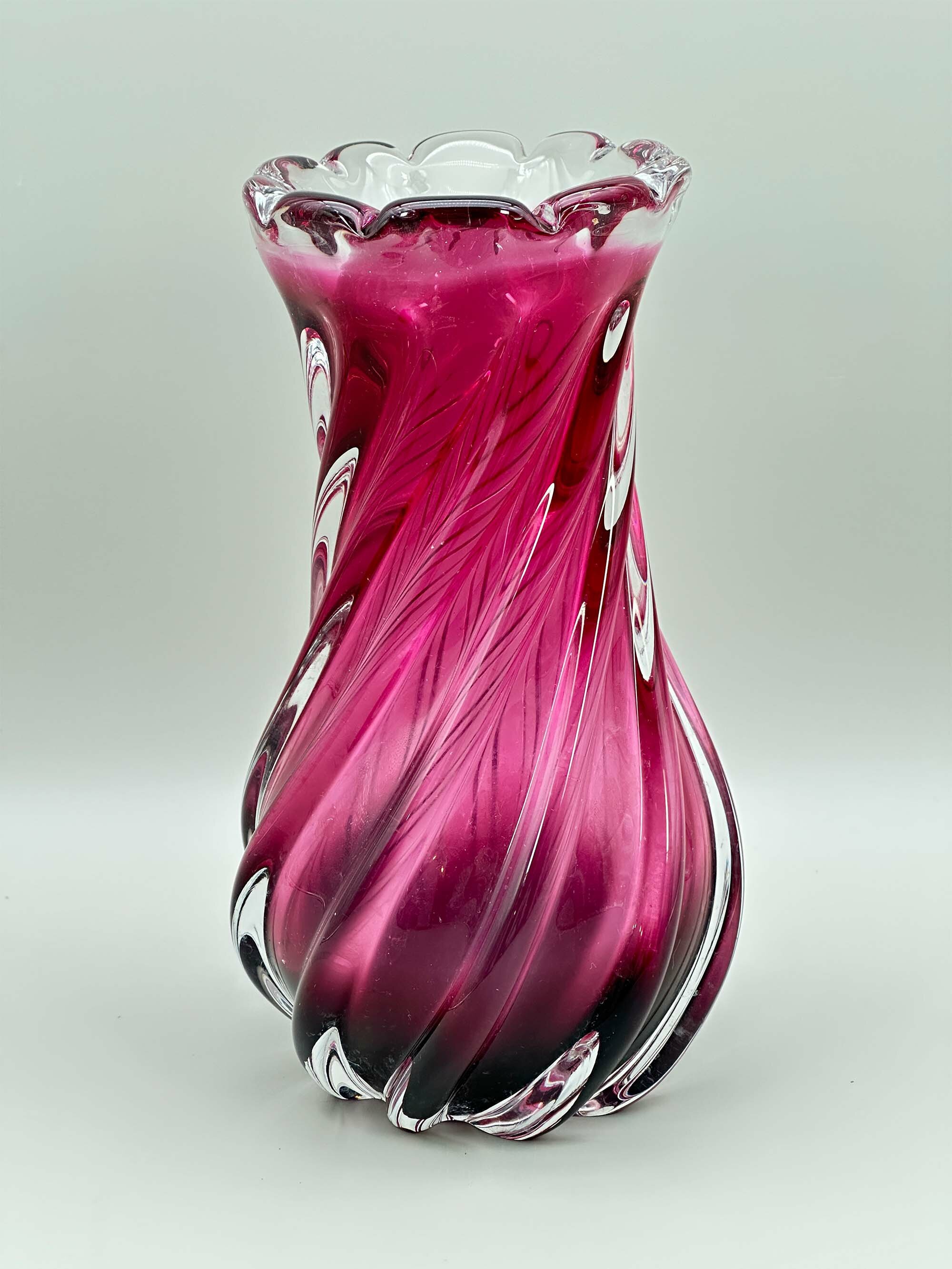
Cranberry art glass Vase, probably Chřibská, Josef Hospodka, Czech late C20th
Price: £55This design is generally attributed to the designer Josef Hospodka (1923-1989) who worked for the Chřibská glassworks in Czechoslovakia from 1950 to 1970 and again from 1985 to 1989. His organic, sculptural blown glass designs enjoyed great popularity and some remained in production after his death until the factory closed in 2007. There are catalogues from the factory and some of the pieces were also illustrated in the Czech Glass Revue where they were directly attributed to Hospodka. There does not appear to be either a catalogue entry for this vase or any mention of it in the journal, but the general style is extremely close to known works by him and the attribution is reasonably safe. Chřibská pieces were distinguished by their vibrant colours, flowing forms, weight and a smooth polished base, all of which are present here making this a fine example of their productions.
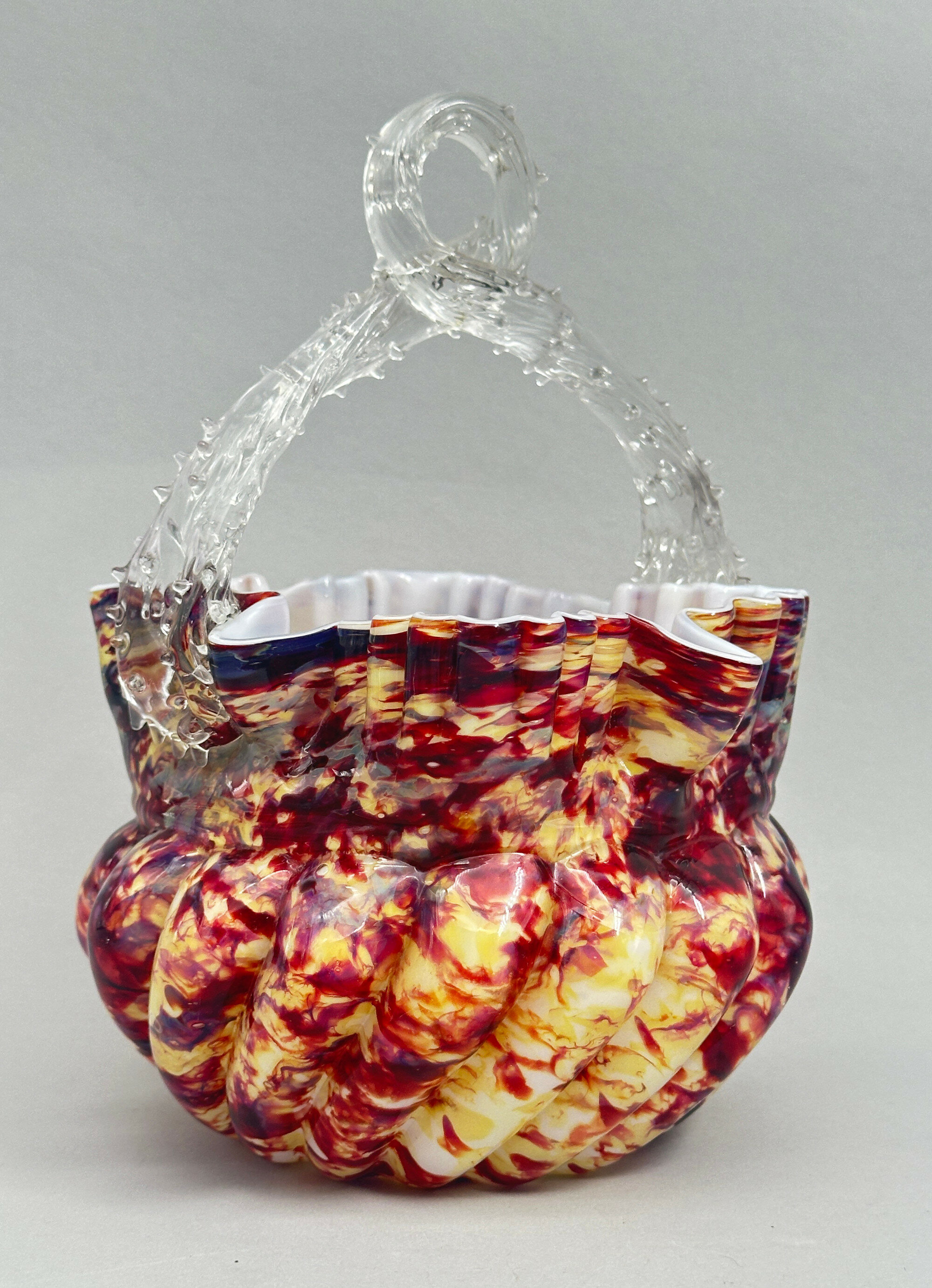
Spatter Glass Basket with thorn rope twist handle, probably Stourbridge, late C19th
Price: £75The 'spatter’ technique was known from Roman times but enjoyed something of a renaissance in the Victorian era when there was a general revived interest in the glass making techniques of the ancient world. Similar baskets are normally associated with the glassmakers at Stourbridge, Worcestershire, a centre of glass production since the 1600s, and this seems the most likely source of this piece, with a dating to the late nineteenth century. It is an excellent example of the type and remains in fine condition.
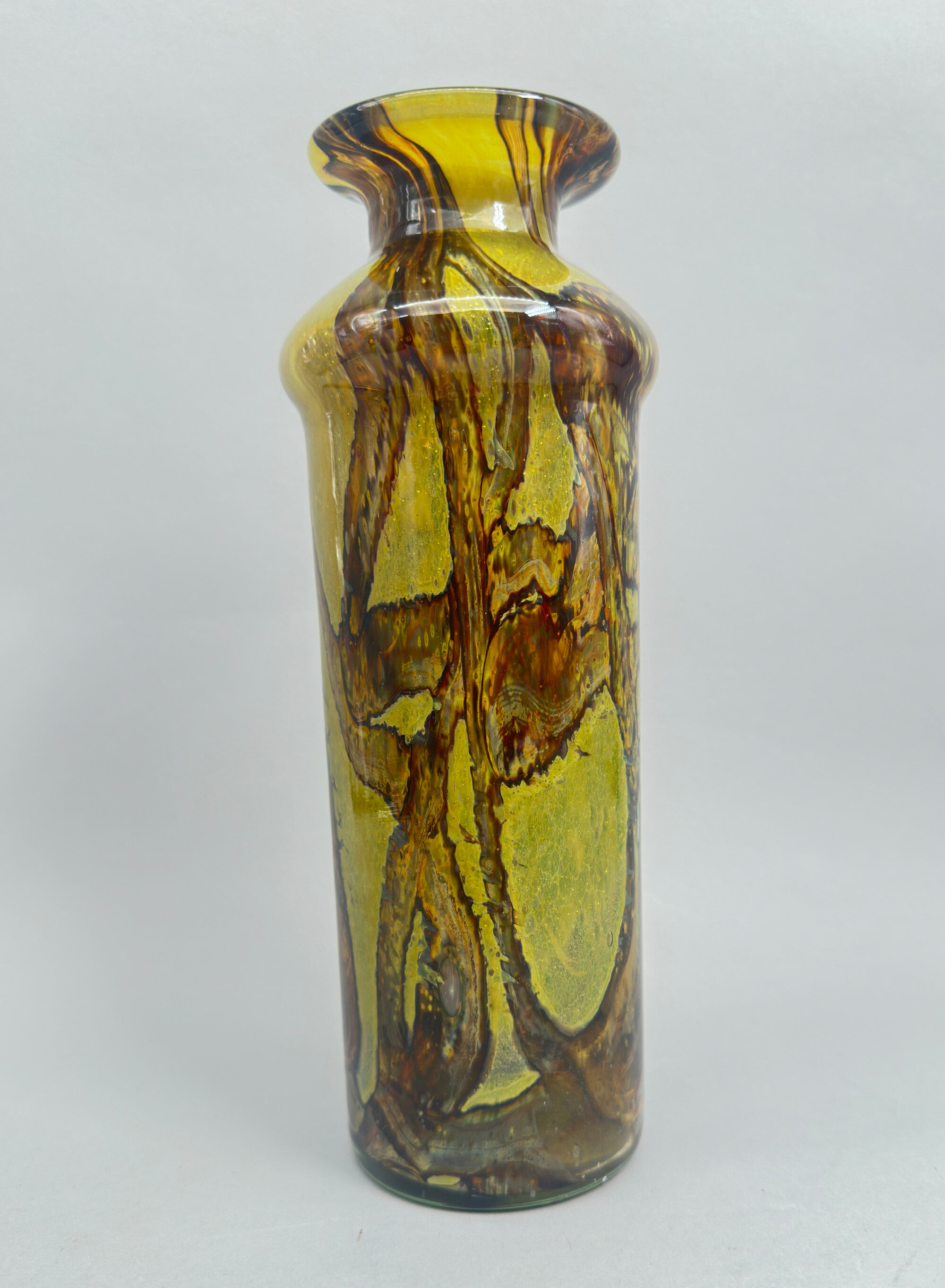
Mdina Earthtones Pattern Vase, late C20th
Price: £55Mdina Glass was founded in the Maltese town of Mdina in 1968 by Michael Harris and Eric Dobson. The town had no history of glass making but the venture proved to be a success. Its wares, free formed organic glassware, often in colours inspired from the sea, sand, earth and sky, proved very popular with tourists visiting Malta. Michael Harris left Mdina in 1972 and formed a new company, Isle of Wight Studio Glass, on the Isle of Wight, UK, leaving Eric Dobson in charge, but many of the designs he created continued to be made at Mdina Glass after his departure although new designs and patterns were added as well of which this vase is an example. Ownership of the company later changed but it is still producing a popular range of glasswares today.
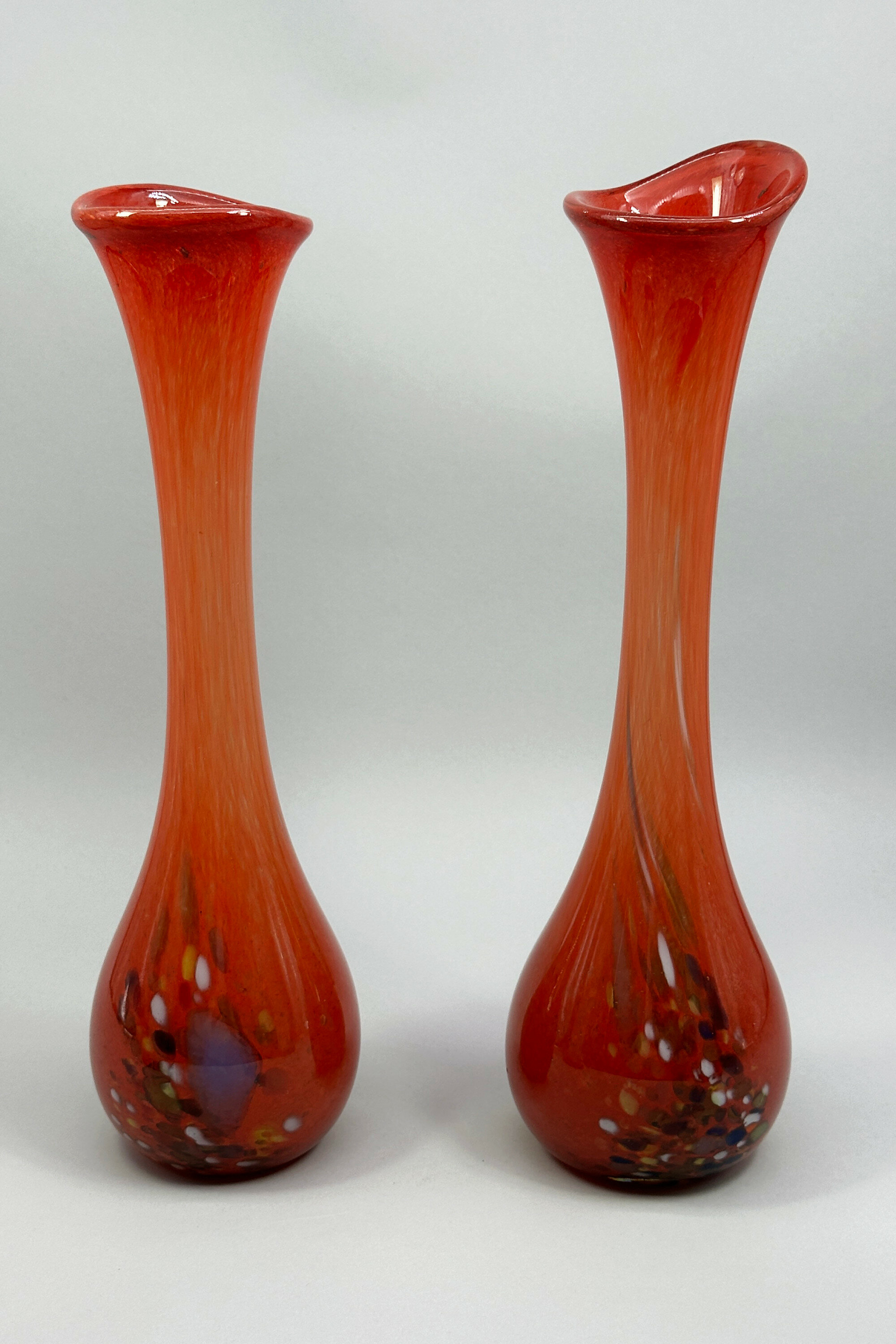
Pair of slender red glass bottle Vases, probably Joska Kristall, Germany, late C20th
Price: £85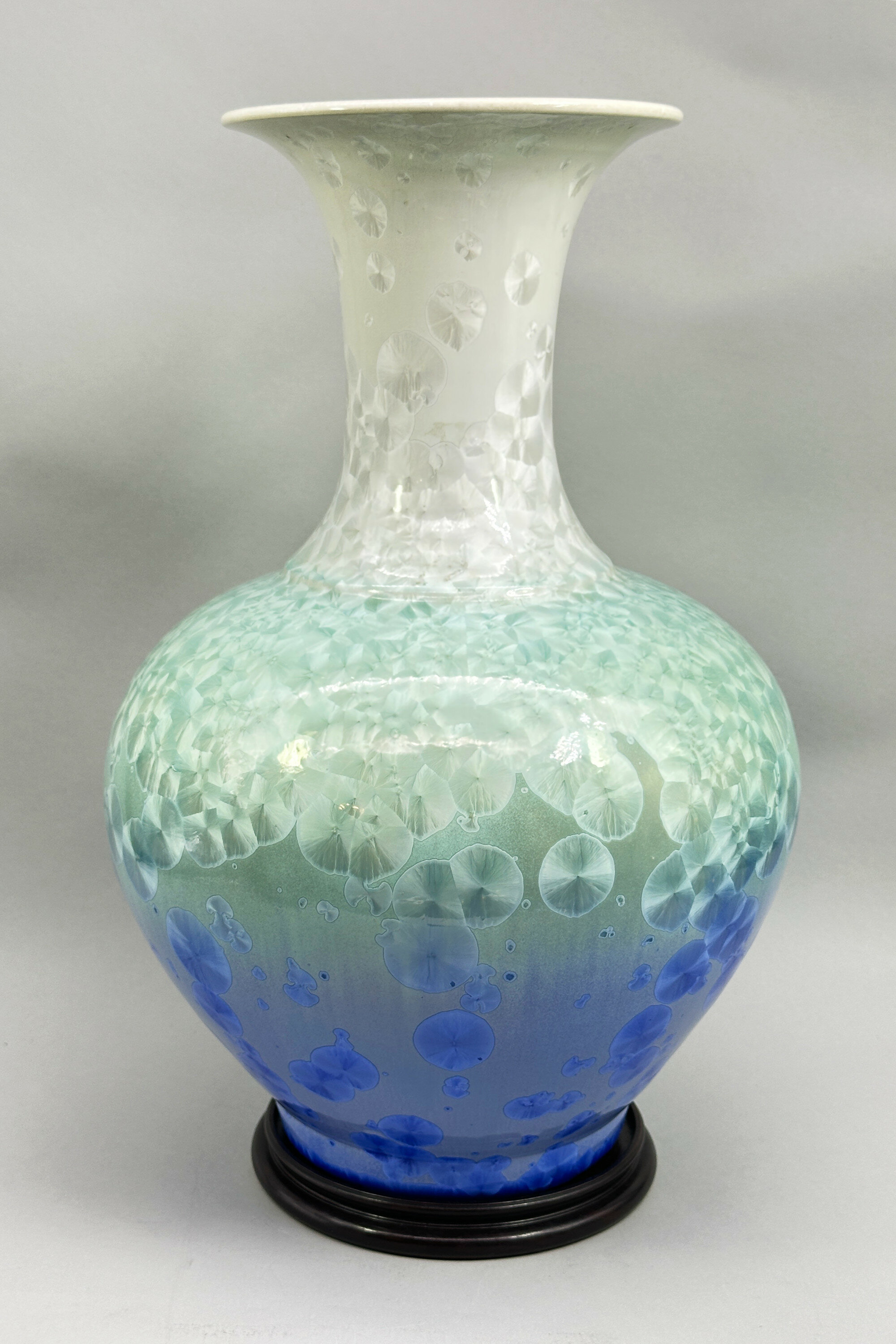
Impressive Chinese crystalline glaze bottle Vase, Jingdezhen mark, second half C20th
Price: £350The striking glaze effects seen here are usually attributed to the kilns at Shiwan, a district of the provincial town Foshan which is located near to Guangzhou, better known in the West as Canton, in the Guangdong province. But the place of manufacture is here clearly advertised by the mark on the base which attributes it to the well known potteries of Jingdezhen, for centuries one of China’s most prolific producers of porcelains for both the domestic and export markets. This particular glaze, though, seems to be a late twentieth century creation with no obvious precedents from the past. Just possibly it derived from an accident of the firing process which was then deliberately imitated. Certainly, the ‘look’ is modern and the interior of the neck reveals one of the hallmarks of the very late pieces made at Jingdezhen where the small but regular potting rings indicate manufacture by machine rather than the hand of a potter (see image 8). The sandy and slightly coarse paste of the foot is fully consistent with this.
By repute, similar vases were bought new in the 1980s so there is, at least, a degree of age here and the overall effects combine sophisticated techniques with inventive decoration to produce a piece of considerable and striking appeal.
(As sometimes happened with the manufacture of larger ceramic items, this vase emerged from the kiln with a slight ‘lean’ when viewed from certain angles, probably due to irregular shrinkage of the clay body during the firing process. Images (11) and (12) are intended to highlight the ‘fault’ but the final image (13) shows how this can easily be corrected with the addition of a wood stand built up inside to provide corrective support.)
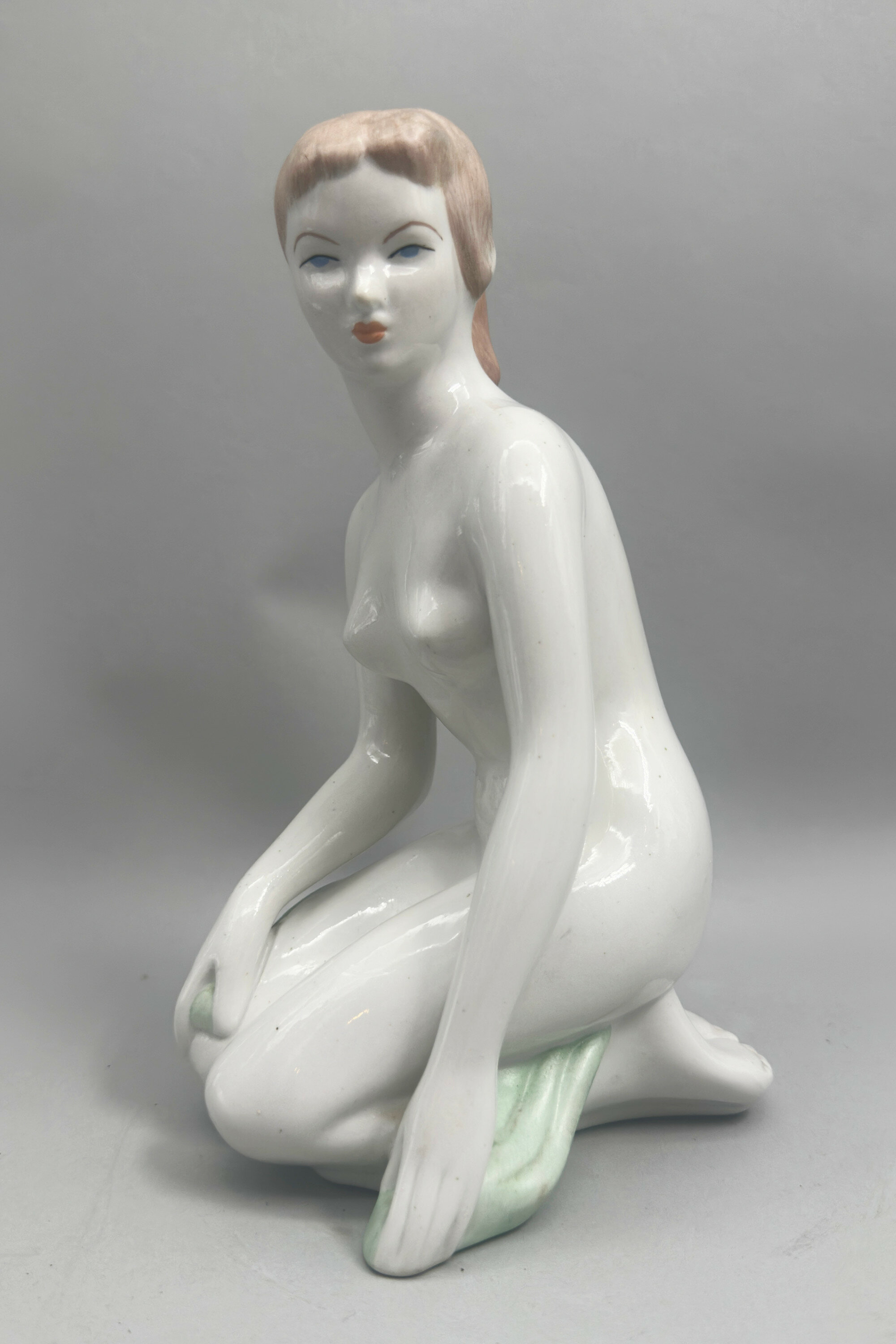
Art Deco style kneeling figure of a Girl, Aquincum Hungary, second half C20th
Price: £75Aquincus was an ancient Roman settlement, eventually to become the town Obuda, the third of the three cities which were merged to form Budapest and the oldest district in the Hungarian capital. In 1854, Hüttl Tivadar set up a shop in Pest selling porcelain eventually becoming involved in porcelain manufacture itself with such success that by the early 1900s he was supplying the court at Buda, eventually supplanting the rival firm of Herend. Despite legal battles amongst the family concerning the ownership of the business, the firm continued to prosper until the 1950s when the new communist government decided to nationalize the factory, renaming it Aquincum Porcelángyár. Tableware, which had been the staple of the Hüttls’ production was replaced by figurines which rapidly enjoyed great popularity. One of the principle artists was Antonia Szabó who became chief designer in 1966. With the end of socialism, the firm went into private hands in 1993 but suffered an immediate and rapid decline causing it to close soon after.
This figure may possibly, then, have been designed by Szabó himself but it is certainly typical of the pieces produced in the early years of state control and perhaps one of the most appealing. The form of the mark corresponds with a dating to the 1950s or 1960s and the piece has both historical associations and considerable decorative appeal.
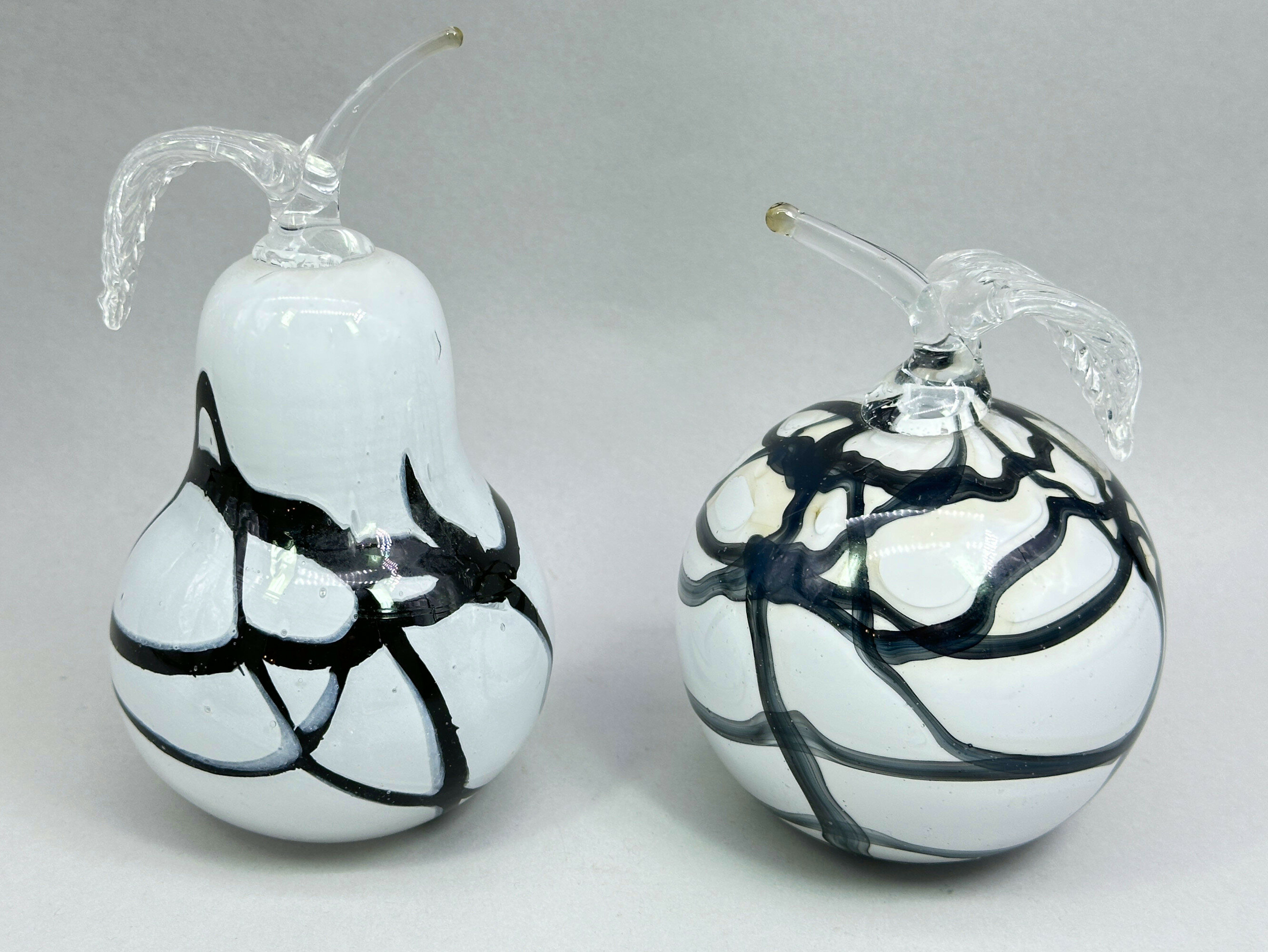
Two Amelia Art Glass Vases, Apple and Pear
Price: £30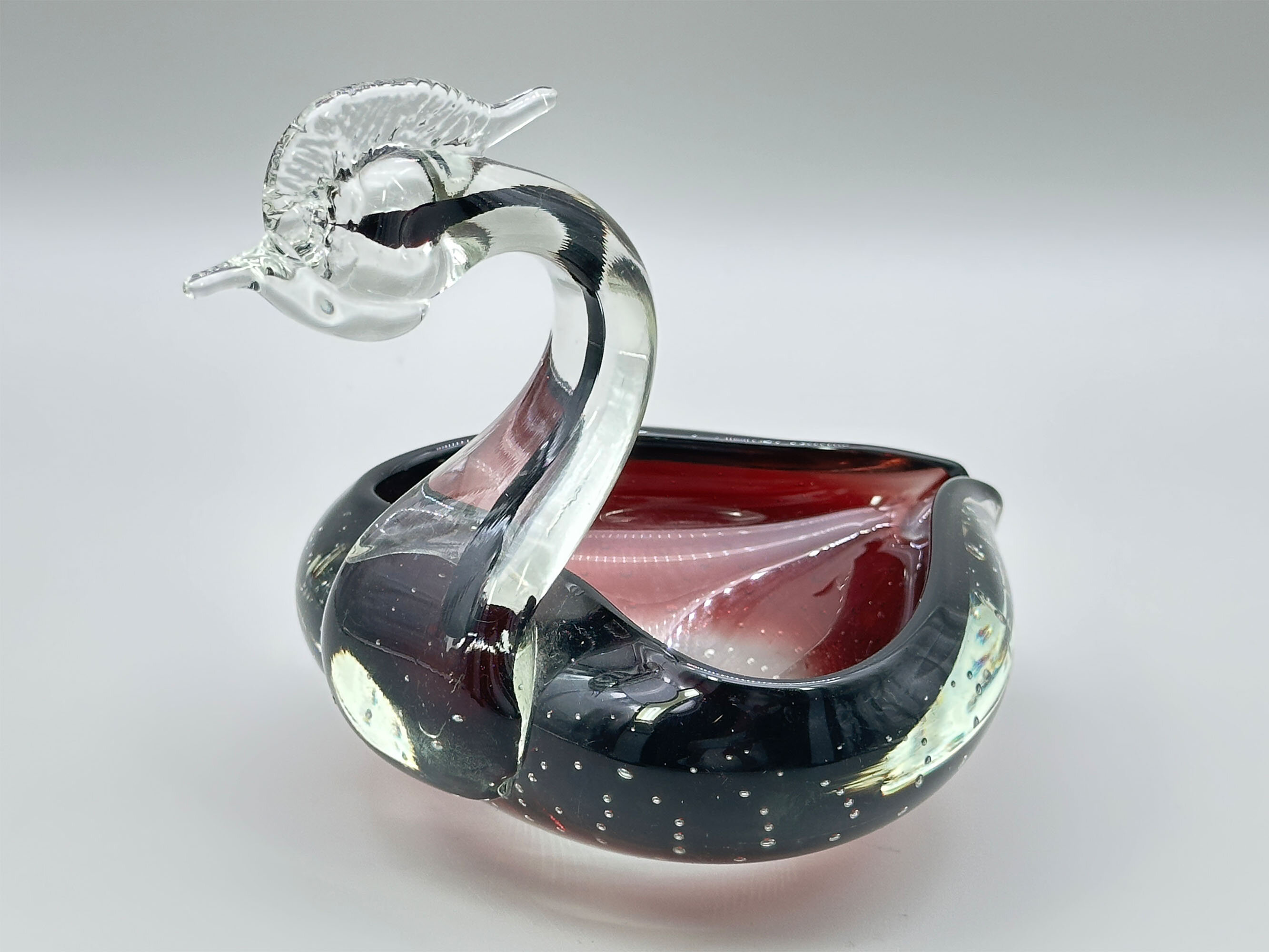
Murano bullicante glass swan dish, second half C20th
Price: £25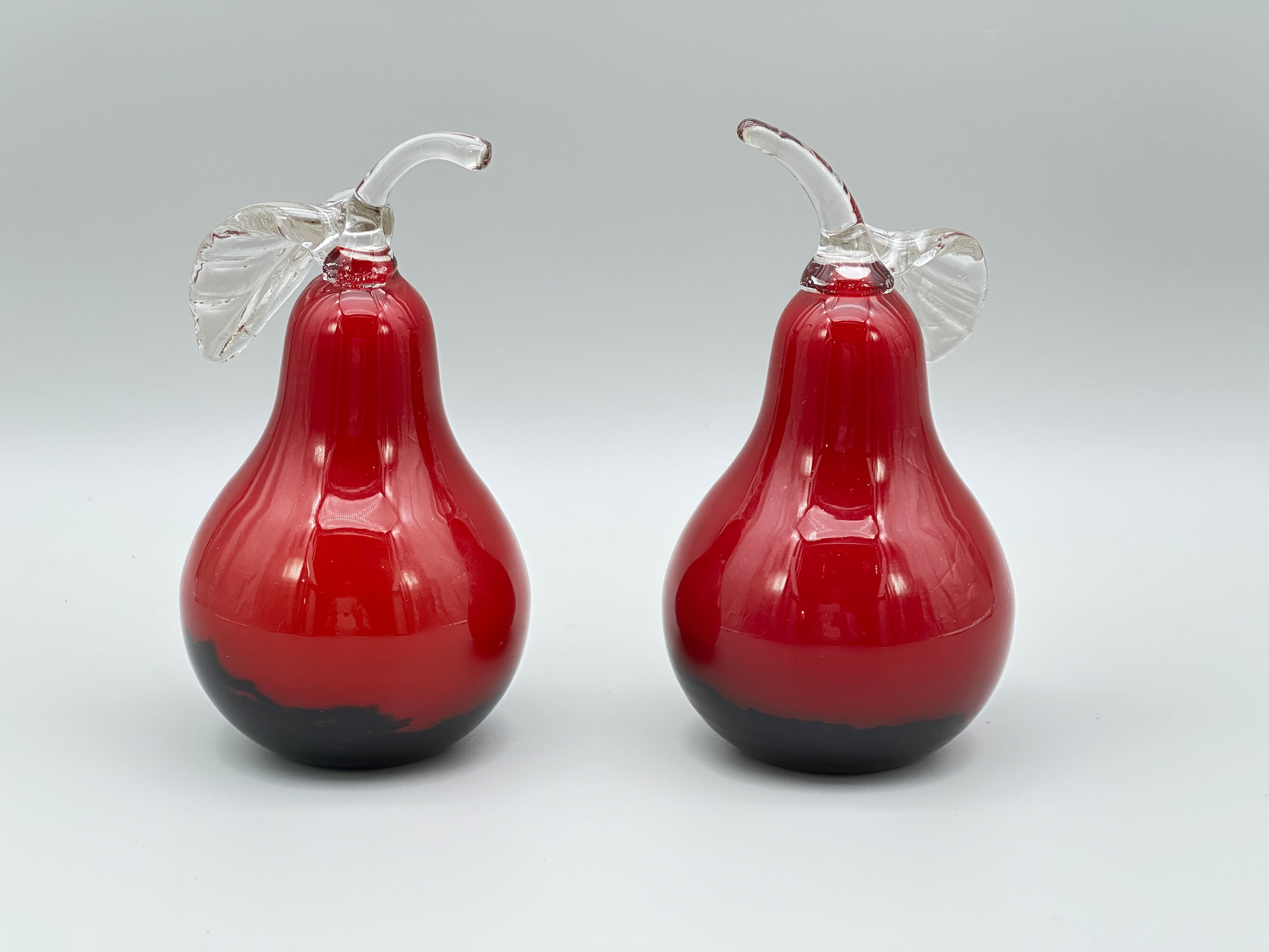
Pair of red glass Pears, possibly Murano, late C20th
Price: £45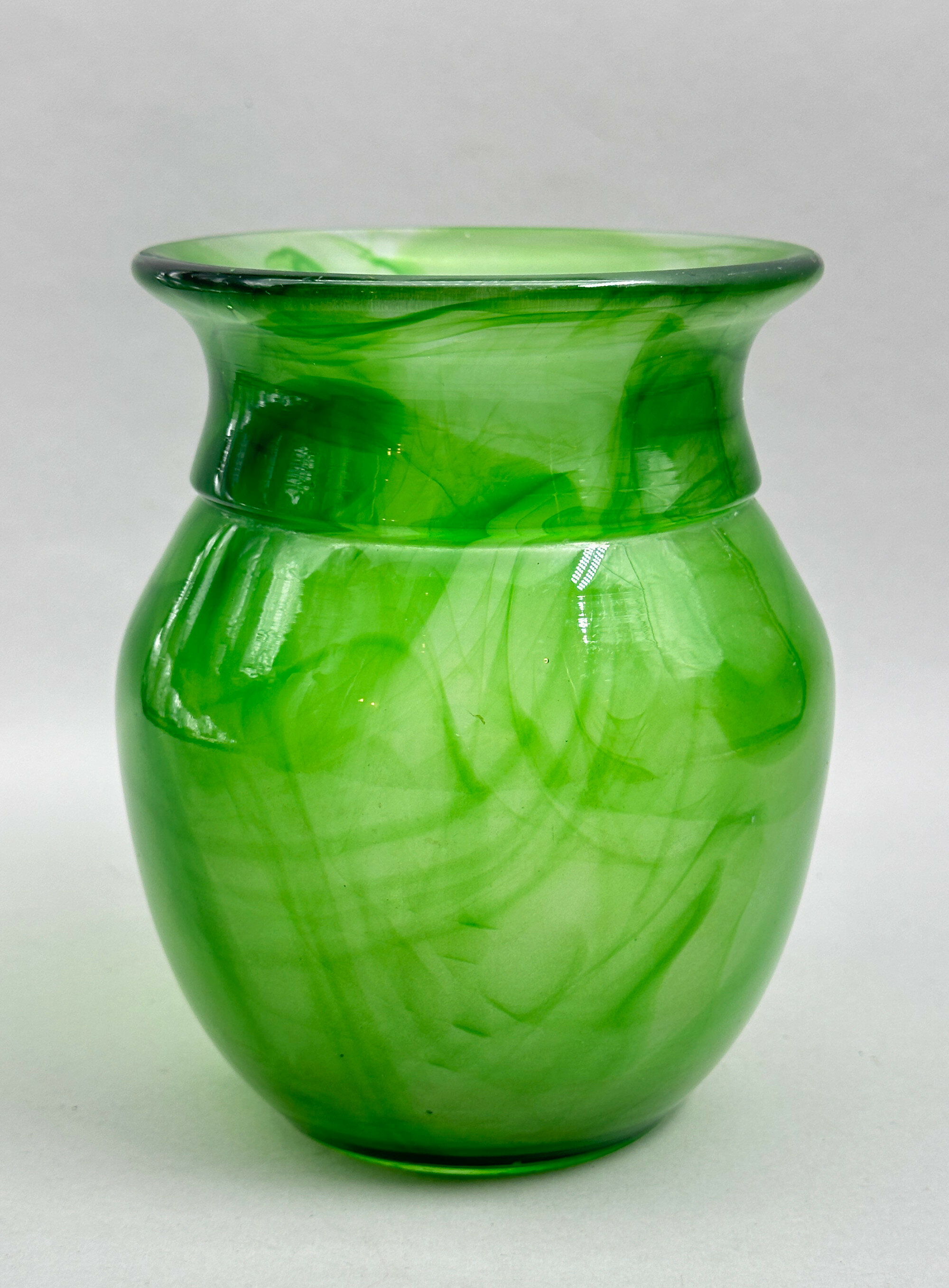
Davidson Green Cloud Glass Vase, 1930s
Price: £55George Davidson founded the Teams Flint Glass Works in 1867, which later became known as George Davidson & Co. In the 1880s the company began producing pressed glass tableware in a variety of shapes and by the 1920s their designs began to reflect the new Art Deco trends. The firm continued production until the 1980s, closing in 1987. This vase is typical of their Art Deco inspired designs although is rather less commonly found today. It has the pattern number '34 'SVF', 'S' standing for 'small', 'V' for 'vase' and 'F' for 'flared rim' and was produced from 1934 to 1942 (see www.cloudglass.com). A slightly larger version was made as well with the pattern number '34' 'VF'. The swirling effect was typical of Davidson's 'cloud glass' designs, one of its most popular ranges. In mint condition, this vase might well fill a gap in a collection of Davidson pieces or pre war British glass generally.
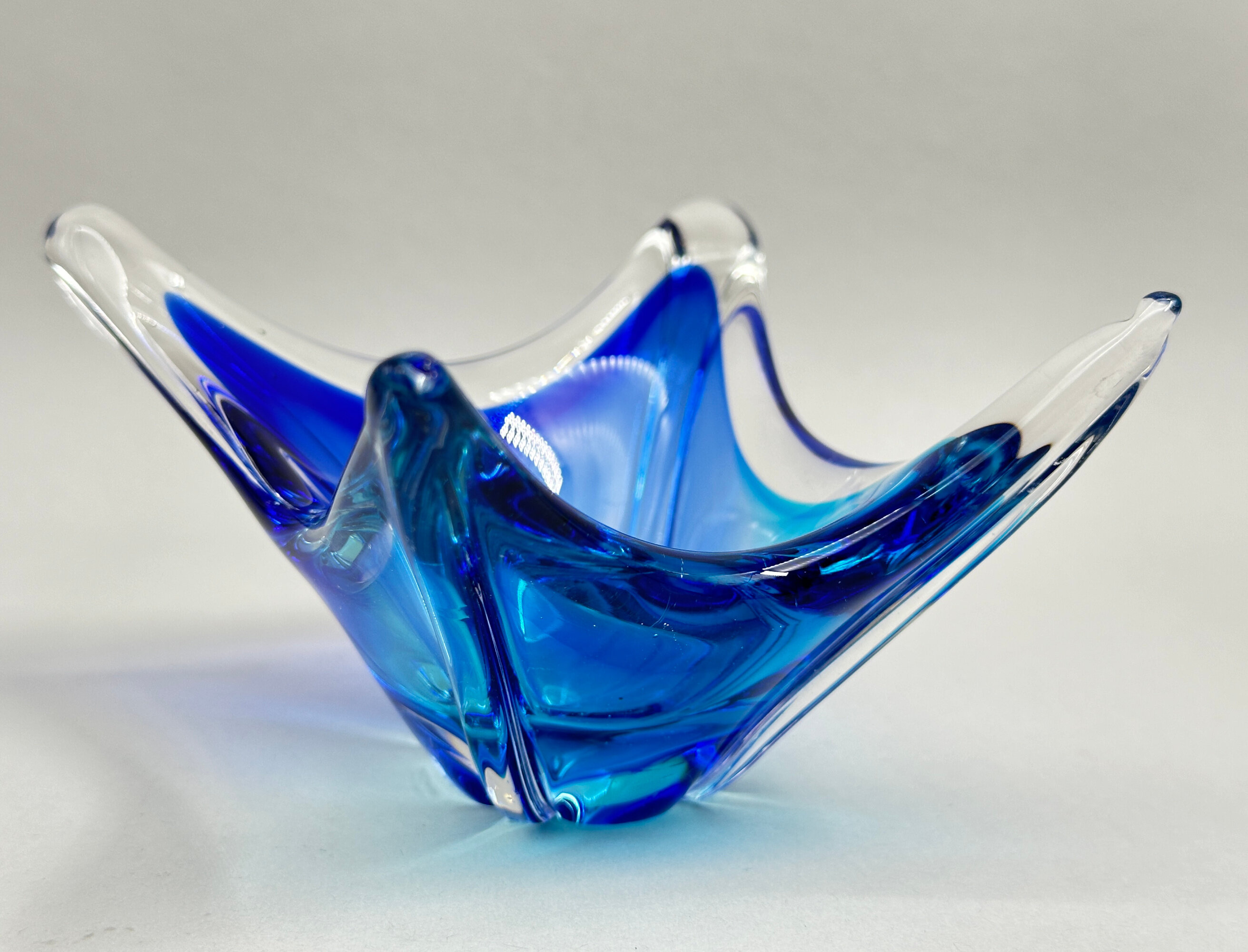
Murano blue glass star shape Bowl, 1960s
Price: £25
Pair of slender green glass Vases with silver decoration, possibly French early C20th
Price: £45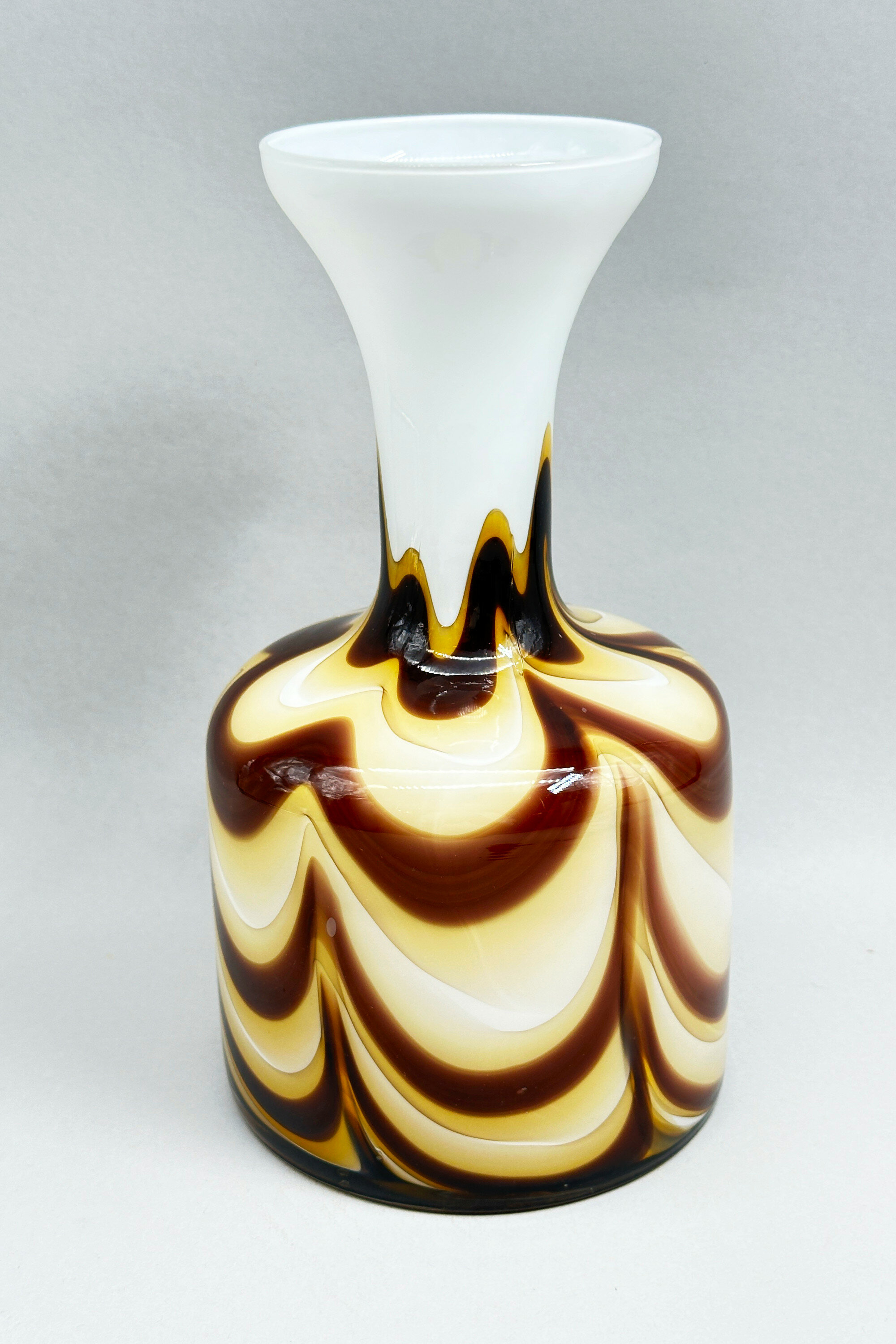
Opaline Art Glass Vase with a marbled design, Vetreria Barbieri, 1970s/1980s
Price: £45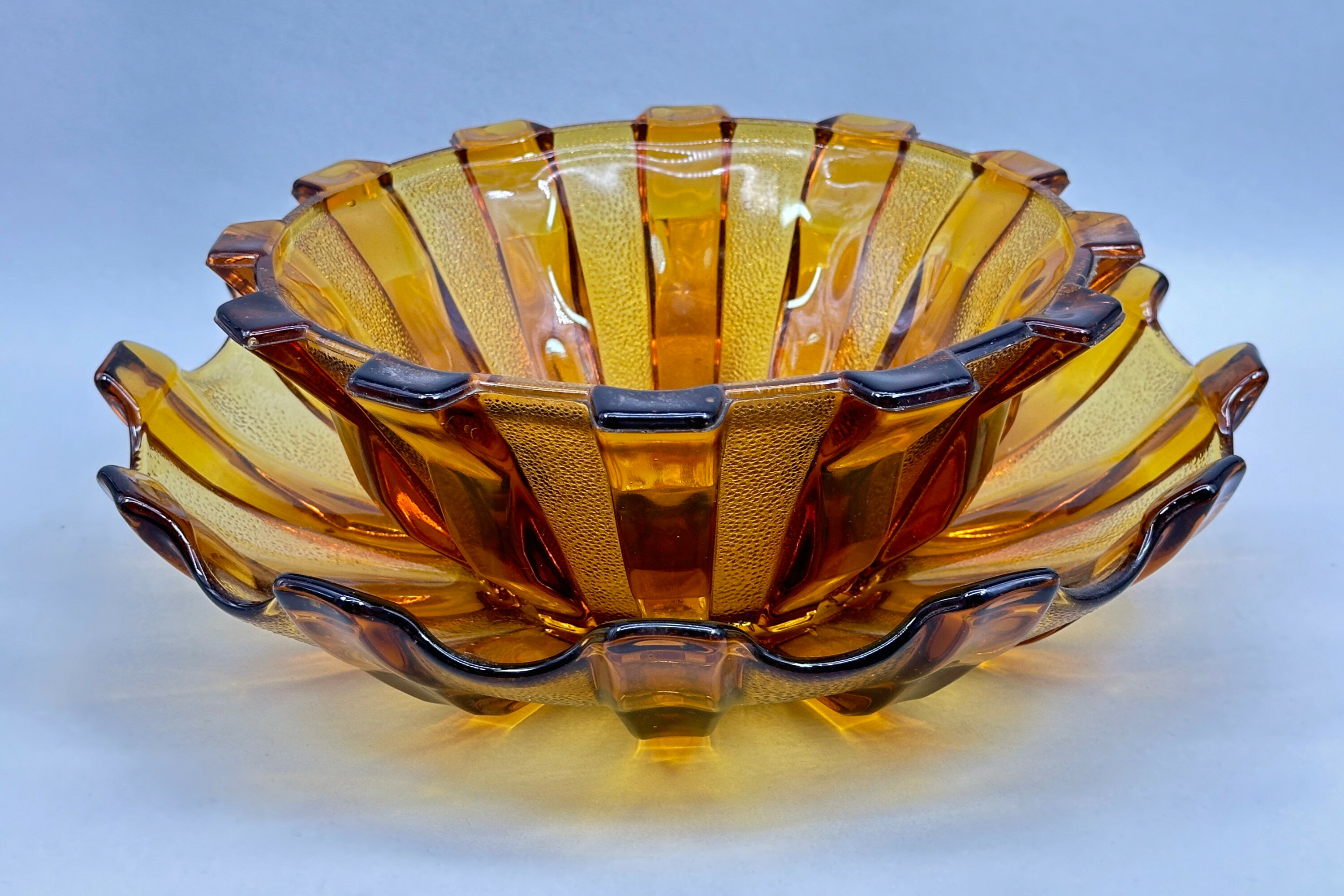
Amber Glass Bowl and stand, Stölzle Hermanova Hut factory, Czech 1930s
Price: £55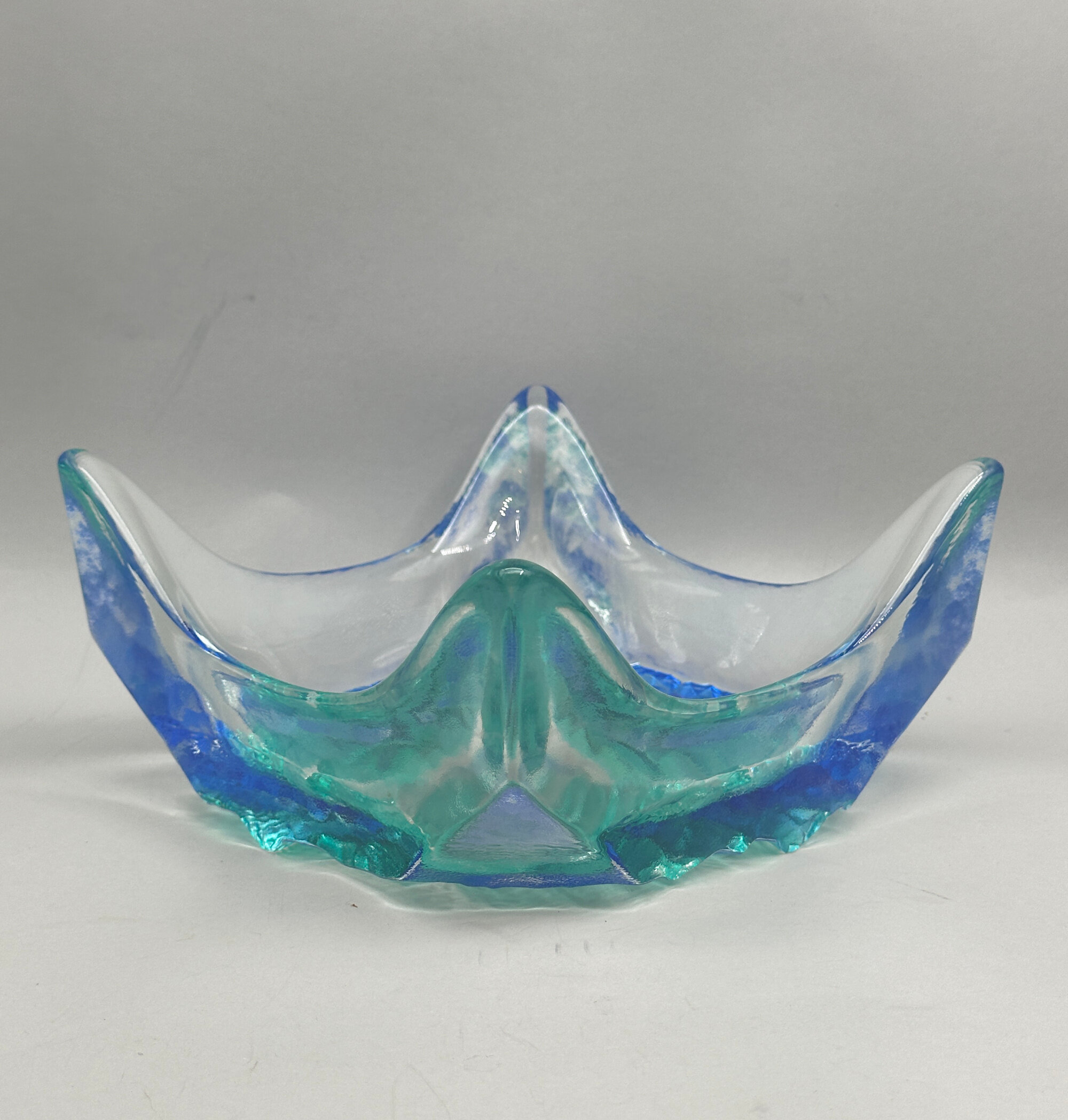
Blue and Green Ice Glass Square Bowl, designed by Tapio Wirkalla for Iitala Finland, late C20th
Price: £55The Finnish designer Tapio Wirkkala (1915–1985) was a major figure of post-war design, working in a wide variety of media including ceramics, wood and glass as well as postage stamps, bank notes and even light bulbs. His first piece for Iitala was produced in 1946 and the commercial ‘Tapio’ collection from 1954. Some of his ‘ice glass’ effects took the Iitala craftsmen many hours to perfect the glass blowing techniques required to produce them but enjoyed immense popularity. These chunky bowls, almost brutalist in style, were produced in the 1970s and 1980s and are an excellent example of his work for the popular market.
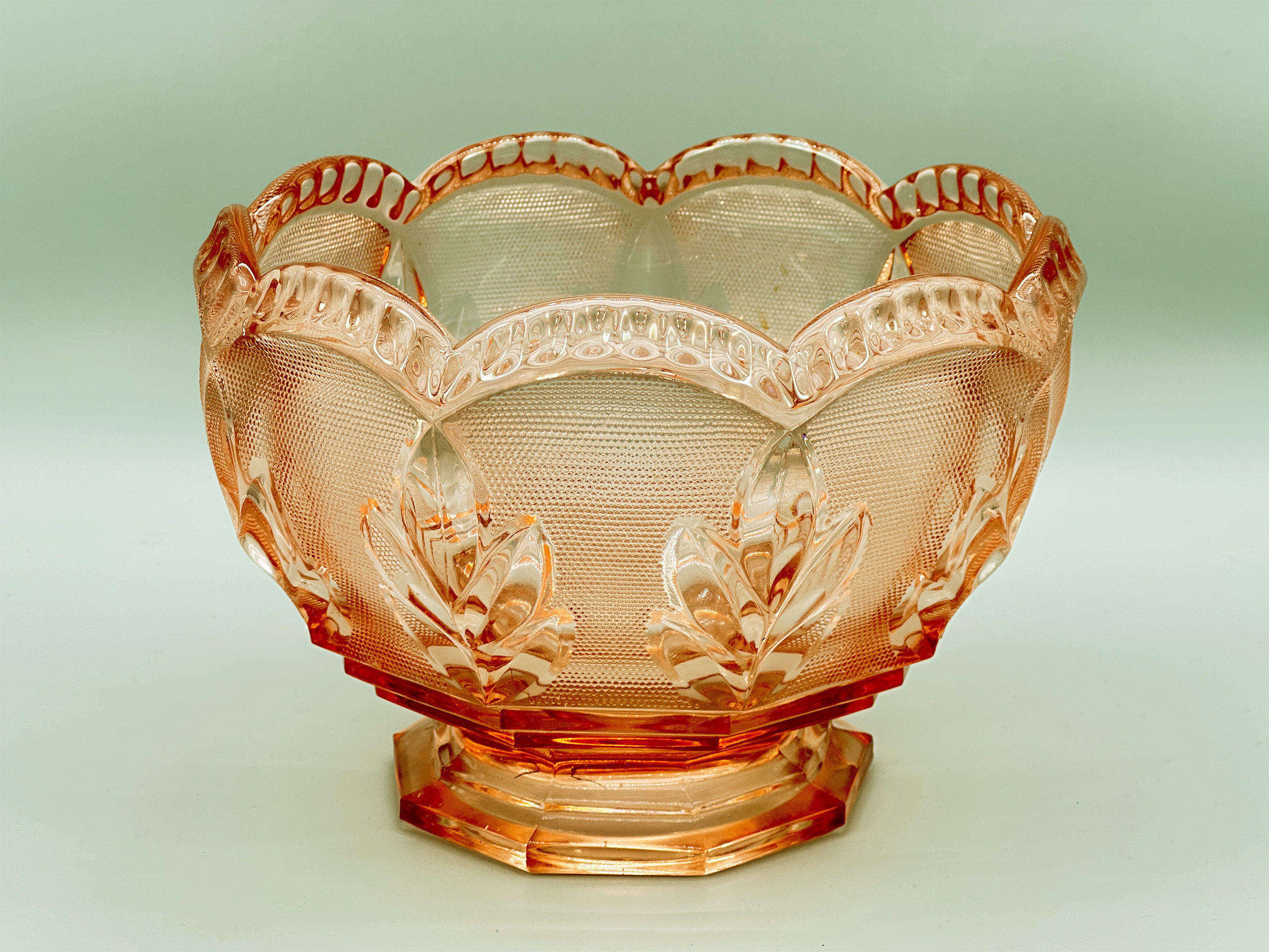
Peach colour pressed glass Bowl, Walther & Söhne, Wilhelm pattern, 1930s
Price: £35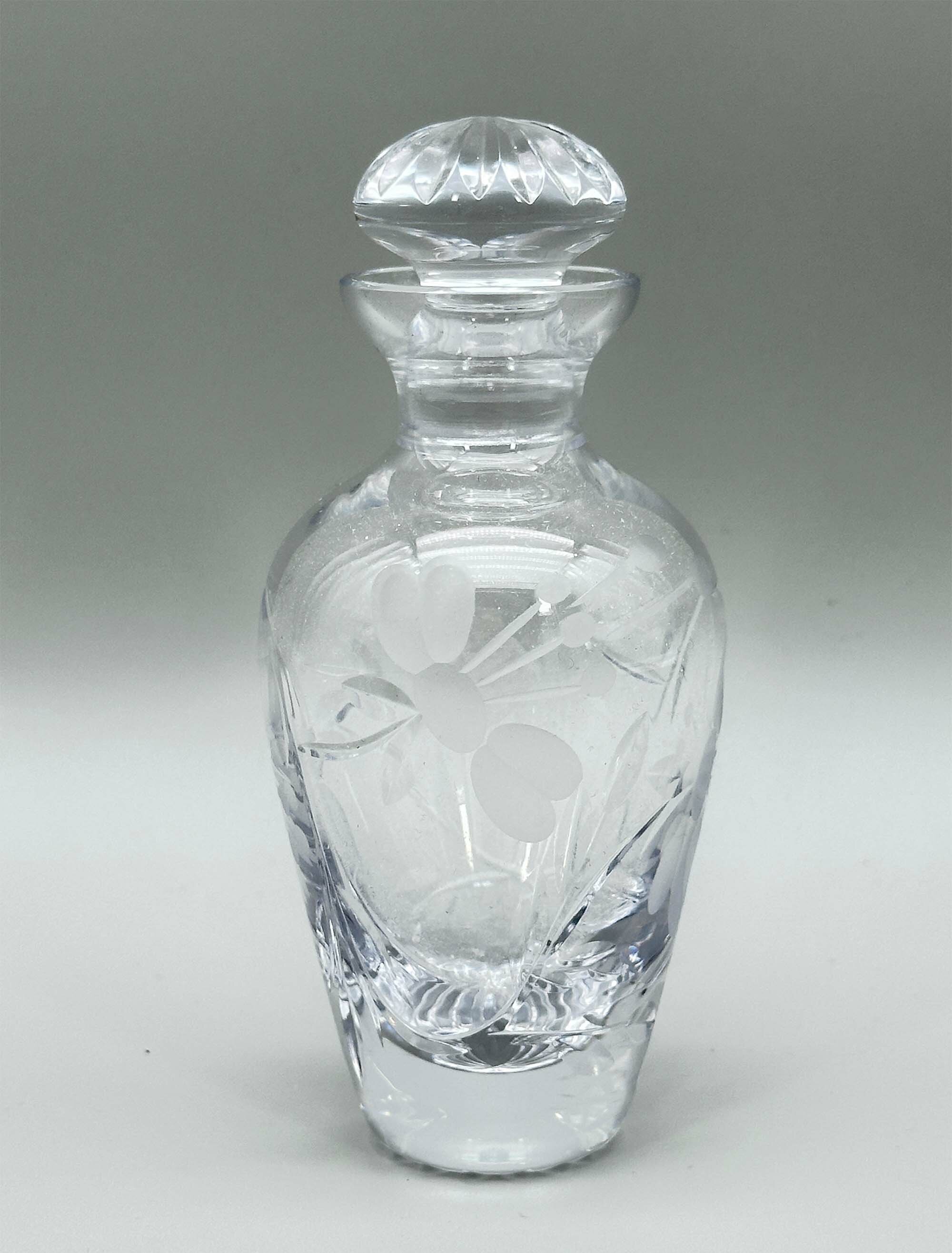
Etched crystal glass Perfume Bottle, possibly Stuart Crystal, second half C20th
Price: £25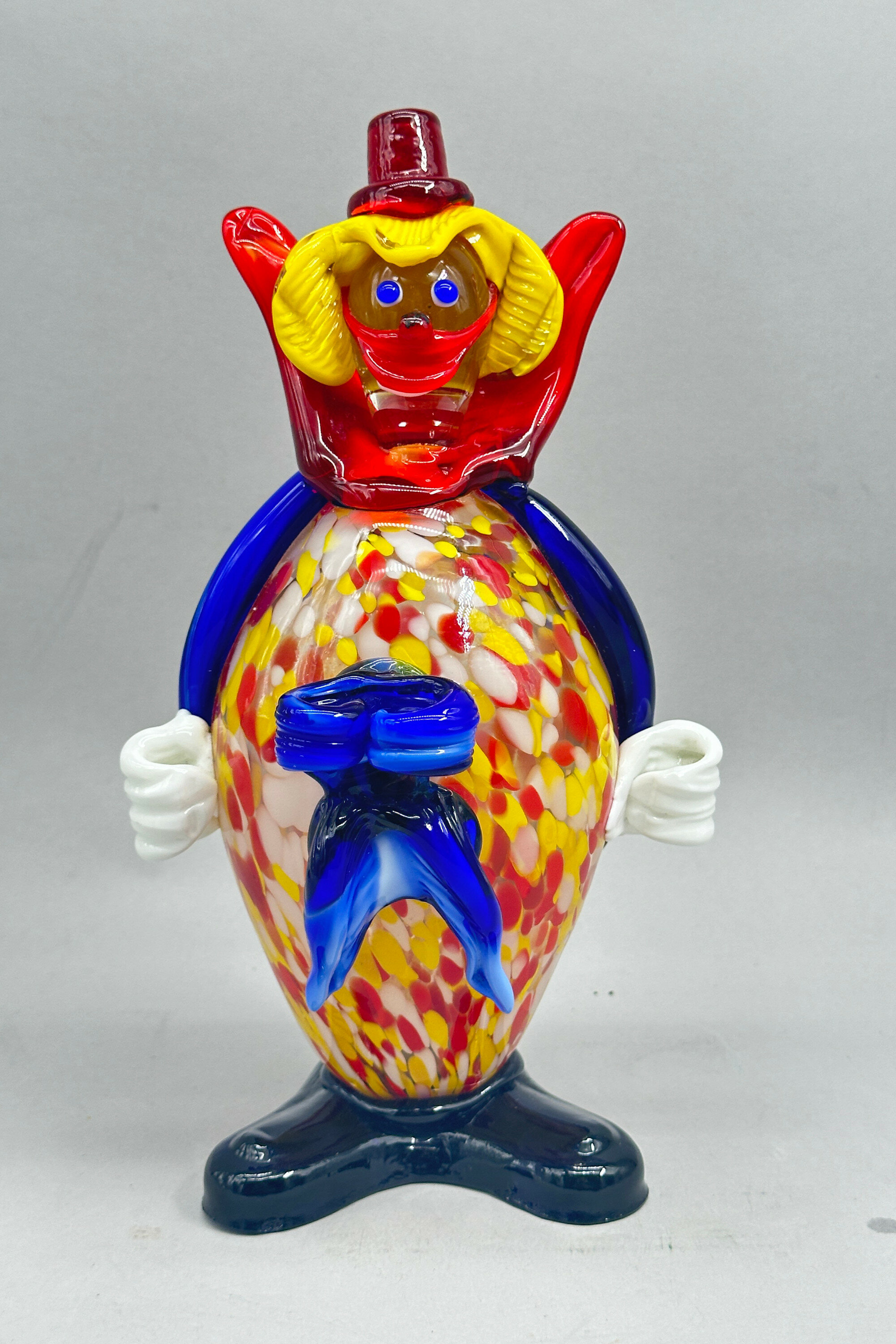
Murano Glass figure of a Clown, mid C20th
Price: £125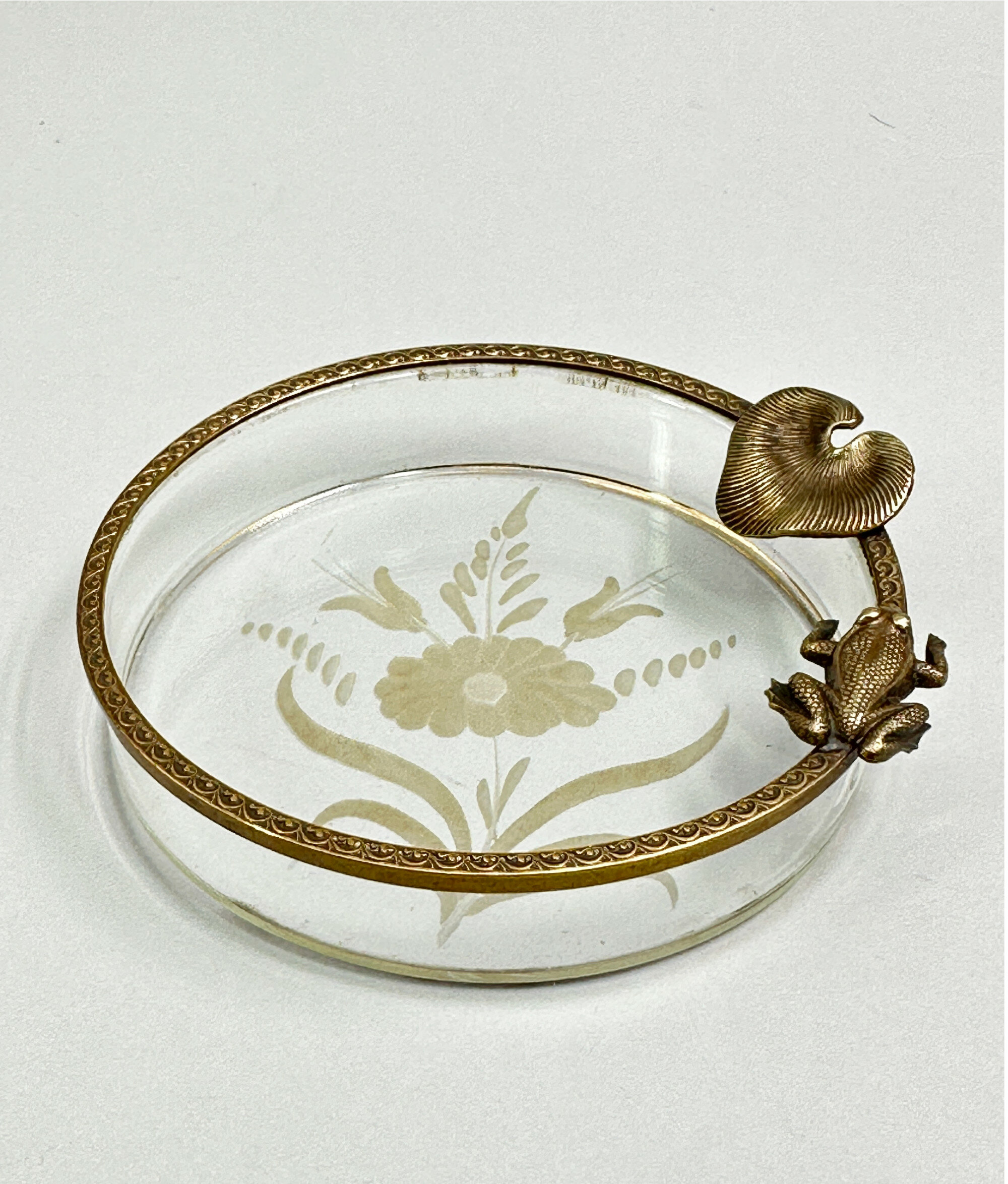
Fine Quality engraved French Glass Dish with naturalistic Ormolu Mounts, early C20th
Price: £25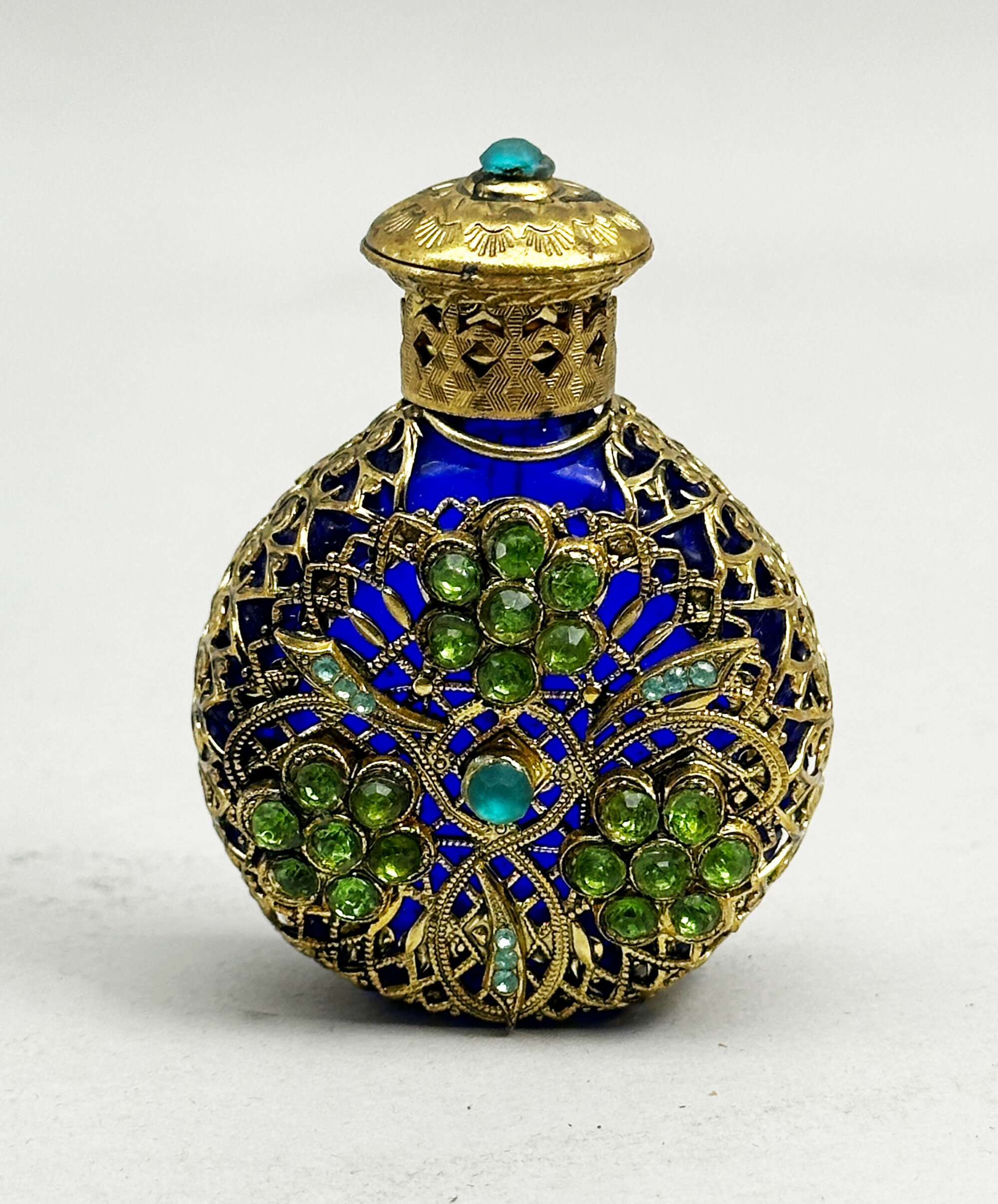
Czech rhinestone jewelled glass metal filigree Perfume Bottle and Stopper, C20th
Price: £45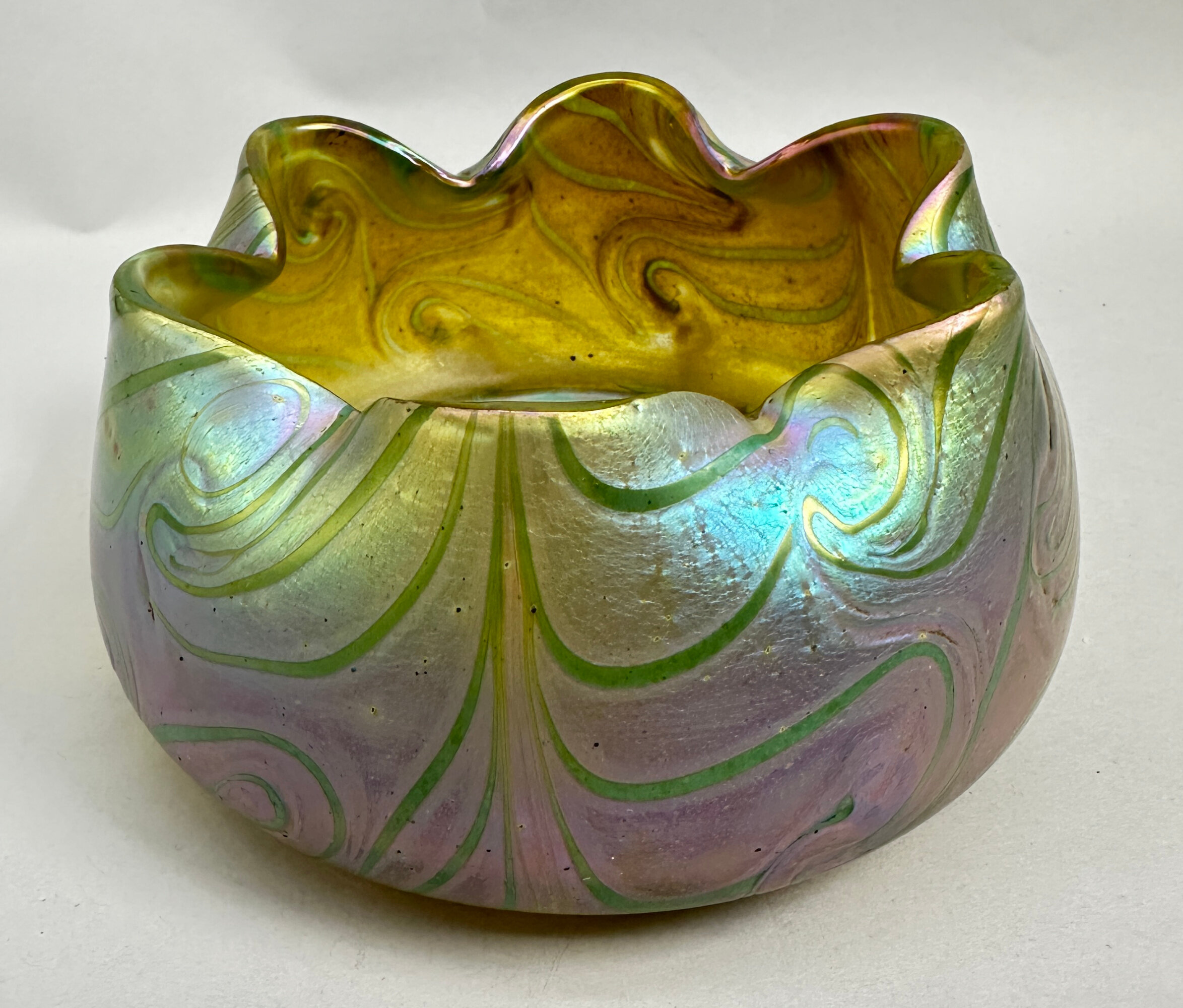
Loetz style glass Bowl, early C20th
Price: £110Most of the original Loetz pieces were not signed and there were many contemporary manufacturers making pieces in a similar style. There are, furthermore, modern reproductions. The attribution ‘Loetz’, is, inevitably, generously and loosely applied but sometimes true certainty is hard to achieve. Much information and assistance can be obtained from the website Loetz.com. On that basis this attractive bowl with its crimped rim and wavy line design on a purple ground is best regarded as Loetz style but probably contemporary with the output of the Loetz factory itself. It has great decorative appeal nevertheless.
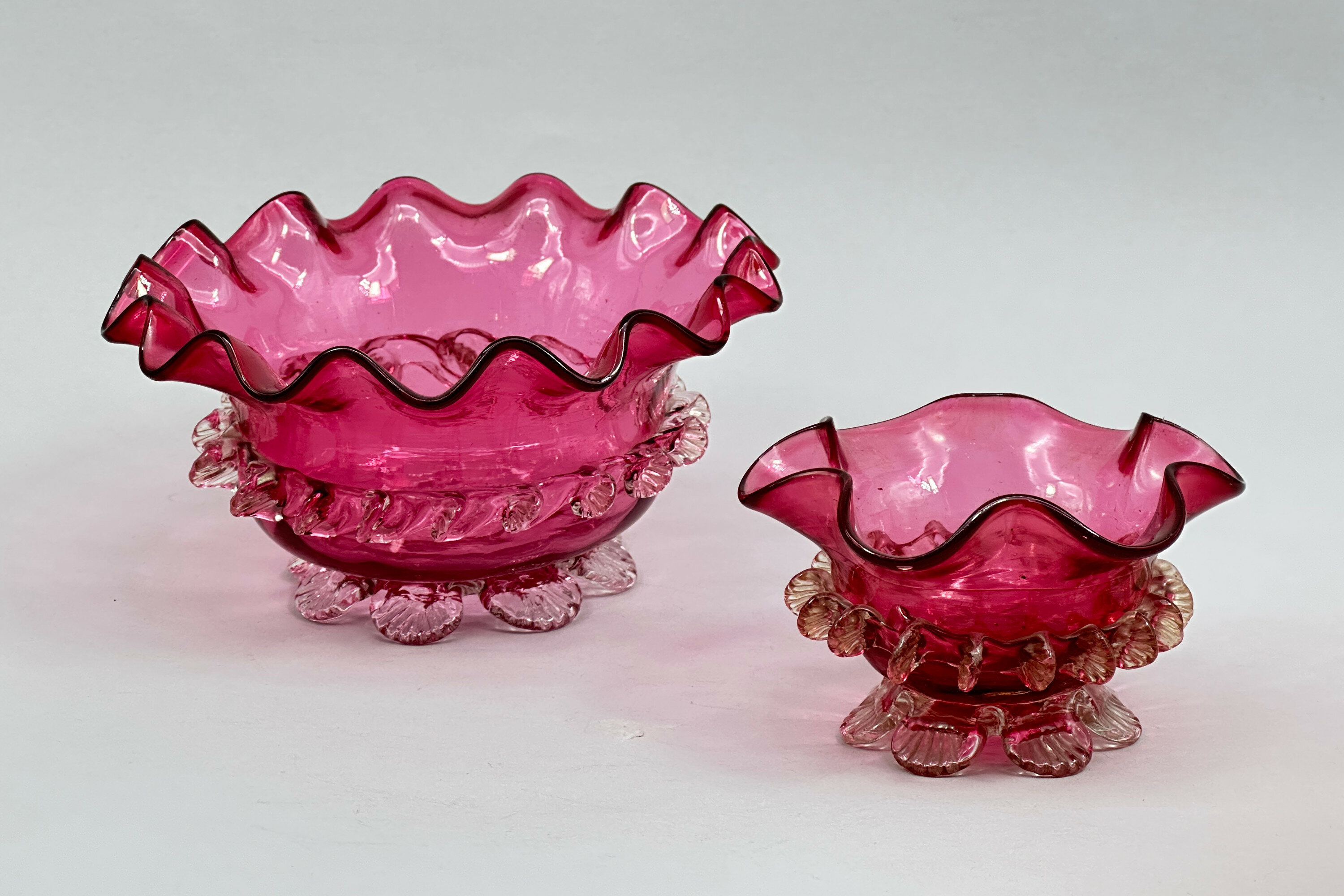
Two Victorian Cranberry Glass Bowls, late C19th
Price: £75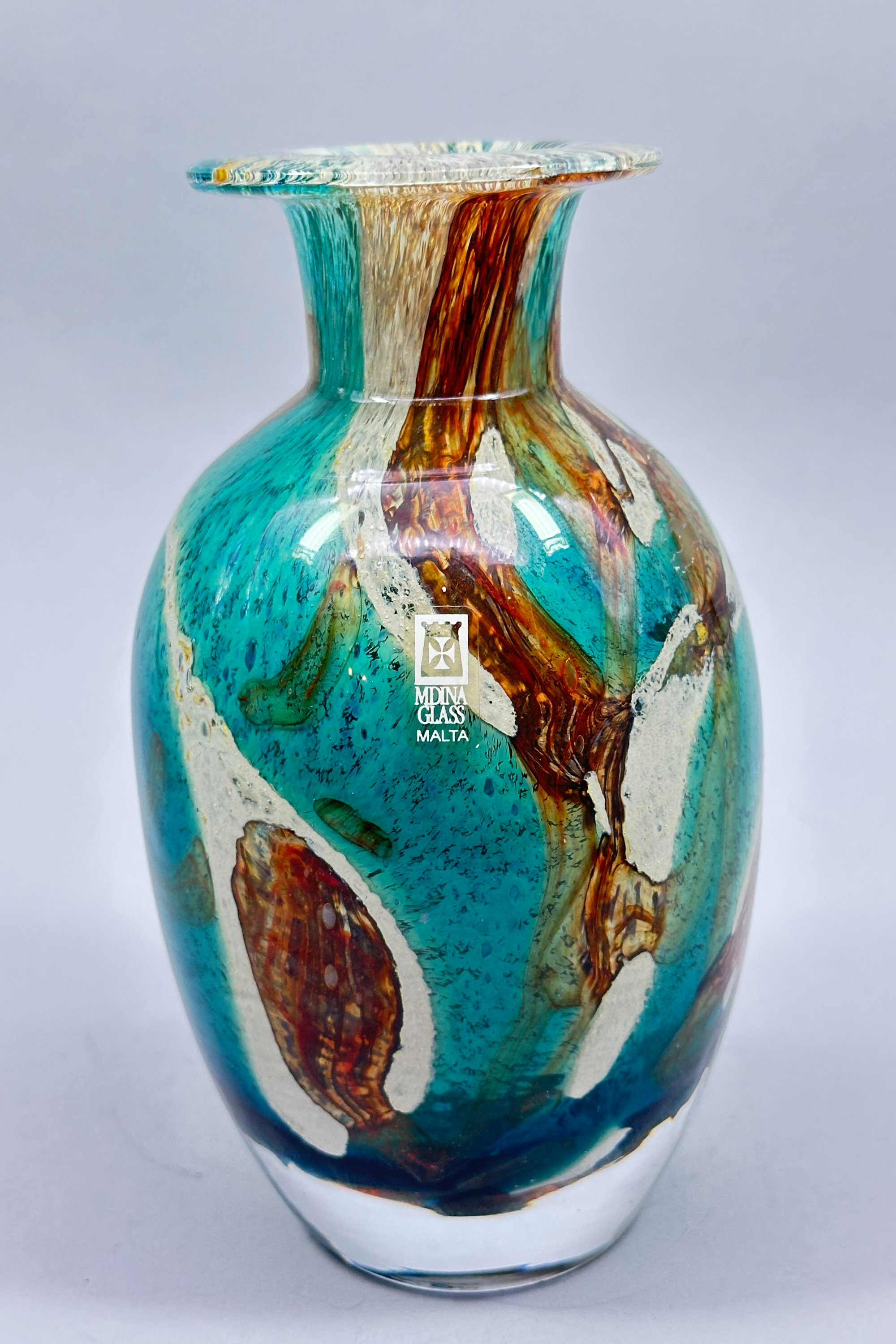
Mdina Glass Vase, signed and with maker’s label, late C20th
Price: £95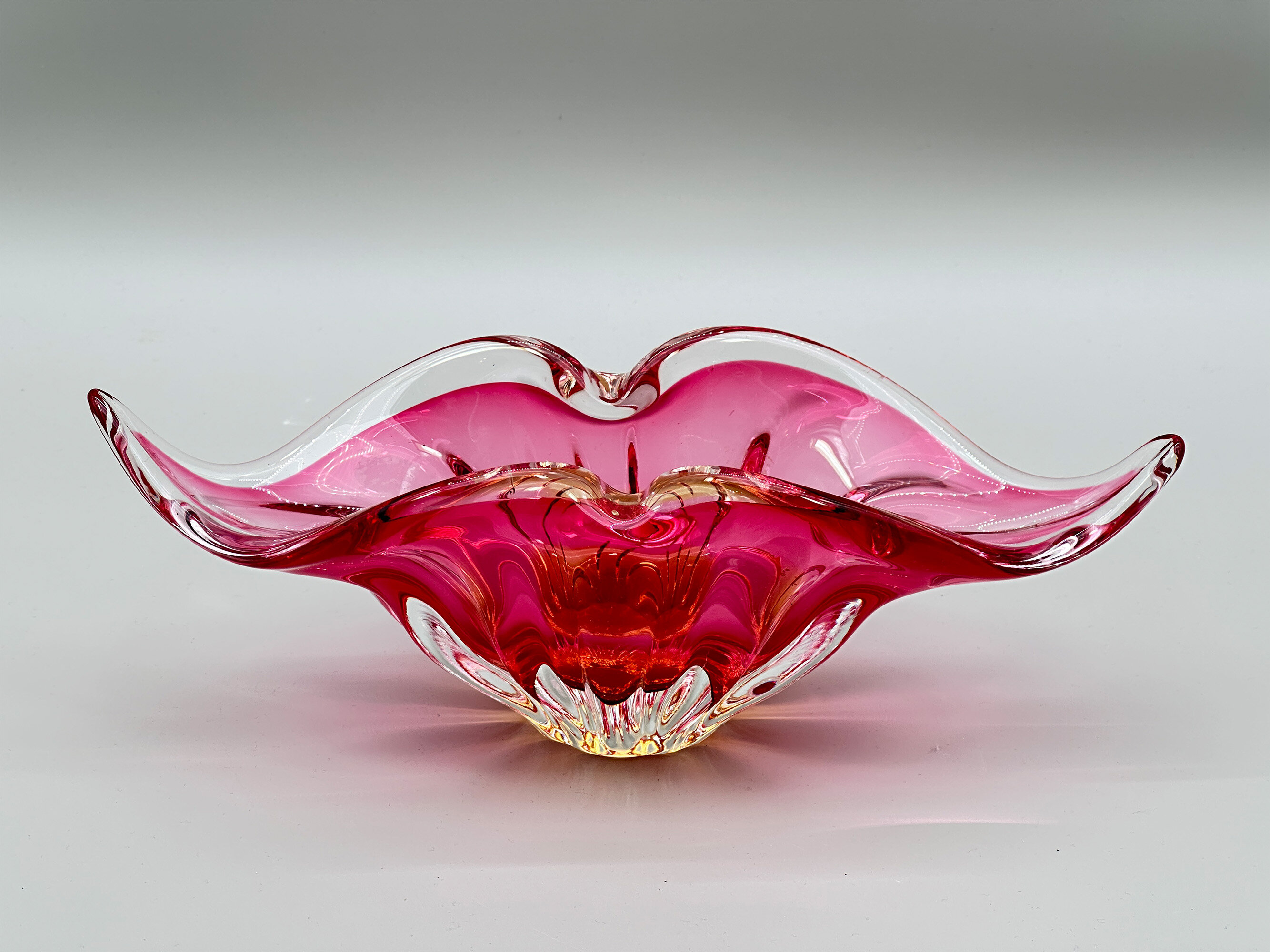
Pink and Orange Glass Bowl, Chřibská Czechoslovakia, Josef Hospodka, late C20th
Price: £45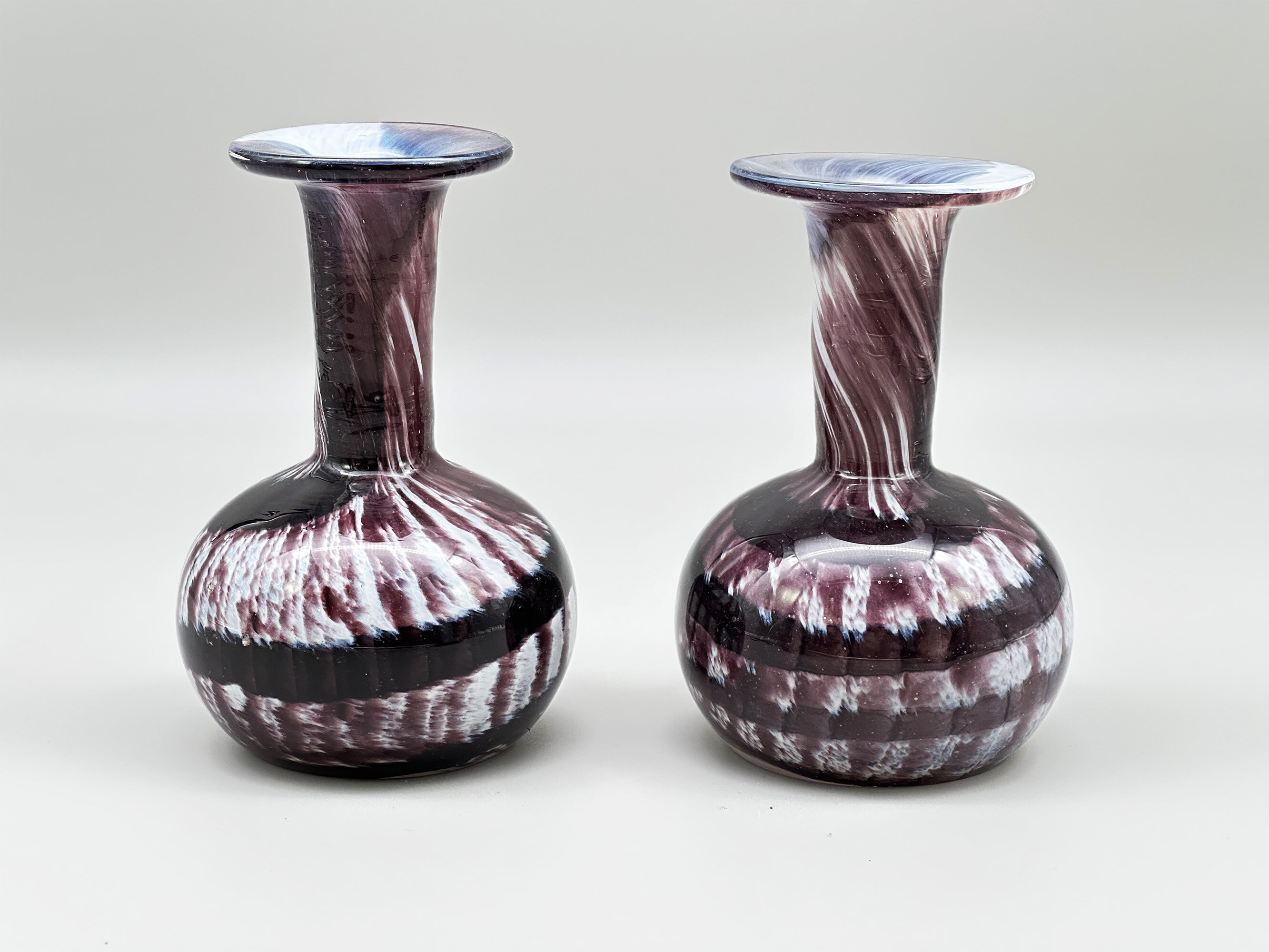
Pair of Maltese Mtarfa Vases, one signed, late C20th
Price: £35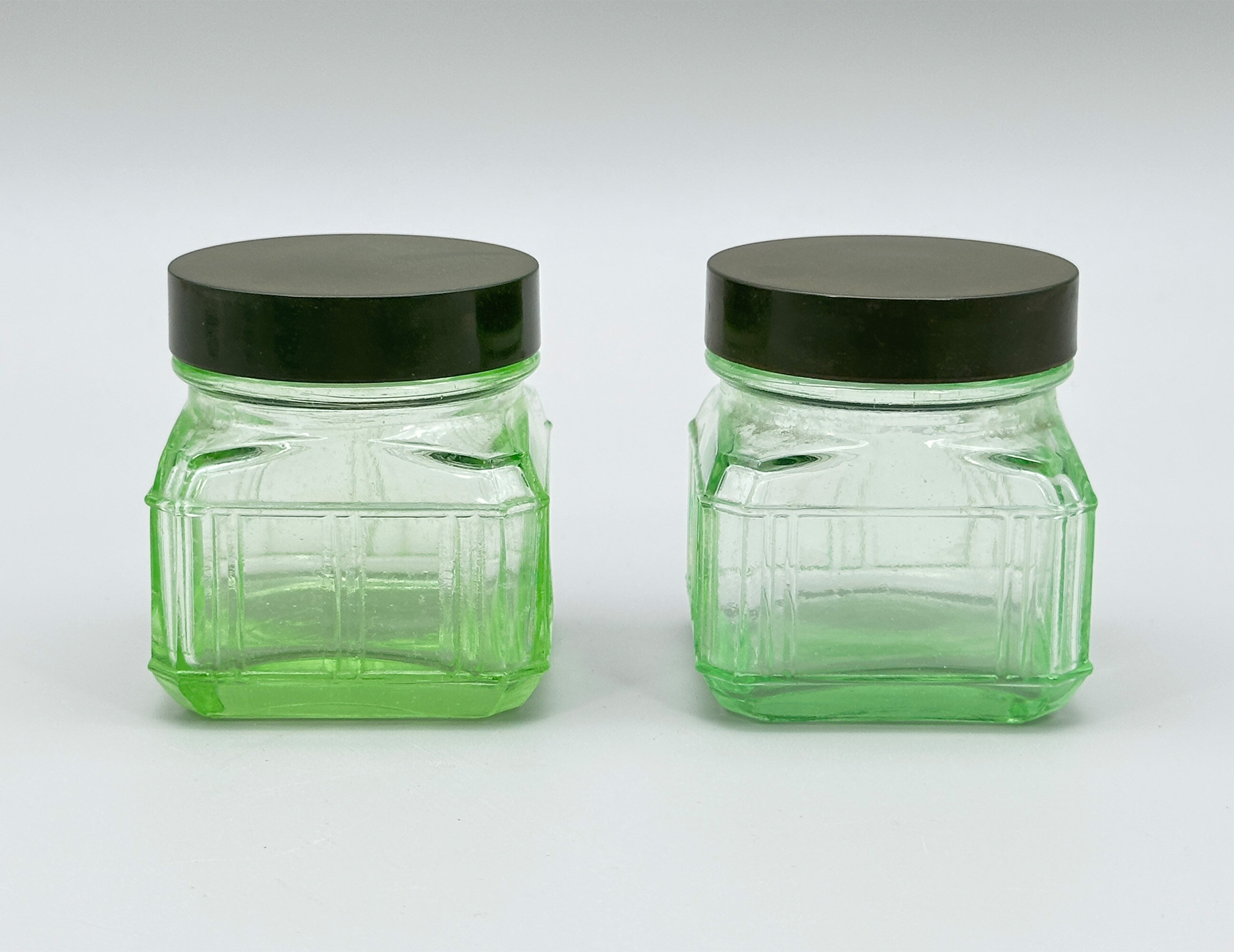
Pair of small green depression glass Jars with bakelite Covers, 1930s
Price: £45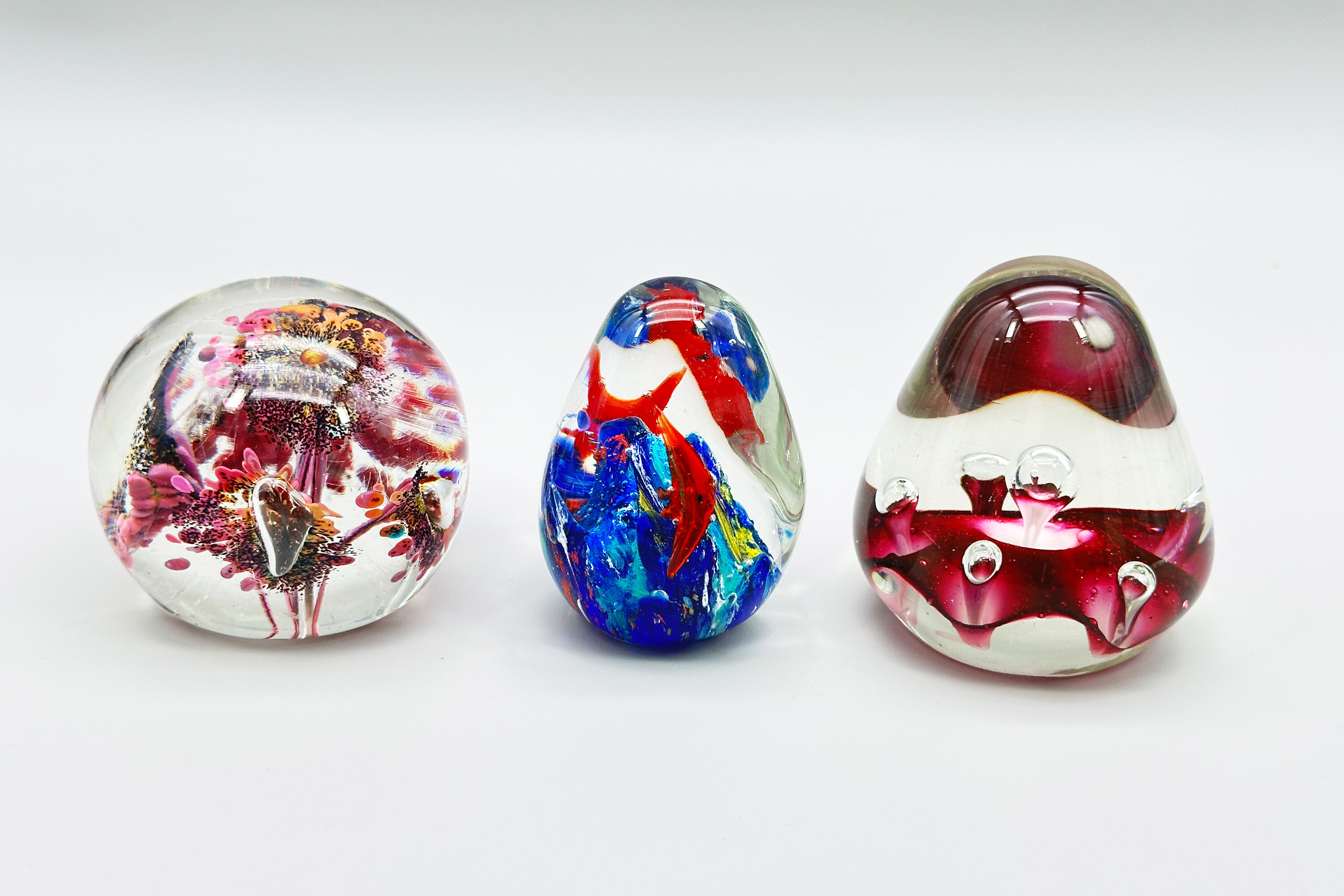
Three Art Glass Paperweights, late C20th
Price: £75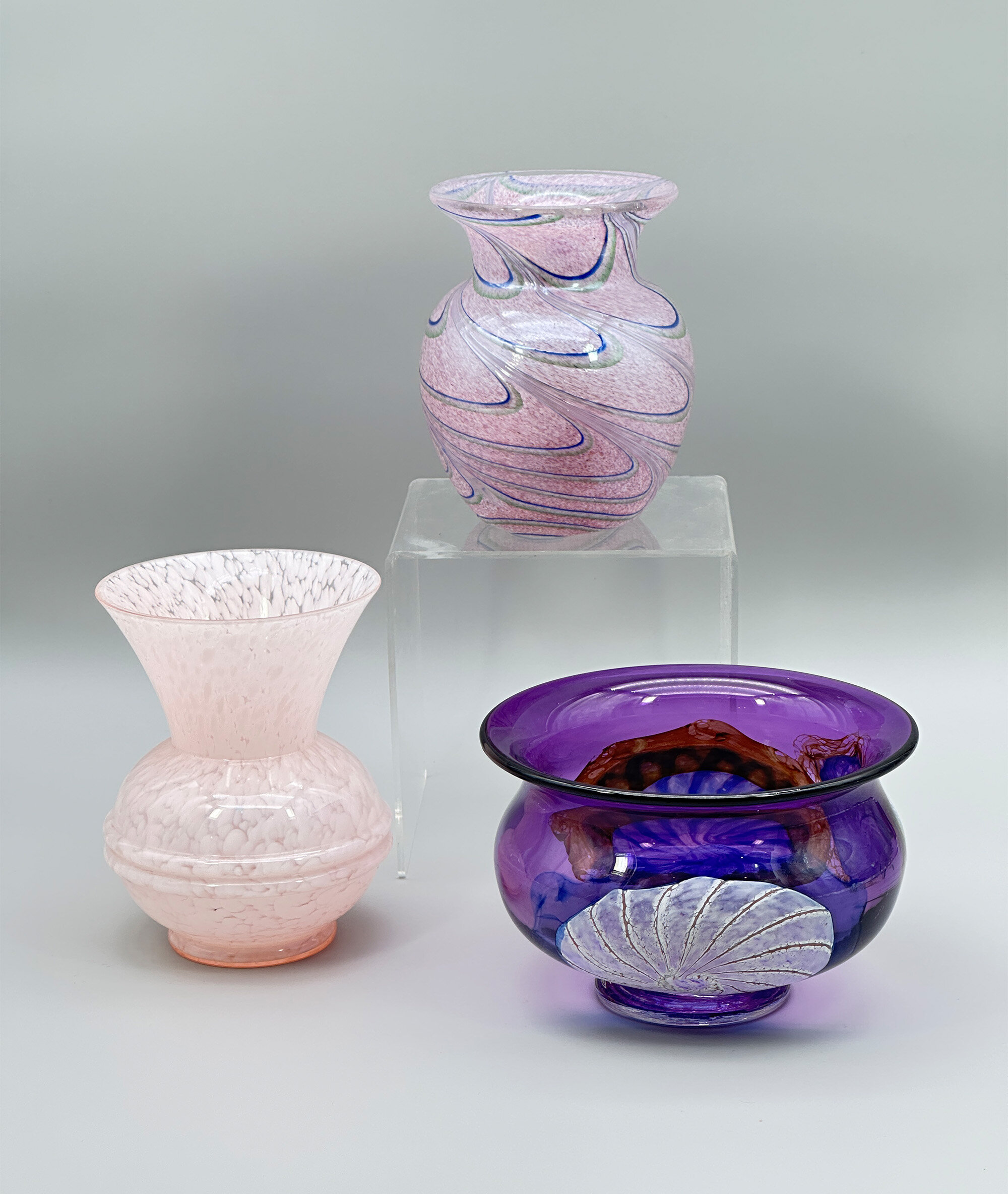
Three Art Glass Vases, second half C20th
Price: £60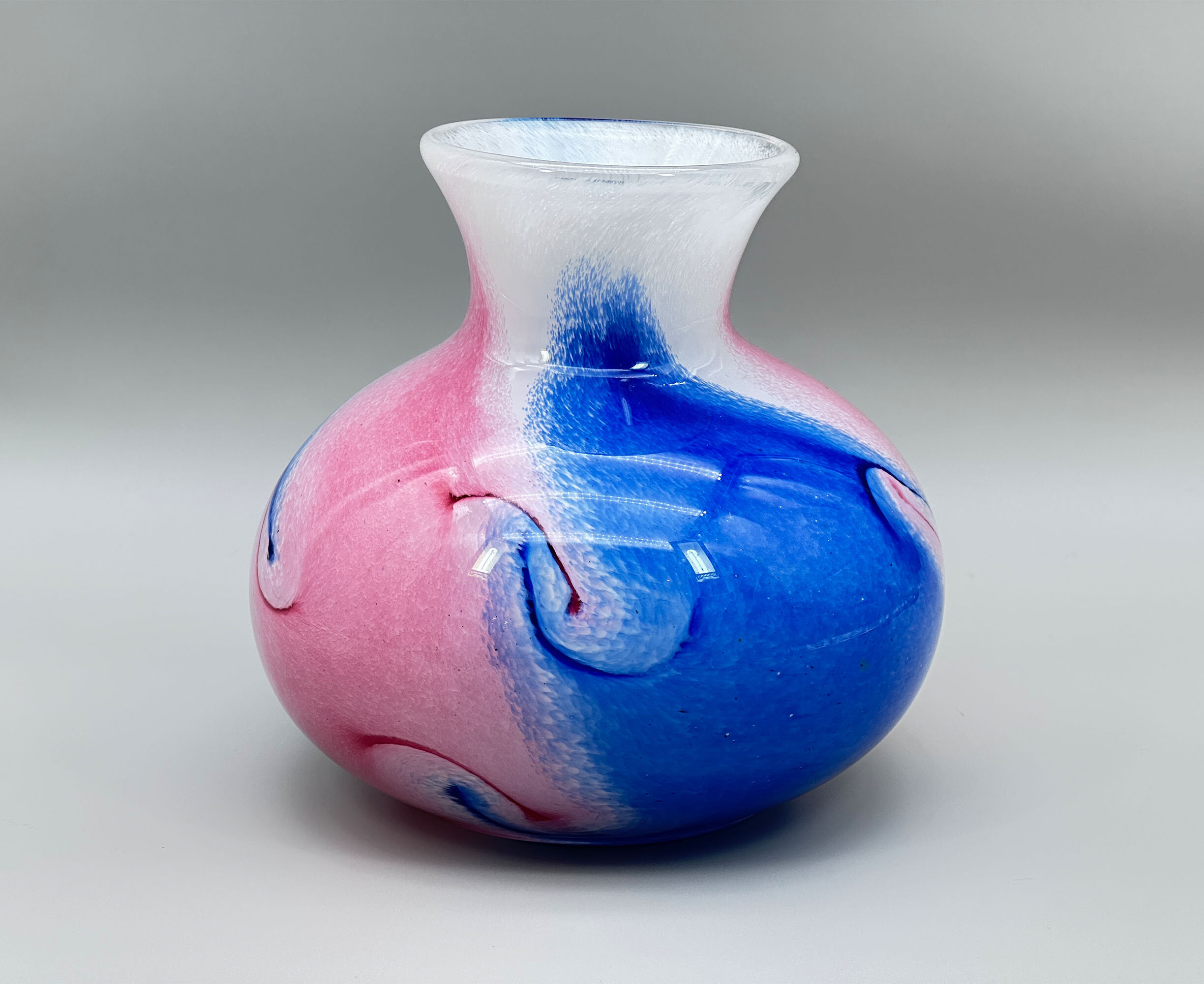
Swirl design art glass Vase, probably Italian, second half C20th
Price: £55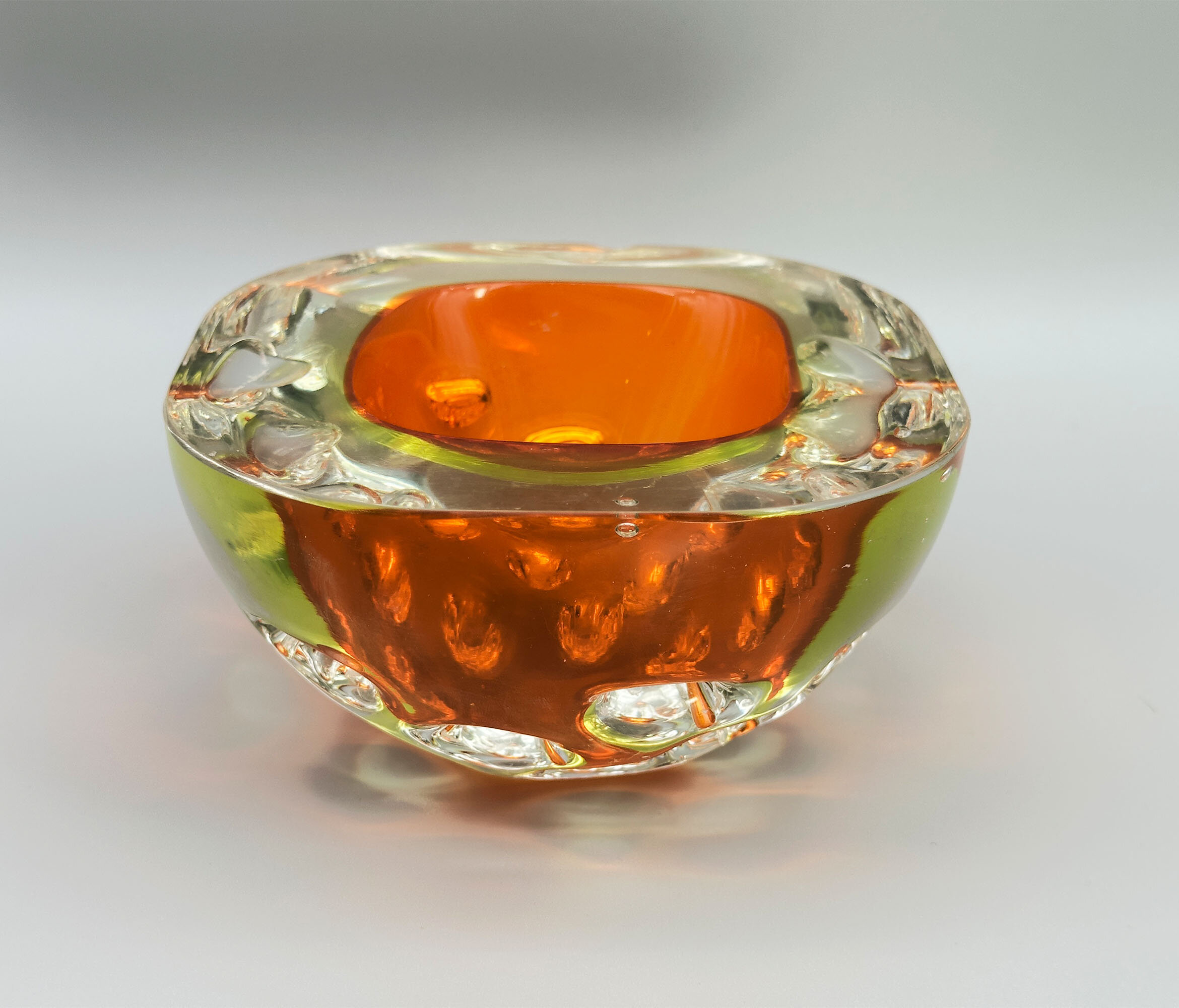
Geode form Murano dimpled sommerso glass bowl, Galliano Ferro, mid C20th
Price: £55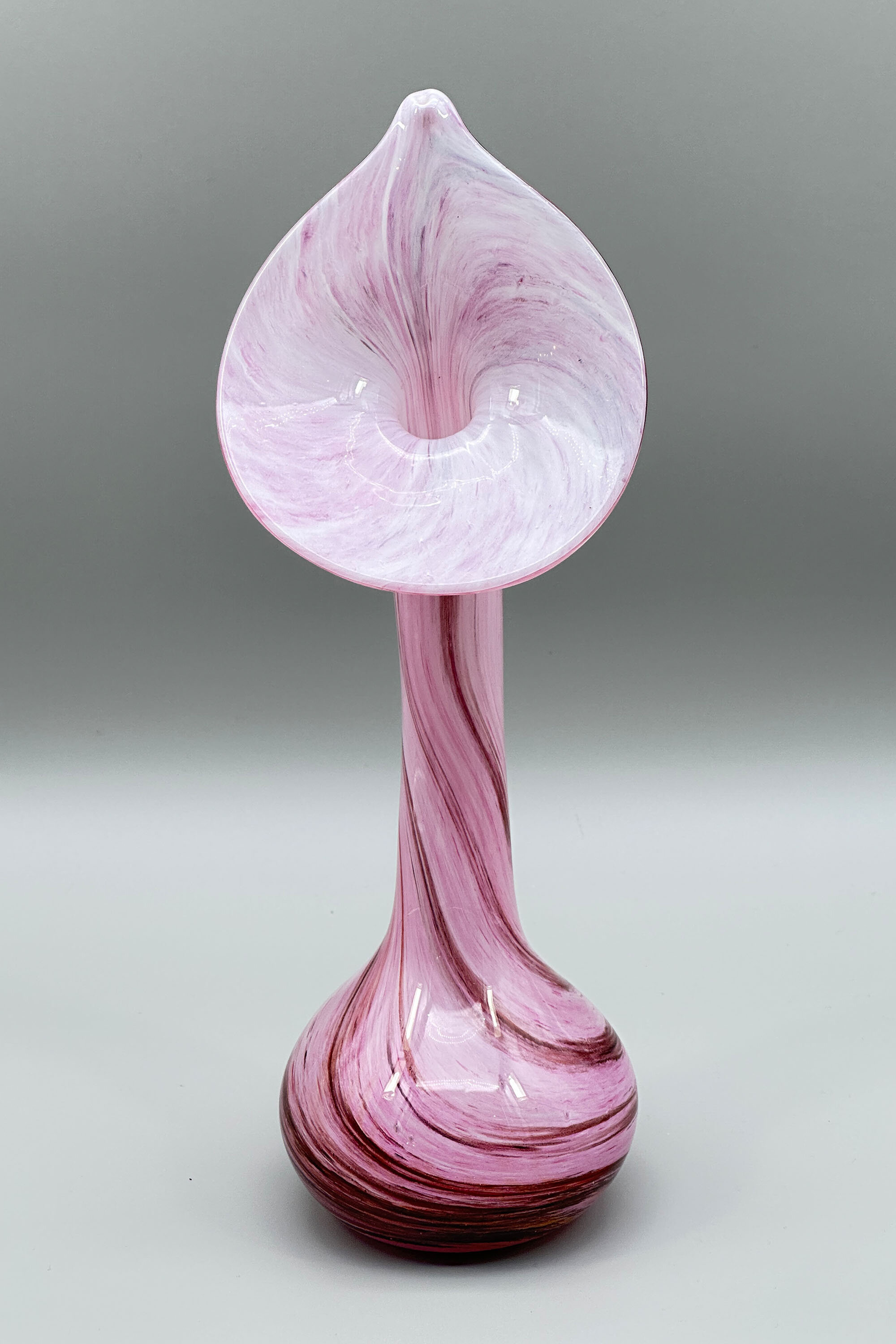
Jack in the Pulpit Vase, Alum Bay Glass, Isle of Wight, with label, late C20th
Price: £35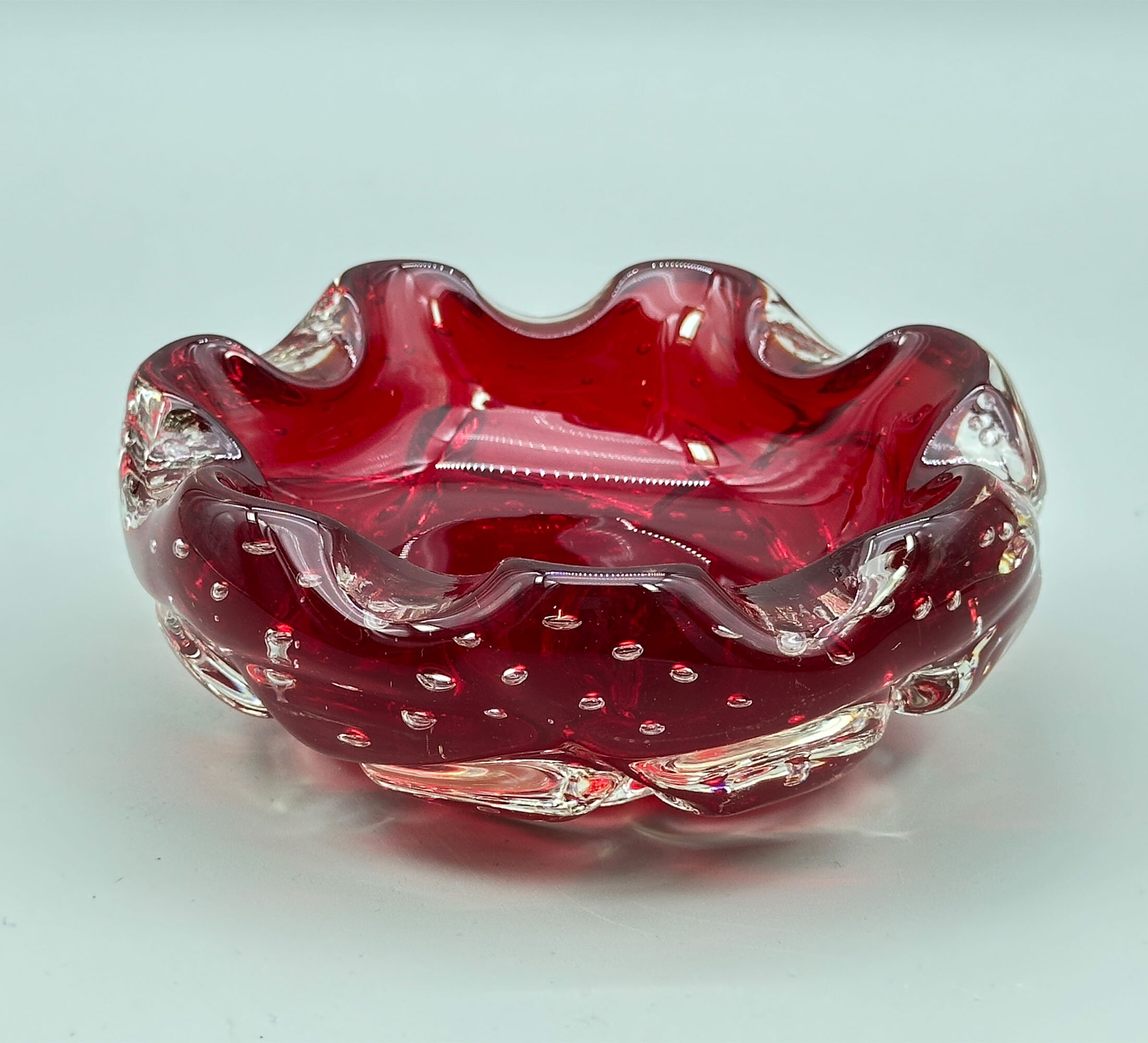
Murano ruby glass bullicante bowl, second half C20th
Price: £55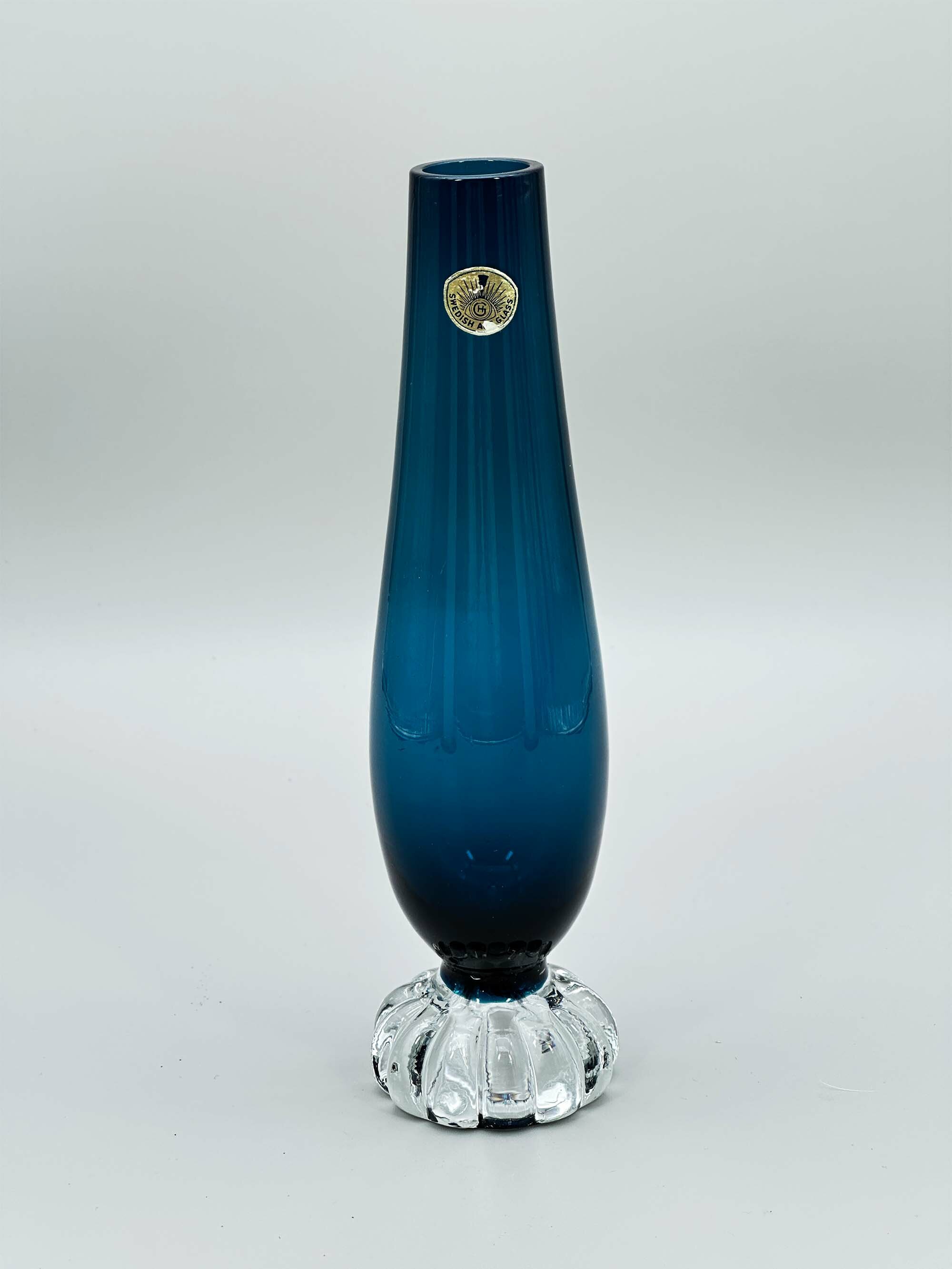
Blue art glass bud vase, Hjorts Glasbruk, Sweden, second half C20th
Price: £35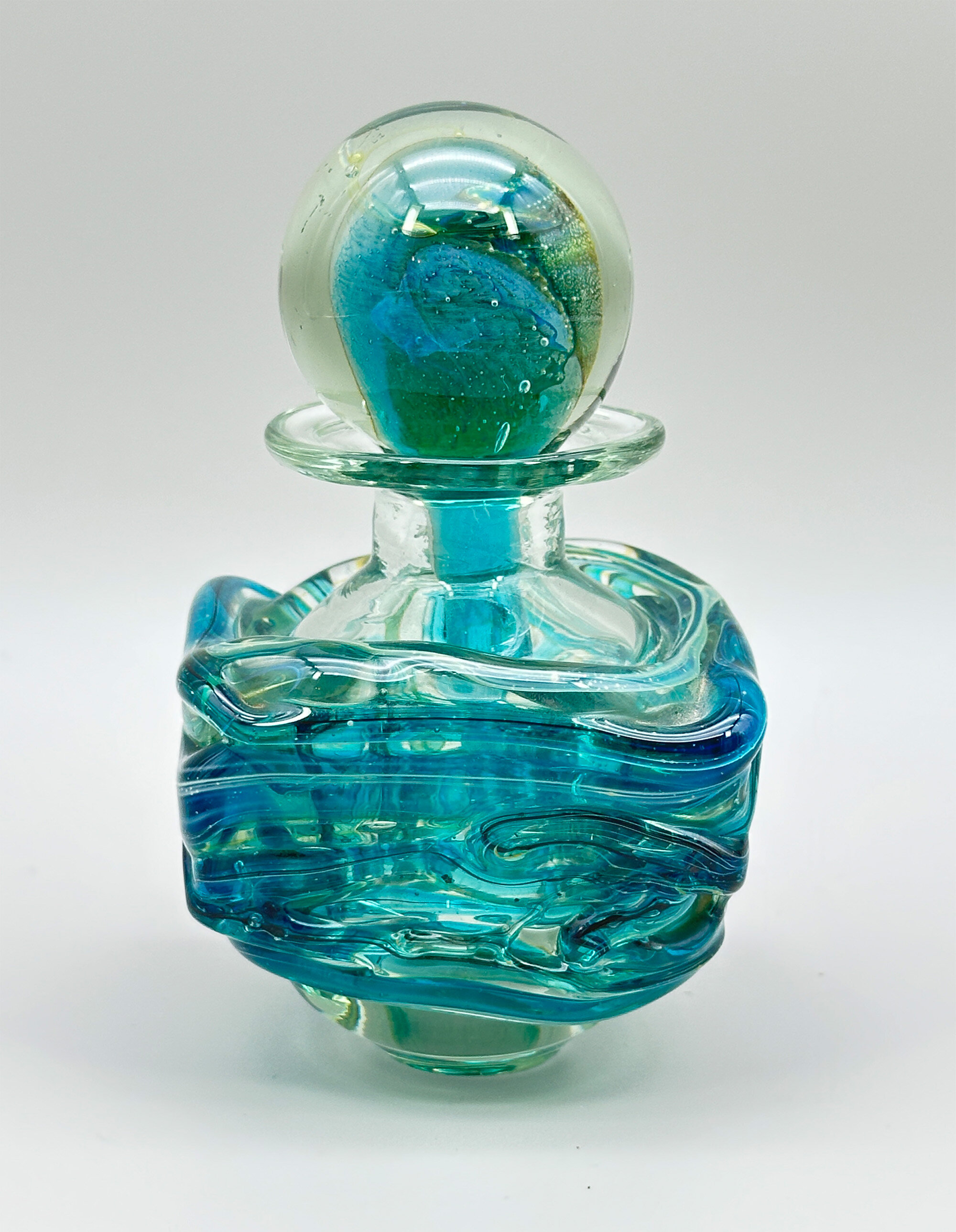
Mdina Blue Summer Perfume Bottle and Stopper, signed, 1970s
Price: £55Mdina Glass was founded in the Maltese town of Mdina in 1968 by Michael Harris and Eric Dobson. The town had no history of glass making but the venture proved to be a success. Its wares, free formed organic glassware, often in colours inspired from the sea, sand, earth and sky, proved very popular with tourists visiting Malta. Michael Harris left Mdina in 1972 and formed a new company, Isle of Wight Studio Glass, on the Isle of Wight, UK, leaving Eric Dobson in charge, but many of the designs he created continued to be made at Mdina Glass after his departure. This perfume bottle may possibly be an original Michael Harris design. Certainly it reflects the organic forms he created and the colourings, resembling the popular ‘sea and sand’ range, are consistent with this although the pattern here is more correctly referred to as ‘blue summer’ and the stopper of this bottle is a better match in colouring and design than some of the other examples currently on the market.
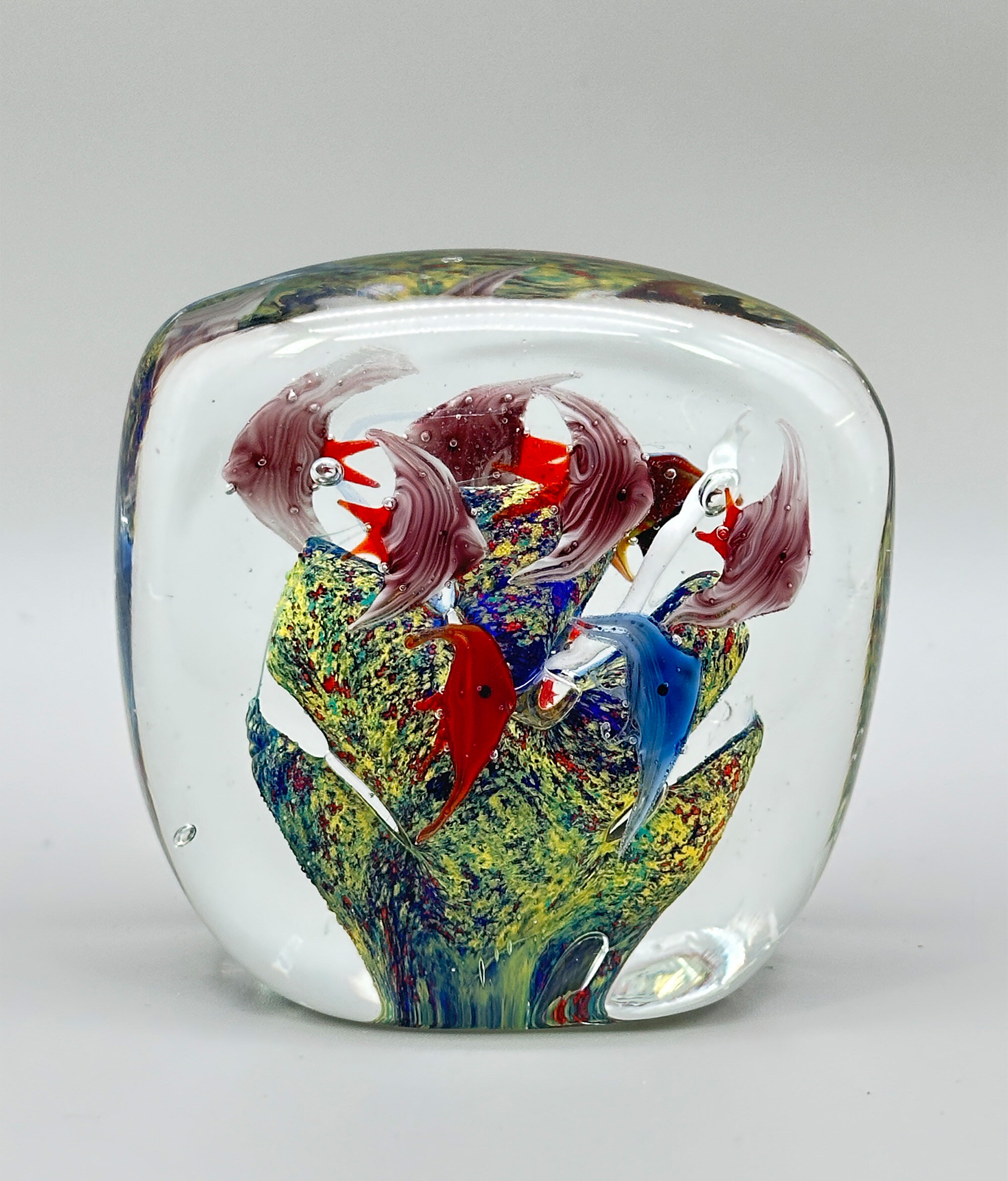
Glass Aquarium Paperweight, probably Murano second half C20th
Price: £45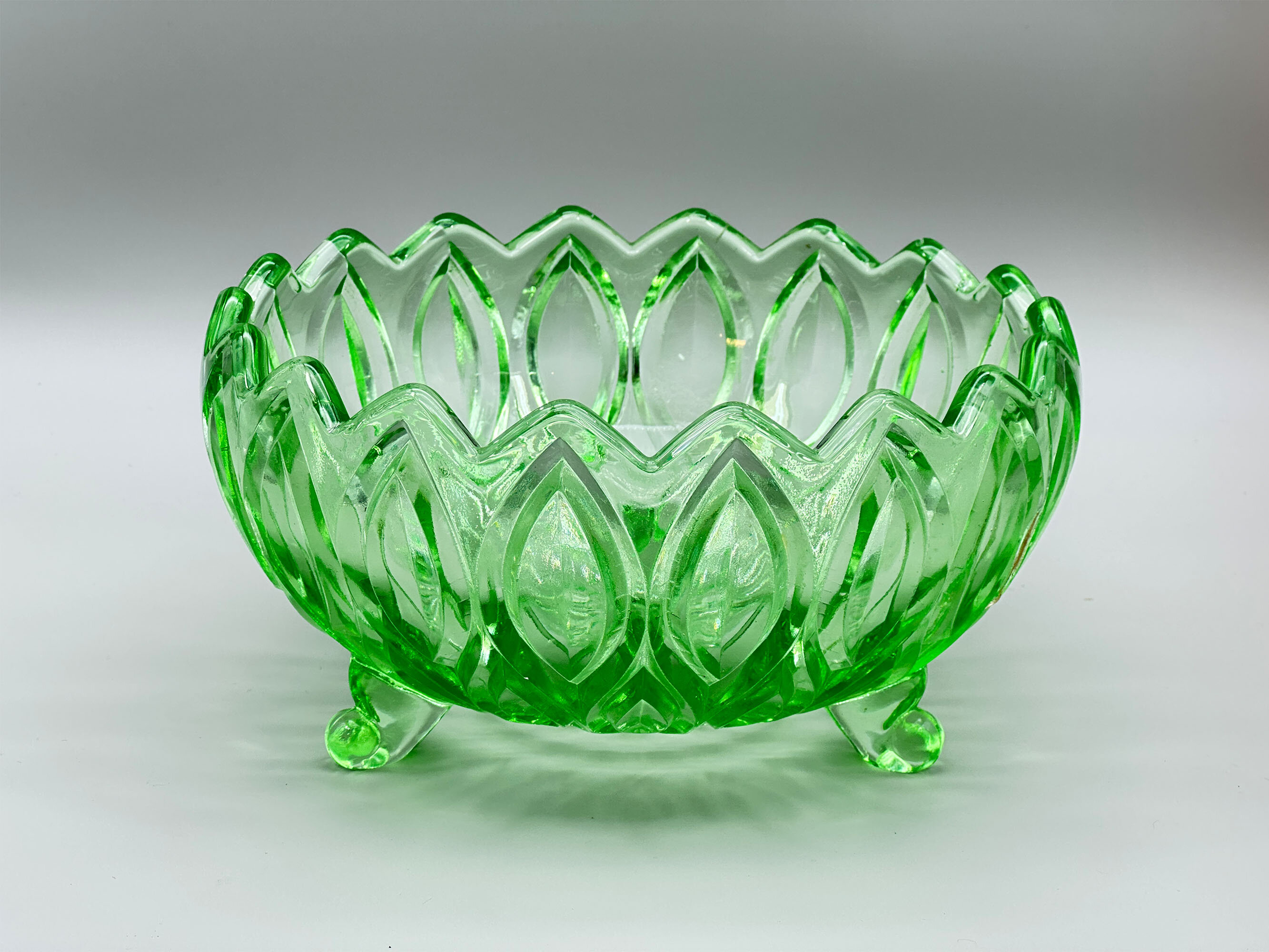
Art Deco green glass Orion Bowl by Lausitzer Glaswerke, Germany 1930s
Price: £45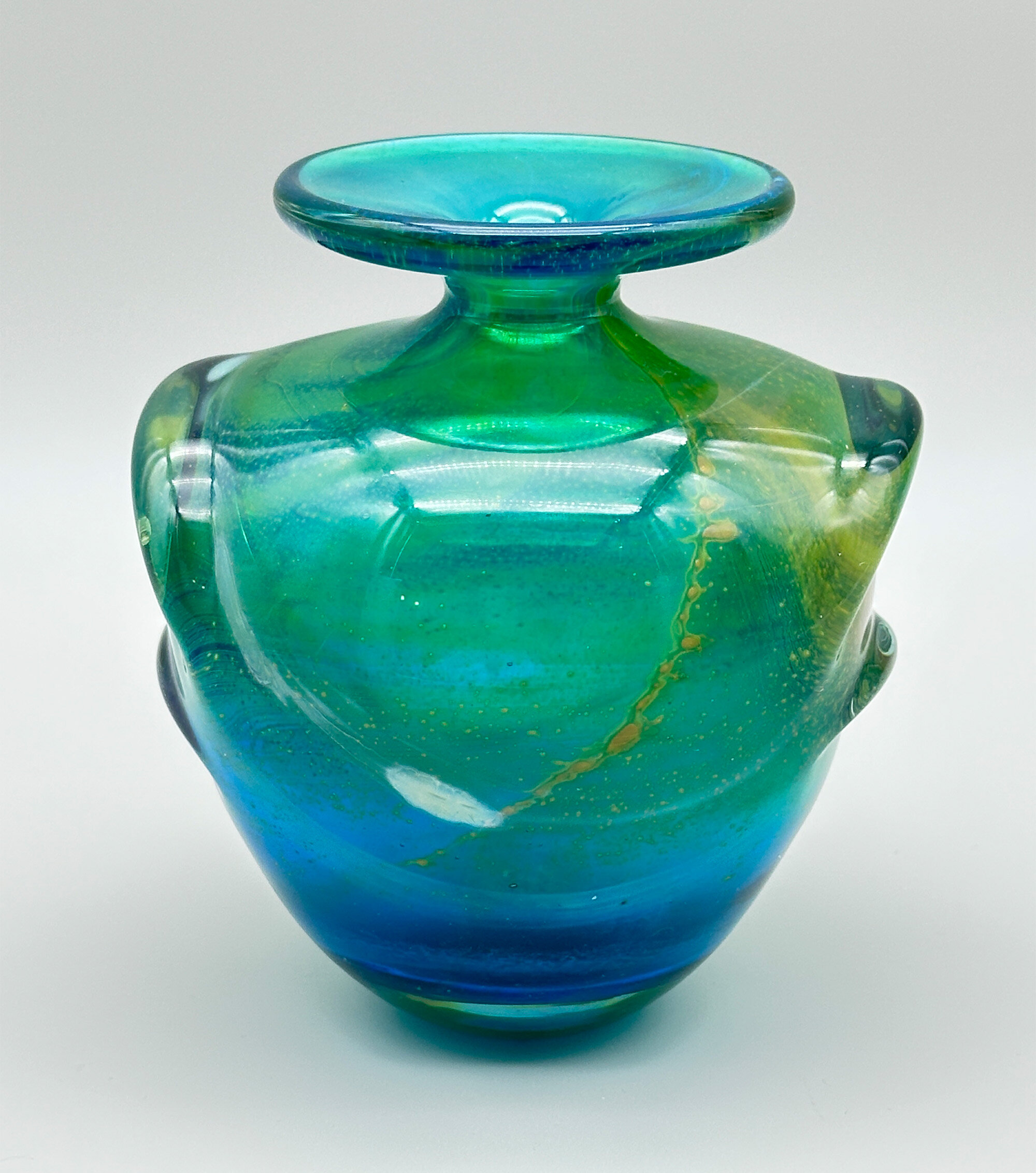
Mdina pulled ear glass Vase, Blue Summer pattern, signed, second half C20th
Price: £55Mdina Glass was founded in the Maltese town of Mdina in 1968 by Michael Harris and Eric Dobson. The town had no history of glass making but the venture proved to be a success. Its wares, free formed organic glassware, often in colours inspired from the sea, sand, earth and sky, proved very popular with tourists visiting Malta. This vase is one of the earlier productions made by Mdina (the format of the signature confirms this) probably dating to the 1970s and, if not designed by Michael Harris, it certainly resembles the organic forms he created and the colourings, often referred to as ‘sea and sand’ although more correctly termed ‘blue summer’, reflect this. The raised detail to the sides enhances the overall profile contributing to a piece of satisfying charm.
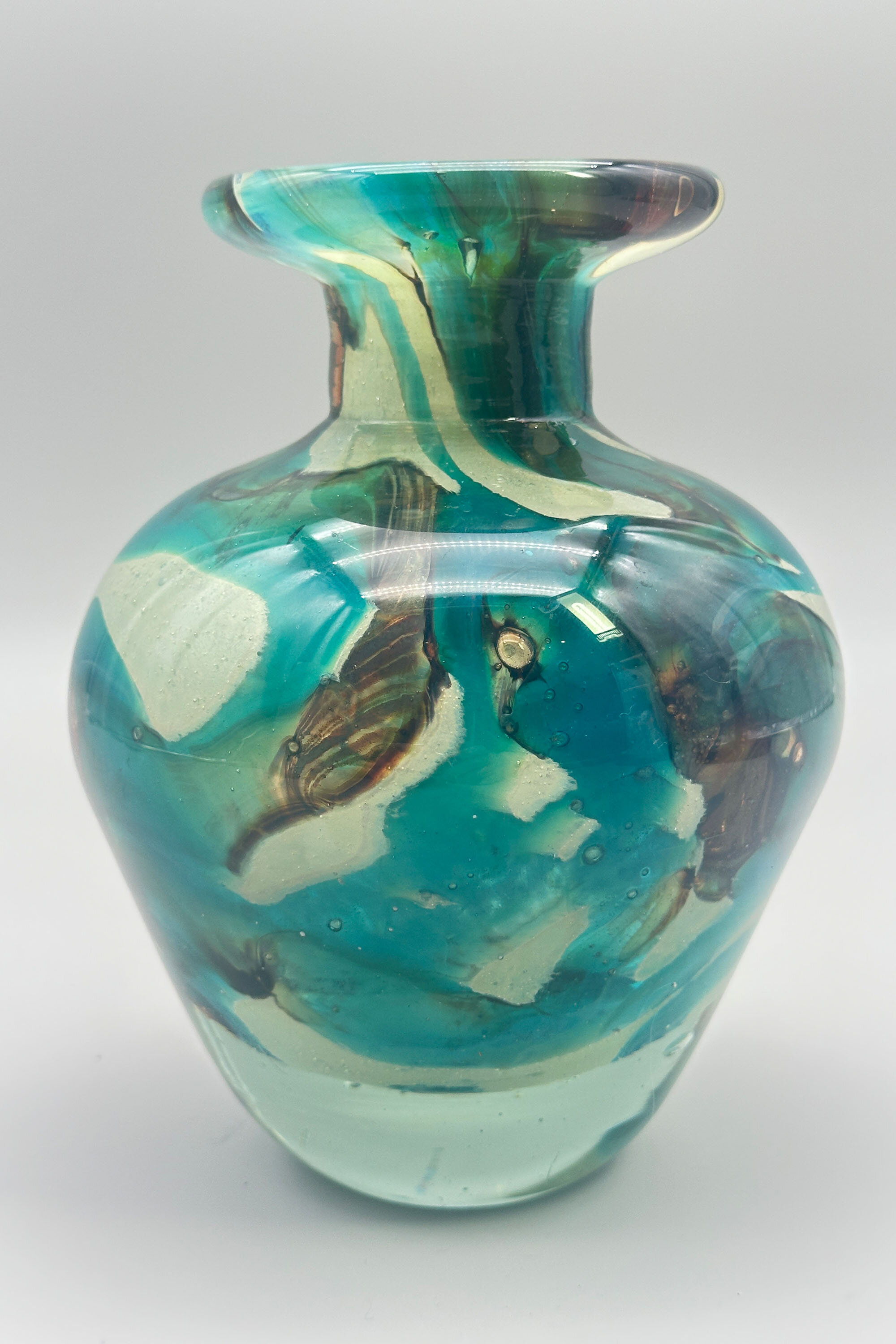
Mdina tiger pattern glass Vase, signed, second half C20th
Price: £45Mdina Glass was founded in the Maltese town of Mdina in 1968 by Michael Harris and Eric Dobson. The town had no history of glass making but the venture proved to be a success. Its wares, free formed organic glassware, often in colours inspired from the sea, sand, earth and sky, proved very popular with tourists visiting Malta. This vase is one of the earlier productions made by Mdina (the format of the signature confirms this) probably dating to the 1970s. The design is known as the ‘tiger pattern’ and is believed to have been created by Eric Dobson himself. All the pieces in the range have individual variations but this particular version is extremely pleasing and highly characteristic of Mdina’s naturalistic style.
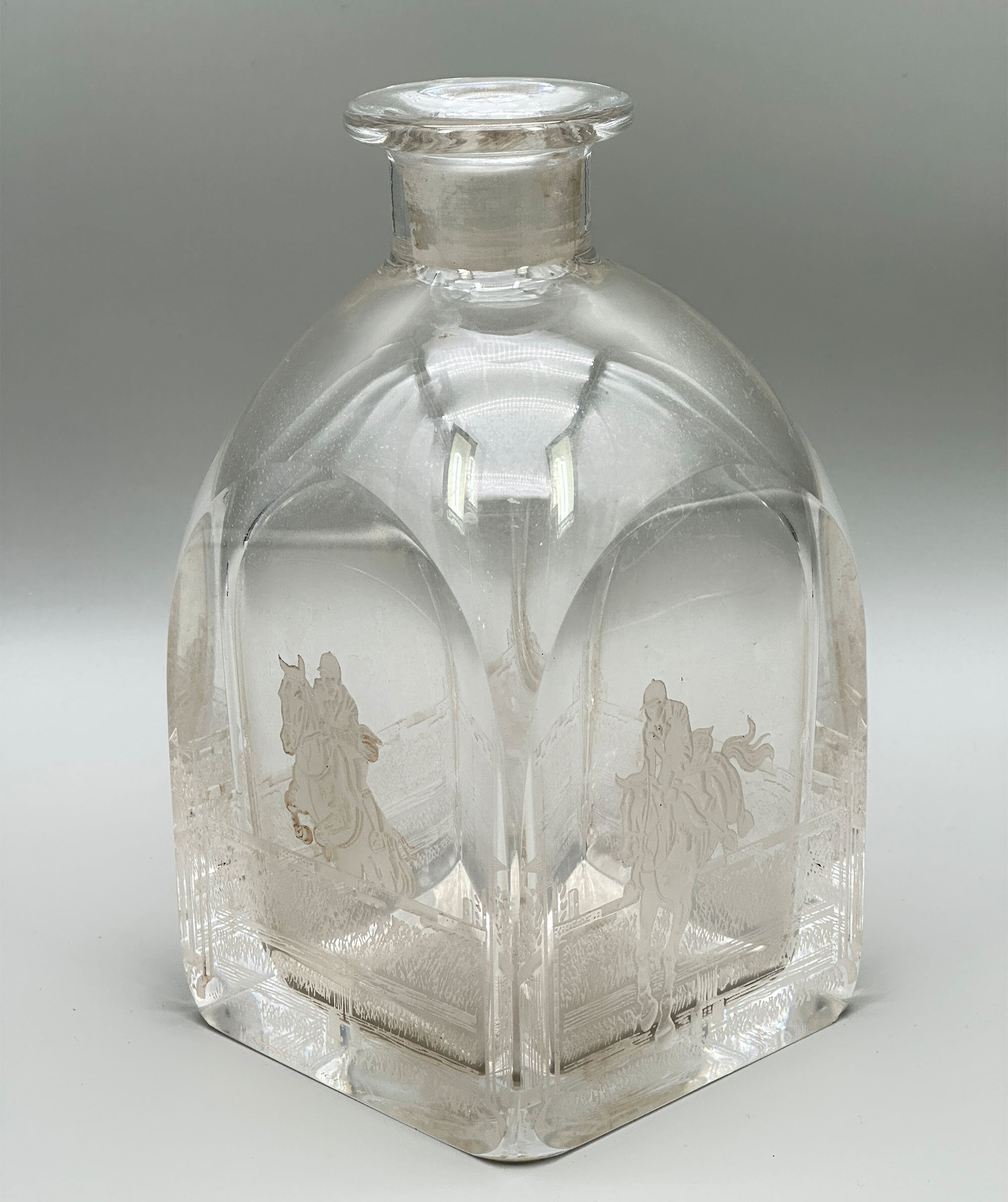
Orrefors Zaglo signed crystal glass Decanter, Riding Scene, mid C20th
Price: £30Orrefors was founded in Sweden in 1898 by Johnan August Samuelson. It then went through a variety of ownerships and also acquired many of its rival glass companies including Kosta Boda. Orrefors became Orrefors Kosta Boda in 1990 and joined The Royal Scandinavia Group in 1997.
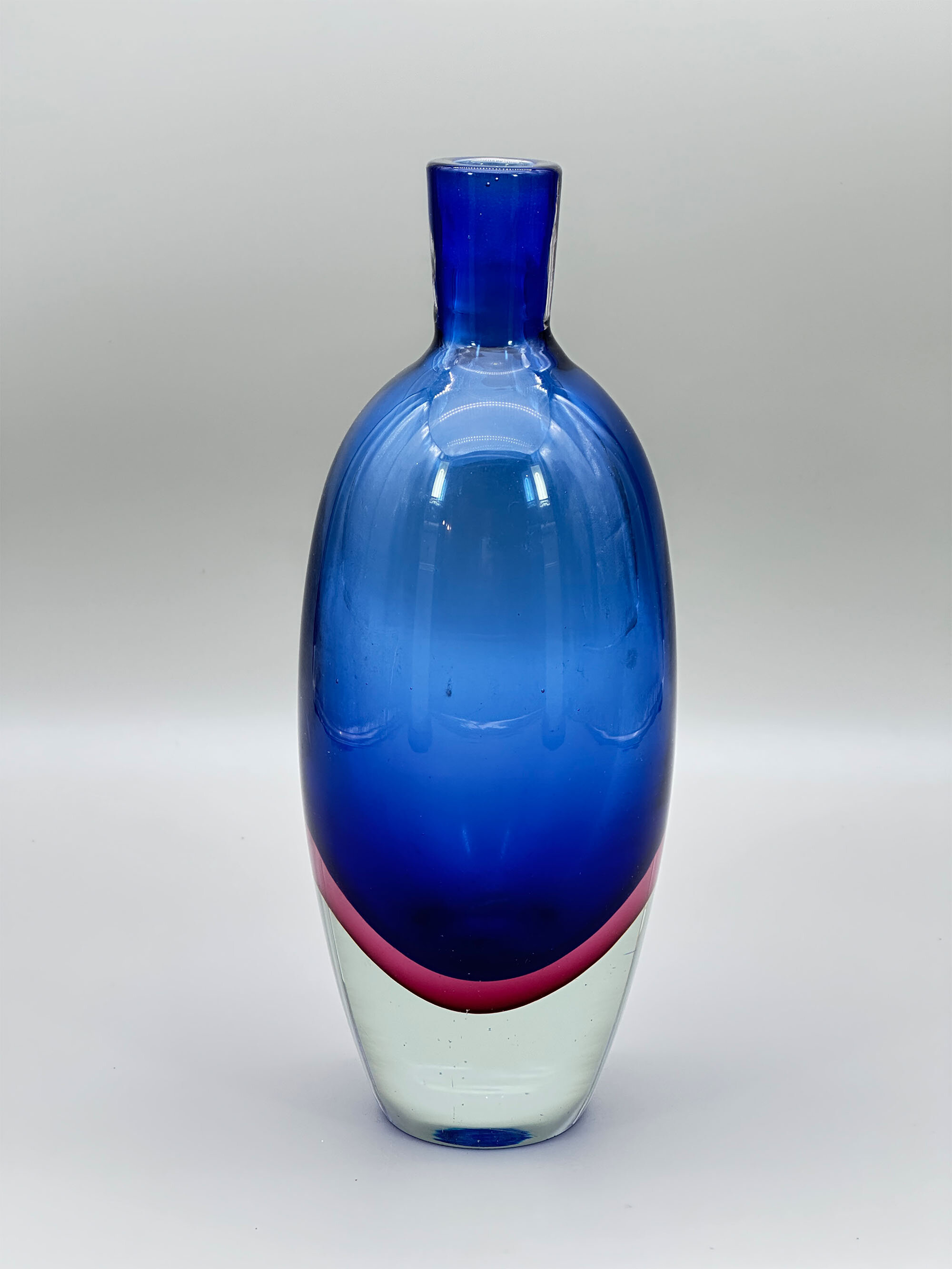
Sommerso blue glass bottle vase, Flavio Poli for Seguso Vetri D’Arte, 1950s
Price: £150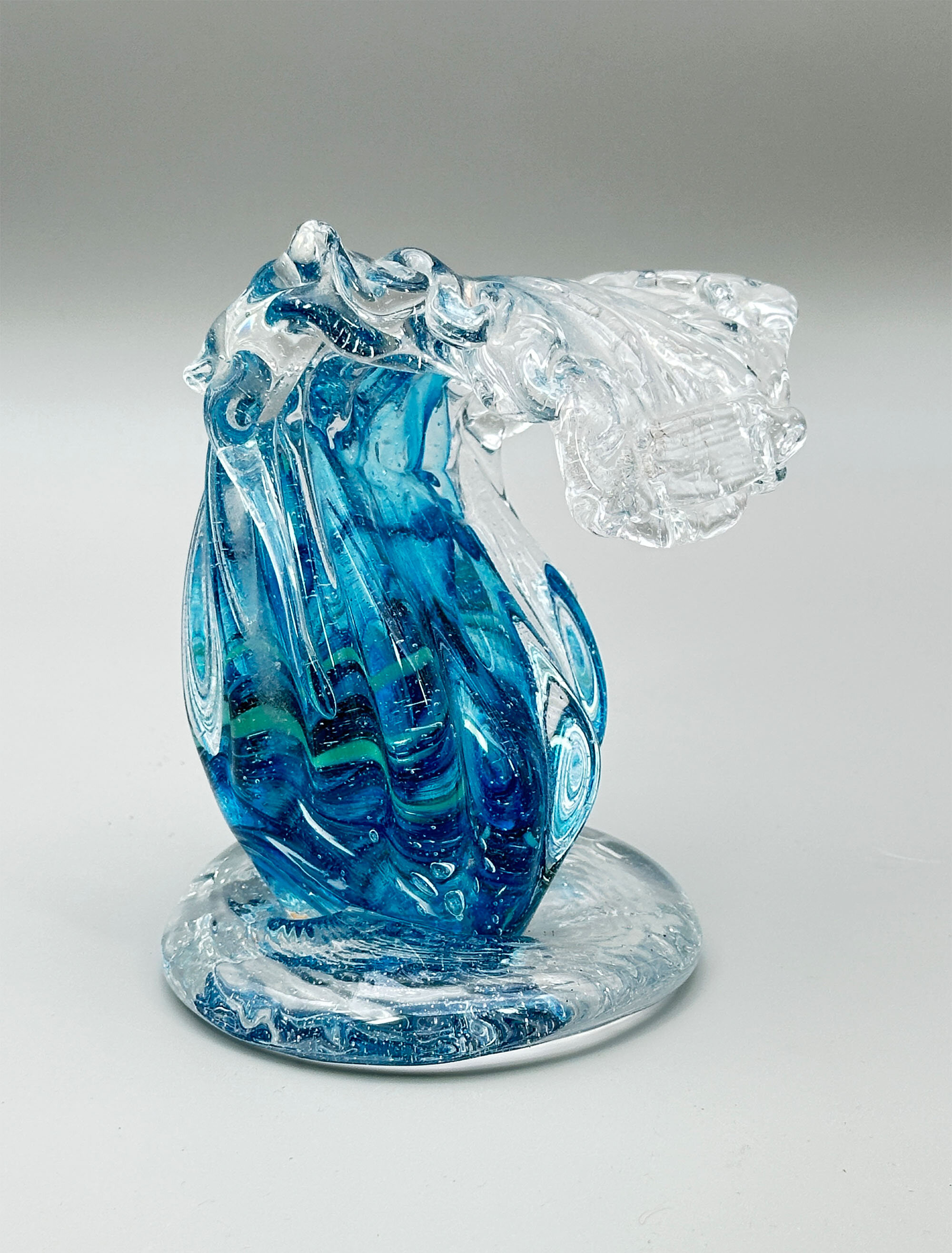
Wave shape glass Vase, probably Murano, second half C20th
Price: £95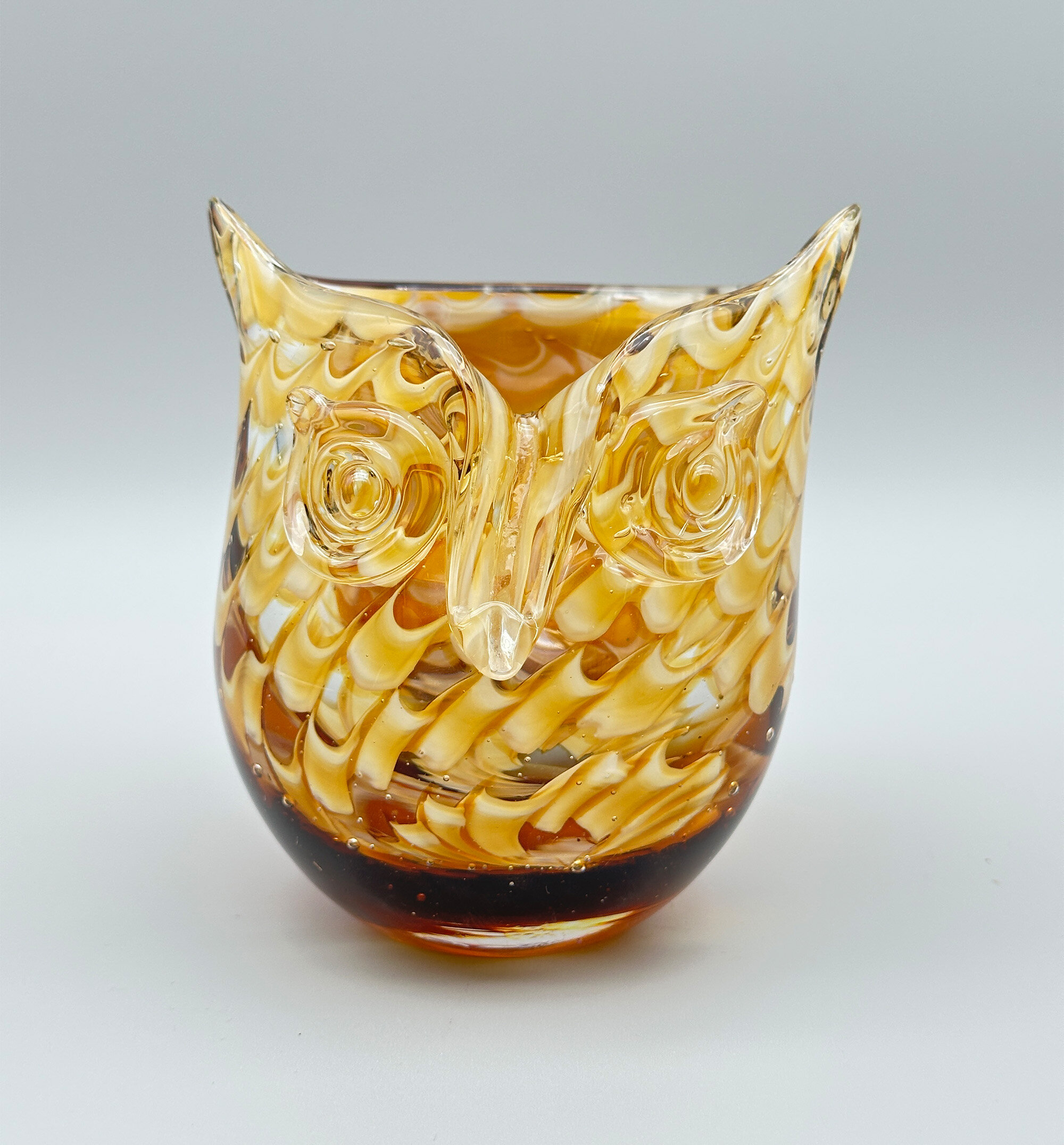
Owl glass Vase, Italian probably Murano, second half C20th
Price: £45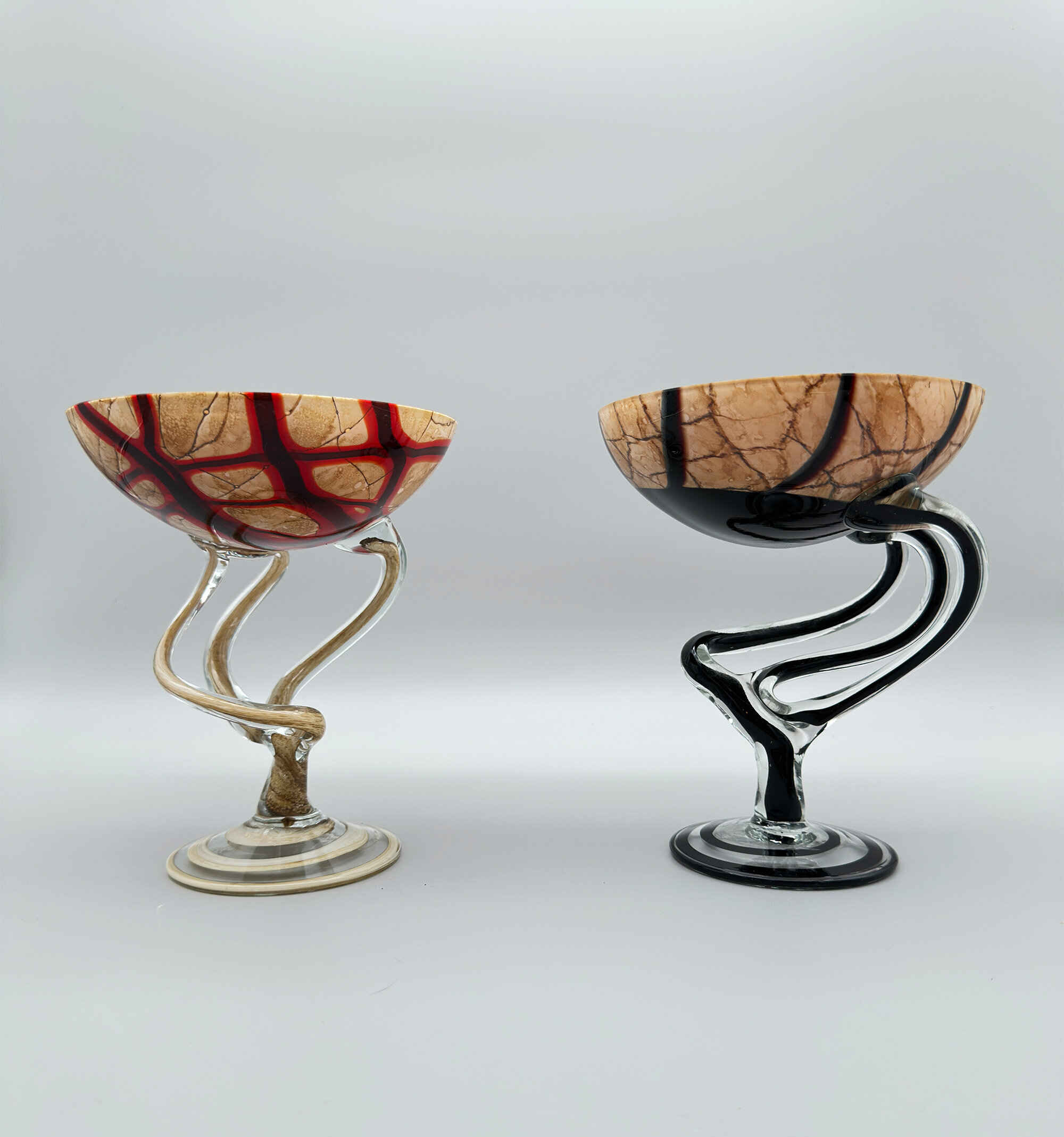
Two art glass pedestal Bowls, Jozephina Glassworks, Krosno, Polish c1980
Price: £75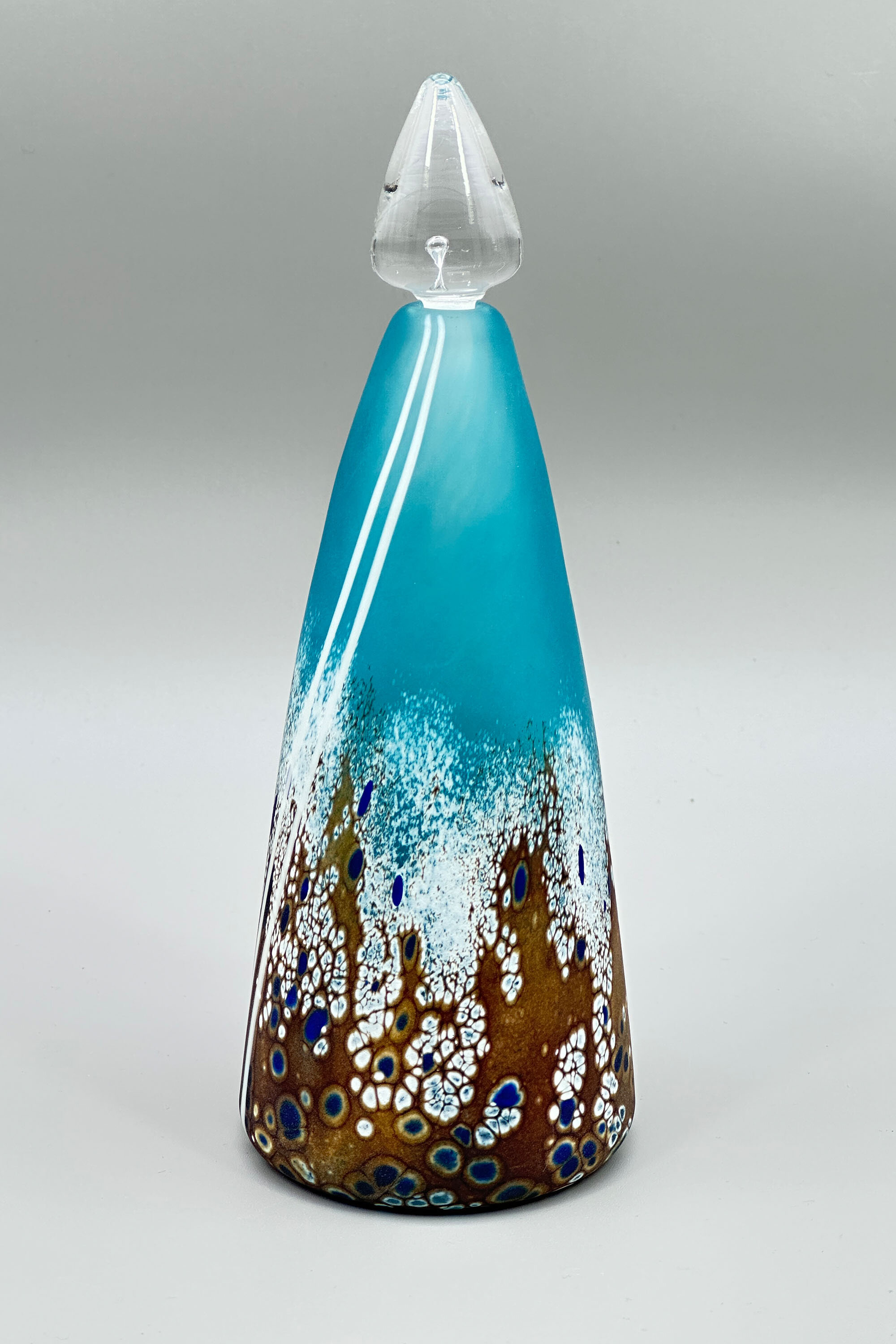
An art glass Perfume Bottle and Stopper, Martin Andrews Glass, C21st
Price: £75Martin Andrews (see image 9) graduated from West Surrey College of Art and Design with a BA (hons) Glass in 1991. Following this he was based in London until 2000 when he then launched his current workshop at the Ruskin Glass Centre in Stourbridge. His work often draws on the earth's natural forms and patterns and his ‘beach’ range is a prime example of this. Most of his pieces are signed, but this bottle is not, perhaps because of its size, but its inclusion in the studio’s inventory makes its provenance beyond doubt.
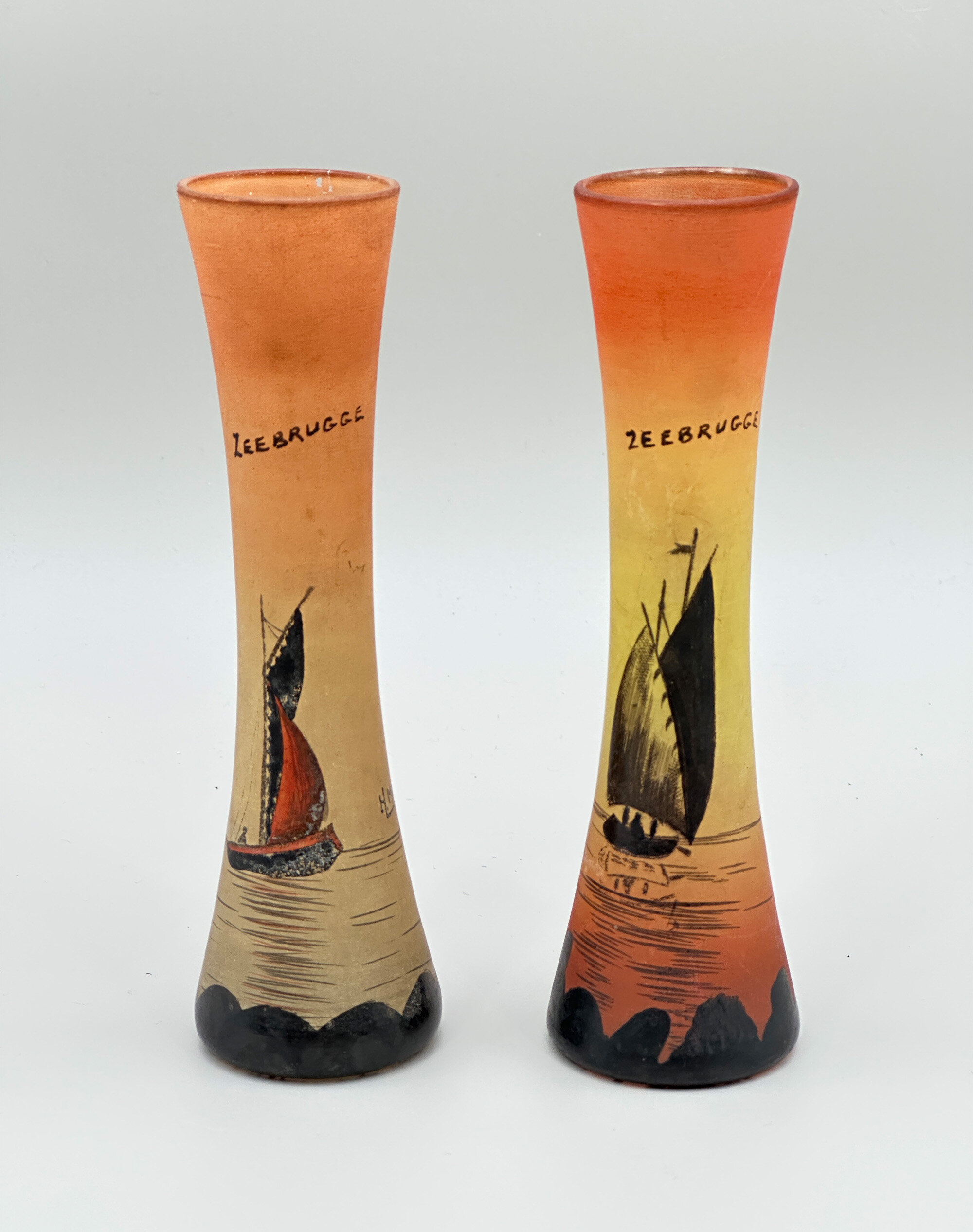
Two satin glass Vases inscribed Zeebruge and signed H.Martin, Belgium, first half C20th
Price: £35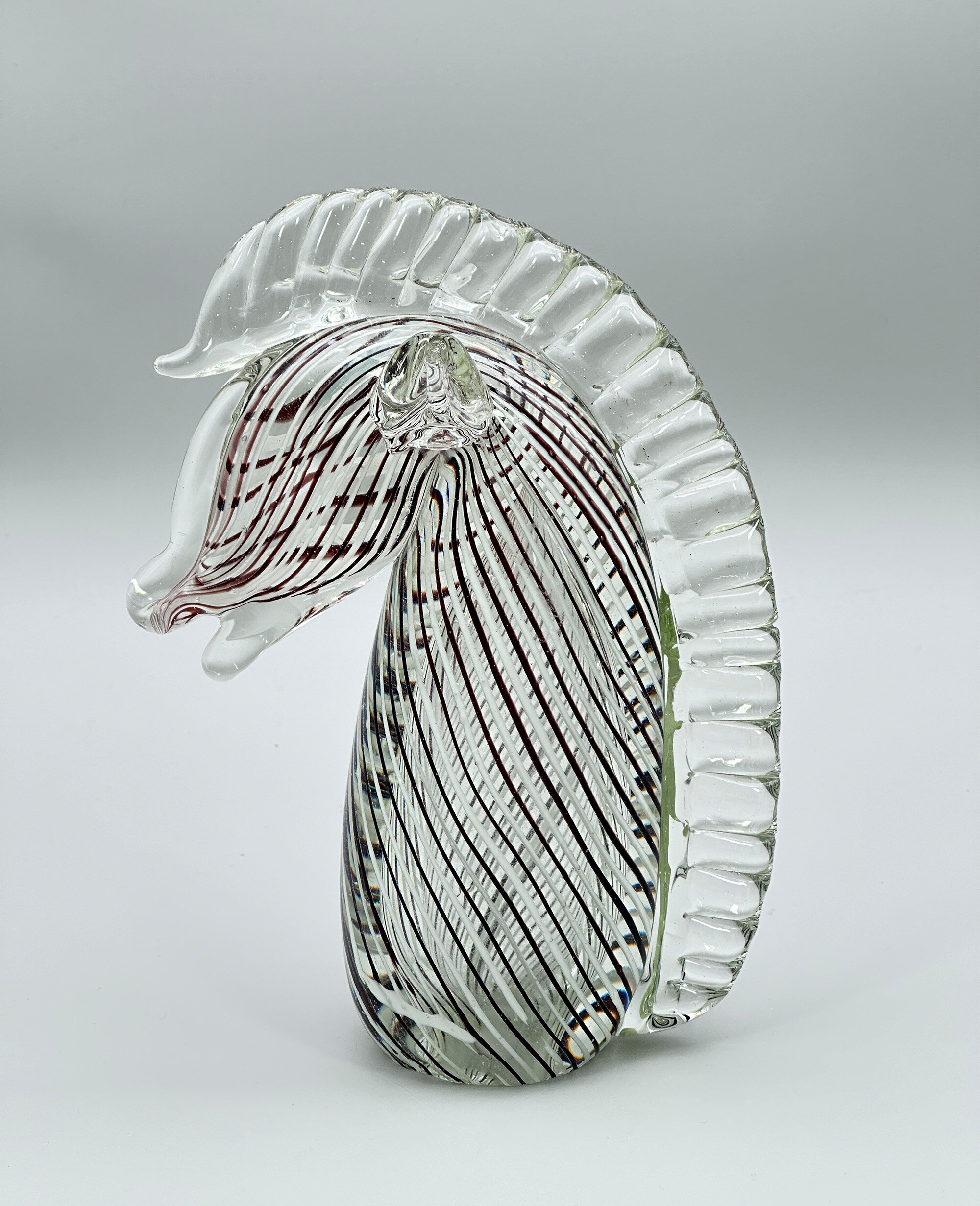
Glass figure of the head of a Sea Horse Head, Murano style, second half C20th
Price: £45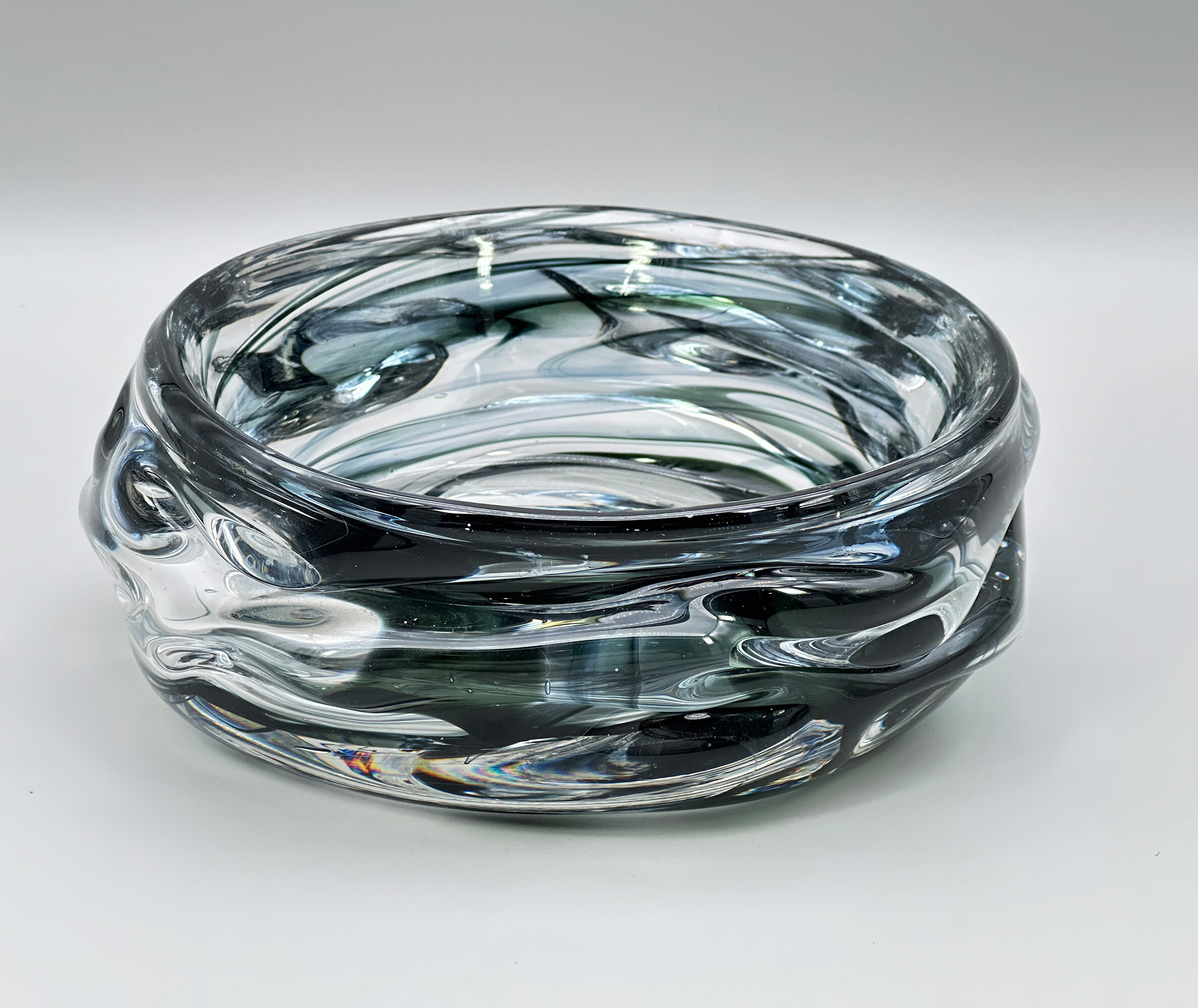
A streaky dark grey/green and clear glass knobbly bowl, Whitefriars, 1960s/1970s
Price: £55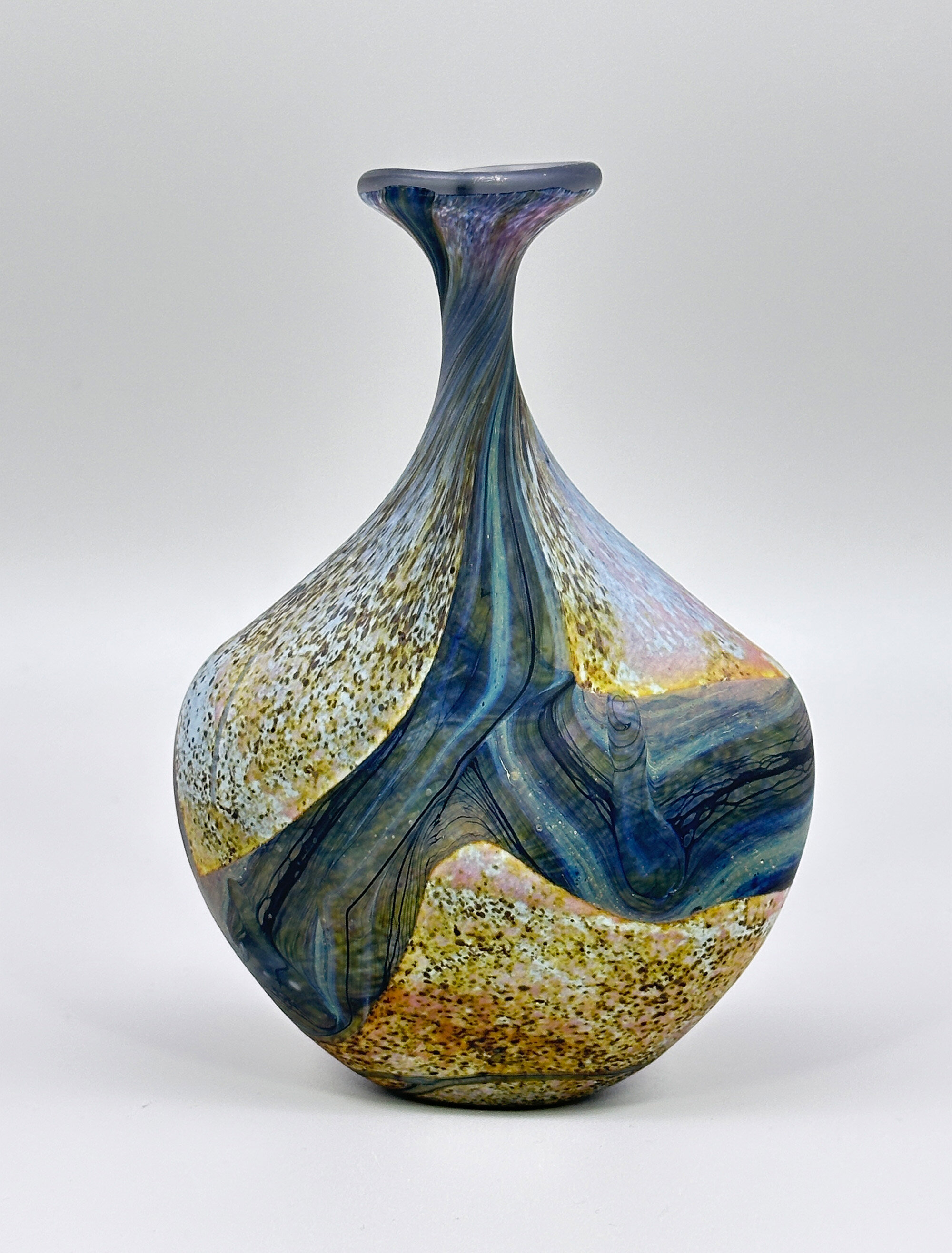
Frosted art glass lollipop form vase, Peter Layton, signed, late C20th
Price: £150Peter Layton is one of Britain’s most celebrated glass artists. Born in 1936, his initial interest was in ceramics but in 1965, while on a teaching post at the University of Iowa, his focus changed and he began to study the art of glass blowing, at a time when the art glass movement in America had an enthusiastic following. Returning to England in 1968, he started a a small glass studio in the Highlands of Scotland while relying on pottery to earn a living. Eight years later, in 1976, he opened the ‘London Glassblowing’ studio which continues to this day and where Peter Layton, now in his eighties, continues to train and supervise upcoming glass artists as well as producing his own work.
This vase is probably one of his earlier pieces and derives its inspiration from the celebrated glass workshops at Mdina and the Isle of Wight whose productions tended to draw heavily on landscape and nature and some of whose shapes clearly influenced it. There are a few other pieces in a similar form, but the colourings and design here are particularly pleasing making this a highly desirable addition to a collection of British studio glass.