Vintage & Contemporary Glass

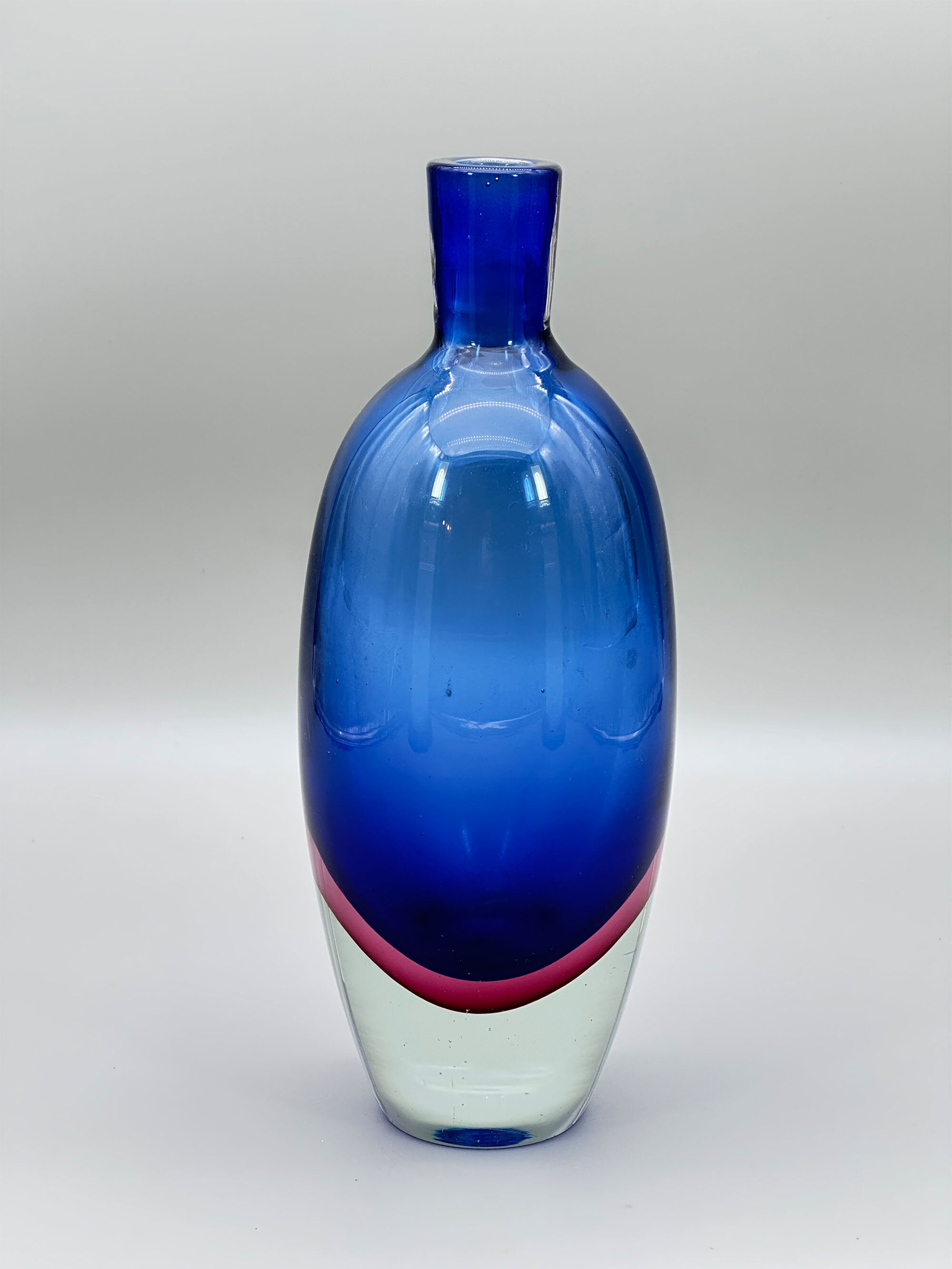
Sommerso blue glass bottle vase, Flavio Poli for Seguso Vetri D’Arte, 1950s
Price: £150
A blue glass bottle vase, the body of slender ovoid form below a narrow slightly tapering neck, the base flat, the blue glass resting above layers of purple and clear glass employing the ‘sommerso’ technique. ‘Sommerso’ pieces (Italian ‘submerged’) are formed by dipping coloured glass into molten glass of a different colour, before blowing the glass into the required form, creating two or more contrasting layers without the colours mixing together. The technique was developed by Flavio Poli (1900-1984) a designer for Seguso Vetri D’Arte, Murano, who joined the firm as artistic director in 1934. Poli began to experiment with ‘sommerso’ pieces in the 1950s and some of his designs can be found in contemporary catalogues and journals which allows a reasonably secure dating. This vase belongs to his ‘blue rubino’ range and is a particularly successful model, the simple form well highlighting the different layers of glass.

Pair of small milk glass Vases with crimped rims, probably French early C20th
Price: £55
A pair of small milk glass vases, the body of an unusual globular form with an in turning crimped top rim the white surface decorated in coloured enamels with mirror image designs of a bird sitting on a rocky bank with a lake in the distance. Milk glass, now so called, was developed in Venice in the 16th century as a competitor for porcelain. Opaque and translucent it was made in a wide variety of colours and was later to enjoy great popularity in the late nineteenth and early twentieth centuries when it was produced by various manufacturers in England, Europe and America. The style of decoration here suggests France and the slightly Japanese feel combined with an element of organic Art Nouveau design indicates a dating to the early twentieth century.

Whitefriars knobbly red glass Vase, pattern no 9612, 1960s
Price: £75
This is an example of the ‘knobbly’ vase range, first produced by Whitefriars Glass in 1964. The organic circular body tapers gently upwards to the uneven top rim, the thick walls with raised ‘knobs’ irregularly placed and the base countersunk. Founded by James Powell in 1834, who bought an existing glassworks in Whitefriars, London, Whitefriars Glass continued through the generations, relocating to Wealdstone in Middlesex in 1923. Many designers worked for it including Geoffrey Baxter, who created the celebrated ‘banjo’ and ‘drunken bricklayer’ vases, but vases of this form and similar pieces with ‘knobbly’ decoration were designed by William Wilson, Whitefriars’ chief designer, and Harry Dyer, with the pattern number 9612 and to be found in the 1964 catalogue (Introduction Page 1) as one of the new designs for that year (see image XXXX). Unfortunately the high labour costs of handmade glass and the economic difficulties in the UK in the late 1970s made Whitefriars uncompetitive and it ceased trading in 1980 after which its factory was demolished.
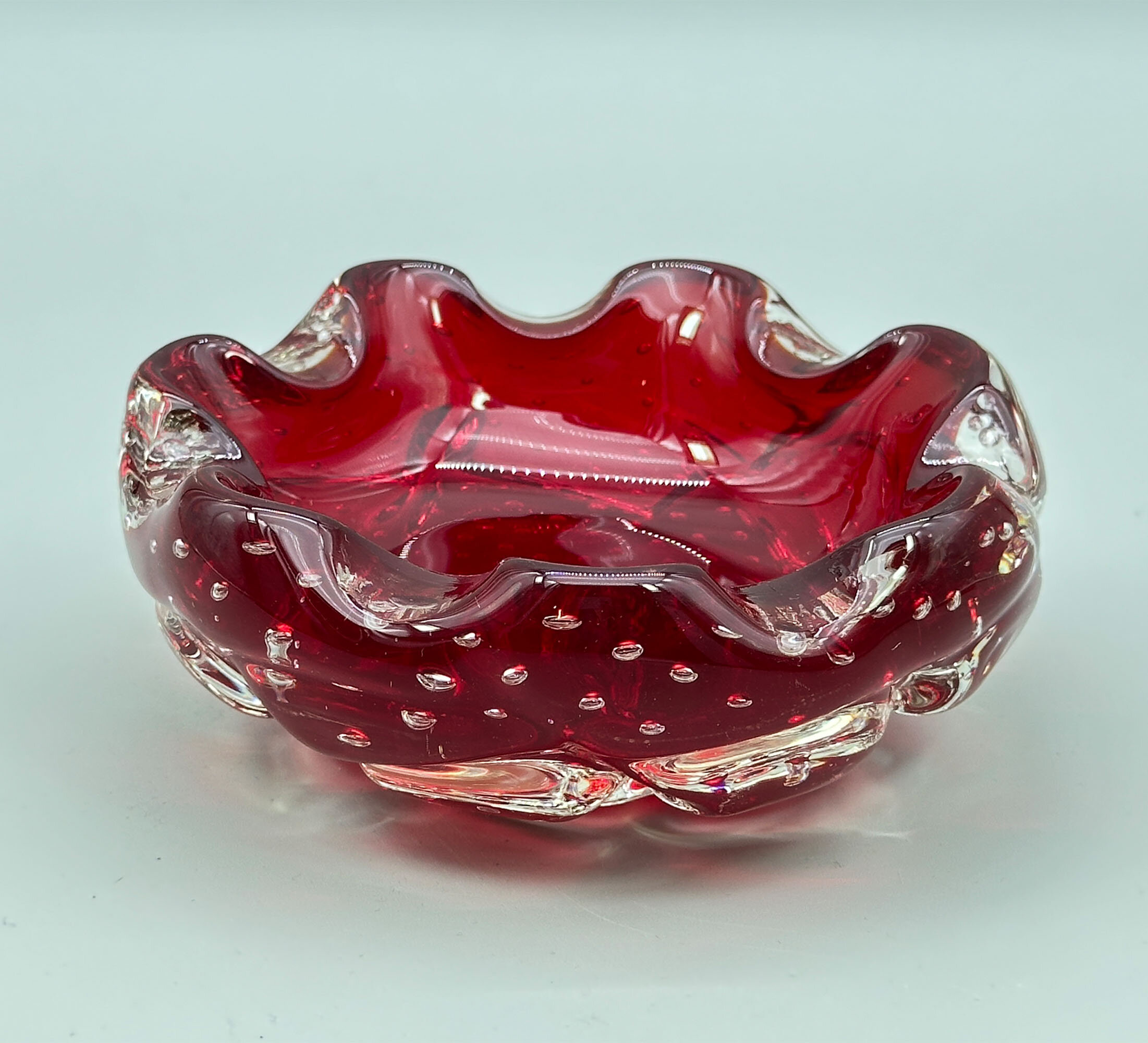
Murano ruby glass bullicante bowl, second half C20th
Price: £55
A rounded glass bowl of irregular shape, the undulating rim with seven ‘dips’, the ruby coloured glass with a multitude of ‘trapped’ small bubbles in the ‘bullicante’ technique. ‘Bullicante’ is the Italian word for ‘boiling’ and the process for creating small bubbles encased in the glass surface so named was developed and perfected at Murano during the 1930’s by Archimede Seguso. But its use continued and this bowl, which retains its original label, albeit slightly damaged, dates to the 1960s or 1970s. The ruffled rim suggests an ashtray but this piece can equally easily stand on its own as an attractive decorative accessory.
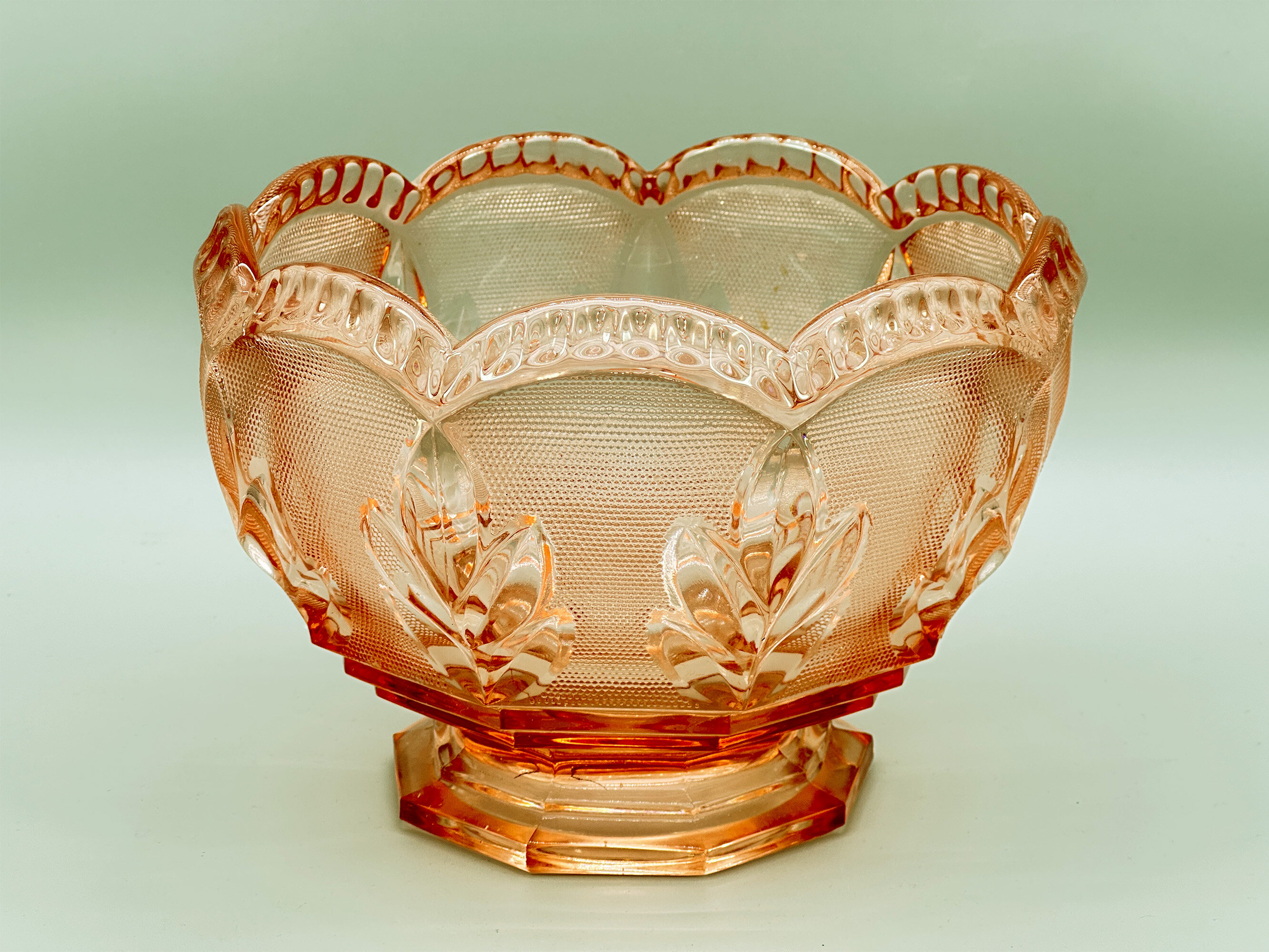
Peach colour pressed glass Bowl, Walther & Söhne, Wilhelm pattern, 1930s
Price: £45
A pressed glass bowl of rounded octagonal form with a stepped concave foot and a wavy edge rim, the peach colour glass with a design of repeating leaves on a micro dot ground, the rim with rope twist edging. The design, pattern and technique here all point to the German manufacturer Walther & Söhne, or more correctly August Walther & Söhne AG, founded by August Walther in 1888. In 1932, the firm merged with Saxonian glass and began producing a wide range of Art Deco inspired pieces including centrepieces, figurines, bowls and vases. After the war, the firm was nationalised and was renamed VEB Sachsenglas, continuing production of its Art Deco designs until its closure in 1990. This bowl comes from the ‘Wilhelm’ range which was made in a variety of shapes and colours including green ‘uranium’ glass. The Art Deco influence is clear, particularly in the clean lines of the stepped foot. Dating is most likely to the 1930s, but, as indicated above, this model may also have continued in production in the years following.
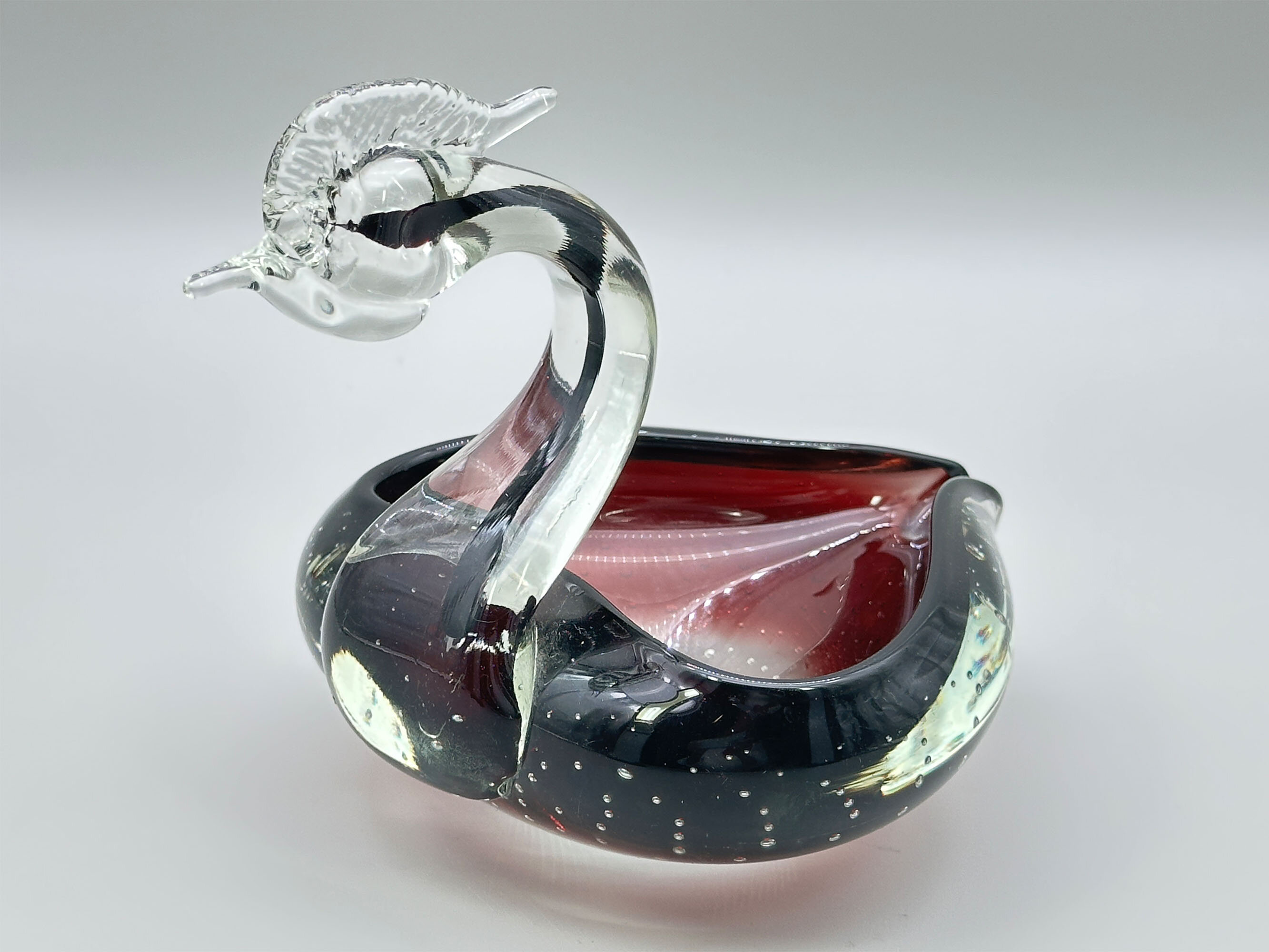
Murano bullicante glass swan dish, second half C20th
Price: £25
A glass dish in the form of a stylised swan, the heart shape body hollowed out in the centre, the two ‘wings’ with a small lip opening at the rear, the front with a clear glass curved neck and head, a black streak to the interior and the crest and beak modelled, the almost circular base flat, the deep purple glass with trapped bubbles in the ‘bullicante’ effect. ‘Bullicante’ is the Italian word for ‘boiling’ and the process for creating small bubbles encased in the glass surface so named was developed and perfected at Murano during the 1930’s by Archimede Seguso. But its use continued and this swan dish, which bears all the hallmarks of Murano work, probably dates to the 1960s or 1970s. Most likely intended as a trinket dish or possibly an ash tray, it can also be enjoyed as miniature sculpture in itself.
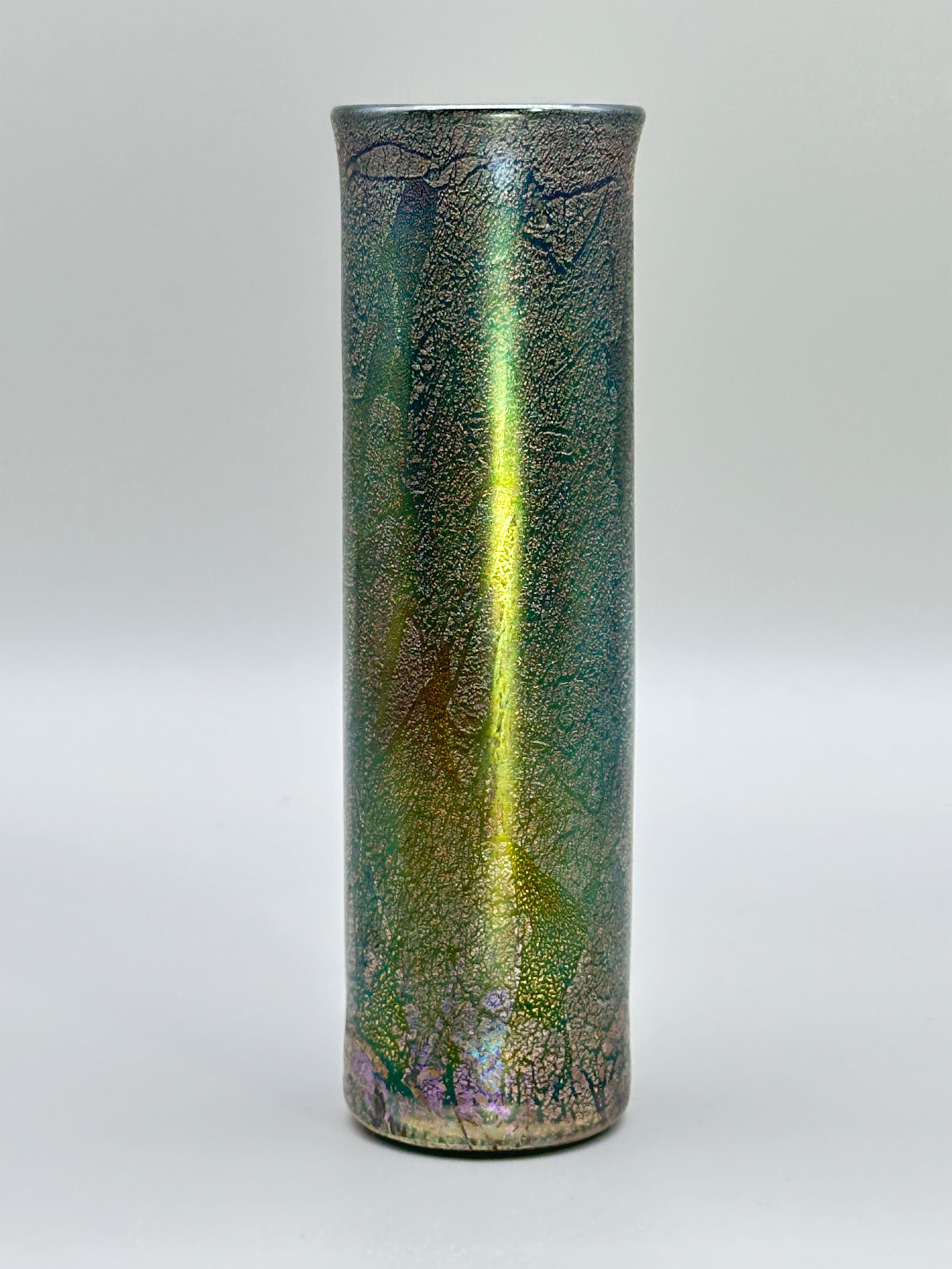
Iridescent glass spill vase, Isle of Wight Glass, second half C20th
Price: £55
A spill vase of cylindrical upright form with a slightly flaring rim, the iridescent glass with a stylised naturalistic rocky mineral design, the black ground heightened with gold flecks. While lacking the original label (and box), the decoration here is indisputably from the ‘Azurene’ range produced by Isle of Wight Glass from 1978 to 2012. The original award winning ‘Black Azurene’ finish was developed by Michael Harris in collaboration with RCA student and glassmaker William Walker in 1978. 22ct gold and sterling silver were applied to the surface of hot glass producing a range of abstract designs inspired by nature and landscape. At various times the range was produced in a variety of colours which included black, white, pink, blue, red, azure, green, gold (on black) and turquoise (the rarest colour). We have here gold on black, without the addition of silver, which was made from 1982 to 1996, an attractive example of the studio’s most popular design range.
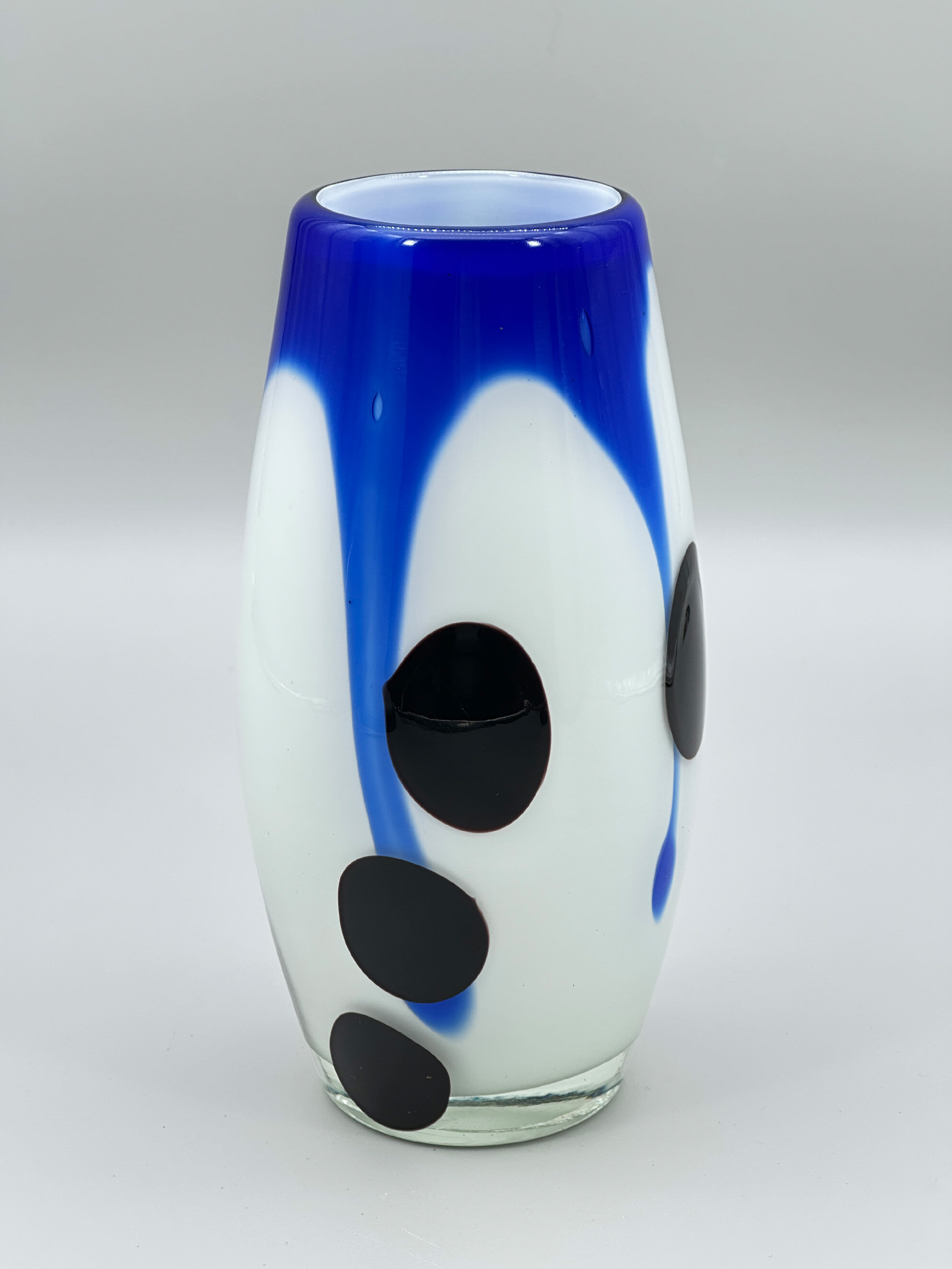
Art Glass Vase probably designed by Joanna Jellinek for IKEA, Swedish early C21st
Price: £35
An art glass vase of ovoid form, the encased white glass body with a ‘sommerso’ base, blue streaks dripping from the top and scattered irregularly shaped ovoid black ‘pebbles’. Similar designs can be found on pieces from Orrefors, Sweden, Tarnowiec, Poland and Italla, Finland, as well as from some of the Italian glasswork studios. But the closest parallel is with vases designed for Ikea around twenty five years ago by Joanna Jellinek who joined the firm in 2002. These striking designs are collectors’ items now and this is a particularly attractive example.
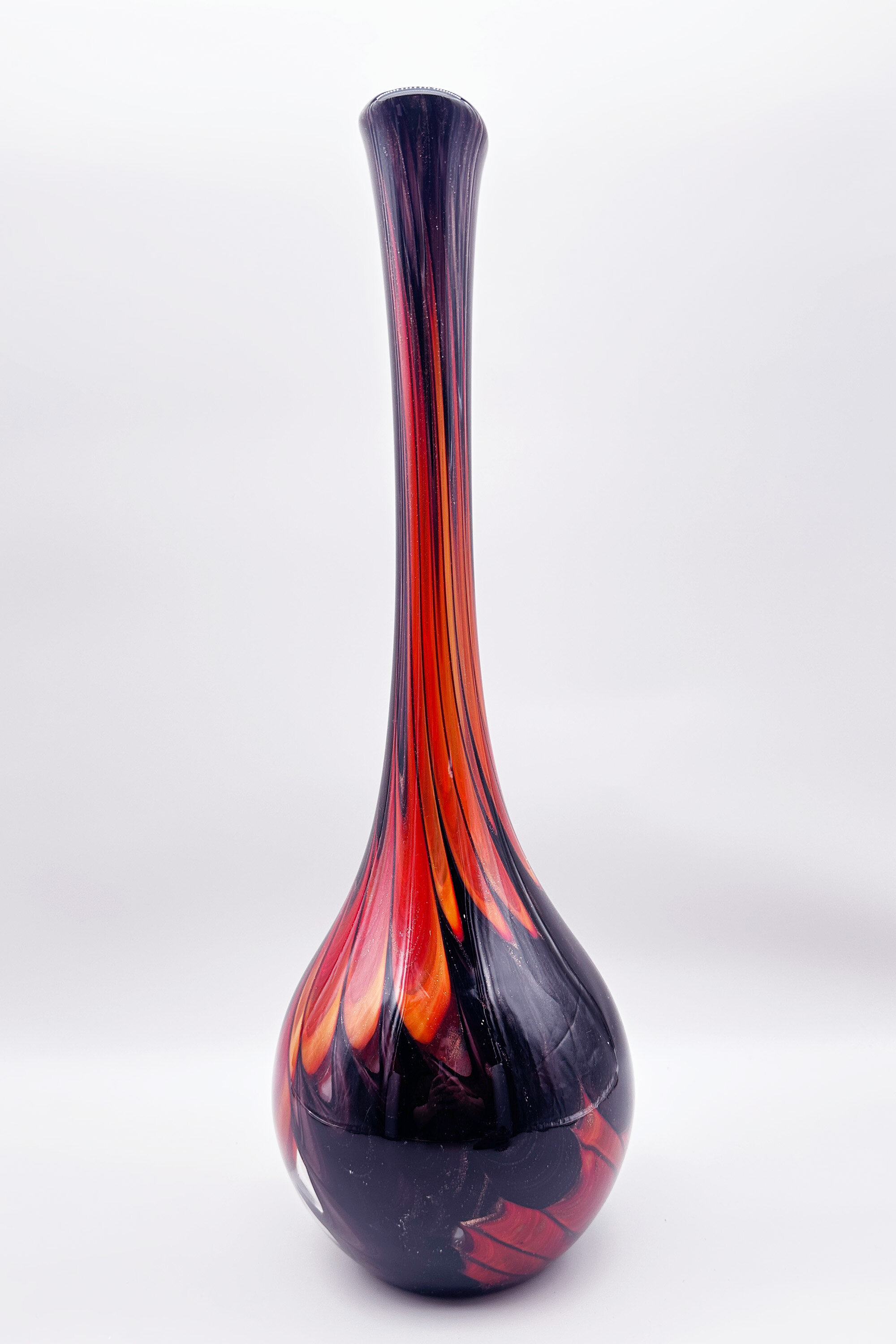
Tall Murano style bottle vase, second half C20th
Price: £150
This is an exceptionally tall art glass bottle vase, the pear shape body rising to a tall, slender neck very slightly tapering inwards and then flaring gently outwards to the uneven profile top rim, the base flat and the decoration with trails of gently spiralling mottled and feathered orange glass on a black ground heightened with gilt speckle. The techniques used here have all the hallmarks of the Murano glassworks and the form, while unusual, is not inconsistent with the work produced there but, while these vases are often described as ‘Murano’ there is no proof of this and ‘Murano style’ is perhaps a safer description. But this does not detract from the grand magnificence of this piece, which would have been a striking decorative accessory when it was made, probably in the 1960s or 1970s, and remains so today.
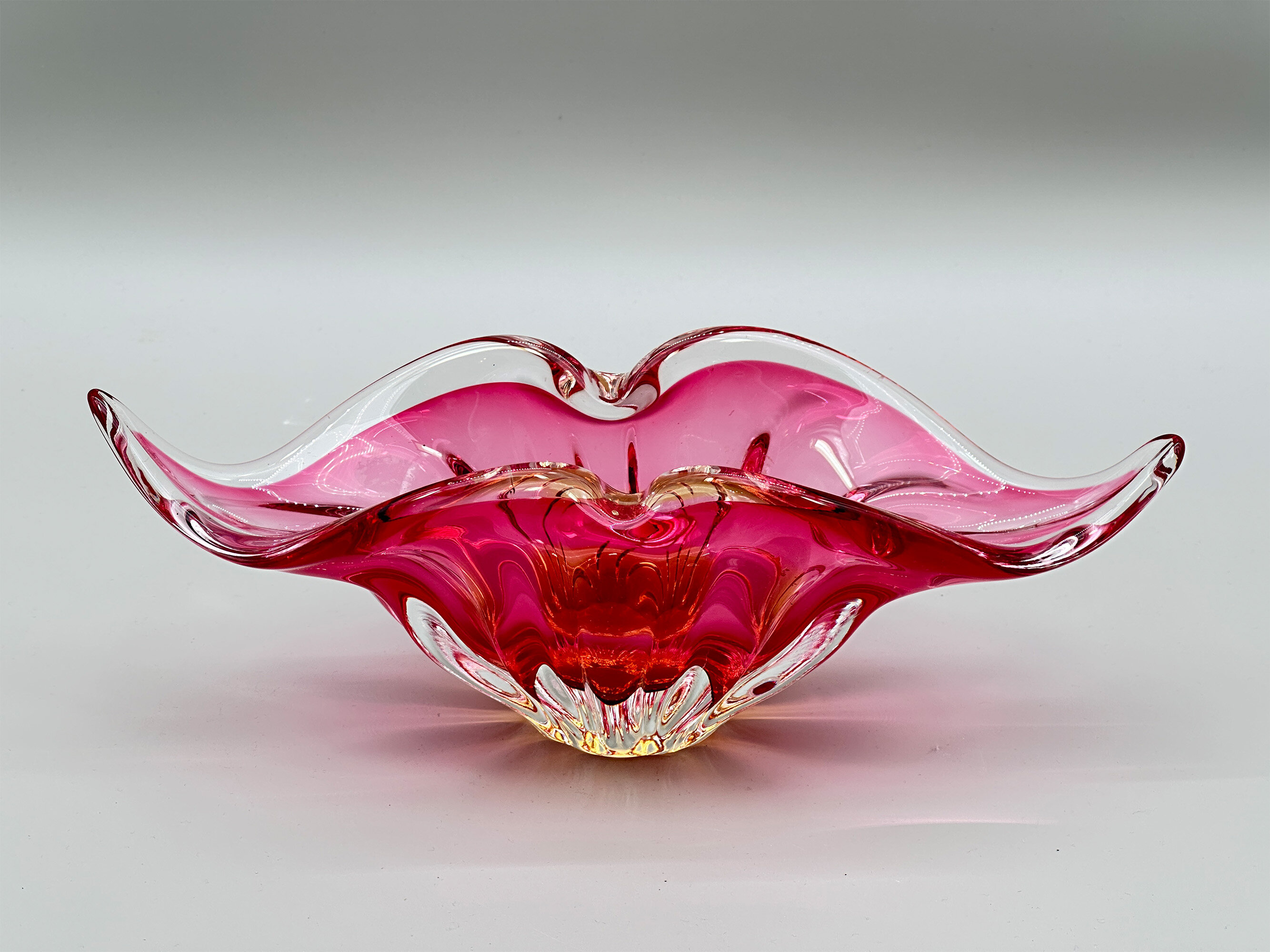
Pink and Orange Glass Bowl, Chřibská Czechoslovakia, Josef Hospodka, late C20th
Price: £45
A heavy glass sculptural bowl with extended edges and concave sides on a narrowing irregularly modelled ovoid foot in colourings of pink and orange encased in clear glass, all artistically blended. The 'chunky' design and the treatment of colour point towards pieces made by the Chřibská glassworks in Czechoslovakia. Founded in 1414, in the town of Chřibská, which was originally part of Bohemia and became part of Czechoslovakia in 1919, the factory became known as the oldest glassworks in Europe, until its closure in 2007. With the advent of communism in the 1950s, the firm became part of the Borske Sklo National Corporation and around the same time Josef Hospodka began to work there becoming head designer from 1958-1970 and returning as a designer in 1985 until his death in 1989. While there are various Chřibská catalogues, the pieces are not assigned to a particular designer, although some of them, including Hospodka himself, are mentioned in the contemporary Czech Glass Revue which allows tentative attribution and, known for his organic blown glass designs, Hospodka may well have been responsible for the piece we have here. It has the pattern number 296/5/30 and can be seen, in a different colour wave and with a slightly different foot, in two (1970s, 1999) of the Chřibská catalogues and also issue 10 of the 1979 Czech Glass Review, allowing a dating to the 1980s or 1990s.
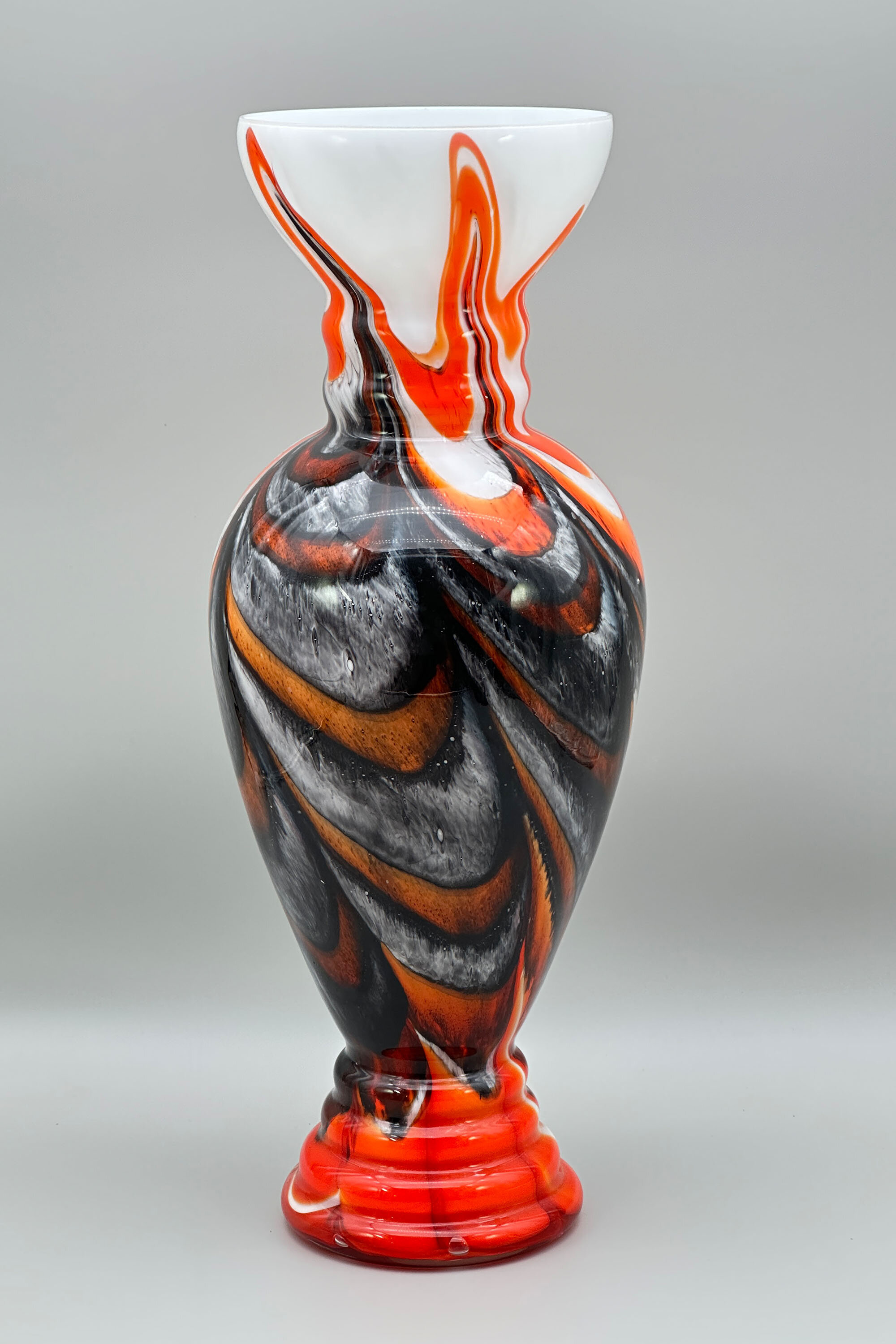
Tall glass vase with orange, grey and black swirls, probably by Carlo Moretti, Italian 1970s
Price: £180
This is a striking glass vase of slender proportions, the ovoid body above a flaring stepped foot, the short ridged neck flaring outwards to the top rim, decorated with a continuous design of black, grey and orange trailing swirls on a white ground. While similar to pieces produced by ‘Vetreria Barbieri’ at Empoli, vases of this type are usually attributed to the Murano based designer Carlo Moretti. Born in Murano in 1934, he founded in 1958 with his brother Giovanni a glassworks named after him which enjoyed great success and was eventually sold by Giovanni in 2013, five years after Carlo’s death, to an Italian fashion company who continue production under the name. Vases in this style were made in the 1970s and this is an exceptionally fine and large example, well deserving a place in a collection of contemporary Italian glass.
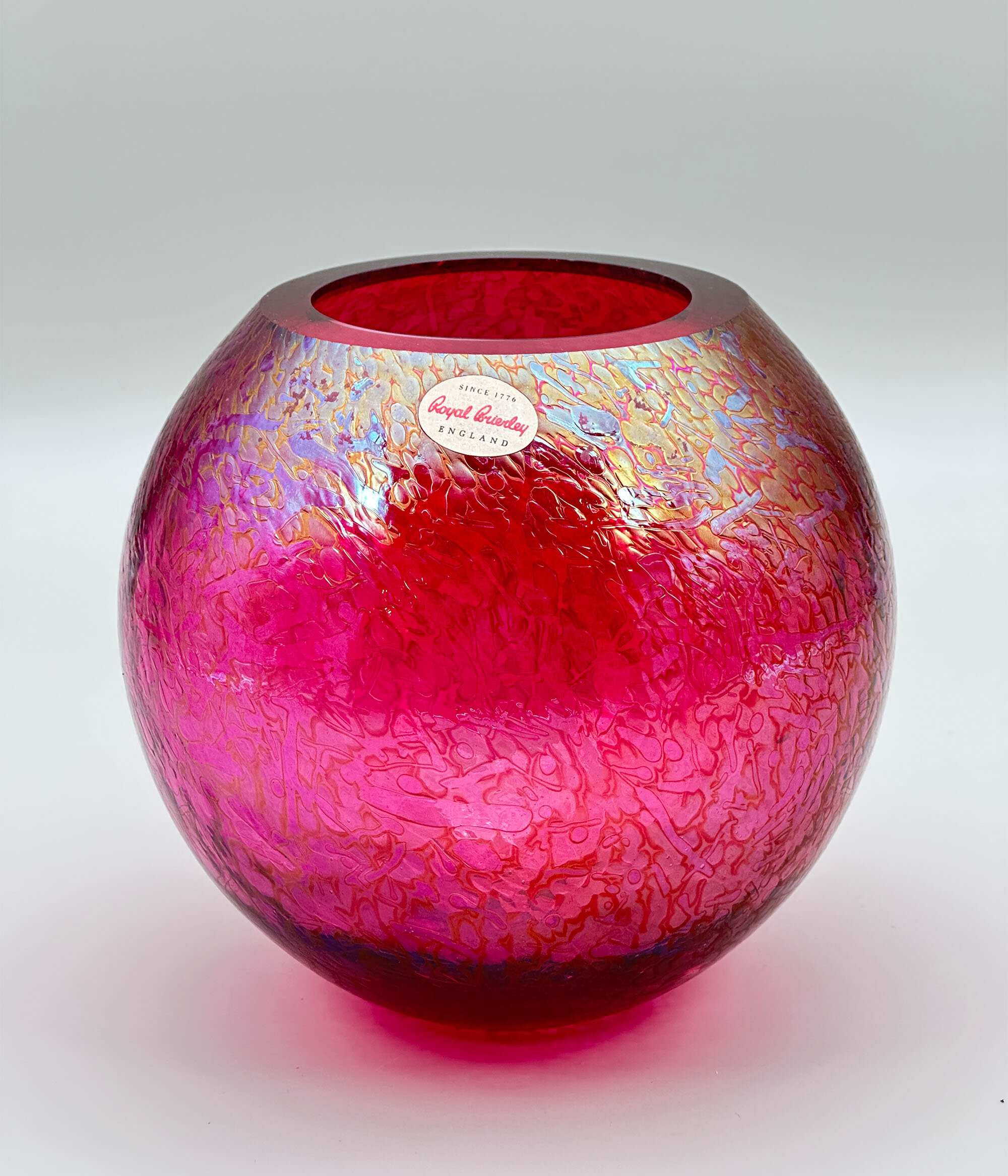
Royal Brierley iridescent red Art Glass Vase with label, late C20th
Price: £30
A thick walled globular glass vase with a wide flat rim, the deep red glass with mottling and iridescent effects, an oval label to the top reading ‘Since 1766’ ‘Royal Brierley’ ‘England’. The glassmakers Royal Brierley did indeed have their origins in the eighteenth century when Joseph Silver, one of the original founders in 1766, leased the Moor Lane Glasshouse at Brierley Hill, North Devon. His daughters married William Stevens and Samuel Cox-Williams, who took control of the business in 1847 and the company subsequently became known as the Stevens and Williams Glassworks, retaining this name until the 1930s when it changed it to Royal Brierley Crystal reflecting the grant of a royal warrant as glassmakers to the Crown. Royal Brierley has always been mainly associated with crystal glass but in the 1980s it produced a range of art glass termed ‘studio’ with iridescent effects and which employed designs by Michael Harris of Isle of Wight Glass and used techniques derived from his own studio. These pieces are similar in style to this vase but generally signed ‘Studio’ at the base and there does not seem to be any direct parallel for this particular form, which may possibly have been intended as a candleholder. An unusual piece, then, which well deserves a place in a collection of twentieth century British art glass.
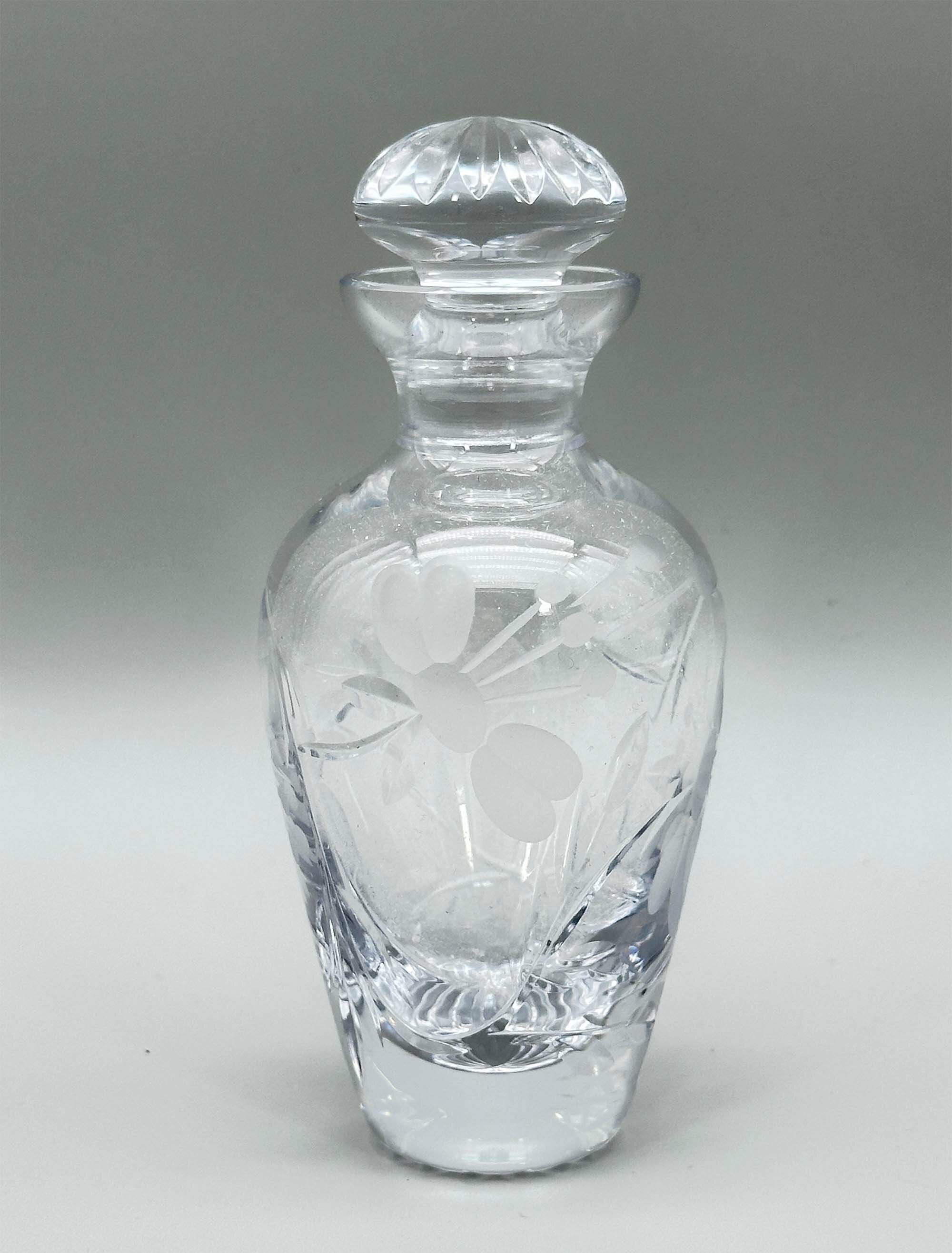
Etched crystal glass Perfume Bottle, possibly Stuart Crystal, second half C20th
Price: £25
A fine quality crystal glass perfume bottle and stopper, the ovoid body tapering inwards towards the base, the neck with a flaring rim and fitted with a stopper, both this and the base with cut glass detailing, the body with an etched design of flowers. The work here is probably English but the manufacturer cannot be identified with certainty, although some of the features resemble those found on Stuart Crystal pieces. Dating is most likely to the 1960s or 1970s and this bottle would make a most elegant addition to a contemporary dressing table.
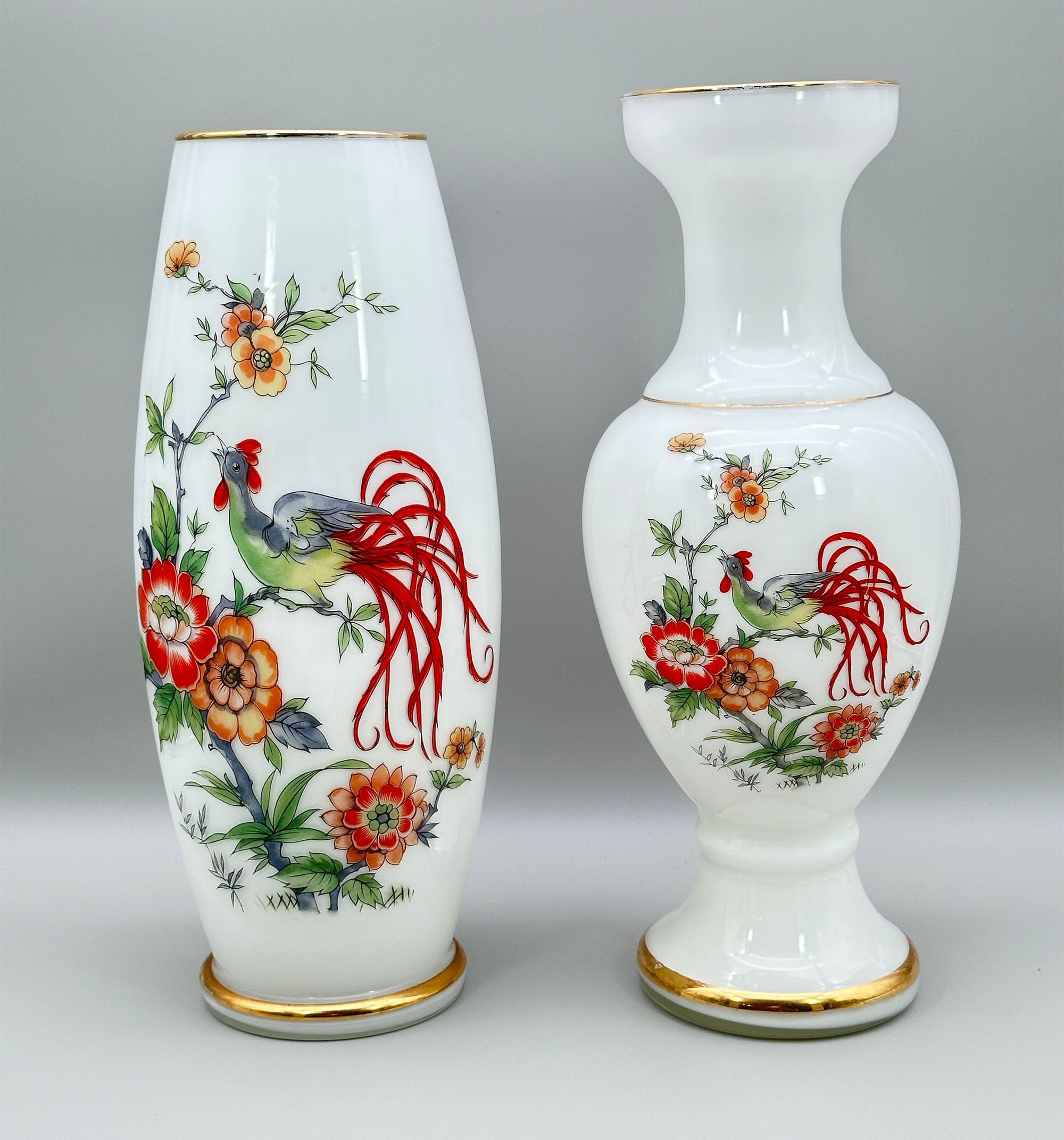
Two complementary opaline glass vases decorated birds, probably French C20th
Price: £55
Two complementary glass vases, one of ovoid and one of baluster form, each with the white ground colourfully decorated with near identical scenes of birds and flowers. The white ground glass seen here is termed opaline and while its production has its origins in Murano, Italy, where it was first produced in the sixteenth century, its main period of production was in France in the nineteenth century, one of the most famous places of manufacture being at Baccarat. The style here, while more ‘modern’ in appearance also suggests French manufacture but at a rather later date, perhaps to the late twentieth century with the decoration possibly being machine printed rather than hand painted. But there is still a modest attraction here and these two vases are rather more affordable than their older counterparts!