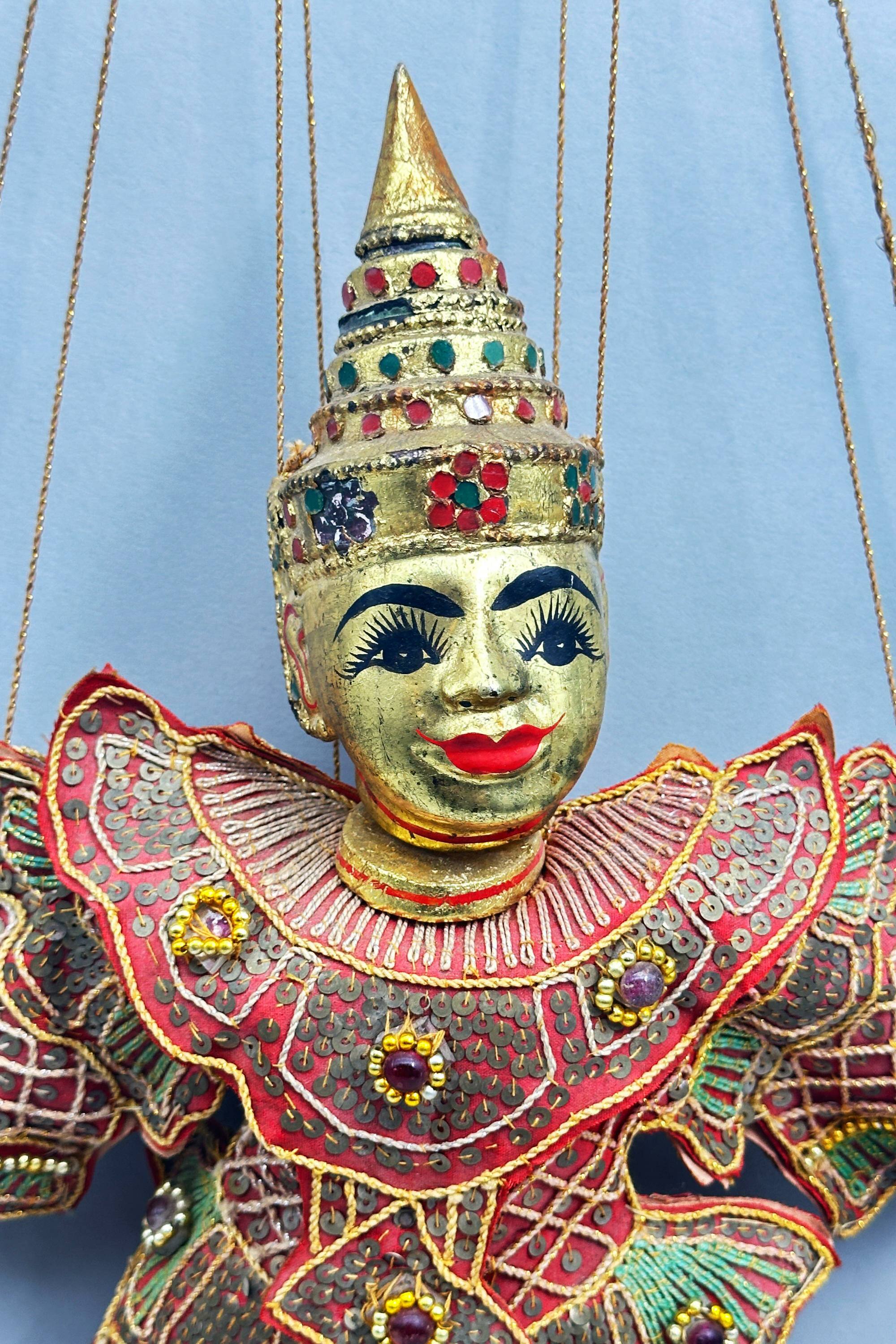
Marionette Figure of a Prince, probably Burmese mid C20th
Price: £45The style of the dress suggests Burma which has a tradition of marionette puppetry (marionettes are a specific form of puppet where the figure is controlled by strings or rods) dating back to the late eighteenth century and still popular today with visitors to the country, now called Myanmar. Termed ‘Yoke thé’, the Burmese marionette tradition allowed political commentary under the guise of of an entertainment display. The standard ‘troupe’ comprised twenty seven characters, both animal and human, and this male figure is probably the ‘King’ (‘Mintayar gyi’). Dating is probably to the mid C20th and a little earlier than the female marionette figure also included in this sale. This figure is rather more majestic as befits his regal status.
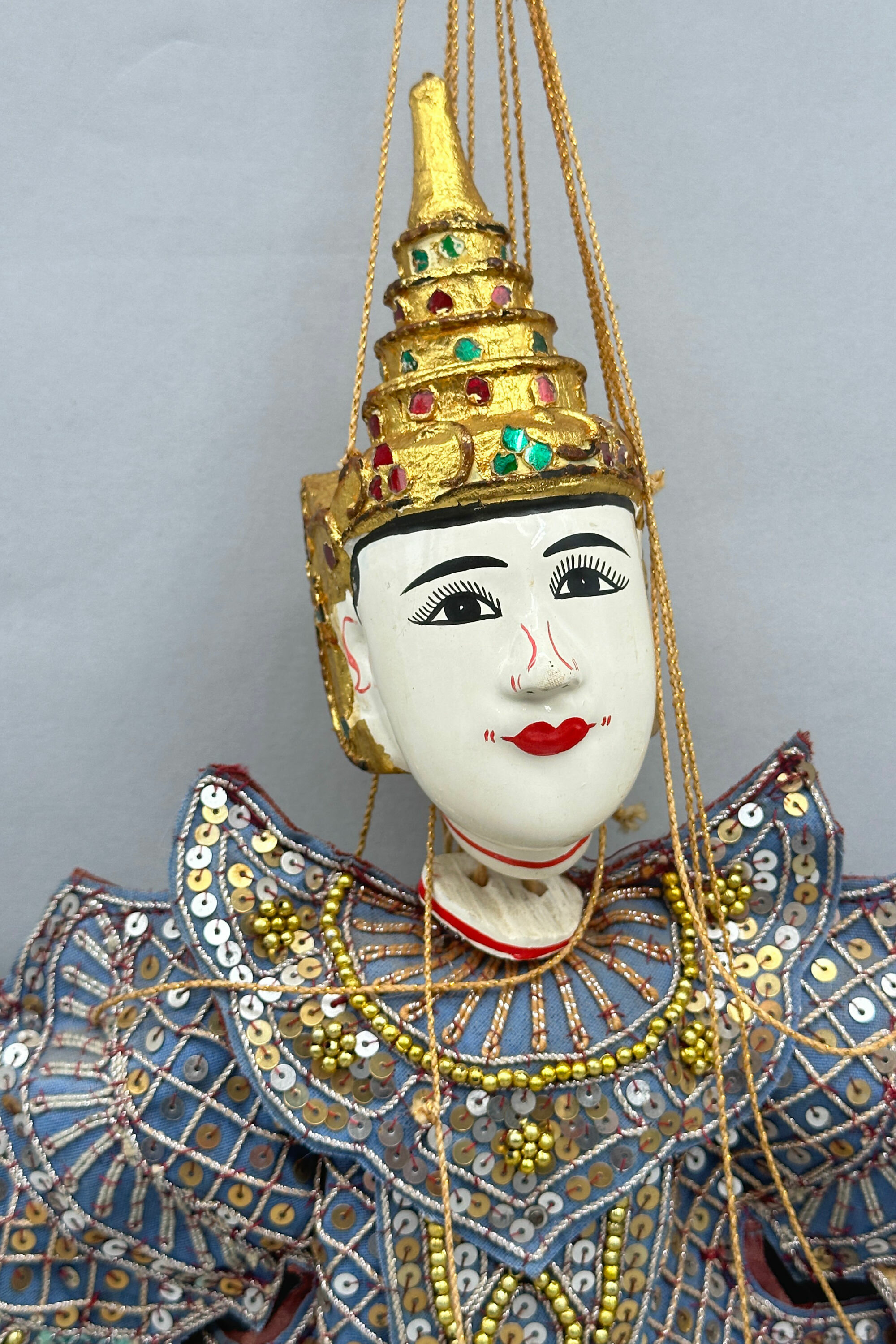
Marionette Puppet of a Dancing Lady or Princess, probably Burmese late C20th
Price: £45The style of the dress suggests Burmese work and very similar fabric decoration can be seen in the cloth wall hangings also included in this sale. Burma has a tradition of marionette puppetry (marionettes are a specific form of puppet where the figure is controlled by strings or rods) which dates back to the late eighteenth century and is still popular today with visitors to the country, now called Myanmar. Termed ‘Yoke thé’, the Burmese marionette tradition allowed political commentary under the guise of of an entertainment display. The standard ‘troupe’ comprised twenty seven characters, both animal and human, and this lady figure is probably the ‘princess’ (‘Minthami’). She is a fine example of the genre and probably dates to the 1990s when General Khin Nyunt of the ruling junta lent official support to marionette actors and troupes in an attempt to revive a tradition which had fallen somewhat into decline.
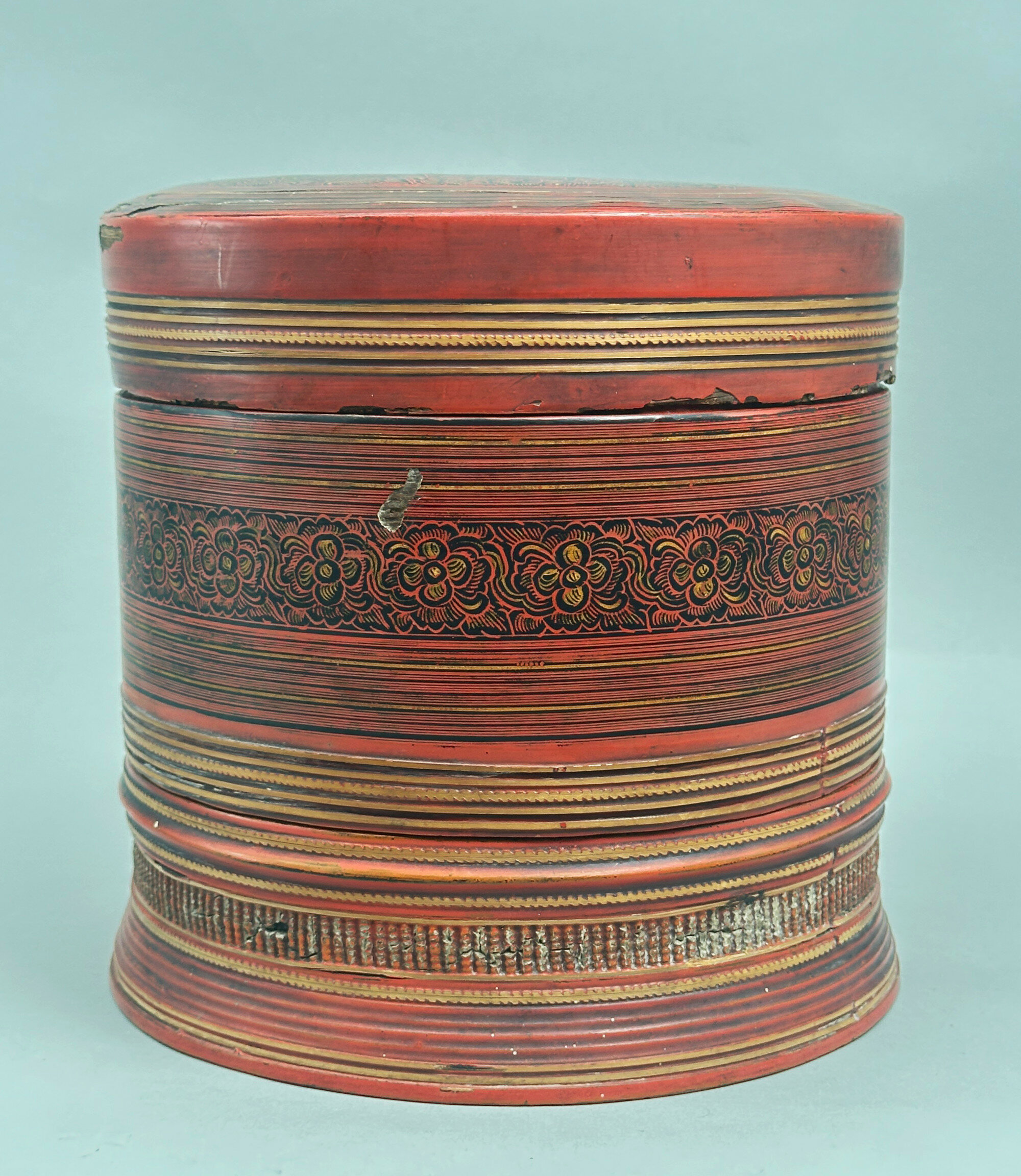
Burmese Lacquer Three Section Betel Box, early C20th
Price: £95The betel box seems to be mainly confined to Burmah, now Myanmar, and was normally made using the lacquer techniques for which the country was so well known. A woven bamboo, or sometimes cane or wood, base (which can be seen here where the lacquer has flaked away : see image 12) was covered in multiple layers of lacquer paste, each allowed to dry and then polished, and finally the piece was decorated. The format here is typical : an upper section with a tray on top covered by a lid which fits on to a lower section also with a tray on the top. The trays are coloured red on the inside and black on the outside, the lid and the boxes orange on the inside. The exterior decoration of the two section body and the base of the lid employs a wide mixture of narrow bands, some indented and some raised, with a broader band of repeated stylised floral decoration at the top and another with modelled vertical line decoration below. The base is slightly flared and the lid slightly very slightly domed. The top of the lid has a densely packed design comprising temples and dancing figures and the base a design of circles and waves. As with many of these boxes great care was taken in the ornamentation and this example was, perhaps, made for one of the wealthier households.
Dating of these boxes is put in the early years of the twentieth century and they survive as a memento of a tradition which is still practised, but with less elaborate accessories, in the present day.
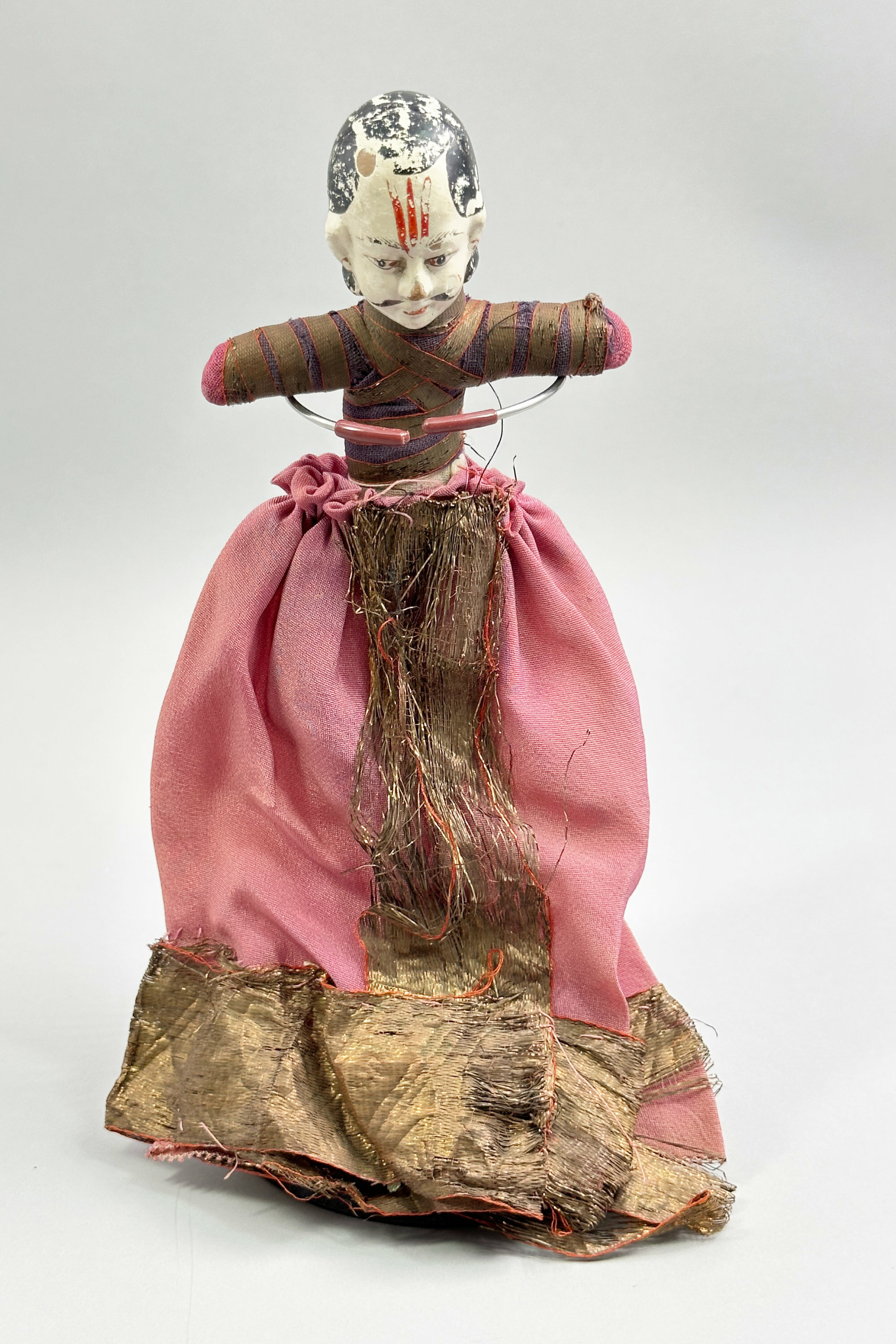
Burmese doll figure of a Priest, C20th
Price: £45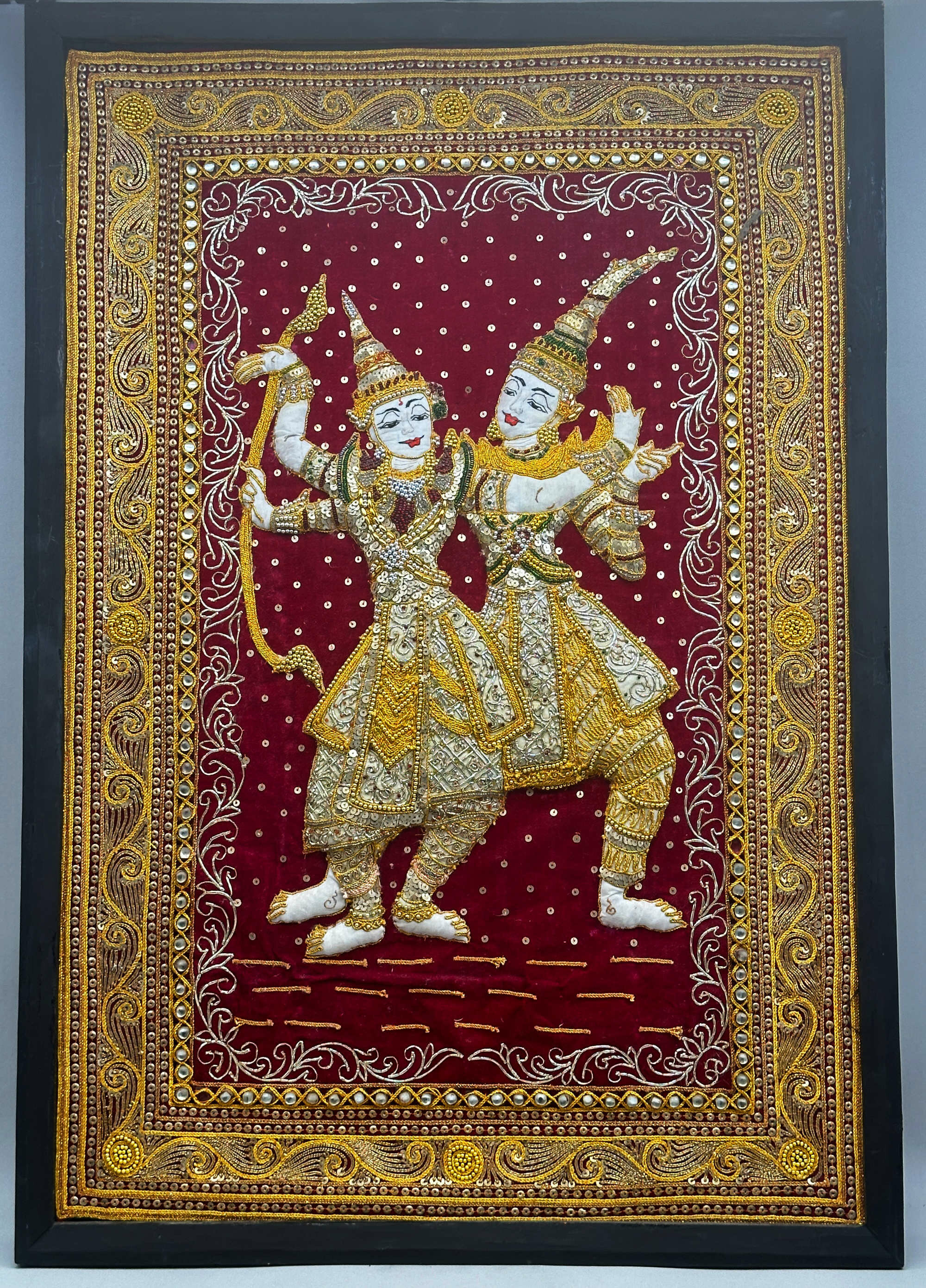
Large Burmese Textile with two dancing figures, probably second half C20th
Price: £110The distinctive style of embroidery and applied work here is typical of Burmese work known as ‘Kalaga’ which means ‘curtain’ in Burmese and is used to refer to heavily embroidered appliqué tapestry sewn with a technique called ‘shwe gyi do’. First produced around 150 years ago, Kalagas are generally linen, silk, cotton or velvet background fabrics embellished with sequins, embroidery, beads, coloured stones, tiny pearls, coral, braids and metal threads, the choice of materials depending in part on the client’s budget. Cotton padding was used to produce the ‘3D’ effect seen here and on many other examples of the work. The elaborate decoration meant that some of the larger pieces could take many months to produce which is likely to have been the case here. Dating is difficult and a mid C20th attribution here is probably sensible but an earlier period of manufacture is quite possible. The hanging has been recently mounted on board and fitted with a simple frame making it ready for display in a contemporary interior.
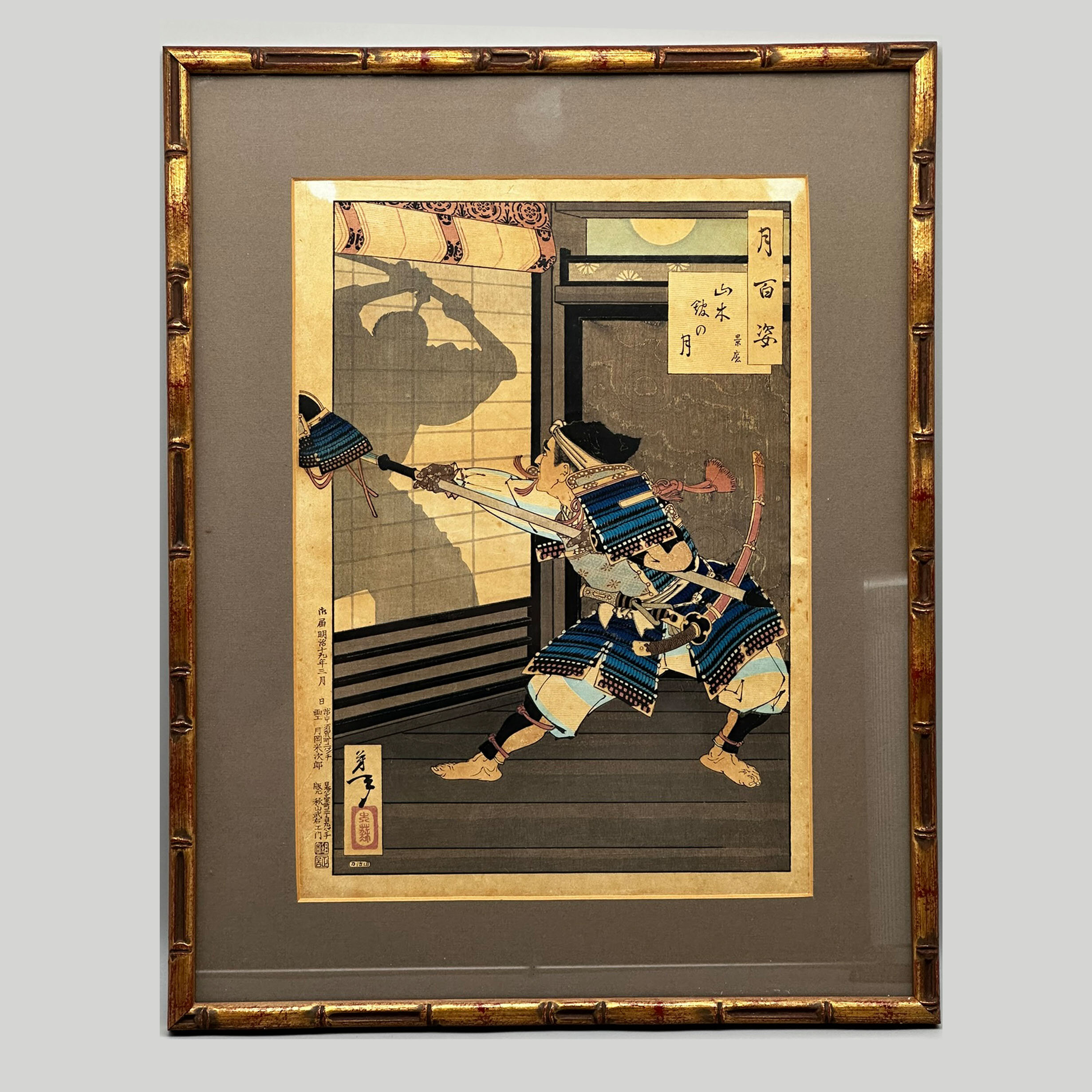
Japanese Woodblock Print - Kagekado, Moon of Yamaki Mansion, by Yoshitoshi Tsukioka
Price: £350…………………………………………………………………………………………..............................................…................................…
Yoshitoshi Tsukioka (1839-1892) was one of the last masters of ‘ukiyo-e’ (literally ‘images of the floating world’) a tradition of paintings and prints which flourished in Japan from the seventeenth to the nineteenth centuries. Known at first for his ‘Bloody Prints’ which concentrated on violence and the depiction of death, Yoshitoshi moved on to gentler themes later in his life, culminating in the series of one hundred prints entitled ‘One Hundred Aspects of the Moon’ which was published by Akiyama Buemon between 1885 and 1892, the final images appearing in the year of the artist’s death. The prints featured subjects from traditional Japanese and Chinese history and legend with the moon appearing in all but a few, giving a linking motif for the series as a whole. They were released singly or in groups every few months and proved to be enormously popular, with queues forming of collectors eager to purchase the new releases as soon as they became available.
This print was entitled ‘Kagekado, Moon of Yamaki Mansion’ and was issued in March 1886, therefore one of the earliest in the series. The scene depicted comes from the ‘Heike monogatari’ or ‘The Tale of the Heike’ an account complied before 1330 of the struggle between the Taira clan and Minamoto clan for control of Japan at the end of the 12th century in the Genpei War (1180–1185). Yoshitoshi’s audience would, no doubt, have been familiar with this. At the beginning of the conflict the head of the Minamoto clan sent his retainer, Kagekado, to kill the leader of the Taira clan, Kanetaka. We see here Kanetaka behind a screen, lit up by the moon, with his sword poised to strike. But Kagekado cunningly put his helmet onto the end of his spear causing Kanetaka to attempt to aim for it which left him exposed and allowed Kagekado to strike in turn a fatal blow and kill him. Yoshitoshi illustrates the moment just before Kanetaka’s death with Kagekado about to make the deadly thrust with his spear with deceptive helmet about to fall off. The detail is exceptional with particular attention given to the wood panel to the rear, created with an imitation woodgrain effect, where a woodblock’s natural grain is emphasized through soaking in water; in addition the black details have been burnished to imitate lacquer.
The artist's seal, ‘Taiso’, is printed in red relief within a rectangular cartouche to the lower left and his signature can be seen above (see image 4). The title, ‘Kagekado, Moon of Yamaki Mansion’, appears in the square cartouche to the upper right and the series title, ‘One Hundred Aspects of the Moon’, in the rectangular cartouche next to it (see image 5). On the reverse is affixed an identification note from the British Museum dated 1983 confirming the artist and the subject of the print which appears to have survived in a remarkably fine state of preservation.
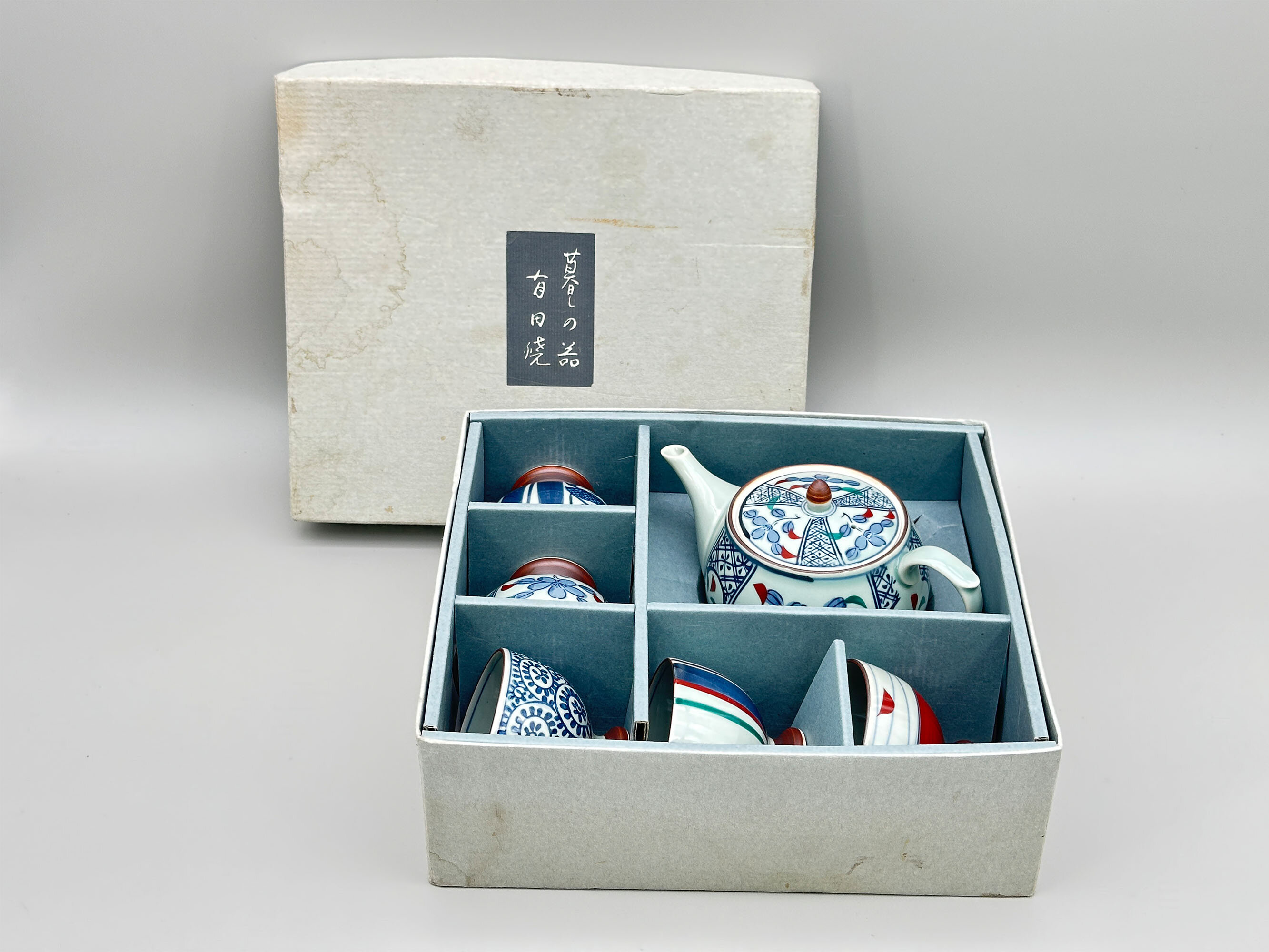
Japanese Arita Tea Set, boxed, late C20th
Price: £55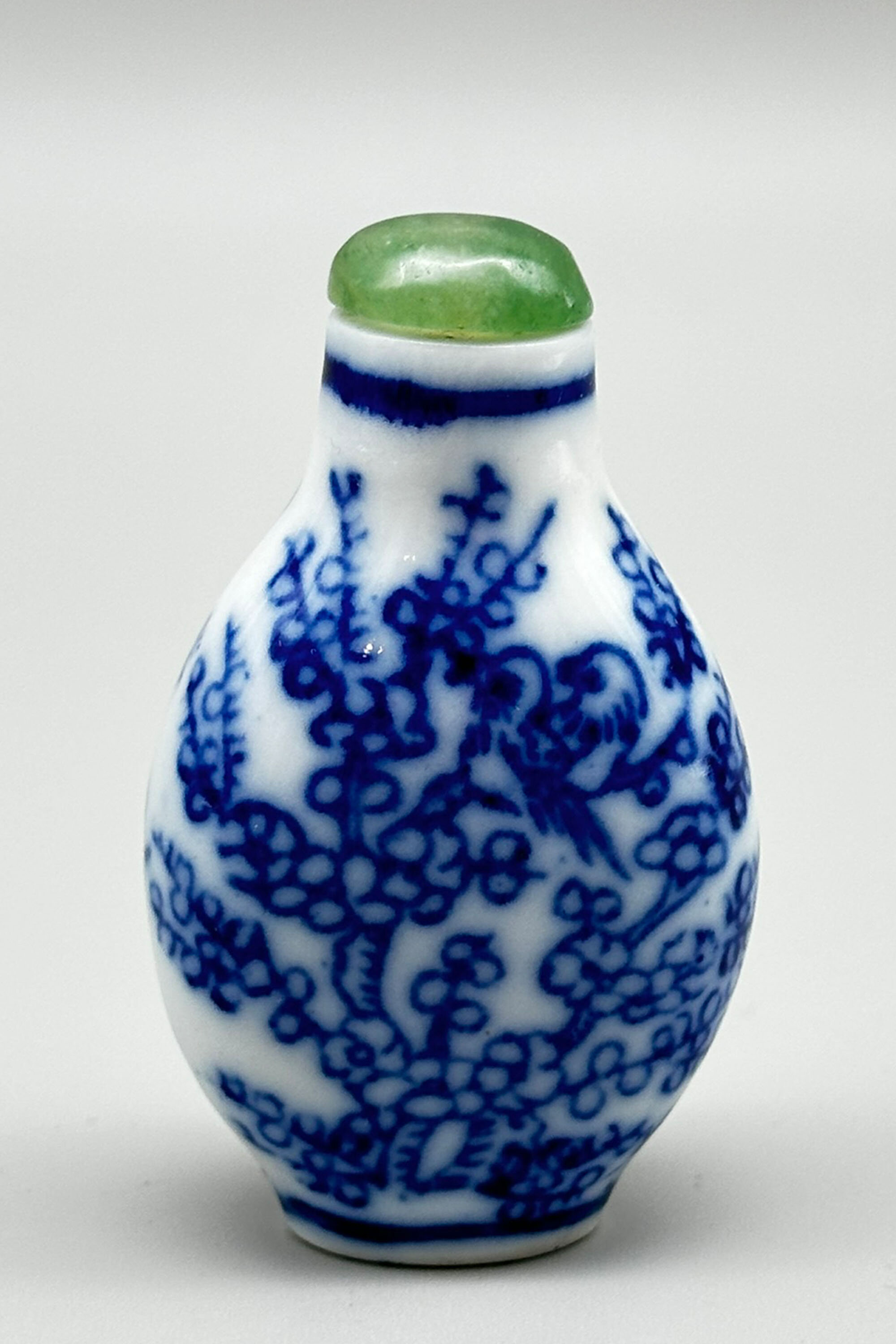
Chinese Blue and White Snuff Bottle with Jade stopper, early C20th
Price: £45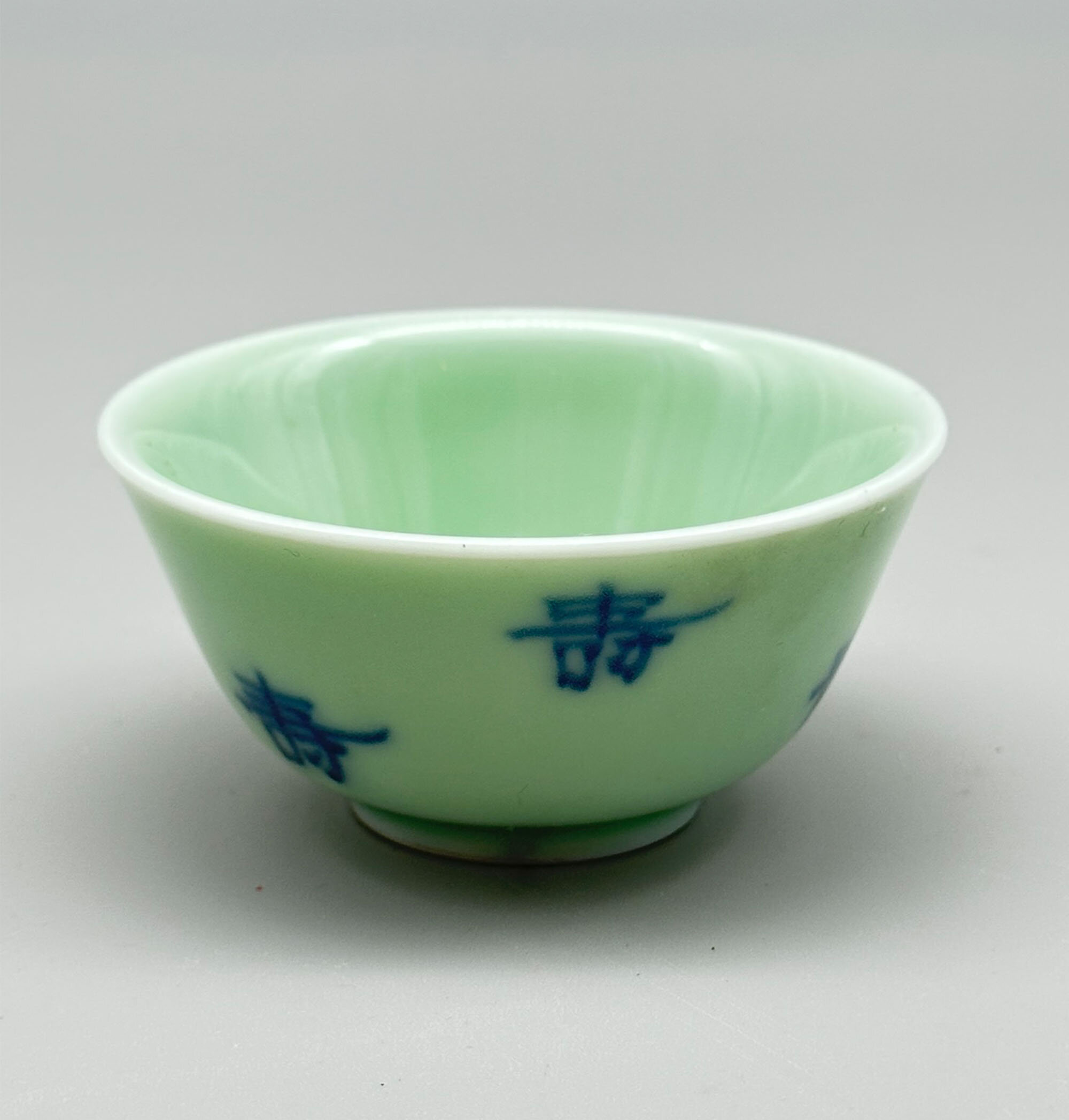
Chinese celadon glaze sake cup with shou symbols, Qing dynasty (1644-1912)
Price: £55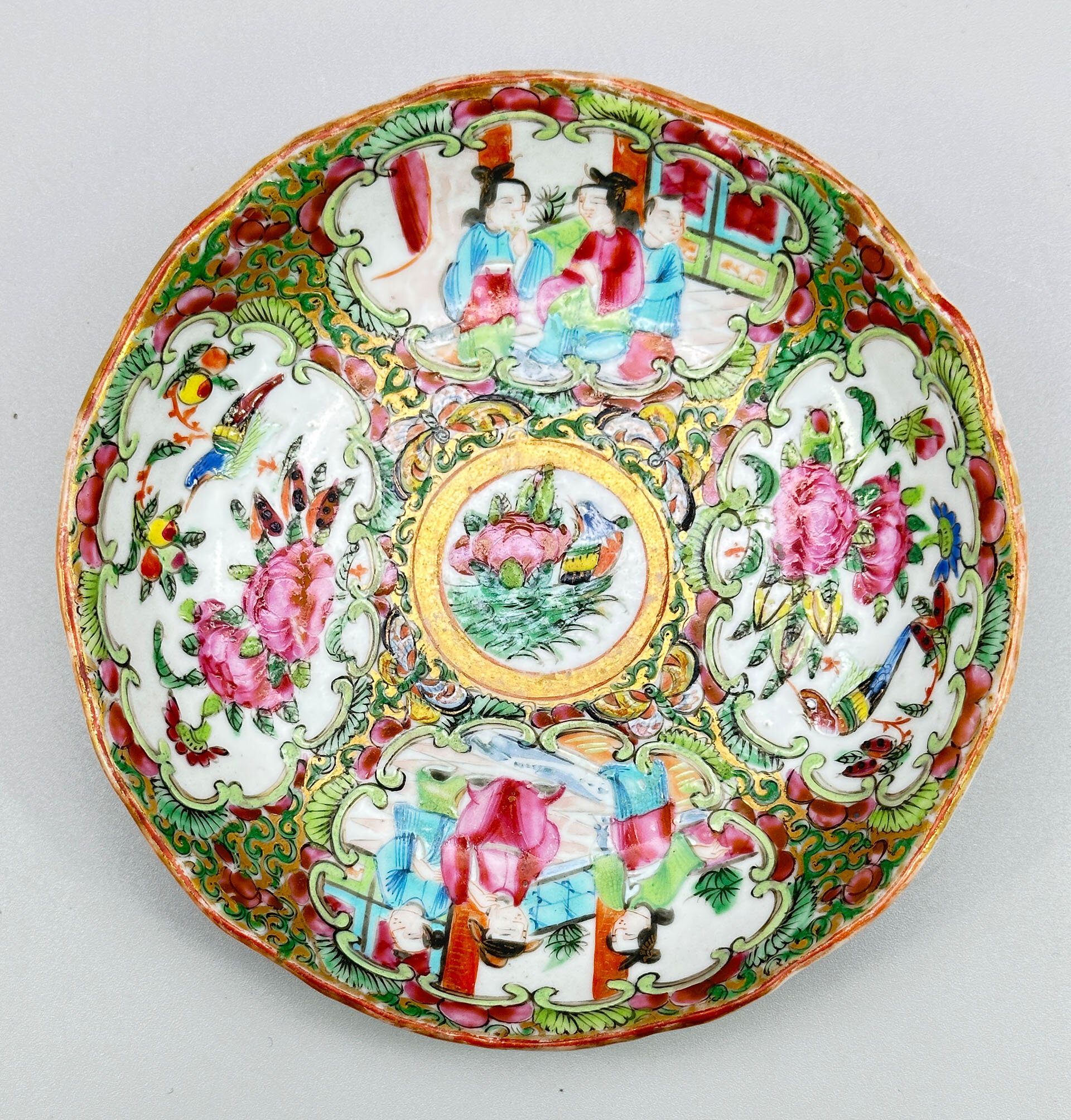
Chinese Rose Medallion Saucer circa 1860
Price: £45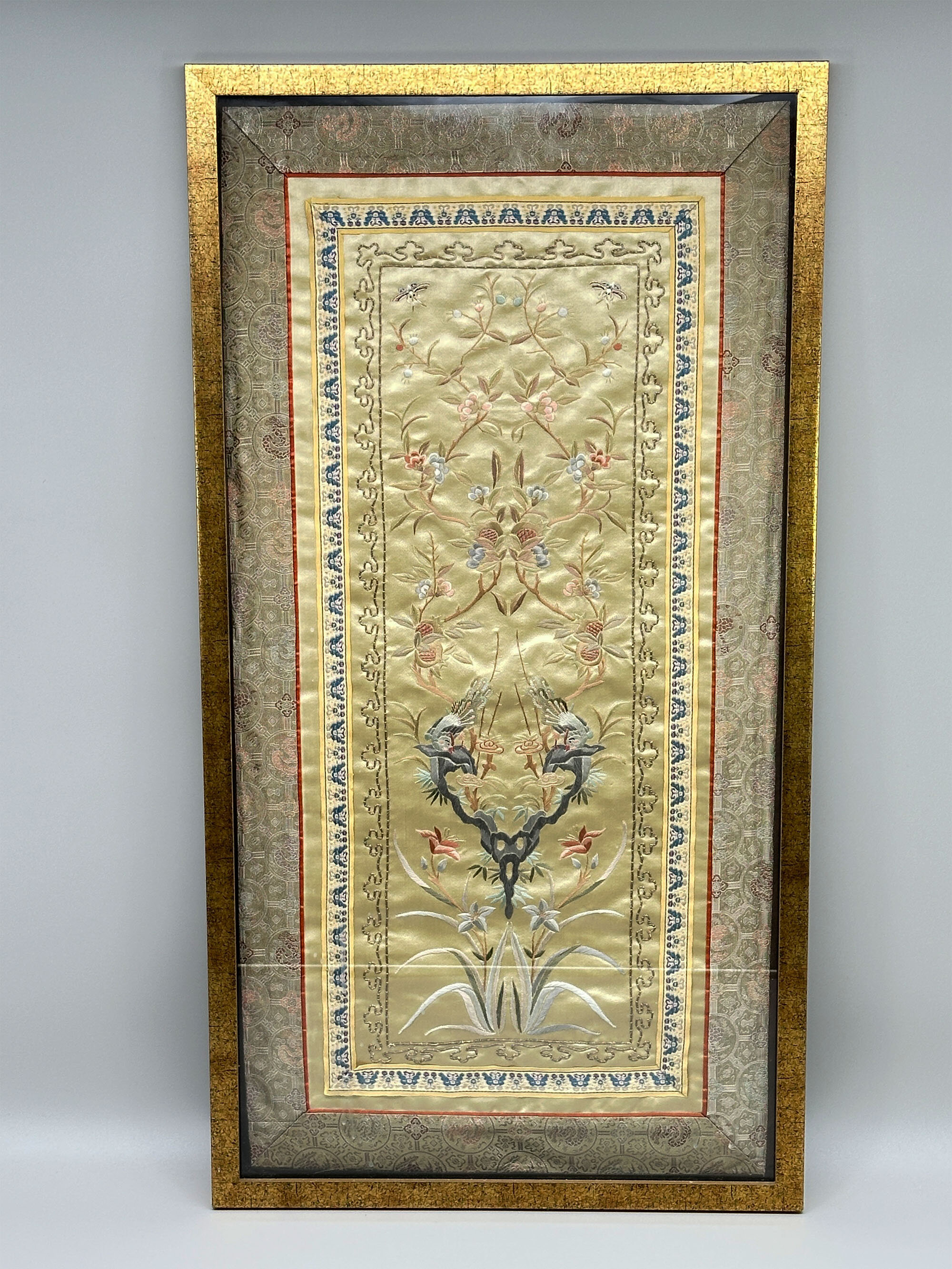
Chinese silk embroidery panel, early C20th, later framed
Price: £75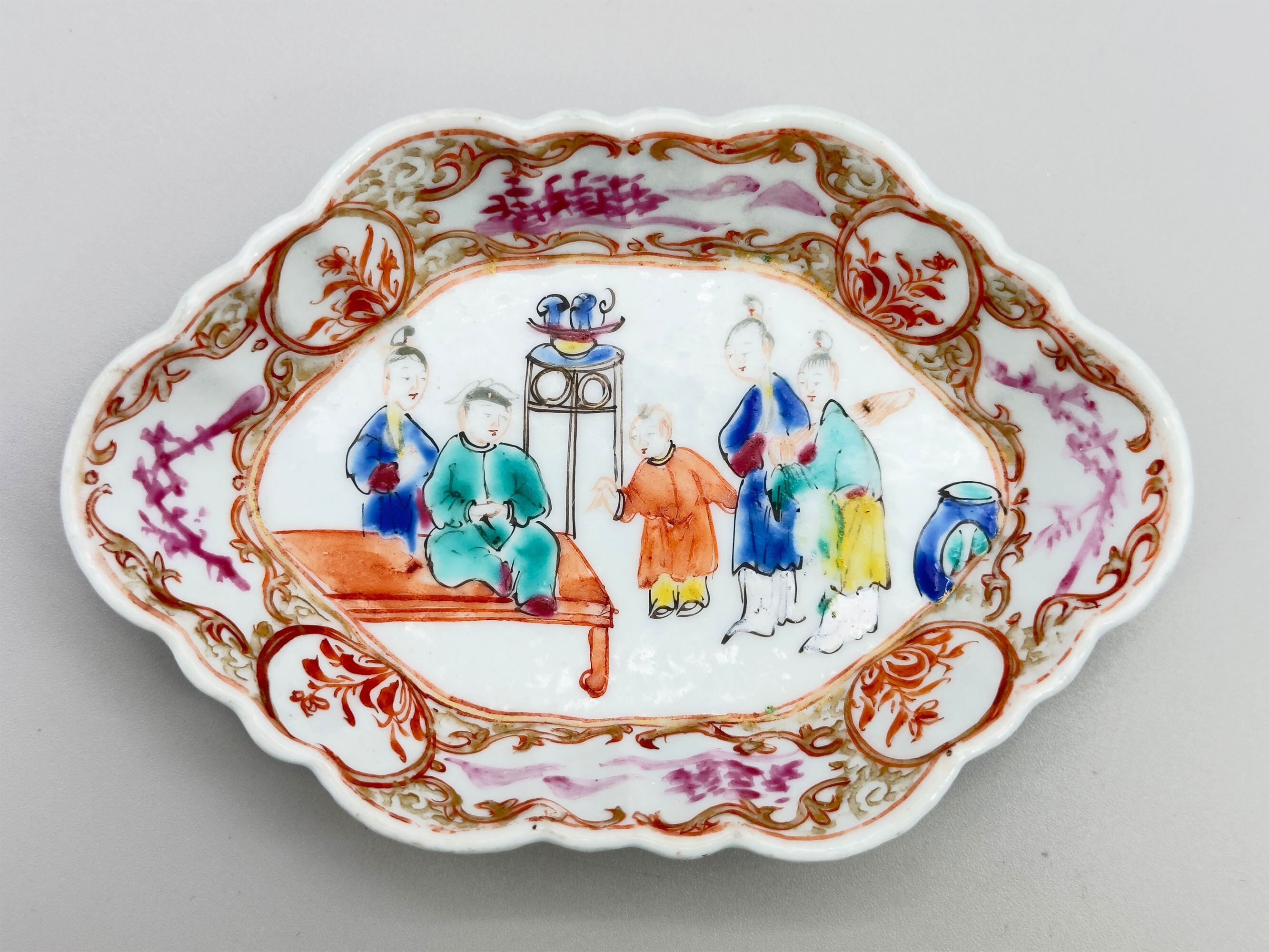
Chinese Mandarin Pattern Spoon Tray, Qianlong period circa 1760
Price: £350This piece comes from an original tea service which would have comprised a wide variety of objects decorated in the same pattern to include a teapot, cover and stand, a caddy and cover, a sugar bowl, a cream jug and cover, bowls and saucers and so forth. The form can be seen (along with a matching teapot stand) at Lunsingh Scheurleer, Chinese Export Porcelain pl 149. Dating is to the middle of the Qianlong period (1736-1795) around 1760. The quality of the decoration speaks for itself and this piece has survived intact with very little wear to the decoration.